



TL;DR
- Multi-stream nozzles reduce runoff because they cut the instantaneous application rate. The same volume arrives as a sequence of small streams instead of one continuous jet, so the rate at any single point on the soil drops.
- On clay the limiting factor is intake rate, not droplet size. Compacted clay has one of the lowest infiltration rates of the common textures, and a slope collects the water it cannot absorb instead of spreading it out.
- Trim the arc so nothing is thrown past the uphill edge, then pull the radius in. The RF201 adjusts from 90° to 210° with up to 25 % radius reduction, which is the adjustment range a slope actually needs.
- Split the run time into two to four cycles with a rest interval. Cycle-and-soak works because the profile drains between passes, not because the water is delivered faster.
- Check the RF201 at 2.8 bar recommended, 1.7 bar minimum, and verify pressure at the top and the bottom of the slope, because static pressure changes with elevation.
Multi-stream nozzles for slopes work by lowering the rate at which water arrives, not by changing the amount of water you apply. A multi-stream nozzle takes the volume a fixed-spray nozzle would deliver in one continuous stream and divides it into a sequence of smaller streams spread across the pattern, so at any instant the soil is receiving a fraction of what it would otherwise receive. On a clay slope that difference decides whether the water infiltrates or runs. Because runoff begins the moment the application rate exceeds the soil's intake rate, multi-stream technology lowers the cause of runoff rather than trying to absorb its consequences. That is the whole mechanism, and everything else in this article is about the site conditions around it.
The part most specifications leave out is that a slope is not flat ground with water on it. Water that runs down a slope does not spread out evenly; it collects. A face that looks evenly watered at the head can deliver several times the intended volume at the bottom, and the ponding everyone complains about is usually concentrated in exactly that band.
My starting point is unglamorous. I have worked in cross-border irrigation component supply since 2014, and most of what I know about how irrigation systems fail came from customers sending back failed units with a complaint attached. The advice below is written from the component side of that relationship rather than from a laboratory bench.
Do Multi-Stream Nozzles Actually Stop Runoff on Clay?
They reduce it substantially, and on clay they are usually the correct first hardware change, but on their own they are not sufficient. The honest answer has three parts: what the nozzle fixes, what it cannot fix, and what has to be fixed in the schedule.
What the nozzle fixes is the peak rate. A fixed-spray head projects water from a stationary orifice in one continuous stream, so the soil receives the full output the moment water lands. INOVATO technical material puts fixed-spray instantaneous rates above 50 mm/h, which is more than many compacted clay profiles can accept, particularly the compacted clay common on sports fields and high-traffic turf. A multi-stream nozzle applies the same volume across the same arc but spread over the full sweep, which lowers that peak.
What the nozzle cannot fix is compaction. If a clay bed has been walked on for years, its intake rate may be low enough that no practical nozzle change closes the gap. That is a site problem, and I would rather tell you that than sell a nozzle into a site that will fail anyway. We see this often enough that our first question on any sloped site is what the catch-can test said, not what the last contract specified.
What has to be fixed in the schedule is cycle-and-soak, which gets its own section below. Because the recovery interval is what allows the soil to drain, a cycle-and-soak schedule without a real interval is just a long run written as several short ones.
The range we work with is published on our multi-stream rotary nozzles category page, covering nine RF models across three arc families and three radius families. On a slope, the specification difference between them matters less than the four site controls above.
Why Does Clay Turn a Slope Into a Runoff Problem?
Clay creates the runoff problem because it has a low infiltration rate and because a slope removes the one thing that normally limits a surface flow: room to spread. On flat ground, water that cannot soak in ponds in place and eventually infiltrates or evaporates. On a slope, the same water leaves the point where it landed and arrives somewhere lower, concentrated.
Two things make clay worse in practice. Compaction reduces pore space and is the normal state of a heavily trafficked turf area, and a slope multiplies the delivery because each head discharges upslope of the area it has to cover. Soil texture and slope therefore stack: a clay slope is not one condition, it is a slow-intake surface with a transport mechanism built into the geometry.
Distribution uniformity is why this is harder than it looks. INOVATO technical material, citing the Irrigation Association as the industry reference, treats uniformity above 80 % as excellent for turf irrigation and below 70 % as significantly variable. Fixed-spray heads commonly land in the 60 % to 70 % range in field conditions because the pattern peaks near the head and falls toward the edge. Laid across a slope, that puts the wet end uphill and the deficit downhill, so the water lost to runoff comes out of the same place as the water you were short of. The U.S. EPA WaterSense programme puts a number on the prize as well, noting that improving uniformity by around 10 % can cut water use by 15 % to 25 % for the same turf quality.
We would rather see you measure intake rate with a catch-can test on the steepest part of the slope than take either figure on faith.
How Do You Set Arc and Radius on a Slope?
You set the arc to face into the slope and stop short of the uphill boundary, then pull the radius in and tighten spacing to match. That is the whole method, and it is the step most often skipped because on flat ground the default adjustment looks acceptable.
Start with the arc. A quarter-circle nozzle on a square bed looks tidy; the same nozzle rotated slightly uphill on a slope throws water past the top edge, and that water returns downslope as a concentrated flow rather than soaking in. The arc has to stop at the uphill boundary with margin, not reach it.
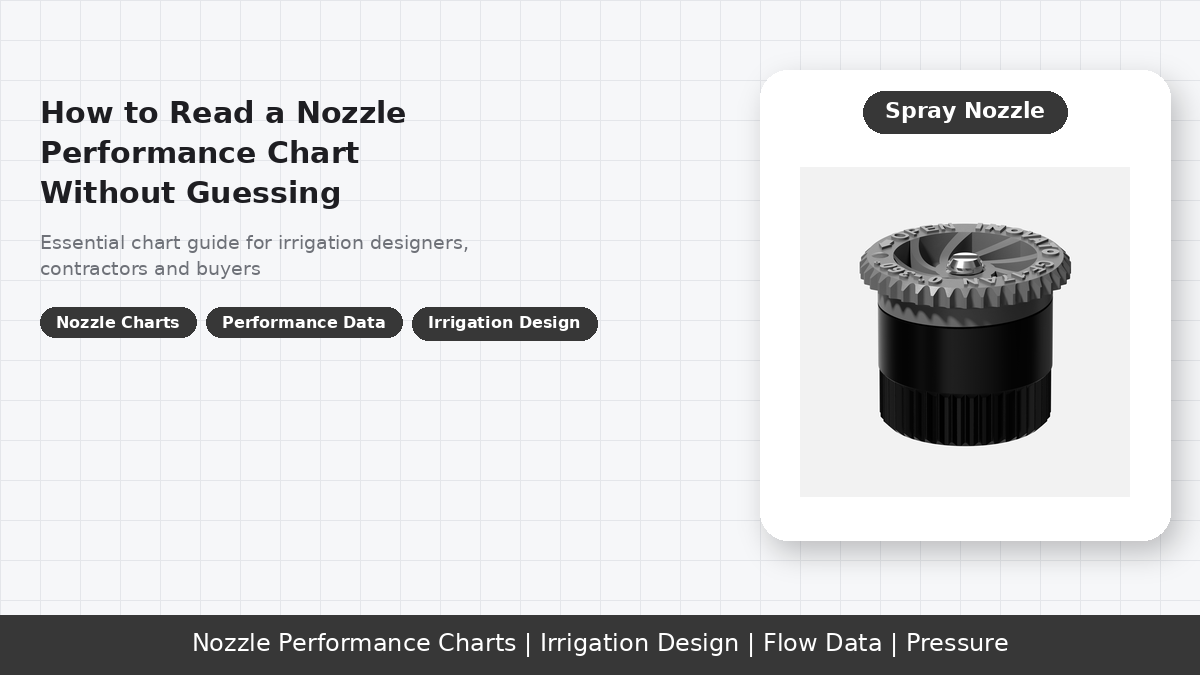
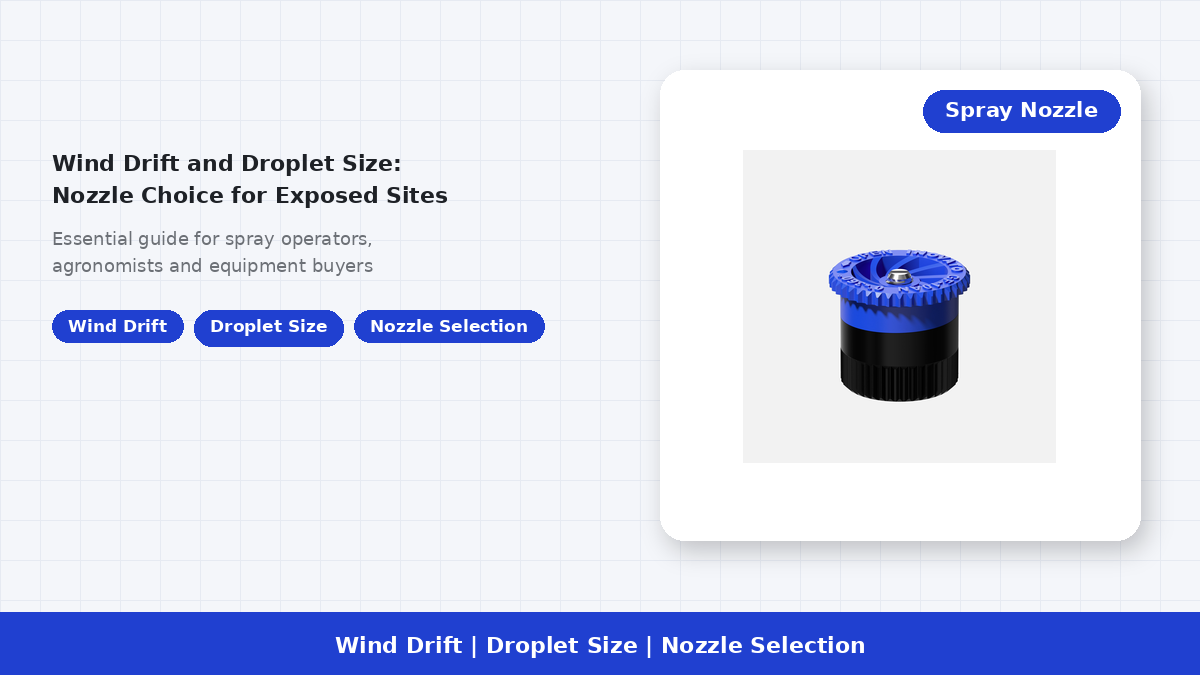
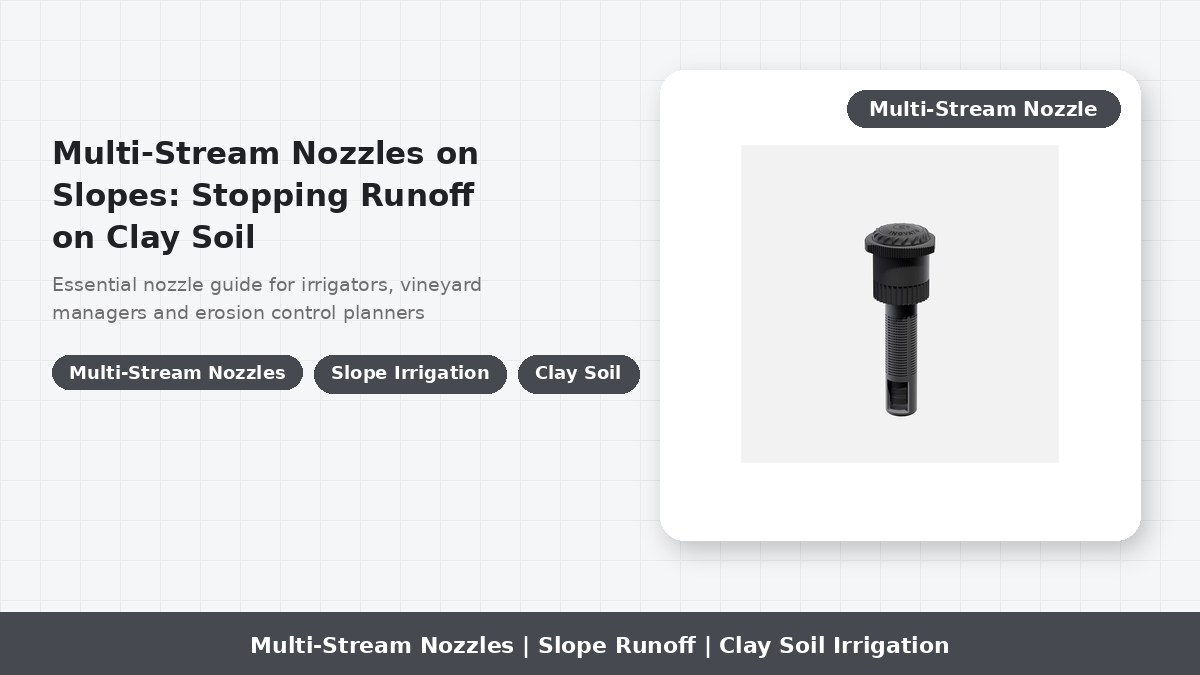
Then reduce the radius, which is the adjustment that matters most on clay. A shorter throw means any one point stays wet for less time and absorbs more before the next pass reaches it. Our RF201 multi-stream nozzle is built for exactly this adjustment: arc adjustable from 90° to 210°, radius reducible by up to 25 %, a removable filter screen and a double-pop seal that keeps debris off the orifice after the head retracts.
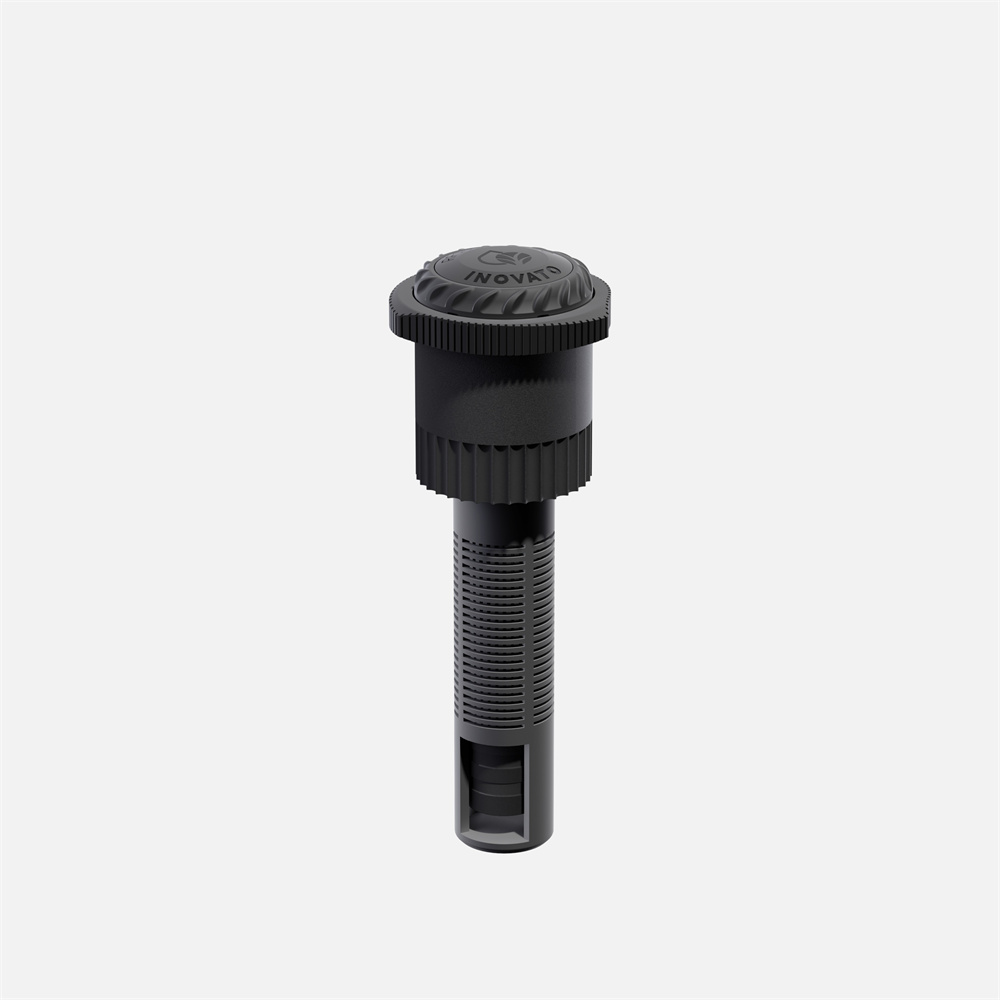 The RF201 in black, with the arc cap on top, the radius adjustment barrel below it and the filter screen visible through the cutaway at the base. On a slope these three features are what you actually use: the cap sets how much of the pattern faces into the hill, the barrel sets how far it reaches, and the screen is what keeps the reduced orifice from clogging.
Those three features are the reason we specify this body for sloped work. The filter screen matters more here than anywhere else, because reducing the radius narrows the orifice and a narrower orifice with clay and silt in the water is a blockage waiting to happen. The double-pop feature matters because a head left retracted with debris sitting on the orifice will hold that debris against the seal.
One caution about pulling the radius in. If you shorten the throw without shortening spacing, you create gaps and the uniformity advantage disappears. Radius reduction and spacing have to change together. I have seen this specified as a nozzle change alone and then blamed on the nozzle when the real fault was the layout.
Should You Use Cycle-and-Soak, and How Short Should the Cycles Be?
Yes, on clay slopes, and the cycle length should come from the measured intake rate rather than from a default schedule. Two to four cycles per zone with a rest interval between them is the range we normally work to, and the interval is set so the profile can accept what was just applied.
The reason cycle-and-soak works is hydraulic rather than mystical. Clay has a finite intake rate and a limited available storage in the surface layer. A long continuous run applies water faster than the profile can accept, so the excess moves downslope. Splitting the run and resting between passes lets the wetted front redistribute and lets the excess storage drain, so the next pass starts with more room. Because the recovery interval does the work, a schedule with short intervals is no better than one long run, and on clay it can be worse if the interval is shorter than the drainage time.
There is a real trade-off here and I would rather name it than pretend it does not exist. More cycles mean longer total watering windows, and on sites with a restricted window you may not have time for proper cycle-and-soak. The honest options are to reduce the area per zone, accept a longer window, or reduce the total application depth. Swapping to a nozzle and hoping is the fourth option, and it is the one that usually fails.
What Does Pressure Do on a Slope?
Pressure on a slope changes the application rate at the bottom of the run, because static pressure rises as elevation drops. A nozzle that is correctly set at the top of a slope can be operating well above its rating at the bottom, and the result is a rate you did not design for in the one place where runoff collects.
Our published operating specification for the RF201 is a recommended working pressure of 2.8 bar, equivalent to 40 psi, and a minimum of 1.7 bar, equivalent to 25 psi. Run below the minimum and you lose throw and the pattern deteriorates; run above the rating and the stream starts to atomise, which raises drift and defeats the reason you chose a multi-stream nozzle in the first place.
On a slope, verify pressure at both ends before anything else. INOVATO technical guidance on large installations recommends pressure regulation wherever the elevation change across the system exceeds 3 m, and the same reasoning applies more tightly to a single sloped zone. Where you cannot regulate, at minimum gauge the low end and confirm the nozzle is still inside its rating there.
The pressure question and the runoff question are the same question on a slope, which is why we treat them as one specification item rather than two.
Multi-Stream Nozzle or Gear-Drive Rotor on a Slope?
Use multi-stream nozzles for beds, borders, shrub masses and small turf areas, and use a gear-drive rotor for large open turf. The choice is driven by the area served and by how much of the site is actually sloped, not by which head has the better pressure rating.
The comparison below uses the figures published in our own technical material comparing gear-driven rotation with fixed-spray systems, so you can see where the two approaches actually diverge.
| Property | Fixed-spray head | Multi-stream nozzle | Gear-driven rotor |
|---|---|---|---|
| Water delivery | One continuous stream from a stationary orifice | One volume divided into a sequence of small streams across the pattern | Single concentrated stream swept slowly through the arc |
| Instantaneous application rate | High; fixed-spray rates above 50 mm/h are common | Low, because the volume is spread across the sweep | Low at each point, because the stream passes a point briefly per revolution |
| Trajectory angle | 15 to 25 degrees | Fixed-spray body geometry, wind-resistant delivery | 25 to 30 degrees |
| Throw distance | 3 to 6 m at 1.5 to 3.0 bar | Short by design, radius reducible to match | More than 12 m by nozzle and pressure |
| Distribution uniformity in the field | 60 to 70 percent | Improved pattern, dependent on spacing | 75 to 85 percent or higher |
| Behaviour in wind | Distorted by 5 to 10 km/h breezes | Wind-resistant, larger droplets | Resistant, penetrates the wind boundary layer |
| Best fit on a slope | Small areas only, with cycle-and-soak | Beds, borders, shrubs, small turf | Large open turf, gentle slope |
The deeper argument behind that table is set out in our material on gear-driven 360-degree uniform coverage. A rotor sweeps its stream across the whole arc in 60 to 120 seconds, so each point on the turf is wetted briefly and evenly and the coarse stream lands close to the target instead of drifting. Our HF series runs at a recommended 2.0 to 4.5 bar for that reason.
Where the slope is steep, long throw is a liability. A rotor throwing more than 12 m across a bank throws a large volume past the uphill boundary unless the arc is trimmed hard, and trimming a rotor wastes the throw you paid for. Because the slope multiplies both delivery distance and runoff transport at the same time, steep banks reward short throw and adjustable arc rather than long reach.
What Happens Downstream When You Add More Cycles?
Adding cycles stops runoff and adds valve open and close events, and on a sloped zone the valve at the bottom of the run is the one that matters. This is the part of the specification conversation where the component side of the business has something to say.
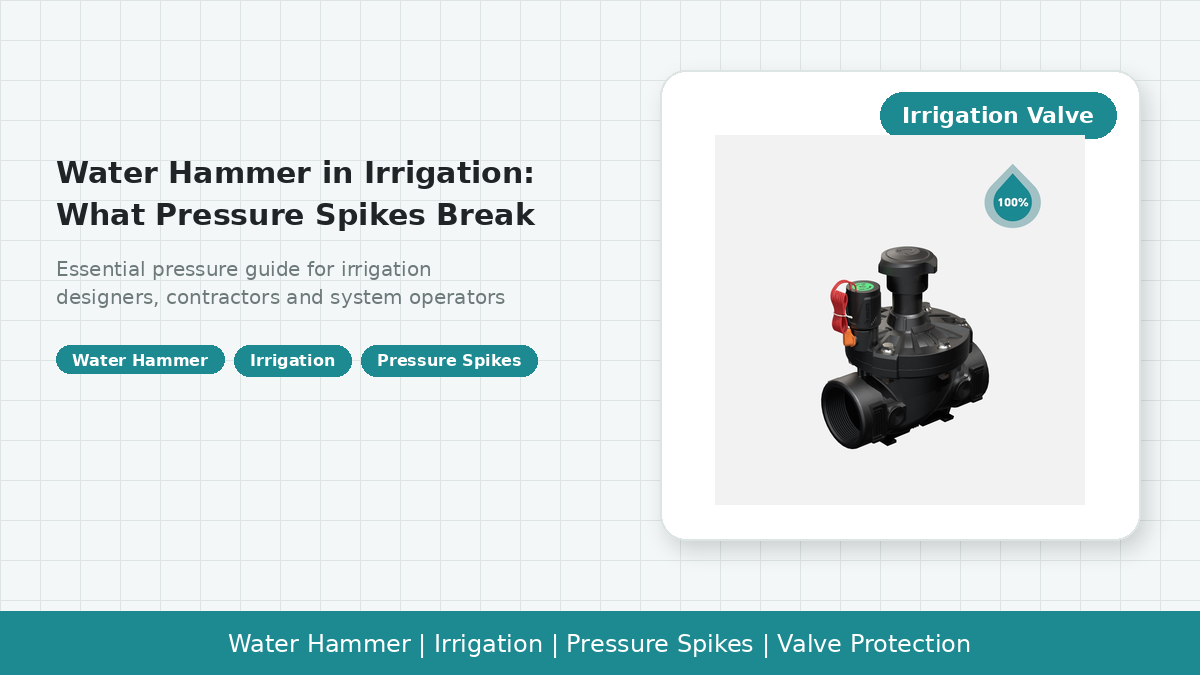
Across a review of 47 irrigation valves returned to us by customers, enough units shared the same failure signature that the mechanism became hard to argue with. That signature pointed to water hammer rather than to the material the valve was made from. My own view after that review is that most surge-related complaints arrive filed as material defects when the material is rarely the problem, and I have stopped treating a material-defect claim as evidence of a material problem.
That is directly relevant to cycle-and-soak on a slope. More cycles mean more shutoffs per week, and on a sloped zone the last head to close generates the largest pressure transient because the water in the lateral is still moving. A design that fixes runoff by doubling cycle frequency without looking at shutoff behaviour is buying a visible improvement at the cost of an invisible one.
If you have a valve failure and want to work through the cause rather than just replace the part, that is a conversation we are happy to have properly. The INOVATO company profile is the fastest route to our technical team, and I would rather spend an email on the mechanism than take a replacement order that leaves the cause in place.
How to Specify Multi-Stream Nozzles for a Clay Slope
- Measure the intake rate first. Run a catch-can test on the steepest part of the slope and compare the measured rate with what the soil accepts. If the gap is large, no nozzle closes it.
- Trim the arc to face into the slope and stop short of the uphill boundary with margin, because an arc that reaches the uphill edge returns that water downslope as a concentrated flow.
- Reduce the radius and tighten spacing together. Shortening the throw without closing the gaps destroys the uniformity you were trying to gain.
- Split the run into two to four cycles with a recovery interval set from the measured intake rate, not from a default schedule.
- Verify pressure at the top and the bottom of the zone and regulate where the elevation change makes the difference material.
- Review shutoff behaviour once the schedule is settled. More cycles mean more valve events, and a sloped zone puts the largest transient at the valve that closes last.
That sequence is what we would send with a quote. If a project needs a layout rather than a part number, tell us the slope, the soil and the watering window, and we will tell you which of these six steps the site cannot support.
One last point on paperwork. Clients commissioning green infrastructure increasingly score irrigation efficiency through frameworks such as the SITES rating system. Because slope runoff is a specification defect rather than a maintenance defect, it has to be closed on the drawing.
Frequently Asked Questions
Do multi-stream nozzles stop runoff on a slope?
They reduce it, because they cut the instantaneous application rate by applying the same volume as a series of small streams rather than as one continuous jet. Runoff still occurs if the rate on the soil exceeds what it can absorb, so on clay the nozzle choice has to be combined with arc trimming, radius reduction and cycle-and-soak scheduling.
Why is clay soil the worst case for slope runoff?
Clay has one of the lowest infiltration rates of the common soil textures, and compaction makes it worse. Because a slope collects the water that runs down it rather than letting it spread out, any water the soil cannot absorb becomes a surface flow concentrated into channels. Fixing compaction and using lower application rates both help; choosing a nozzle alone does not.
What is the difference between a multi-stream nozzle and a fixed-spray nozzle?
A fixed-spray nozzle throws one continuous stream from a stationary orifice, delivering a high instantaneous rate at the moment water lands. A multi-stream nozzle divides the same volume into a sequence of smaller streams spread across the pattern, so the rate at any one point is lower and the droplets are large enough to resist wind drift.
How do I set the arc and radius on a sloped site?
Set the arc to face into the slope and stop short of the uphill edge, then pull the radius in from the boundary and tighten spacing to match. Our RF201 nozzle is adjustable from 90 to 210 degrees, with up to 25 percent radius reduction, which gives enough range to build a pattern that matches a slope instead of a flat plane.
What pressure should I run a multi-stream nozzle at on a slope?
Our RF201 nozzle has a recommended working pressure of 2.8 bar, equivalent to 40 psi, and a minimum of 1.7 bar, equivalent to 25 psi. On a slope you must verify pressure at both the top and the bottom, because static pressure changes with elevation, and a nozzle at the bottom of the run can end up well above its rating.
Should I use multi-stream nozzles or a gear-drive rotor on a large slope?
For beds, borders, shrub masses and small turf areas a multi-stream nozzle is the efficient choice. For large open turf a gear-drive rotor is usually the better answer, because its concentrated stream lands closer to the target under wind and its lower instantaneous rate reduces runoff. The decision is driven by the area served and by how much of the site is actually sloped.
Does adding cycles to stop runoff shorten valve life?
It can, and this is the trade-off most specifications ignore. Every additional cycle is another valve open and close event, and on a sloped zone the last head to close is the one generating the pressure transient. Across our review of 47 returned valves, the recurring failure signature was consistent with a water-hammer mechanism rather than with a material defect, which is why we ask designers to control shutoff behaviour as well as application rate.
How long should the cycle and soak interval be on clay?
Long enough for the soil profile to accept what has already been applied, and short enough to stay within the watering window. In practice that means two to four cycles per zone with a rest interval between them rather than one long run, with the interval set from the measured intake rate on the slope rather than from a default schedule.