

Rotor Nozzle vs Fixed Spray Nozzle: Which Wins on Mid-Sized Commercial Turf in 2026?
TL;DR (5 bullets, 60 seconds). For mid-sized commercial turf (5,000-50,000 sq ft) in 2026, the choice between rotor and fixed spray nozzles is not about which is "better" but which trade-off matches the site. Rotor Nozzles win on wind tolerance, longer throw distance (20-65 ft vs 8-18 ft), and lower total cost of ownership over 10 years. Fixed spray nozzles win on lower per-head cost and faster zone runtime on small, flat, low-wind sites. The decision matrix axes are: area size (small <10,000 sq ft vs large >10,000 sq ft) and site conditions (sloped/compacted vs flat/sandy). Rotor Nozzles are typically specified for areas >10,000 sq ft and sloped/compacted sites. Mixing rotor and fixed spray nozzles on the same irrigation zone is a design error — each zone must use one nozzle type with matched precipitation rates.
What this guide covers. A 2x2 decision matrix for selecting Rotor Nozzles versus fixed spray nozzles on mid-sized commercial turf installations in 2026. The matrix axes are: total irrigated area (small versus large) and site conditions (sloped/compacted versus flat/sandy). Each cell of the matrix gives the recommended nozzle type and the engineering trade-off that drives the recommendation. The guide is structured as a comparison matrix because the right answer depends on two variables rather than one — area alone or site condition alone is not sufficient to drive the selection.
The Inovato nozzle product line includes both rotor and fixed spray options with matched precipitation rates per zone, plus the RF304 series with adjustable arc and radius for irregularly-shaped landscape areas.
Side-by-Side Comparison Matrix — Rotor vs Fixed Spray Nozzle
The matrix below compares Rotor Nozzles and fixed spray nozzles across the eight decision variables that matter for commercial turf installations. Each row is a variable; the columns show how each nozzle type performs on that variable. The trade-off is not absolute — nozzle selection depends on the specific site area, soil conditions, slope, and wind exposure.
| Decision Variable | Rotor Nozzle | Fixed Spray Nozzle |
|---|---|---|
| Precipitation Rate (at standard pressure) | 0.4-0.6 inches/hour (10-15 mm/h) | 1.5-2.5 inches/hour (38-64 mm/h) |
| Throw Distance | 20-65 feet (6-20 m) | 8-18 feet (2.4-5.5 m) |
| Distribution Uniformity (CU, properly spaced) | 84-88% Christiansen's CU | 82-86% Christiansen's CU |
| Wind Tolerance (5-15 mph / 8-24 km/h) | Within 5% of no-wind uniformity | 10-20% uniformity loss vs no-wind |
| Per-Head Cost (typical commercial grade) | $15-30 per head (rotor with nozzle) | $3-8 per head (fixed spray with nozzle) |
| Heads Required per 20,000 sq ft | 30-50 heads | 100-180 heads |
| Total Hardware Cost per 20,000 sq ft | $450-1,500 (fewer heads × higher per-head) | $300-1,440 (more heads × lower per-head) |
| Slope Performance | Lower precipitation rate reduces runoff on slopes | Higher precipitation rate causes runoff on slopes >5% |
| Soil Compaction Tolerance | Better — lower application rate allows longer soak-in | Worse — high application rate causes pooling on compacted soil |
| Zone Runtime (per inch of water applied) | 100-150 minutes per inch | 24-40 minutes per inch |
| 10-Year Total Cost of Ownership (per 20,000 sq ft) | 15-25% lower than fixed spray (less water waste, fewer replacements) | Higher due to water waste, more frequent replacements |
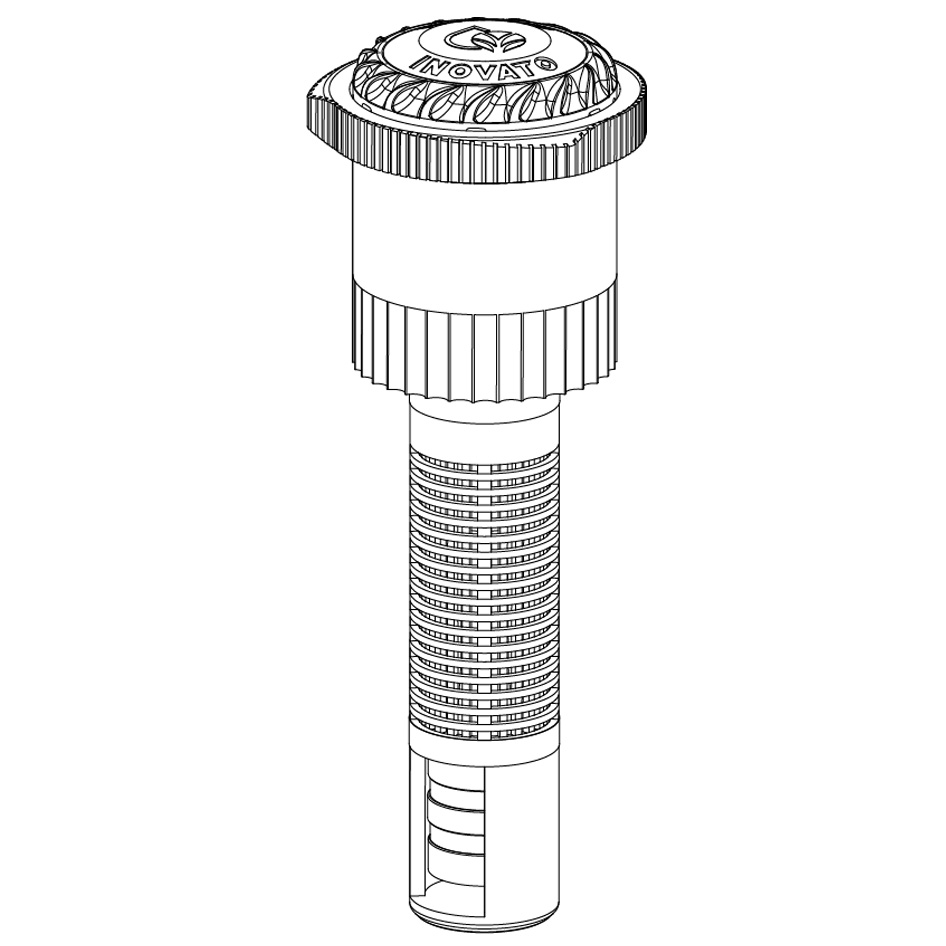
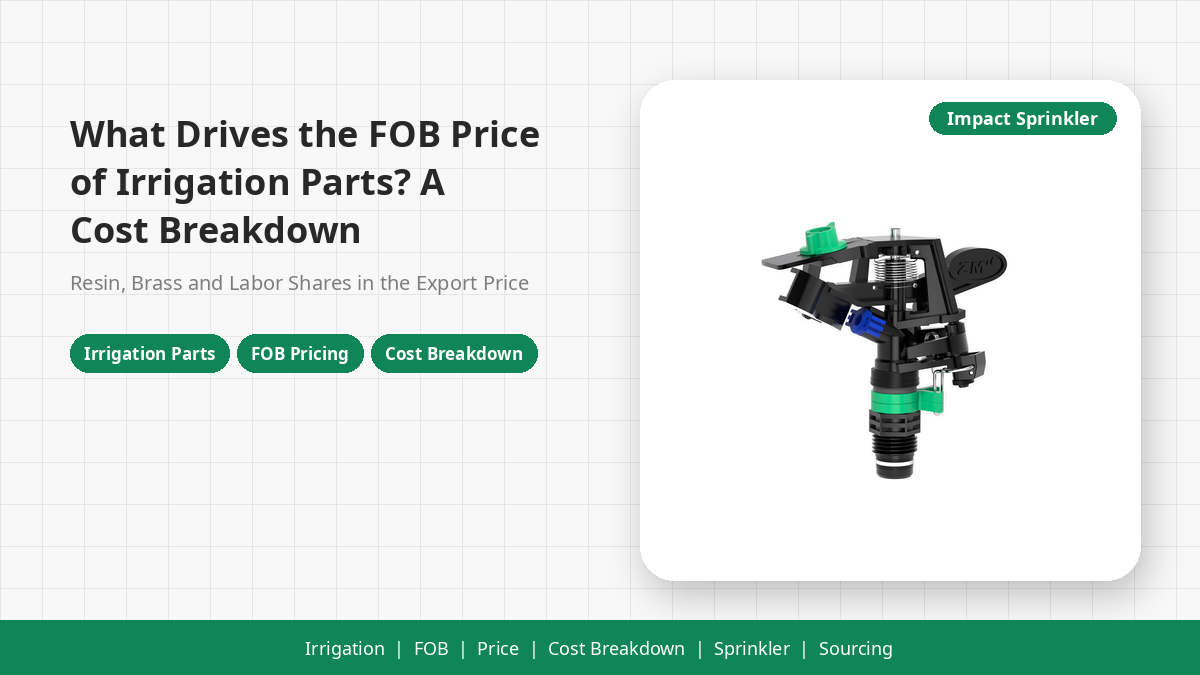
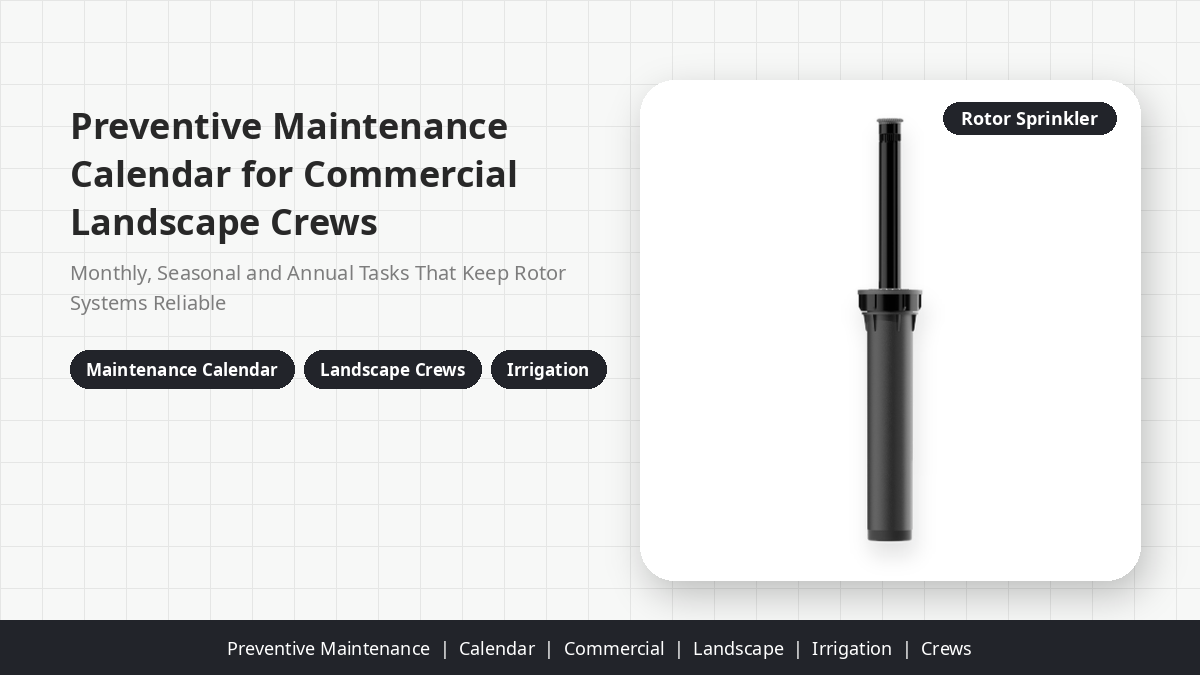
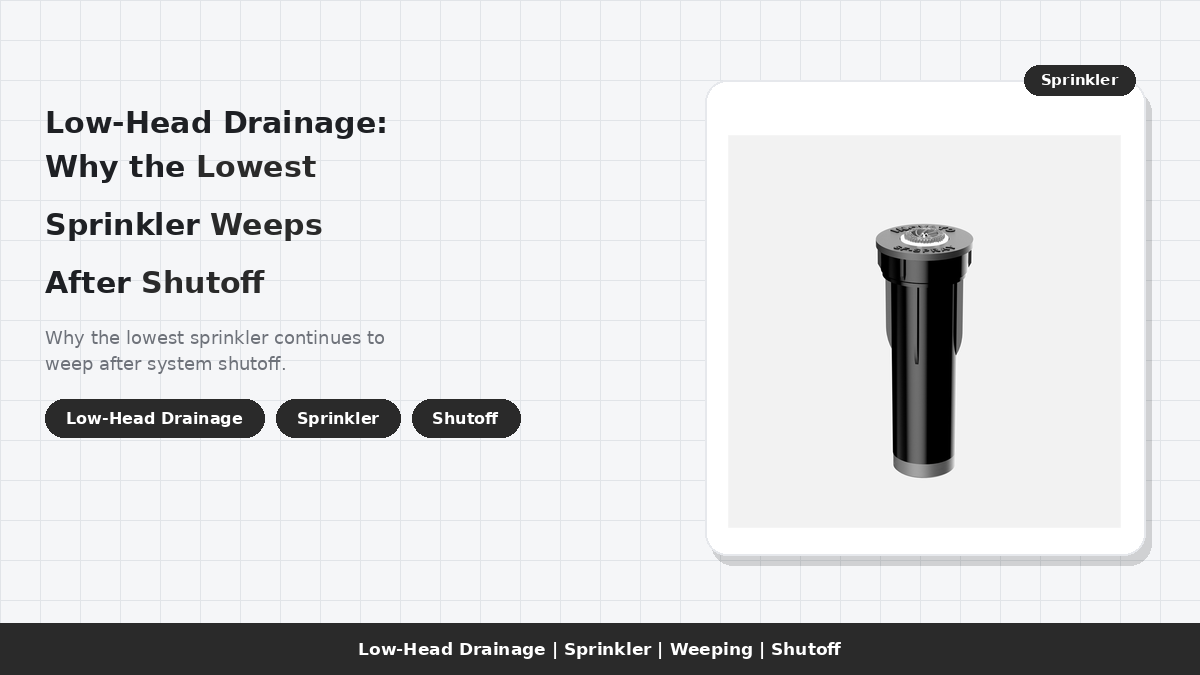
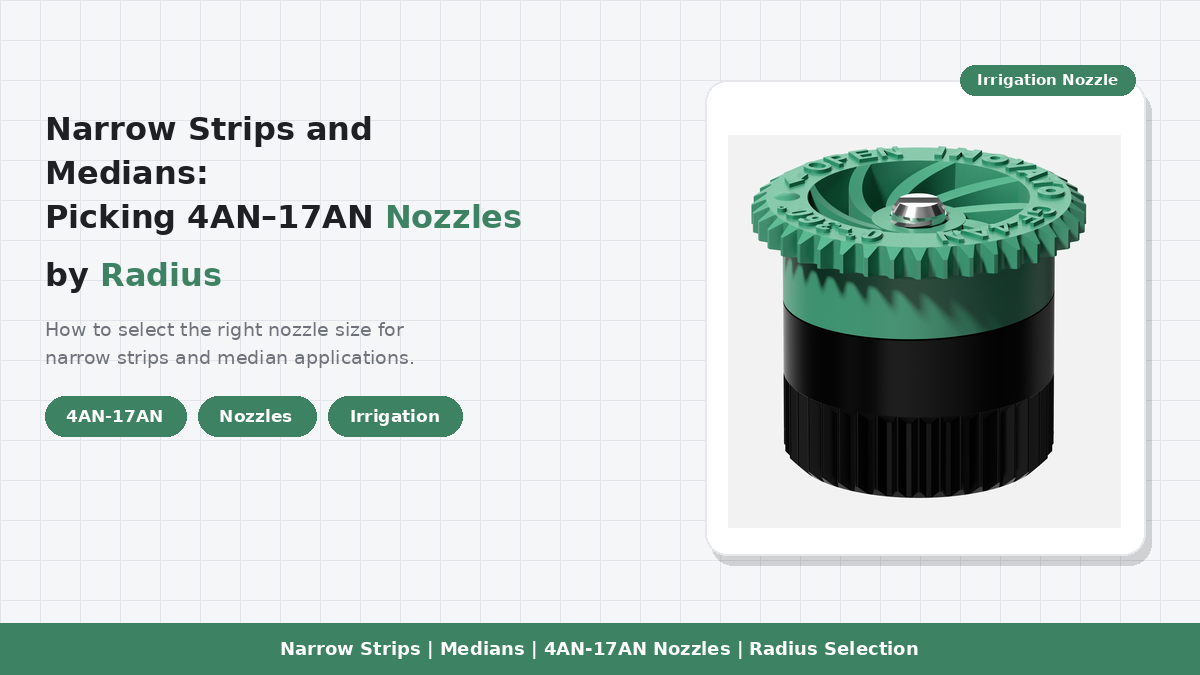
Inovato rotor nozzle and fixed spray nozzle product line. Both nozzle types are available with matched precipitation rates per zone, allowing specifiers to mix zones within the same irrigation system while maintaining uniform application within each zone.
Quadrant 1 — Large Area + Sloped/Compacted: Rotor Wins (the dominant commercial specification)
The first quadrant of the matrix is large area (>10,000 sq ft) combined with sloped or compacted soil conditions. This is the dominant specification for commercial turf installations: hotel grounds, office parks, sports fields, golf course rough areas, and large municipal parks. The recommended nozzle type is rotor because the lower precipitation rate (0.4-0.6 in/h) matches typical soil absorption rates on slopes and compacted soils, reducing runoff and the need for cycle-and-soak programming.
The trade-off that drives this recommendation is application rate matching. Soil absorption rates for typical loam soils are 0.4-0.8 inches per hour; for compacted clay soils, 0.2-0.4 inches per hour. A fixed spray nozzle applying 1.5-2.5 inches per hour exceeds the soil absorption rate, causing surface pooling and runoff. A rotor nozzle applying 0.4-0.6 inches per hour matches the soil absorption rate, allowing water to infiltrate without runoff.
The second driver is wind tolerance. On exposed commercial sites (open parks, coastal turf, sports fields), Rotor Nozzles maintain distribution uniformity within 5% of no-wind conditions at 5-15 mph wind speed. Fixed spray nozzles lose 10-20% uniformity at the same wind speed due to fine droplet drift, leading to dry spots and over-watered areas in the same zone.
Quadrant 1 outcome. Large area (>10,000 sq ft) + sloped/compacted soil or windy site → rotor nozzle. Lower precipitation rate (0.4-0.6 in/h) matches soil absorption, reduces runoff, improves wind tolerance, and reduces zone runtime water waste.
Quadrant 2 — Large Area + Flat/Sandy: Rotor Still Wins (lower water cost over time)
The second quadrant is large area combined with flat, sandy, well-drained soil. This applies to inland commercial properties on sandy soil, golf course fairways, and large residential developments. The recommended nozzle type is still rotor because the total cost of ownership over 10 years favors rotor on large areas regardless of slope.
On flat sandy soil, the fixed spray nozzle's high precipitation rate does not cause runoff because the sandy soil absorbs water faster than the nozzle applies. The wind tolerance advantage of rotor is less important on flat, sheltered sites. The deciding factor becomes total cost of ownership — over 10 years, Rotor Nozzles typically deliver 15-25% lower TCO because of fewer heads (lower replacement cost), lower water consumption (matched precipitation rate), and longer service life (rotor internals are engineered for longer cycles than fixed spray internals).
Quadrant 2 outcome. Large area + flat/sandy soil → rotor nozzle. TCO advantage over 10 years: 15-25% lower than fixed spray.
Quadrant 3 — Small Area + Flat/Sandy: Fixed Spray Wins (lower upfront cost, faster zone runtime)
The third quadrant is small area (<10,000 sq ft) combined with flat, sandy, well-drained soil. This applies to small commercial properties, retail strip malls, restaurant landscapes, and small residential yards. The recommended nozzle type is fixed spray because the lower per-head cost and faster zone runtime dominate the decision when the area is small and slope is not an issue.
On a small flat area with sandy soil, the fixed spray nozzle's high precipitation rate (1.5-2.5 in/h) applies the same amount of water in roughly one-quarter the zone runtime of a rotor nozzle. For a homeowner or small business operator running irrigation during off-peak hours, the faster runtime is a significant convenience advantage. The lower per-head cost ($3-8 vs $15-30) is also relevant for budget-conscious small installations.
Quadrant 3 outcome. Small area (<10,000 sq ft) + flat/sandy soil → fixed spray nozzle. Lower per-head cost, faster zone runtime, no slope or wind challenges.
Quadrant 4 — Small Area + Sloped/Compacted: Fixed Spray with Cycle-and-Soak (not the obvious choice)
The fourth quadrant is small area combined with sloped or compacted soil. This applies to small commercial properties on hillside sites, urban infill developments with compacted backfill, and small residential yards on clay soils. The recommended nozzle type is fixed spray, but with cycle-and-soak irrigation programming to compensate for the high precipitation rate.
Cycle-and-soak programming splits the irrigation runtime into multiple short cycles (e.g., 5 minutes on, 15 minutes off, repeated 3-4 times) to allow water to infiltrate between cycles. This compensates for the high precipitation rate of fixed spray nozzles on slopes and compacted soils without requiring a switch to Rotor Nozzles. The trade-off is controller programming complexity — the controller must support cycle-and-soak, and the runtime is longer than rotor operation on the same site.
Quadrant 4 outcome. Small area + sloped/compacted soil → fixed spray nozzle + cycle-and-soak programming. Trade-off: faster per-zone runtime but longer total runtime due to multiple soak cycles.
Site-Specific Override Rules (when the matrix recommendation flips)
Three site-specific overrides change the matrix recommendation regardless of quadrant. These are hard rules based on irrigation engineering standards, not trade-offs.
Override 1: Wind exposure >15 mph on >25% of operating days. Specify Rotor Nozzles regardless of quadrant. The fixed spray nozzle's wind drift loss exceeds acceptable distribution uniformity thresholds per ASABE S398.1 (uniformity coefficients for landscape irrigation) when wind exposure is consistently above 15 mph. This overrides Quadrant 3 and Quadrant 4.
Override 2: Slope >10% across the irrigated area. Specify Rotor Nozzles regardless of quadrant. At slopes above 10%, the fixed spray nozzle's high precipitation rate causes surface runoff that exceeds 15% of applied water per ASABE S398.1 runoff thresholds. Rotor Nozzles' lower precipitation rate reduces runoff to acceptable levels. This overrides Quadrant 3 and Quadrant 4.
Override 3: Sports field or golf course specification. Specify Rotor Nozzles with matched precipitation rates per zone. The distribution uniformity requirements for sports turf (CU ≥85%) and golf course fairways (CU ≥88%) typically require Rotor Nozzles regardless of area size. The Sports Turf Managers Association (STMA) and Golf Course Superintendents Association of America (GCSAA) guidelines reference Rotor Nozzles as the standard specification for these applications.
How to Read the Matrix for Your Specific Project
Start with the total irrigated area. That puts you in the upper half (large area >10,000 sq ft) or lower half (small area <10,000 sq ft) of the matrix. Then assess the soil and slope conditions. That puts you in the left half (sloped/compacted) or right half (flat/sandy) of the matrix. The intersection of the two halves gives you the quadrant, and the quadrant gives you the recommended nozzle type.
Then apply the three site-specific override rules. If any override applies (high wind, steep slope, sports/golf specification), the override recommendation wins regardless of quadrant. The matrix is the starting point; the overrides are the deciding rules for unusual sites.
For most mid-sized commercial turf installations (5,000-50,000 sq ft) with typical soil and slope conditions, Quadrant 1 or Quadrant 2 applies, and the recommendation is rotor nozzles. The Inovato RF304 nozzle product line is engineered for these commercial specifications, with adjustable arc (40-360°) and radius (20-65 ft) for irregularly-shaped landscape areas.
What the Inovato Project Desk Tells Every Commercial Turf Buyer
If you are specifying irrigation nozzles for mid-sized commercial turf (5,000-50,000 sq ft), the choice between rotor and fixed spray nozzles is governed by area size, soil condition, slope, and wind exposure — not by which nozzle is "better" in absolute terms. The 2x2 decision matrix above covers the four common combinations and the engineering rationale behind each. The three site-specific override rules (high wind, steep slope, sports/golf specification) apply regardless of quadrant.
For most mid-sized commercial installations, rotor nozzles are the dominant specification because the lower precipitation rate matches typical soil absorption, the longer throw distance reduces head count by 50-70%, and the 10-year total cost of ownership is 15-25% lower than fixed spray despite higher per-head cost. For small installations on flat sandy soil with no wind exposure, fixed spray nozzles are the right specification because of lower upfront cost and faster zone runtime.
Mixing rotor and fixed spray nozzles on the same irrigation zone is a design error that causes uneven distribution. Each zone must use one nozzle type with matched precipitation rates across all heads in the zone. The Inovato nozzle product line includes both rotor and fixed spray options with matched precipitation rates per zone, allowing specifiers to mix zones within the same irrigation system while maintaining uniform application within each zone.
For nozzle specification support on your specific commercial turf project, the Inovato project desk is reachable through our contact form.
FAQ — Rotor vs Fixed Spray Nozzle for Commercial Turf
1. What is the precipitation rate difference between rotor nozzles and fixed spray nozzles?
Rotor nozzles typically have a precipitation rate of 0.4-0.6 inches per hour (10-15 mm/h) at standard operating pressure, while fixed spray nozzles have a higher precipitation rate of 1.5-2.5 inches per hour (38-64 mm/h) on the same area. The rotor's lower precipitation rate allows longer soak-in time and reduces runoff on slopes or compacted soils, while the fixed spray nozzle's higher rate is suitable for flatter areas with sandy or loamy soils that absorb water quickly.
2. Which nozzle type has better distribution uniformity on commercial turf?
Both rotor and fixed spray nozzles can achieve Christiansen's Coefficient of Uniformity (CU) above 80% when properly spaced. Modern rotor nozzles with matched precipitation rates typically achieve CU 84-88%, while precision fixed spray nozzles with matched precipitation rates achieve CU 82-86%. For mid-sized commercial turf (5,000-50,000 sq ft), the difference in CU between rotor and fixed spray is marginal when both are properly designed; the deciding factor is more often application rate and wind tolerance than CU alone.
3. What is the wind tolerance difference between rotor and fixed spray nozzles?
Rotor nozzles have better wind tolerance than fixed spray nozzles because the rotating stream produces larger droplets with higher momentum that resist wind drift. In typical wind conditions (5-15 mph / 8-24 km/h), rotor nozzles maintain distribution uniformity within 5% of no-wind conditions, while fixed spray nozzles lose 10-20% uniformity at the same wind speed due to fine droplet drift. For windy sites (coastal turf, exposed sports fields), rotor nozzles are typically the better specification.
4. What is the typical throw distance for rotor vs fixed spray nozzles?
Rotor nozzles have a typical throw distance of 20-65 feet (6-20 m), while fixed spray nozzles have a typical throw distance of 8-18 feet (2.4-5.5 m). The longer rotor throw means fewer heads per zone and lower per-head labor cost, but the trade-off is higher per-head water consumption and longer zone runtime. For mid-sized commercial turf (5,000-50,000 sq ft), rotor nozzles typically reduce head count by 50-70% compared to fixed spray nozzles.
5. What is the total cost of ownership comparison between rotor and fixed spray nozzles?
For a mid-sized commercial turf installation of 20,000 sq ft, rotor nozzles typically cost 30-50% more per head than fixed spray nozzles but require 50-70% fewer heads, so total hardware cost is roughly comparable. Installation labor favors rotor (fewer heads to trench, wire, and connect). Water consumption favors rotor in most cases because the lower precipitation rate matches typical soil absorption rates, reducing runoff and the need for cycle-and-soak programming. Over a 10-year horizon, rotor nozzles typically deliver 15-25% lower total cost of ownership on mid-sized commercial turf.
6. Can rotor and fixed spray nozzles be mixed on the same zone?
No. Mixing rotor and fixed spray nozzles on the same irrigation zone is a common design error that causes uneven distribution and over/under-watered areas. The two nozzle types have fundamentally different precipitation rates (rotor 0.4-0.6 in/h vs spray 1.5-2.5 in/h at standard pressure), so a zone mixing both will deliver very different water amounts to different heads. Each irrigation zone must use one nozzle type with matched precipitation rates across all heads in the zone.