



The spacing pattern is the cheapest performance decision on an irrigation job, because it costs nothing in the field and decides whether a zone delivers uniform coverage or develops dry corners. A square grid and a triangular grid place the same number of heads over the same area, and they do not water it the same way. This guide sets out the geometry, the percentage rules that follow, where each pattern wins, and the specification that keeps a layout holding up.
Direct answer
- Triangular wins where uniformity is measured, square where head count is the constraint. Triangulation at 60% of throw diameter typically delivers 15 to 25% better uniformity than a square grid on the same area.
- The percentage rule is the whole rule. Triangular uses 60% of the rated diameter between heads, square 50%. On a 15 m radius head that is 18 m against 15 m of spacing.
- Neither pattern is universally correct. Wind-exposed coastal sites run 50 to 55% rather than 60%, and rough areas are routinely designed on square or single-row layouts because nothing there is measured.
- Uniformity is a pressure problem before it is a geometry problem. Pressure at the farthest head should not drop below 90% of the nearest head, and no spacing pattern repairs a system that fails that test.
- The pattern has to match the head, not just the spacing. A gear-drive rotor with 12 nozzle options and a 50 to 360° arc range gives the arc and flow freedom a square grid needs but a triangular grid does not.
The reference product throughout is our HF02-06 gear drive sprinkler, and the platform is set out in our gear drive sprinkler range, where the arc and nozzle options a layout depends on are published. The field performance figures come from the course audit data in our golf course sprinkler layout and uniform coverage design work.
Why the Grid Shape Changes the Result
Two layouts covering the same area with the same number of sprinklers do not produce the same coverage, and the difference is geometric. In a square grid each head is surrounded by four neighbours at equal distance. In a triangular grid each head is surrounded by six, and the nearest-neighbour distance along the axes is longer than the diagonal.
That single fact drives everything. The point of any spacing pattern is that the throw radius of each sprinkler reaches the base of its neighbours, creating overlap that compensates for wind drift and pressure fluctuation. Triangulation reduces the distance from any point on the turf to the nearest head, and that shorter distance produces higher uniformity. A square grid leaves larger gaps between the diagonals, and those gaps are where dry patches appear first.
The cost side is equally clear. Because the triangular pattern runs at 60% of diameter where square runs at 50%, a triangular layout over the same area needs fewer heads: 620 to 770 heads for 20 to 25 hectares of irrigated fairway on an 18-hole course, roughly 35 to 43 per average par-4 hole.
The Percentage Rule and Where It Breaks
Every spacing decision reduces to one number, and that number is a percentage of the throw diameter. For square spacing it is 50%. For triangular spacing it is 60%. On a sprinkler with a rated radius of 15 m under its design pressure, triangular spacing gives 0.60 × 30 m = 18 m between adjacent heads, where square spacing gives 15 m.
That is the counterintuitive part worth stating plainly: the triangular layout uses wider spacing and still covers better, because the hexagonal overlap geometry compensates for the extra distance. The percentage is not a compromise made to save heads. It is the point at which the pattern's overlap reaches its best balance.
The rule has conditions. On wind-prone coastal courses the guidance is to reduce spacing to 50 to 55% of diameter, which on a 15 m radius head means 14 to 16.5 m rather than 18 m, to compensate for wind drift. Tighter spacing costs more up front, and the water savings typically recover that premium within three to five growing seasons.
Two operational notes are missed at quotation stage. The percentage is applied to the rated radius under the design pressure, so if the head runs at a different pressure the effective diameter changes and the spacing should be recalculated rather than carried over. And the rule assumes a uniform pressure regime, which is why the hydraulic constraint later has to be checked first.
Uniformity is measured rather than assumed, and the standard method is the low-quarter distribution uniformity, DU lq, from the ASABE irrigation standards: the average catch of the lowest quarter of the test area divided by the overall average. In practice, lay out catch cans across a representative zone, 3 m × 3 m on greens and 6 m × 6 m on fairways, run a standard cycle, and measure each can.

Zone by Zone: Where Each Pattern Wins
The targets and the field results point the same way: the pattern that measures well is the right one where the result is measured. The DU targets are 0.80 for greens, 0.75 for tees, 0.70 for fairways and 0.60 for rough, and the audit data shows which patterns reach them.
| Zone | Pattern | Spacing (m) | Pressure (bar) | Measured DU lq | Target |
|---|---|---|---|---|---|
| Putting green | Triangular, 4-span | 12–14 | 4.5–5.5 | 0.82–0.88 | ≥ 0.80 |
| Tee box | Triangular, 3-span | 14–16 | 3.5–4.5 | 0.76–0.82 | ≥ 0.75 |
| Fairway | Triangular 60% | 16–20 | 3.0–4.5 | 0.70–0.77 | ≥ 0.70 |
| Rough, primary | Square 50% | 18–24 | 2.5–3.5 | 0.62–0.70 | ≥ 0.60 |
| Rough, secondary | Square 50% or single row | 22–28 | 2.0–3.0 | 0.55–0.65 | ≥ 0.55 |
That table is the design logic stated directly. Greens use a triangular four-span layout at 12 to 14 m spacing with part-circle rotors in three or four rows around the perimeter, delivering 8 to 12 mm/hr and a four-way overlap. Because a putting surface shows a dry spot immediately, greens get the tightest spacing and the best result.
Tees are smaller targets, typically 300 to 700 m², but they sit 0.3 to 1.0 m above the surrounding grade, so wind exposure is higher, spacing is reduced 10 to 15% against the theoretical maximum, and a three-sided triangular layout is used.
Fairways are where the trade-off between head count and uniformity is most acute, being the largest zone at typically 1.2 to 2.0 hectares per hole. Full-circle impact sprinklers sit in the interior at 18 to 20 m triangular spacing, part-circle heads at the edges 14 to 16 m. Part-circle heads at fairway perimeters eliminate overspray onto cart paths and cut total head count by 5 to 8%.
Rough areas are the deliberate exception. Primary rough is designed at 20 to 24 m spacing and secondary rough on single-row layouts at 24 to 30 m, and square 50% patterns appear in the field data because nothing in a rough is measured to a tight tolerance. Spending triangulation money on rough returns nothing.
Matching Heads to the Layout You Chose
A spacing pattern is a statement about the heads, and the head specification has to be able to express it. Two properties do most of that work: the arc range, which decides whether a head can serve an edge without wasting throw, and the nozzle range, which decides whether one spacing can serve more than one precipitation rate.
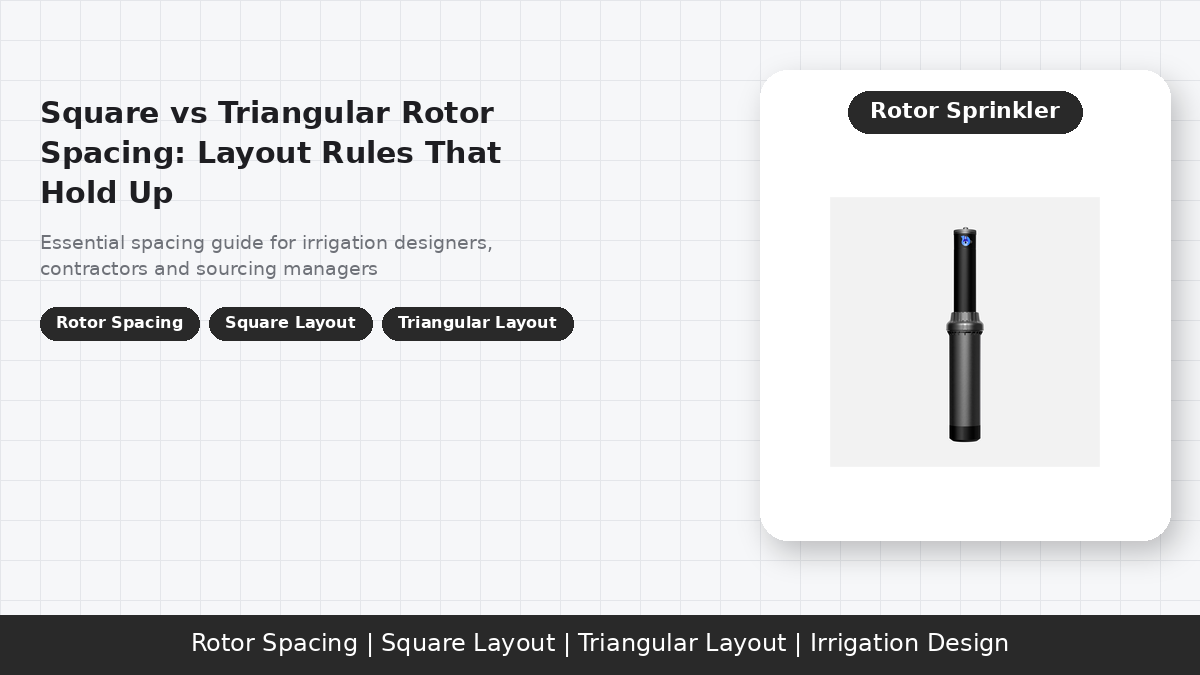
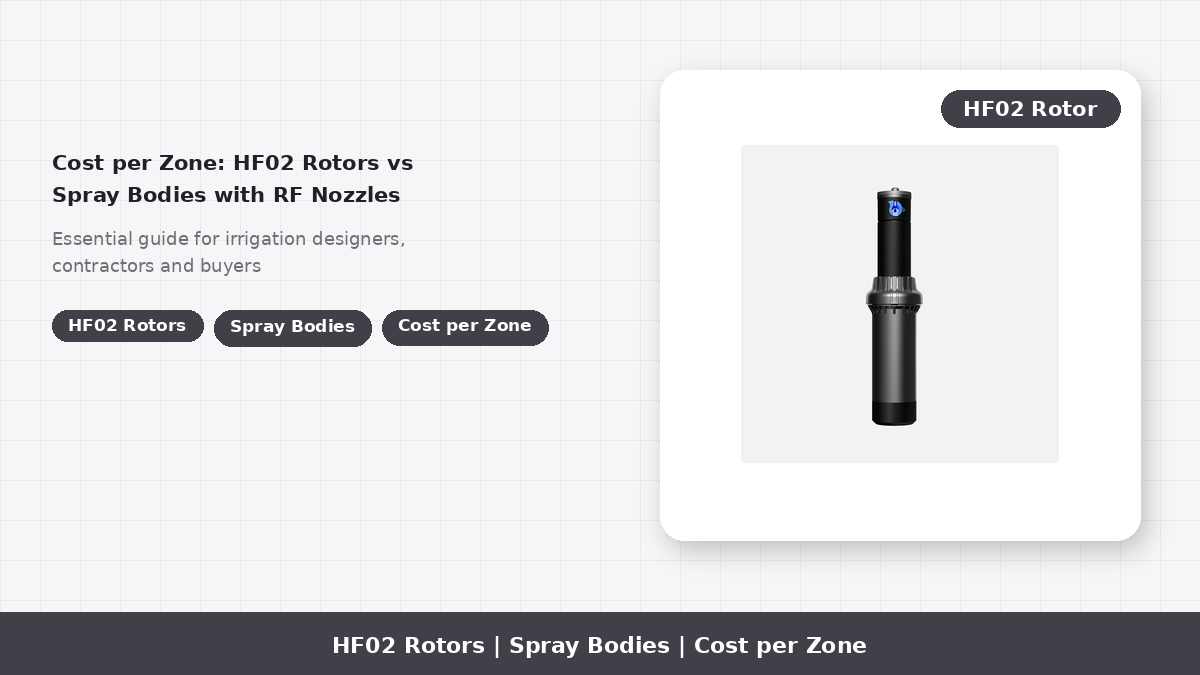
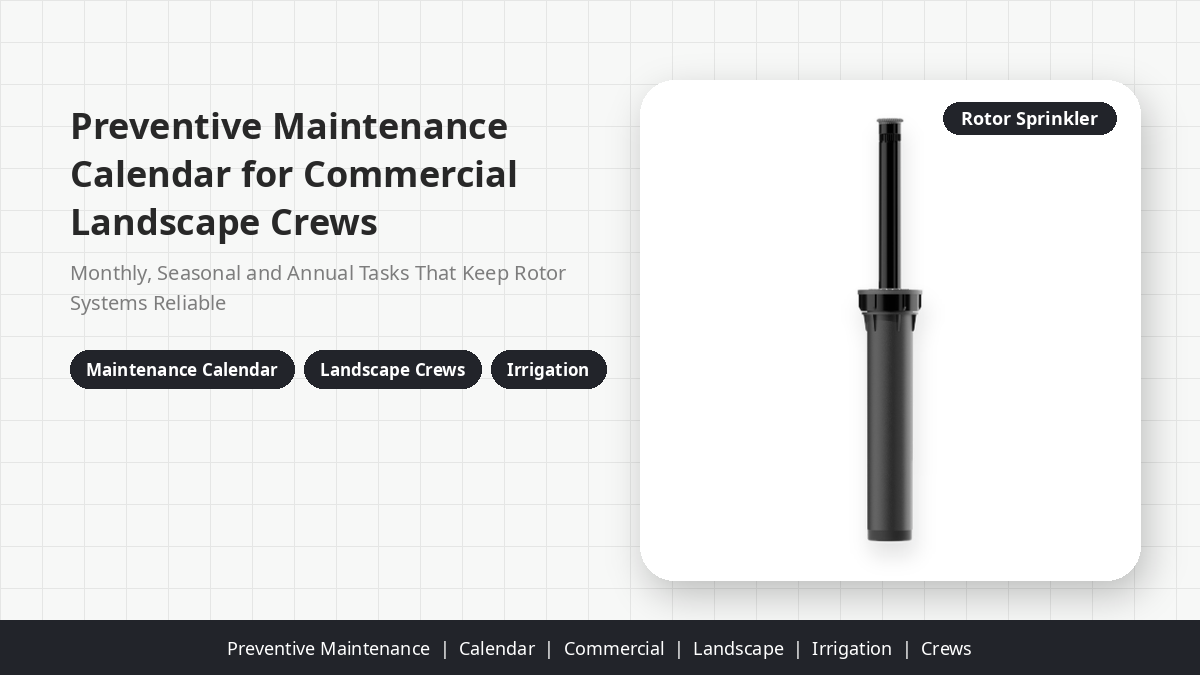
Our gear drive platform is built for that. The HF02-06 is a 6 inch pop-up with arc adjustable through the top from 50° to 360°, a 3/4 inch female inlet, 25 cm overall height and 4.5 cm exposed diameter. It carries a factory-installed rubber cover, a quick-check arc mechanism and a water-lubricated gear drive, with twelve nozzles from 1.5 to 8.0 mm blue plus 2.0 to 4.5 mm low-angle blue.
That arc range lets a triangular layout work with fewer part-circle heads than a square grid needs, because a head can be set to 90° or 180° at an edge without wasting throw. The twelve-nozzle selection lets one spacing carry different precipitation rates, which matters where a fairway zone serves two turf demands.
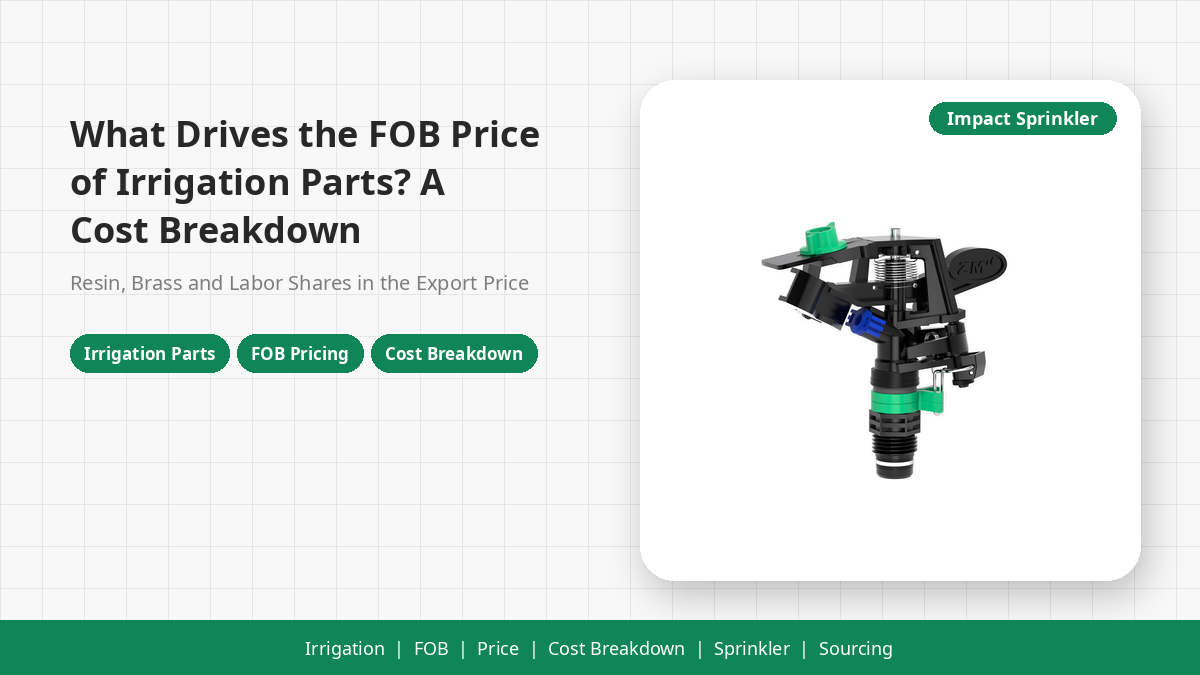
For larger areas the impact platform covers the same geometry. The 8028 impact sprinkler has a 10.5 to 14.6 m radius, a 0.36 to 1.58 m³/h flow range and four nozzle sizes at 3.0, 3.5, 4.0 and 4.5 mm, so precipitation rate can be matched to local conditions without changing spacing. The 8427 impact sprinkler, at 0.45 to 1.03 m³/h with an 11 to 13 m radius and five nozzles from 2.5 to 4.5 mm, is the cost-per-head option.
The Hydraulic Constraint That Overrides Layout
Spacing is a distribution decision, and distribution is downstream of hydraulics. If the pressure regime across a zone is wrong, no arrangement of heads fixes it, and a triangular pattern on a badly sized lateral produces a layout that is geometrically correct and hydraulically wrong.
The rule to enforce on every project is that pressure at the farthest head must not drop below 90% of the pressure at the nearest head on the same zone. On HDPE laterals, flow velocity is limited to 1.5 m/s, and friction loss is calculated with Hazen-Williams at a C-factor of 140. One result is worth remembering: doubling the pipe diameter cuts friction loss by roughly a factor of 30, which is why lateral sizing is not where to economise.
Two further points. Pressure regulation at each head is not optional on tight-uniformity zones; a regulated head with a stated tolerance is what holds a green above DU 0.80. And uniformity responds to hydraulics as clearly as to geometry: every 0.05 improvement in low-quarter DU correlates to roughly 6 to 8% water savings, which is the intervention EPA WaterSense works at.
How to Specify a Spacing Package
Send the layout intent rather than a head count, and the supplier can price and supply the right package. For each zone, the pattern you intend to use, the percentage of diameter, the target spacing in metres, the throw radius and nozzle you have selected, and the arc or arcs required at the edges.
Then send the pressure and the pipe: design pressure for the zone, lateral material and diameter, lateral length and the number of heads on it, because those numbers determine whether the spacing you specified is achievable at the uniformity you specified.
Finally, send the validation plan. Sample validation before bulk ordering is what makes a layout hold up: sample heads on a test zone, with flow rate, radius and distribution uniformity verified against the specification before the container is committed. Every INOVATO shipment includes a certificate of conformance with measured flow and radius data, and above 500 heads we prepare a quotation within 48 hours.
One last item costs nothing on site and belongs in any spacing package: the material declaration for the parts in contact with water. For an EU-bound programme that covers the body, seals and nozzle materials under the REACH obligations the European Commission administers, and it takes longer to assemble than drawings.
Frequently Asked Questions
What is the optimal sprinkler spacing for a rotor system?
Equilateral triangulation for uniform coverage, where the throw radius of each head reaches the adjacent head base. Triangular spacing uses 60% of the throw diameter and square 50%, so on a 15 m rated radius the figures are 18 m against 15 m. Triangular still covers better because of the hexagonal overlap geometry and the shorter distance to the nearest head.
How do I calculate distribution uniformity for a sprinkler zone?
Use the low-quarter method, DU lq, from the ASABE irrigation standards: the average catch of the lowest quarter of the test area divided by the overall average. In practice, lay out catch cans across a representative zone, 3 m × 3 m on greens and 6 m × 6 m on fairways, run a standard cycle, and measure each.
Should I use square or triangular spacing in windy locations?
Reduce the percentage rather than switching patterns. On wind-prone coastal courses the guidance is 50 to 55% of diameter, which on a 15 m radius head is 14 to 16.5 m instead of 18 m. The reason is wind drift: a square grid has an aligned directional weakness, so wind down a line of heads produces a stripe rather than a scattered pattern.
Does a rotor need a part-circle head at the edge of a triangular layout?
It depends on the arc range of the head. A rotor adjustable through the top from 50° to 360° can be set to 90° or 180° at an edge without wasting throw, which lets a triangular layout carry fewer part-circle heads than a square grid would. Part-circle heads at fairway perimeters are still worth specifying because they eliminate overspray onto paths and cut head count by 5 to 8%.
What pressure variation can a zone tolerate before spacing matters less?
Set the rule before the layout: pressure at the farthest head must not drop below 90% of the pressure at the nearest head on the zone. Flow velocity in HDPE laterals is limited to 1.5 m/s, and doubling the pipe diameter cuts friction loss by roughly a factor of 30, so lateral sizing is where a layout is won or lost.
How many sprinkler heads does an 18-hole course layout need?
For 20 to 25 hectares of irrigated fairway, triangulation at 18 m spacing takes roughly 620 to 770 heads, about 35 to 43 per average par-4 hole. A full course bill of materials usually runs 1,200 to 1,800 heads, 5 to 8 km of HDPE lateral, 200 to 400 control valves and 8 to 15 km of control wire.
Published 4 November 2026 · Last verified 4 November 2026 · Spacing percentages, zone patterns, measured distribution uniformity figures, catch-can method, head counts and hydraulic limits verified against the INOVATO golf course sprinkler layout article, the Gear Drive Sprinkler range and the HF02-06 product page on 4 November 2026. This article is design and procurement guidance only, not a substitute for a site-specific hydraulic design. Spacing percentages, pressure limits and uniformity targets must be confirmed against local conditions before a layout is fixed.