



What Is Matched Precipitation Rate? Mixing Arcs on One Zone
TL;DR
- Matched precipitation rate (MPR) means every nozzle on a single zone delivers the same depth of water per hour, regardless of its arc pattern.
- A 90-degree nozzle throwing water on a quarter circle must apply four times the volume of a 360-degree nozzle to keep pace -- if it does not, you get dry crescents and soggy centers.
- Manufacturers engineer MPR by shrinking the nozzle orifice on narrower arcs so the smaller watering area still delivers the same precipitation depth.
- Mixing non-MPR nozzles on a zone creates a 30-40 percent precipitation gap between full-circle and quarter-circle heads in typical residential installations.
- Choose nozzles from the same matched precipitation rate family, such as the Inovato RF304 adjustable-arc nozzle, to guarantee uniform application across mixed arcs.
Why Uniform Application Matters More Than You Think
When we design irrigation zones at Inovato Irrigation, the single metric we obsess over is whether every square meter of turf receives the same depth of water after every cycle. This is the principle behind matched precipitation rate, and it governs everything from nozzle selection to zone layout.
A precipitation rate is the depth of water a sprinkler applies per unit time, typically measured in millimeters per hour or inches per hour. When two heads on the same zone have different precipitation rates, the controller runs them for the same duration, but one area gets more water than the other. Because the controller cannot differentiate between heads on a zone, any mismatch in precipitation rate becomes a mismatch in soil moisture that persists cycle after cycle.
Most property managers we work with initially assume that coverage radius is the only variable that matters. They look at a quarter-circle nozzle and a full-circle nozzle and figure that as long as their throw patterns overlap, the lawn will be fine. It will not. Without matched precipitation rates, overlapping arcs merely average out the problem rather than solving it.
The Geometry Problem: Why Arcs Create Uneven Watering
Consider a single rotary head on a rectangular lawn. A full-circle (360-degree) nozzle distributes water over a complete disc. A half-circle (180-degree) nozzle covers half that area. A quarter-circle (90-degree) nozzle covers one quarter. Now, if all three nozzles discharge water at the same flow rate, the half-circle head applies twice the precipitation depth of the full-circle head, and the quarter-circle head applies four times the depth.
This is a simple area-versus-volume relationship. Because a 90-degree nozzle waters only one-quarter of the area a 360-degree nozzle covers, it must either slow its flow rate to match, or the zone will produce a four-fold precipitation imbalance. Most conventional fixed-flow nozzles do not make this adjustment, which is why mixing arcs from standard nozzle families almost always fails.
Let us walk through a real scenario. We were called to troubleshoot a commercial campus where the grounds crew had replaced several broken heads with whatever was in the parts bin. The original zone used half-circle rotary nozzles. The replacements included quarter-circle and full-circle heads from a different manufacturer. Within two weeks, the zones with mixed arcs showed brown streaks along the quarter-circle arcs (oversaturated, compacted soil) and yellow patches under the full-circle heads (underwatered). The crew blamed the controller scheduling, but the real culprit was a classic matched precipitation rate failure.
This pattern repeats across residential and commercial sites alike. Because the irrigation controller treats every head on a zone identically, the only way to achieve uniform soil moisture is to ensure that each nozzle inherently delivers the same precipitation depth. That is the entire premise of matched precipitation rate engineering.
How Matched Precipitation Rate Nozzles Work
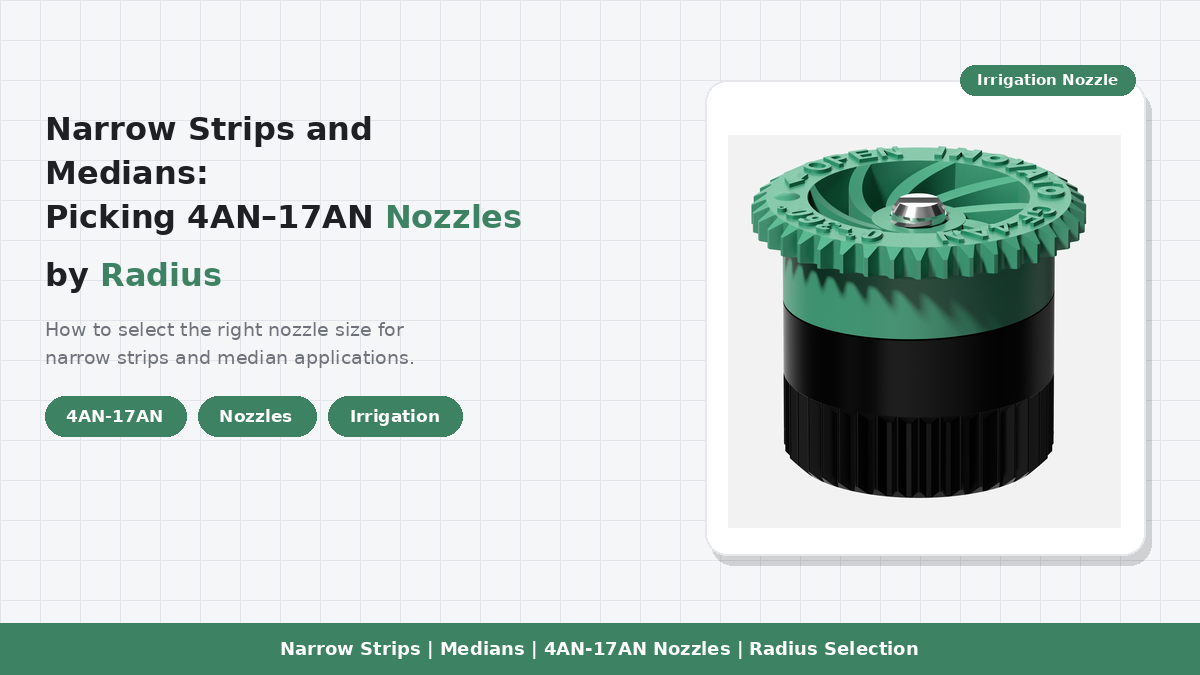
Manufacturers achieve matched precipitation rate by engineering the nozzle orifice and internal flow path so that narrower-arc nozzles emit proportionally less water. A properly designed 90-degree nozzle will have a smaller orifice than its 360-degree counterpart from the same family, reducing its flow rate to exactly one-quarter. This way, even though the 90-degree head covers less area, it deposits the same depth of water per hour as the 360-degree head.
Here is the key design element most people miss: matched precipitation rate is not just about the orifice size. The stream trajectory, deflector plate geometry, and pressure regulation all contribute to how evenly water distributes within the nozzle's arc. A well-engineered MPR nozzle delivers not only the correct total volume but also a uniform pattern within its arc. Poorly designed nozzles may match the total flow but create heavy and light streaks within the pattern itself.
At Inovato, our approach to matched precipitation rate nozzle design starts with the stream architecture. The RF series multi-stream rotary nozzles use multiple independent streams that rotate at controlled intervals. This multi-stream design distributes water in a way that resists wind drift and provides inherently more uniform distribution than single-stream alternatives. When we then scale the orifice for each arc variant -- 90, 180, 270, and 360 degrees -- the precipitation rate stays consistent across the entire family.
The RF304 adjustable-arc nozzle takes this a step further. Instead of requiring separate fixed-arc nozzles for each corner and side of a bed, the RF304 lets the installer set any arc from 30 to 360 degrees while maintaining matched precipitation rate across its full adjustment range. Because the orifice self-adjusts with the arc setting, there is no need to stock a dozen different fixed-arc nozzles on the truck.
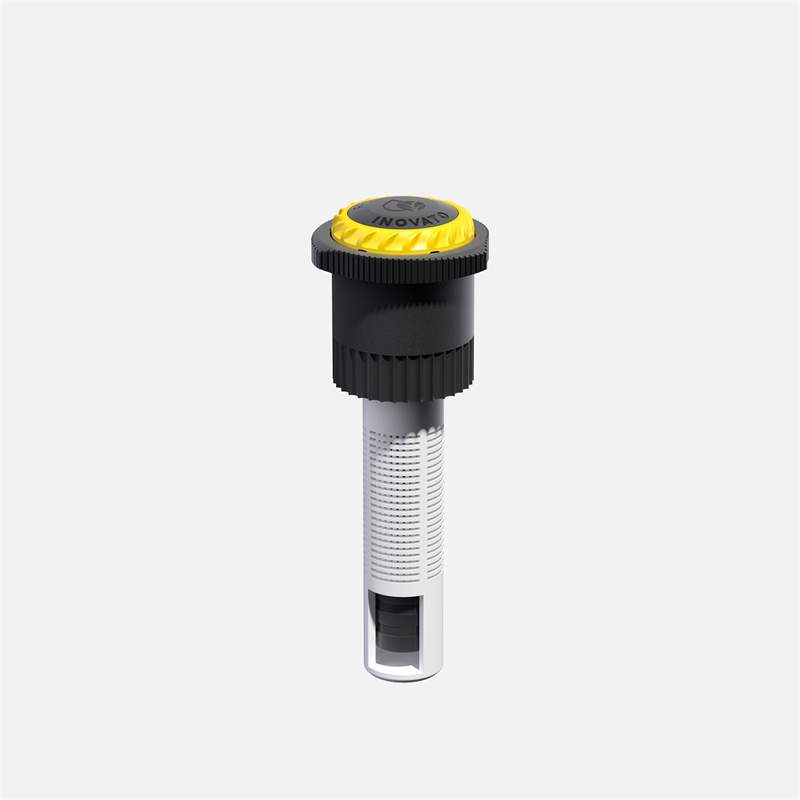
The RF304 adjustable-arc nozzle maintains matched precipitation rate across its entire arc adjustment range, making it ideal for zones that require multiple arc patterns on a single valve circuit.
Calculating Precipitation Rate: A Practical Walkthrough
To verify that a nozzle set is truly matched, you need to calculate the precipitation rate for each head. The standard formula is:
Where:
- 96.25 is a unit conversion constant (for US customary: gallons/minute to inches/hour)
- Total Flow = nozzle flow rate in gallons per minute (GPM)
- Area = irrigated area in square feet
For metric:
PR (mm/hr) = (60 x Total Flow in L/min) / Area in m2
Let us apply this. Say you have two heads on a zone:
| Nozzle | Arc | Flow Rate | Coverage Area | Precip Rate |
|---|---|---|---|---|
| Full-circle (360 deg) | 360 deg | 2.0 GPM | 314 sq ft | 0.61 in/hr |
| Quarter-circle (90 deg) | 90 deg | 2.0 GPM | 78.5 sq ft | 2.46 in/hr |
The quarter-circle head applies four times the precipitation depth of the full-circle head. If the controller runs for 20 minutes, the area under the 90-degree head receives roughly 0.82 inches, while the area under the 360-degree head receives only 0.20 inches. That is a massive disparity.
Now replace both nozzles with MPR-matched versions:
| Nozzle | Arc | Flow Rate | Coverage Area | Precip Rate |
|---|---|---|---|---|
| Full-circle MPR (360 deg) | 360 deg | 2.0 GPM | 314 sq ft | 0.61 in/hr |
| Quarter-circle MPR (90 deg) | 90 deg | 0.5 GPM | 78.5 sq ft | 0.61 in/hr |
Because the MPR quarter-circle nozzle reduces its flow rate to one-quarter, both heads now deliver the same 0.61 inches per hour. The controller can run them for identical durations, and every square foot of turf receives the same watering depth. This is what matched precipitation rate buys you: scheduling simplicity and uniform soil moisture.
For a deeper look at how different nozzle families handle precipitation rate matching, see our comparison article on RF vs. FN series spray patterns, precipitation rates, and retrofit compatibility.
Common Failure Cases When Mixing Arcs Without MPR
Over the years, we have audited hundreds of irrigation systems where mixed arcs were deployed without matched precipitation rate nozzles. The failure patterns are remarkably consistent:
Scenario 1: The Rotating Crew Swap
A landscape maintenance crew replaces a broken half-circle head with a full-circle head from a different product line. Because the full-circle head delivers only half the precipitation rate of the original half-circle, the adjacent turf starts showing drought stress within three irrigation cycles. Because the property manager does not measure soil moisture, the crew is instructed to increase run times on the entire zone, which overwaters the heads that were already correct.
Scenario 2: The Designer Mix-and-Match
An architect specifies decorative rotary nozzles for a courtyard and standard fixed spray nozzles for the surrounding lawn. Both are placed on the same zone to save on valve costs. The fixed spray nozzles have a precipitation rate of 1.5 inches per hour, while the rotary nozzles deliver 0.4 inches per hour. Because the controller cannot run two different schedules on the same zone, the rotary nozzle areas end up severely underwatered or the fixed spray areas become waterlogged. Neither outcome is acceptable.
Scenario 3: The Adjustable-Arc Trap
An installer uses adjustable-arc nozzles across an entire zone, which sounds ideal. But if the nozzles are from a non-MPR family, adjusting the arc changes the watering area without proportionally changing the flow. Setting one nozzle to 90 degrees and another to 270 degrees from the same non-MPR family creates a three-to-one precipitation imbalance. The fix is simple: use MPR-rated adjustable nozzles like the RF304, where the orifice scales with the arc setting.
Scenario 4: The Pressure Problem
Even with matched nozzles, inlet pressure variations across a zone can destroy the precipitation rate balance. A head at the far end of a long lateral line may see 10-15 psi less than the head closest to the valve. Lower pressure means lower flow and smaller throw radius, both of which change the precipitation rate. We always recommend pressure-regulated bodies or compensating nozzles for zones with significant elevation changes or long pipe runs. The Irrigation Association notes that proper pressure management is one of the most overlooked factors in system efficiency. For reference, see the Irrigation Association residential irrigation system guidelines.
Choosing the Right Nozzle Family for Mixed-Arc Zones
When we help distributors and contractors select nozzles for projects with complex zone geometries, we recommend a three-step process:
Step 1: Map the zone geometry. Walk the site and identify every arc pattern needed: full circles in open turf, half circles along straight edges, quarter circles in corners, and narrow strips along sidewalks. Document the arc angles and approximate spacing.
Step 2: Select a single nozzle family with proven MPR across all arcs. Do not mix families. Even if two manufacturers claim the same precipitation rate, their internal stream dynamics, pressure loss characteristics, and wind sensitivity will differ. Staying within one family eliminates these variables. Browse our complete nozzle catalog to find matched families for your application.
Step 3: Verify with the can test. Place catch cans (or straight-sided containers of uniform size) at equal distances around each head. Run the zone for a measured time period and compare the water depth in each can. If the cans under a 90-degree head collect significantly more water than cans under a 360-degree head, the nozzles are not matched, regardless of what the manufacturer claims.
The UGA Cooperative Extension provides a straightforward guide on measuring irrigation uniformity using the catch-can method. See UGA Extension Bulletin C926 for a step-by-step protocol. The EPA WaterSense program also emphasizes uniform application as a core principle of efficient landscape irrigation; see their overview at EPA WaterSense.
MPR and Water Conservation: The Bigger Picture
Matched precipitation rate is not just a design nicety; it is a water conservation strategy. When precipitation rates are mismatched, the only way to keep the driest areas alive is to overwater the wettest areas. In practice, this means running zones longer than necessary for the majority of the turf. The excess water either runs off into storm drains or percolates below the root zone, wasting both water and the energy used to pump it.
Because overwatered turf develops shallow root systems, it becomes more susceptible to disease and requires more fertilizer to maintain its appearance. The downstream environmental costs of over-irrigation extend well beyond the water bill. Runoff carries dissolved nutrients into waterways, contributing to algal blooms and degrading aquatic ecosystems. The EPA estimates that landscape irrigation accounts for nearly one-third of all residential water use in the United States, and a significant portion of that is avoidable through better system design. For more on water-efficient practices, visit the EPA WaterSense Start Saving page.
By engineering nozzles that inherently match precipitation rates across all arc patterns, manufacturers like Inovato help contractors deliver systems that use only the water the landscape actually needs. This is not about restricting flow arbitrarily; it is about making each nozzle a precision instrument calibrated to its specific task.
Designing Zones That Eliminate Mixed-Arc Headaches
In an ideal world, every zone would contain only one type of nozzle at one arc angle. In practice, that is rarely achievable, especially on sites with complex geometry, narrow strips, curved beds, and irregular corners. The real question is not whether you will mix arcs, but how you will handle it when you do.
Here are the principles we follow when designing zones that require mixed arcs:
Separate rotary and fixed spray heads onto different zones. Rotary nozzles and fixed spray nozzles have fundamentally different precipitation rates -- typically 0.4 to 0.6 in/hr for rotaries versus 1.0 to 1.5 in/hr for fixed sprays. Because these rates differ by a factor of two or more, no amount of arc matching can reconcile them. Put them on separate valves.
When mixing arcs within a rotary nozzle family is unavoidable, use only MPR-rated nozzles from the same series. Our RF multi-stream rotary nozzle family includes 90, 180, 270, and 360-degree variants, all engineered to deliver identical precipitation rates. For the corner and edge cases where a fixed arc does not fit, the RF304 adjustable-arc nozzle fills the gap without breaking the MPR balance.
Account for head-to-head spacing differences. Even with matched nozzles, if a 90-degree head is spaced at 4 meters and a 360-degree head is spaced at 5 meters, the precipitation rate per square meter will differ. MPR engineering assumes comparable spacing ratios. Adjust your layout to maintain consistent spacing-to-radius ratios across all heads on the zone.
Pressure regulation is non-negotiable. Install pressure-regulating bodies or inline regulators to ensure every head on the zone receives the same inlet pressure. Our technical team has seen installations where a 5-psi pressure differential between the first and last head on a 60-meter lateral line produced a 20 percent flow variation, completely negating the MPR design of the nozzles.
For a broader comparison of nozzle technologies and their suitability for retrofit projects, see our detailed analysis of RF vs. FN series spray patterns and retrofit compatibility.
Frequently Asked Questions
Our Perspective as Nozzle Manufacturers
At Inovato Irrigation, we have spent years refining nozzle geometry to solve the matched precipitation rate problem at the product level. We understand that contractors and distributors face real-world constraints: trucks carry limited inventory, sites have complex geometries, and maintenance crews are not always trained in hydraulic theory. Our design philosophy is to embed MPR into the nozzle itself so that the person installing or replacing the head does not need to think about precipitation rate math -- the nozzle handles it automatically.
The RF304 adjustable-arc nozzle is the clearest expression of this philosophy. Its flow-adjusting orifice means that whether a contractor sets it to 45 degrees for a narrow strip or to 360 degrees for an open lawn, the precipitation rate stays within the matched family envelope. Combined with our RF multi-stream fixed-arc nozzles, it gives installers a complete toolkit for mixed-arc zones without the risk of precipitation imbalance.
We encourage distributors, contractors, and specifiers to explore our full range of irrigation nozzles designed for matched precipitation rate performance. If you have a project with challenging zone geometry or need help specifying the right nozzle combination, our technical team is available to assist. Visit inovatoirrigation.com to learn more about our products and engineering approach.
Matched precipitation rate is one of those concepts that sounds technical but has profoundly practical consequences. Get it right, and your zones deliver uniform, efficient watering with minimal maintenance headaches. Get it wrong, and you spend the season chasing brown spots and wet patches with a controller schedule that can never quite fix the underlying problem. The solution starts at the nozzle.