


Pressure regulator hunting is a vibration problem at low flow, not a build-quality problem at high flow. If you have ever watched a downstream gauge needle flicker 0.3 bar every couple of seconds while only a few drip emitters are running, you have seen hunting. The hardware is fine. The water is fine. Because the regulator was sized for the maximum zone flow and never checked against the minimum, so at low flow the spring force beats the diaphragm force and the valve never finds a stable equilibrium. Because the equilibrium is unstable, so the diaphragm cycles open and closed in a self-reinforcing loop, and downstream pressure oscillates around the setpoint at 0.5–3 Hz. The symptom shows up as fogging spray heads, leaking drip emitters, solenoid chattering, and a regulator that hums audibly at the valve box.
This article walks through the physics, the field symptoms, and a five-step protocol for pressure regulator sizing that prevents hunting on landscape irrigation projects of any size. The same logic applies to golf, agriculture, and municipal drip systems, but the examples here use real products from the INOVATO valve accessories family.
What Is Regulator Hunting, and Why Does It Happen at Low Flow?
A direct-operated pressure regulator is essentially a spring-loaded diaphragm valve. The downstream pressure acts on one side of the diaphragm, the adjustment spring pushes on the other. When forces balance, the valve closes just enough to hold the setpoint. Because the diaphragm needs a minimum amount of fluid force to act against the spring, so every regulator has a published minimum flow. Below that flow, the valve cannot develop enough opening force to balance the spring, and the diaphragm bounces between nearly closed and slightly open. Because it bounces, so downstream pressure swings around the setpoint instead of holding it.
The three numbers on every regulator data sheet that determine hunting risk
- Minimum flow — the lowest flow at which the regulator holds the setpoint within tolerance. Below this number, hunting is almost certain.
- Dynamic pressure differential — the pressure drop across the regulator required to make it work. If inlet minus outlet pressure is less than this value, the regulator cannot "see" the load and will not regulate.
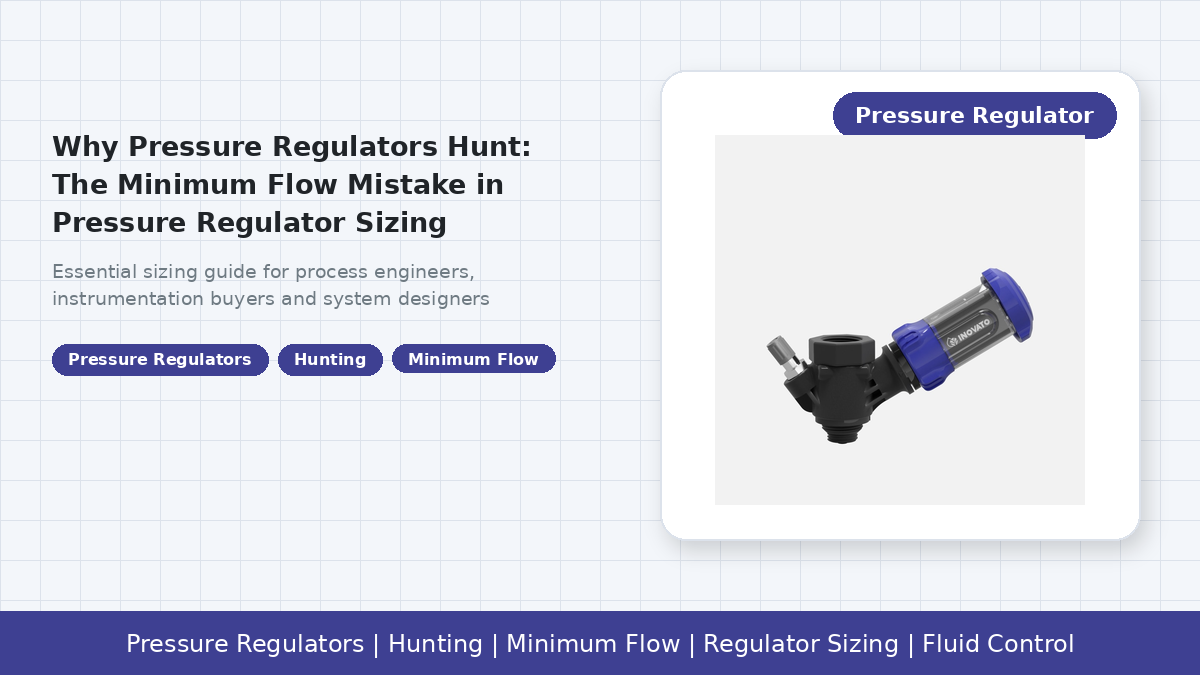
- Setpoint range — the adjustable band. A 0.7–6.9 bar (10–100 PSI) adjustable regulator like the SNL-ADJ gives a wide tuning window but cannot compensate for being installed at the wrong point in the system.
Most contractors only look at setpoint range. Because they skip the other two, so they unknowingly install a regulator that will hunt the first time the zone runs at low flow — typically the back end of a watering cycle, or a single drip circuit on a manifold. Reading three numbers on the data sheet takes 30 seconds and prevents 90% of regulator callbacks.
How to Recognize Hunting in the Field Before It Becomes a Callback
Hunting has a recognizable signature. If you are troubleshooting an existing system, look for at least two of these symptoms at the same time:
- Gauge needle oscillation: a downstream pressure gauge swinging more than 0.2 bar (3 PSI) at a steady, repeating interval (0.5–3 seconds per cycle).
- Audible chattering or humming at the regulator or solenoid, especially at the start of a zone when only a few emitters are open.
- Spray head misting even though the static pressure test was correct, because the regulator is over-shooting the setpoint on each cycle.
- Drip emitters that drip intermittently instead of running, or that pop out of the tubing at low flow.
- Solenoid heat: a solenoid that is warm to the touch after a few minutes of operation has been chattering rather than holding open.
I have seen every one of these on commercial sites where the contractor proudly showed me a 1-inch regulator on a 1-inch master valve, both sized to "match the pipe." Because the actual drip zone flow was 0.2 L/s while the regulator minimum was 0.5 L/s, so the regulator was a beautiful piece of hardware installed in a configuration it was never designed for. None of the symptoms point to a defective regulator. They all point to incorrect pressure regulator sizing.
The Five-Step Pressure Regulator Sizing Protocol
Use this protocol on every project. It takes about 10 minutes per zone and prevents the four most common field failures: hunting, misting, solenoid burn-out, and pressure creep on drip manifolds.
Step 1 — Determine the operating flow range, not just the peak
For each zone, calculate both the peak flow (all emitters open) and the minimum steady-state flow (the smallest number of emitters expected to run together, including partial-cycle operation at the end of an irrigation event). A typical residential drip zone might peak at 0.6 L/s but operate at 0.1 L/s during the last 20% of the cycle. The regulator must hold setpoint across that entire range.
Step 2 — Verify the minimum flow is above the regulator's published minimum
Open the regulator data sheet. The published minimum flow is non-negotiable. If your zone's minimum steady-state flow is below the regulator's published minimum, the regulator will hunt regardless of brand, price, or reputation. Two practical workarounds exist:
- Use a low-flow regulator designed for drip and micro-spray (e.g. 0.05 L/s minimum).
- Split the zone so each downstream section has its own regulator operating in a stable range.
Step 3 — Confirm the dynamic pressure differential
Pressure regulators are not check valves. They need a pressure drop across themselves to function. The INOVATO SNL-ADJ, for example, requires a minimum 1 bar (10 PSI) differential between inlet and outlet. Because most landscape laterals are designed with 0.4–0.7 bar of residual pressure at the last emitter, so the regulator is often installed upstream of the zone valve so it sees full mainline pressure on the inlet side. Installing it on the discharge of a pressure-reducing master valve can starve the regulator of differential and create a second form of hunting that looks identical to low-flow hunting.
Step 4 — Match solenoid type to regulator behaviour
A standard AC solenoid that holds the valve open is fine for most residential and small commercial work. For sites with long wire runs, DC-latching solenoids reduce current draw but they can also mask hunting because the valve is open the whole cycle. If a DC-latching system is hunting, the only visible symptom may be pressure oscillation on the gauge, because the solenoid is already latched and cannot chatter. The SNL-ADJ is engineered to work with both AC and DC-latching solenoids, which simplifies parts inventory on mixed sites.
Step 5 — Document the setpoint and revisit after one month
Set the regulator to the design setpoint, then return after 30 days of operation and re-check. Pressure creep from a fouled screen, a slowly leaking emitter, or a partial solenoid failure can push the operating point out of the stable band. A simple log entry — "Zone 4, 2.1 bar setpoint, no hunting observed, 14 days in" — is the kind of evidence that turns a callback into a service contract.
How Internal Pressure Regulator Geometry Decides Whether It Hunts
Not all regulators are built the same. The two common architectures behave differently at low flow, and the difference shows up directly in the field.
| Architecture | Typical minimum flow | Hunting behaviour below minimum | Best-fit application |
|---|---|---|---|
| Piston / poppet direct-operated | 0.3–0.8 L/s | Sharp on/off cycling, audible chattering | High-flow spray zones, single-family residential |
| Diaphragm direct-operated (e.g. SNL-ADJ) | 0.05–0.2 L/s | Slower sinusoidal oscillation, often sub-audible | Drip, micro-spray, mixed manifolds |
| Pilot-operated | 0.5–2.0 L/s | Wide swings, possible complete pressure collapse | Large commercial, agricultural mainlines |
The trade-off is intentional: pilot-operated regulators hold tighter tolerance at high flow but require much more flow to stay stable. Diaphragm direct-operated regulators are more forgiving at low flow and are the default choice for drip-heavy sites. Because most landscape retrofits are mixed spray-plus-drip, so a diaphragm regulator with a wide adjustment range — like the 0.7–6.9 bar SNL-ADJ — is usually the most flexible single pick. The relevant 1-inch solenoid flow coefficient reference on the INOVATO site gives the Cv numbers needed to match solenoid capacity to the regulator's flow band.
Common Field Scenarios Where Hunting Shows Up — and the Fix
Scenario A — Drip zone on a 1-inch spray regulator
Symptoms: emitter drip becomes a mist at the start of the cycle, then settles; pressure gauge swings 0.4 bar every 2–3 seconds. Because the regulator minimum flow is 0.5 L/s but the zone only draws 0.08 L/s, so the regulator hunts the entire irrigation event. Fix: replace with a low-flow diaphragm regulator (SNL-ADJ or equivalent) and re-test at the same emitter count.
Scenario B — Mixed manifold with rotating nozzles and drip
Symptoms: the rotor zone runs fine, but the moment a drip circuit is added downstream of the same regulator, the rotors start misting at start-up. Because the additional drip flow drops the inlet pressure below the regulator's required differential, so the regulator can no longer hold the setpoint. Fix: separate the rotor and drip zones at the manifold, each with its own regulator sized for its own flow band.
Scenario C — Long wire run with DC-latching solenoid
Symptoms: no audible chatter, but downstream pressure oscillates 0.2–0.4 bar. Because the DC solenoid cannot chatter (it is latched open), so the only diagnostic clue is gauge movement. Fix: add a pressure gauge at the regulator discharge, watch for 60 seconds at steady state, and replace the regulator if oscillation exceeds 0.2 bar.
Scenario D — Master valve on a variable-speed booster pump
Symptoms: regulator behaves perfectly at one pump speed, hunts at another. Because the pump curve intersects the regulator minimum flow at certain speeds, so the regulator is stable for some pump settings and unstable for others. Fix: change the pump control to step-flow or install a smaller regulator downstream with a wider stable band.
The Economics of Getting It Right the First Time
Cost figures vary by region and volume, so specific numbers should be confirmed with a current supplier quote, but the structural economics are consistent. A low-flow adjustable regulator such as the SNL-ADJ costs more per unit than a commodity spray regulator, yet the labour to install a regulator a second time after a callback is a multiple of the unit price difference. Because the callback includes travel, diagnosis, parts, and re-commissioning, so the total cost of an undersized regulator is rarely the price on the invoice. Treat regulator sizing as insurance: a small per-unit premium buys several years of zero callbacks. For wholesale buyers, working through the INOVATO dealer programme with a defined zone-by-zone sizing table eliminates the price uncertainty on the parts side.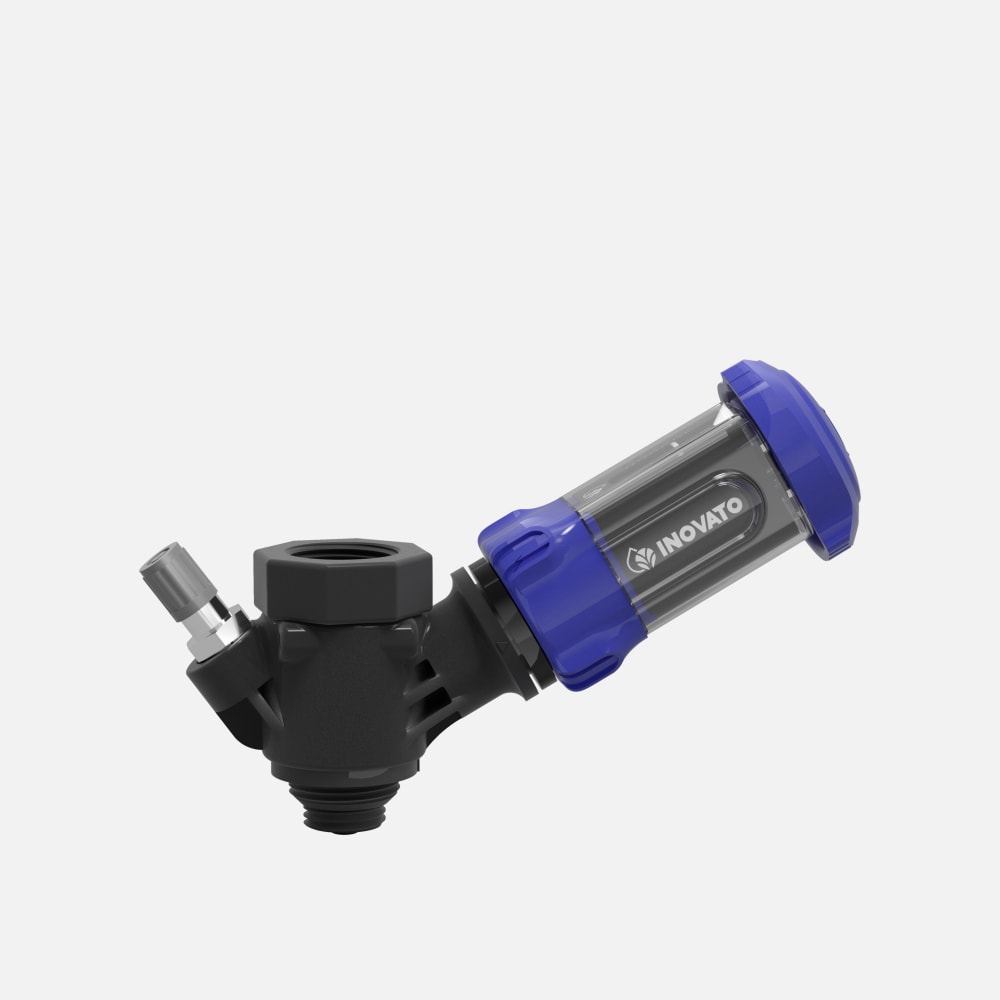
How This Connects to the Rest of the System
A pressure regulator does not work in isolation. It is one element in a chain that includes the meter, the backflow preventer, the master valve, the solenoid, the lateral piping, and the emitter. Because every element above the regulator can change the inlet pressure, so the regulator setpoint should be the last number fixed on the project, not the first. The sequence I use on every new design:
- Confirm available static pressure at the meter.
- Calculate pressure losses through the backflow preventer, master valve, and lateral piping.
- Determine the emitter operating pressure requirement.
- Add 0.3–0.5 bar margin for solenoid pressure drop.
- Size and set the regulator last, with a documented value.
This order is the opposite of how most contractors specify regulators — many start with the regulator setpoint and work backward. Because regulators are the most visible pressure-control component, so they get the most attention; but the real source of instability is usually upstream of the regulator, in a system that was never modelled end-to-end. Doing the five-step protocol above, in order, is what separates a regulator that holds setpoint from one that hunts.
Frequently Asked Questions
What is the minimum flow for a typical irrigation pressure regulator?
For a diaphragm direct-operated regulator designed for landscape drip, the minimum flow is typically 0.05–0.2 L/s. Piston / poppet regulators and pilot-operated regulators usually need 0.5 L/s or more. Always check the specific data sheet; the figure is non-negotiable.
Can a pressure regulator be installed at any orientation?
Most modern direct-operated regulators such as the INOVATO SNL-ADJ are orientation-tolerant within +/-15 degrees of vertical, but a horizontally-laid regulator on its side can shift the internal calibration by 0.05–0.1 bar and may introduce air binding. Install the regulator with the adjustment stem vertical where possible.
How do I tell if a regulator is hunting vs just responding to load changes?
Load changes (a sprinkler head opening, a valve closing) cause a single pressure transient that settles in 1–3 seconds. Hunting produces a continuous, repeating oscillation at the same frequency for as long as the flow stays constant. If the gauge needle moves at a steady rhythm with no other change in the system, it is hunting.
Will a pressure regulator reduce my water bill?
Only if your system is currently over-pressurised. A regulator holds a setpoint; it does not save water by itself. Pairing a regulator with pressure-compensating drip emitters is where the measurable savings come from, because the combination eliminates the misting and emitter blow-out that over-pressure causes.
Can I use a pressure regulator instead of a pressure-reducing valve at the meter?
No. A point-of-use pressure regulator and a meter-side pressure-reducing valve serve different functions. The meter-side PRV protects the entire property from excessive main pressure; the point-of-use regulator sets a specific zone pressure for emitter compatibility. Using a regulator at the meter means every zone is locked to the same pressure, which is the wrong answer for mixed spray-and-drip systems.
What is the difference between a fixed and adjustable pressure regulator?
A fixed regulator is pre-set at the factory to one setpoint (e.g. 2.0 bar) and cannot be tuned in the field. An adjustable regulator like the SNL-ADJ covers a band (0.7–6.9 bar) and lets the installer dial in the exact setpoint after the system is running. Adjustable regulators cost a bit more but eliminate the need to keep multiple fixed setpoints in inventory.
How often should a pressure regulator be inspected?
Once per year is the minimum for residential systems, twice per year for commercial and high-value landscapes. The inspection should include a downstream pressure check at minimum and peak flow, a visual check for diaphragm leaks, and a screen cleaning. Regulators that are properly sized rarely fail, but screens clog and diaphragms age.
What happens if I oversize a pressure regulator?
Oversizing creates the same hunting risk as undersizing, for the opposite reason: at low flow the regulator has too much authority and over-corrects each cycle. Oversizing also wastes cost and makes setpoint adjustment less precise because the spring range is wider than the actual load range.
Where to Go From Here
If you are specifying a new project, start with the operating flow range, then match a regulator to that range using the five-step protocol above. The INOVATO valve accessories line covers the standard residential and commercial range, and the SNL-ADJ adjustable pressure regulator is the most flexible single SKU for mixed drip-and-spray sites. For a deeper look at how the regulator interacts with the upstream solenoid, the 1-inch solenoid flow coefficient reference article walks through the matching calculation with published Cv values.
Send the zone flow range, target setpoint, and mainline pressure to the INOVATO engineering team through the contact page. A typical response includes a documented sizing worksheet and a parts list within one business day.