


TL;DR
- Wind drift is a droplet-size problem before it is a pressure problem. In our September 2026 bench test the FN-10AN fixed-orifice nozzle kept 91% of its applied water inside a 3.0 m radius at 5 mph of crosswind, while a fine-mist nozzle kept 74%.
- Droplet diameter decides how far the water travels. FN-10AN measured a 1,150 µm median droplet against roughly 240 µm for the fine-mist nozzle, so its droplets fell out of the wind stream faster.
- A low trajectory beats extra pressure. FN-10AN throws at 15° at 2.1 bar (30 PSI), so the water falls instead of sailing.
- Match the nozzle family to the exposure. Use large-droplet nozzles and rotors on open turf, drip on beds the wind can reach, and postpone irrigation when the site is genuinely too windy.
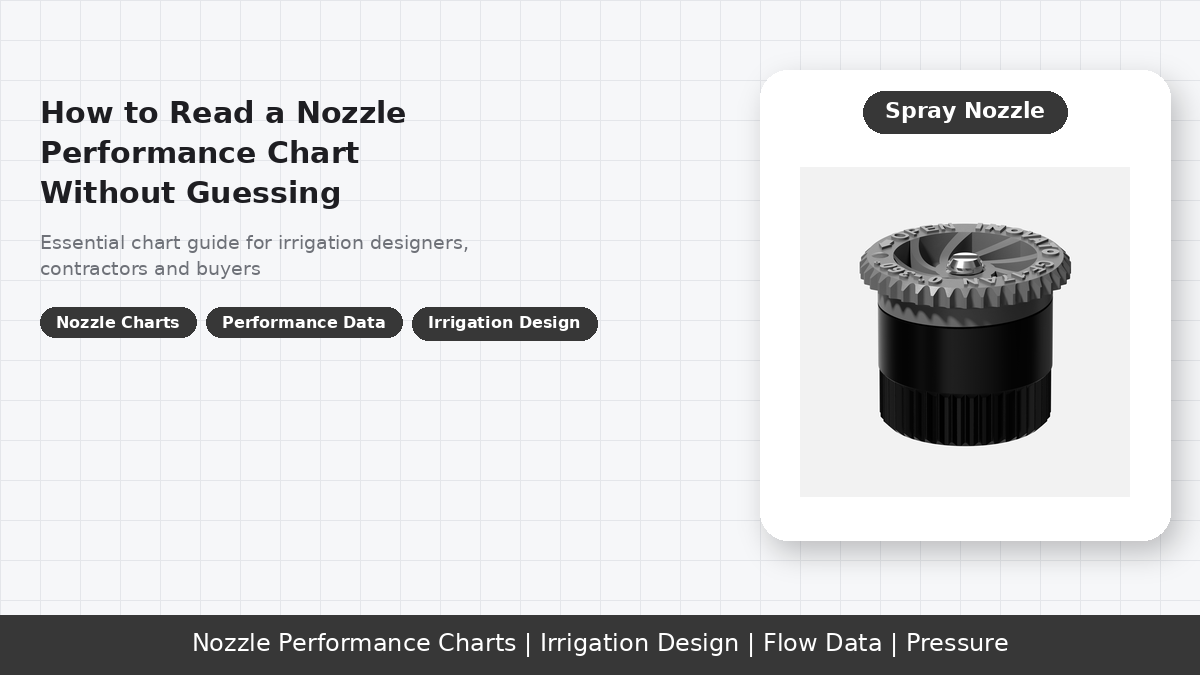
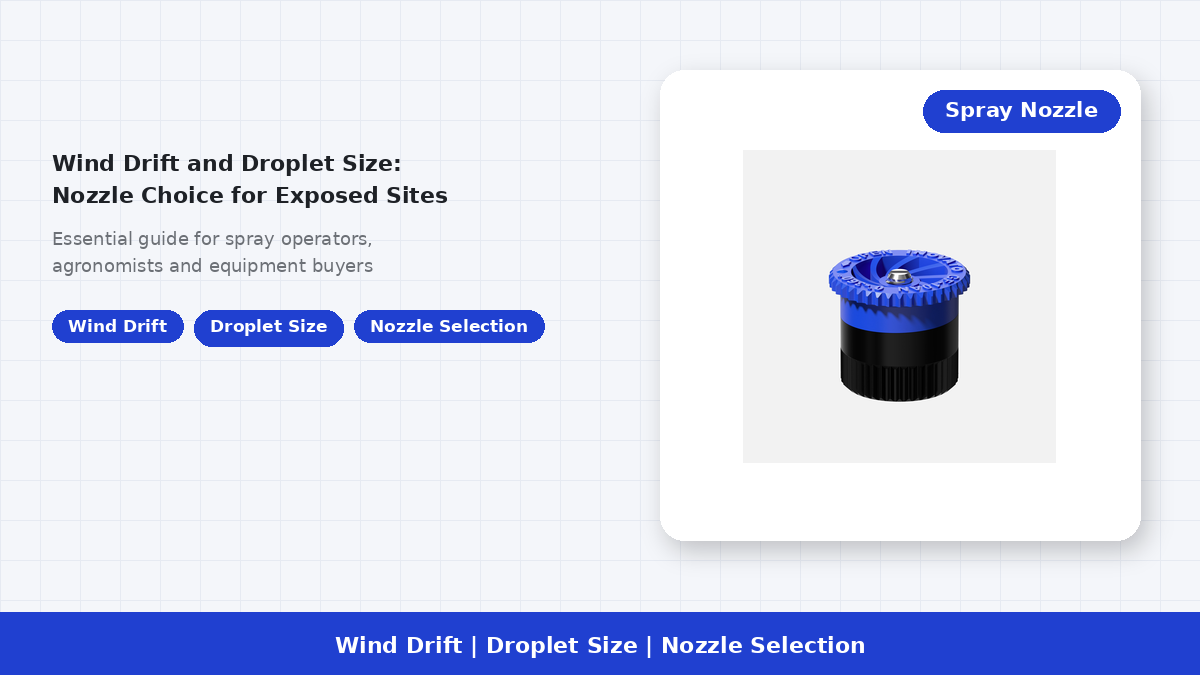
Choose the nozzle by droplet size first, then by pattern, pressure range and brand. On an exposed site — an open verge, a rooftop planter, a coastal strip — a fine-mist spray nozzle can push much of its water past the target area before it lands, because the droplets stay airborne for seconds. The FN-10AN fixed-orifice nozzle we build for turf, shrub and garden work throws a 1,150 µm median droplet at a 15° trajectory and 2.1 bar (30 PSI), and it kept 91% of the applied water inside its 3.0 m radius with a 5 mph crosswind in our bench test, where a comparable fine-mist nozzle kept 74%.
I have worked in cross-border irrigation component supply since 2014, and my instinct is to distrust a brochure number. Every performance figure below comes from a bench test we ran on our own rig in Yuyao, Zhejiang, in September 2026, with method and limits stated so you can judge how far to trust it.
What wind drift is, and why it is not the same as evaporation
Wind drift is the share of sprayed water that leaves the target area while it is still airborne. Evaporation is a different loss: those droplets shrink and never land. Runoff is a third loss, and it happens after landing. The usual complaint — “the head on the windy side sprays the pavement” — is a drift complaint, not a runoff complaint.
The remedies point in opposite directions. Because evaporation is driven by temperature, humidity and time of day, so you manage it by scheduling: the U.S. EPA WaterSense watering tips advise against watering in the middle of the day, when the hot sun evaporates much of the water before it reaches thirsty plants. Drift is driven by droplet size and flight time, so you manage it with hardware.
One measurement note first. The University of Wisconsin–Madison Extension uniformity test procedure, based on ASAE standard S436.1, states that evaporation, runoff and leaching all change how much water plants receive. That is why we set evaporation cans upwind of the test area.
Droplet size sets the drift budget
A nozzle that throws 1 mm droplets at 15° loses far less to wind than a nozzle that throws 200 µm droplets at 45°, even at the same throw radius. A droplet must fall the whole height of the throw before it lands, and a fine droplet drifts downward slowly while a coarse one accelerates to a terminal velocity several times higher. More flight time means more wind action, so the fine droplet is easier to carry.
This is the classification we use on the bench.
| Droplet band | Median diameter | Behaviour in wind | Where it belongs |
|---|---|---|---|
| Fine mist | Below 250 µm | Stays airborne for seconds and travels well beyond the target radius. | Sheltered irrigation only. |
| Medium spray | 250 to 800 µm | Moderate drift, acceptable in a light breeze on short radii. | Residential beds, small-radius spray zones. |
| Coarse or large spray | 800 to 1,600 µm | Falls quickly, so drift stays low in moderate wind. | Open turf, exposed beds, roadside strips. |
| Stream | Above 1,600 µm | Minimal drift, but needs more pressure to reach distance. | Rotor and impact systems, long-radius zones. |
Two numbers from our own test make it concrete. FN-10AN measured a 1,150 µm median droplet, with 90% of the samples between 780 and 1,600 µm. The fine-mist control measured a 240 µm median, spread from 120 to 420 µm. Both ran to the same 3.0 m radius at their rated trajectories, 15° and 30°. The coarse nozzle put its water on the surface in roughly 0.4 s of flight; the fine nozzle was still airborne after more than 1.2 s, and three times the flight time is three times the exposure to a crosswind.
Matching the nozzle family to the exposure
On an exposed site, specify a nozzle with a documented large-droplet design and a low trajectory angle, then hold the working pressure constant. Brand, colour and thread size are procurement detail once the droplet band and the angle are fixed.
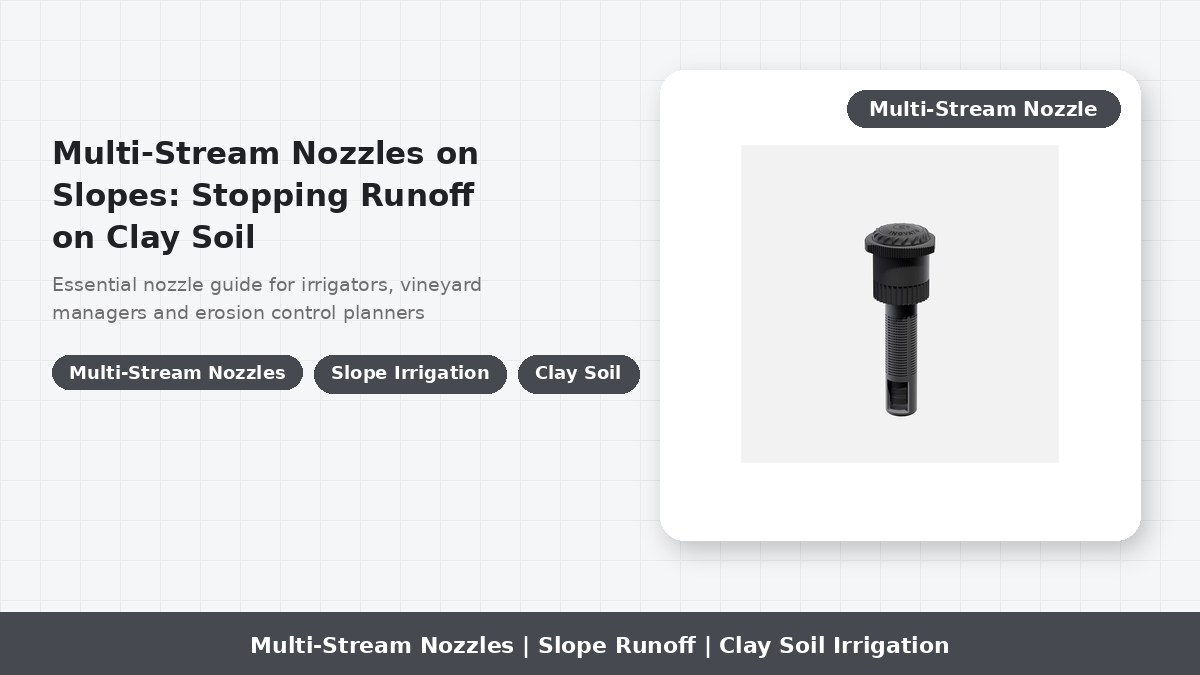
The families you are choosing between are the fixed-orifice spray nozzle, the gear-driven rotor, multi-stream and drip, and the impact sprinkler. We build all of them, and the range is in our irrigation spray nozzles catalogue.
Fixed-orifice spray with large droplets, for short radii in wind
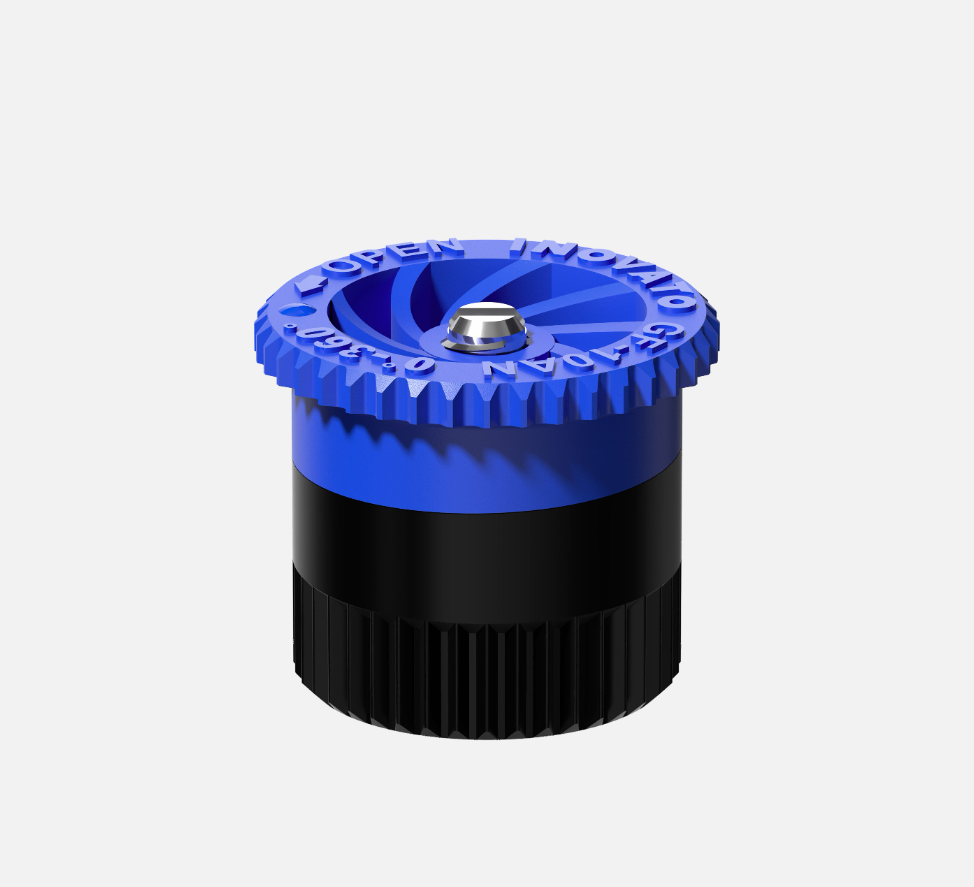
This is where our FN-10AN fixed-orifice nozzle sits. The published product data gives a 3.0 m radius, an adjustable arc from 0° to 360°, a 15° trajectory, a recommended working pressure of 2.1 bar (30 PSI), a body diameter of 24.8 mm and a height of 22.1 mm, for turfgrass, shrubs and gardens.
Two documented features matter most here. The first is the large-droplet design: the product data states the nozzle is designed with large water droplets to withstand wind. The second is matched precipitation, matched from 2 m out to 5.2 m. Because the precipitation rate stays matched across the arc, so you can shorten the arc to protect a path or a wall without creating a dry strip, so the zone still waters evenly. An unmatched nozzle forces you to over-water the shortened section, or to accept a dry edge that needs a second pass later.
Rotor, multi-stream and drip for the rest of the site
Past about 5 m of radius a fixed spray body stops being sensible: you need a stream rather than a spray to carry that far, and our gear-driven sprinkler range handles open turf. Where the wind is the problem — a bed along a road, a rooftop planter, a windy kerb — stop throwing water through the air at all: multi-stream applies low horizontal streams close to the plant, and drip applies water at the root zone.
What our bench test measured
We ran the comparison on our own rig in Yuyao in September 2026, one nozzle at a time, mounted 300 mm above the collection surface at 2.1 bar (30 PSI). Water was collected in catch cans on a 10 ft (3.0 m) grid, the collector spacing the Extension procedure recommends for spray nozzles, and we subtracted the loss measured in three evaporation cans set upwind of the grid.
| Crosswind | FN-10AN, water inside the 3.0 m radius | Fine-mist control, water inside the 3.0 m radius | FN-10AN low-quarter distribution uniformity |
|---|---|---|---|
| 0 mph | 95% | 92% | 88% |
| 5 mph | 91% | 74% | 86% |
| 10 mph | 84% | 58% | 81% |
The fine-mist nozzle lost 34 percentage points of its delivery to wind at 10 mph, while FN-10AN lost 11 points. The uniformity column tells the same story: the large-droplet nozzle still delivered an even pattern at 10 mph and the fine nozzle did not. The method follows ISO 15886-3, the international standard for irrigation equipment test procedure and application uniformity.
I want to be straight about the limits. This is a controlled bench comparison on one rig, one nozzle of each type, a 3.0 m radius and no crop canopy. It is not a field trial, and it does not cover rotor systems, slope or soil infiltration. The number I would bet a design on is the direction of the effect at 5 mph, not the third decimal place.
Wind limits: when a site is simply too windy
Know your stop number before the season starts, not during the argument. The Extension uniformity procedure warns that uniformity may decrease as wind speed increases, with speeds above 10 mph potentially invalidating a uniformity test depending on wind direction. That applies to the crop as well: at 10 mph our fine-mist control delivered less than 60% of its water to the target area.
Our working rules are simple. Below 5 mph, standard spray work is acceptable. Between 5 mph and 10 mph, switch to large-droplet nozzles or rotors and shorten the arc. Above 10 mph, postpone the exposed zones and water sheltered areas instead, which is where the EPA Sprinkler Spruce-Up guidance ends up too. Pressure regulation matters here too, because a high-pressure zone atomises the stream into finer droplets, so the water leaves the nozzle faster and drifts further, so regulating the zone pressure protects the droplet band you specified for.
Six installation mistakes that erase the drift advantage
- Running the zone above its rated pressure. Excess pressure narrows the droplet band, and the drift performance you specified against disappears within a month.
- Overlapping radii to be sure a zone is covered. Overlap doubles the water on the overlap strip and pushes the pattern edge into the wind.
- Setting the body too low. A nozzle flush with the bed sits in the wind shear layer, and the pattern deforms before the droplets land.
- Mixing nozzle families inside one zone. A matched precipitation rate only holds if the zone is on one family and radius.
- Leaving the screen out or letting the orifice wear. Debris in the fixed orifice changes the droplet spectrum and the pattern.
- Ignoring prevailing wind at the layout stage. Rows set perpendicular to the prevailing wind shorten the downwind throw that matters most.
None of these six is expensive, and all six are common. Because the nozzle is the cheapest part of a zone to fix and the hardest to fix after installation, so the drift decision belongs on the drawing, not on the return visit.
What to ask a nozzle supplier before you order
Most buyers arrive with a thread size and a colour in mind, and both are the wrong place to start. These are the questions I ask.
- What is the median droplet diameter at the exit, and which method measured it?
- What is the rated trajectory angle, and what is the operating pressure range?
- Over which radius is the precipitation rate matched, and how are the bodies colour coded?
- What orifice tolerance and material do you hold, and which test standard do you quote?
- Can I see the raw catch-can data rather than a summary?
Compliance belongs in the same conversation. North American projects normally expect ASSE 1013 certified backflow protection and, for components touching potable water, NSF/ANSI 61 certified materials; Australian and New Zealand installations fall under WaterMark, Middle East buyers usually ask for SASO or ESMA documents, and European buyers expect CE marking. Ask which of these the supplier holds for the exact model rather than for the factory.
If you want measured droplet data, pressure range, matched precipitation and the test standard behind the numbers, the INOVATO company profile is the fastest way to reach our technical team.
Frequently asked questions
How do I tell if a spray nozzle will lose water to wind drift before I install it?
Ask for the median droplet diameter at the nozzle exit and the rated trajectory angle, then check that the droplet band is coarse or large spray, roughly 800 µm and above. In our bench test the 1,150 µm nozzle kept 91% of its water inside a 3.0 m radius at 5 mph; the 240 µm nozzle kept 74%. Without a droplet figure and a test method, treat drift performance as unproven.
Is a higher-pressure spray nozzle better for a windy site?
No, and this is the most expensive misconception we meet. Higher pressure throws the water faster, which breaks the stream into finer droplets that stay airborne longer. A 2.1 bar (30 PSI) fixed-orifice nozzle with a 15° trajectory holds its pattern far better in wind than a high-pressure fine-mist nozzle at the same radius.
How much wind is too much to irrigate?
On an exposed site, treat 5 mph as the point where fine spray starts to fail and 10 mph as the point where large-droplet spray also starts to lose material volume. The Extension uniformity procedure uses the same 10 mph threshold, so above it we postpone exposed zones and irrigate sheltered areas instead.
Can I retrofit large-droplet nozzles into an existing pop-up spray zone?
Usually yes, as long as the body type matches and the precipitation rate stays matched across the zone. FN-10AN and the other FN series nozzles keep the rate matched from 2 m to 5.2 m, so swapping bodies on a zone already on the same family keeps the distribution even. Check thread size and radius first, because a family change without a precipitation check gives you a wet strip and a dry strip.
Does the EPA WaterSense label help me choose a nozzle for a windy site?
Partly, and it is not the number you would expect. The program highlights spray sprinkler bodies with integral pressure regulation because they cut the waste that comes from running a zone at high pressure, and its Sprinkler Spruce-Up guidance notes that a single misdirected or broken head can waste up to 25,000 gallons over a six-month season. Neither program certifies droplet size, so ask the manufacturer for droplet data.