

Adjustable Nozzle for Landscape Irrigation: A Flow Rate Specification Guide for Designers Specifying Variable Coverage Patterns
TL;DR
- Adjustable nozzles let designers match precise coverage arcs to irregular landscape zones without swapping hardware.
- Industry-standard flow rates for pop-up nozzles in the 90-360 degree range typically fall between 0.06 and 1.50 GPM depending on arc, throw radius, and operating pressure.
- Match precipitation rates across mixed-arc stations by pairing nozzle arc settings with the manufacturer's published flow data at your design pressure.
- INOVATO's RF and FN nozzle families cover arcs from 90 to 360 degrees and radii from 1.2 m to 5.2 m, accommodating nearly every residential and commercial turf layout.
- Always verify specifications directly with the manufacturer before finalizing hydraulic calculations.
Why Adjustable Nozzles Matter in Modern Landscape Irrigation Design
Landscape irrigation designers face a recurring challenge on every project: translating irregularly shaped planting beds, curved walkways, and offset building footprints into a uniform spray grid using off-the-shelf components. Fixed-arc nozzles offer predictable performance, but they demand a large inventory to cover the arc increments that real-world geometry presents. Adjustable nozzles solve this problem by allowing the installer to dial in any arc within a published range, eliminating the gap between a 180-degree and a 270-degree nozzle when the site actually needs 225 degrees of coverage.
From a specification standpoint, adjustable nozzles reduce SKU complexity for contractors and simplify submittals for design engineers. A single 90-to-210-degree nozzle can replace three or four fixed-arc alternatives, cutting warehouse costs and reducing the risk of field substitution errors. This flexibility also benefits phased projects where landscape plans evolve between the initial irrigation design and final installation. The designer can select a nozzle series with a broad arc range, then fine-tune each head during commissioning without requesting new parts from the supplier.
However, the convenience of adjustability introduces a hydraulic variable that fixed-arc nozzles do not present: the flow rate changes as the arc changes. A nozzle set to 180 degrees delivers roughly twice the flow of the same nozzle set to 90 degrees, because it must wet twice the arc length per revolution. Designers who ignore this relationship risk mismatched precipitation rates between adjacent stations, leading to dry spots or saturated zones. Understanding how manufacturers characterize flow rate versus arc is therefore essential to specifying variable coverage patterns correctly.
Understanding Flow Rate Fundamentals for Adjustable Arc Nozzles
The fundamental hydraulic relationship governing nozzle performance is the orifice equation, which states that flow rate equals a discharge coefficient multiplied by the orifice area and the square root of twice the pressure differential. In practical irrigation terms, this means that flow rate is proportional to the square root of operating pressure and directly proportional to the effective orifice size. For adjustable nozzles, the effective orifice is a function of both the physical nozzle geometry and the arc setting, because the spray stream is redirected through a narrower or wider deflection path as the user rotates the adjustment collar.
According to irrigation engineering references such as the Irrigation Association technical standards and the USDA Natural Resources Conservation Service guidance documents, flow rate specifications for adjustable nozzles are typically published at a nominal operating pressure of 30 psi (207 kPa) unless otherwise stated. Industry-standard flow rates for nozzles in the 90-to-210-degree adjustable arc class used on quarter-circle to half-circle residential turf zones generally range from 0.10 to 0.75 GPM at 30 psi, depending on the throw radius. Wider-radius nozzles intended for athletic fields and commercial landscapes may exceed 1.50 GPM at the same pressure.
Precipitation rate, measured in inches per hour, is derived by dividing the flow rate by the area covered. Because the covered area scales with arc angle, a correctly specified adjustable nozzle maintains a consistent precipitation rate across all arc settings if the manufacturer has engineered the orifice and deflector to compensate. When this is not the case, the designer must calculate the precipitation rate at the chosen arc setting and adjust the station runtime to achieve uniform application across the zone.
RF Series Nozzles: Fixed-Range Adjustable Options for Pop-Up Sprinklers
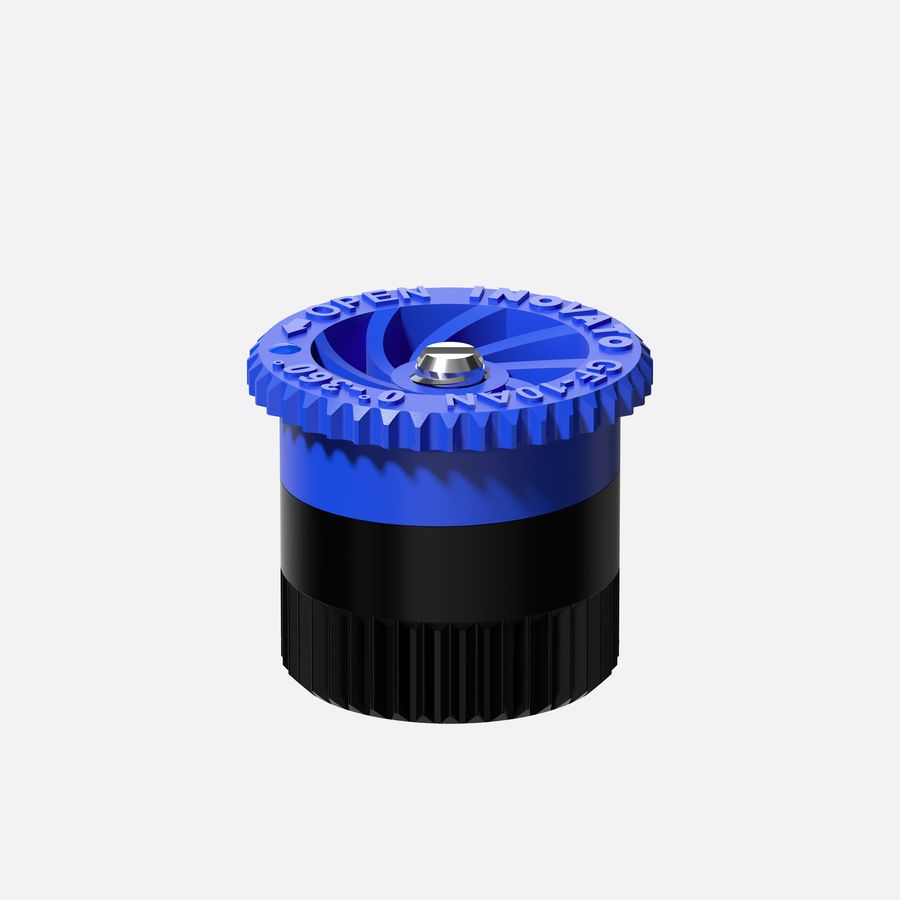
The INOVATO RF nozzle family consists of nine models designed as replacement nozzles for standard pop-up sprinkler bodies. These nozzles are organized into three radius groups, each offering three arc options: a 90-to-210-degree adjustable model, a 210-to-270-degree adjustable model, and a 360-degree full-circle model. This structure allows designers to mix arcs within a single radius group while maintaining similar throw distances, which simplifies precipitation rate matching across a zone.
In the first radius tier, the RF101 covers 90 to 210 degrees, the RF103 covers 210 to 270 degrees, and the RF104 delivers full 360-degree coverage. Each nozzle in this group is color-coded red, blue, and bottle green respectively, enabling quick visual identification during installation and maintenance. The second radius tier follows the same arc pattern with RF201, RF203, and RF204 models, coded black, yellowish-green, and gray. The third tier includes RF301, RF303, and RF304, coded dark blue, brown, and yellow.
For hydraulic calculations, designers should request the manufacturer's published flow rate data at their specific design pressure. As a general industry reference, small-radius pop-up nozzles in this class typically deliver flow rates between 0.06 and 0.20 GPM per quarter-circle station at 30 psi, scaling proportionally with arc setting. The tiered structure of the RF family also simplifies inventory management for irrigation contractors who service multiple residential or commercial properties, as stocking one model per tier covers the most common arc requirements encountered in the field. The American Society of Agricultural and Biological Engineers publishes standards for sprinkler testing methodology that manufacturers use to generate these specifications, ensuring consistency across suppliers.
FN Series Nozzles: Full 0-to-360-Degree Arc Adjustment with Varied Radii
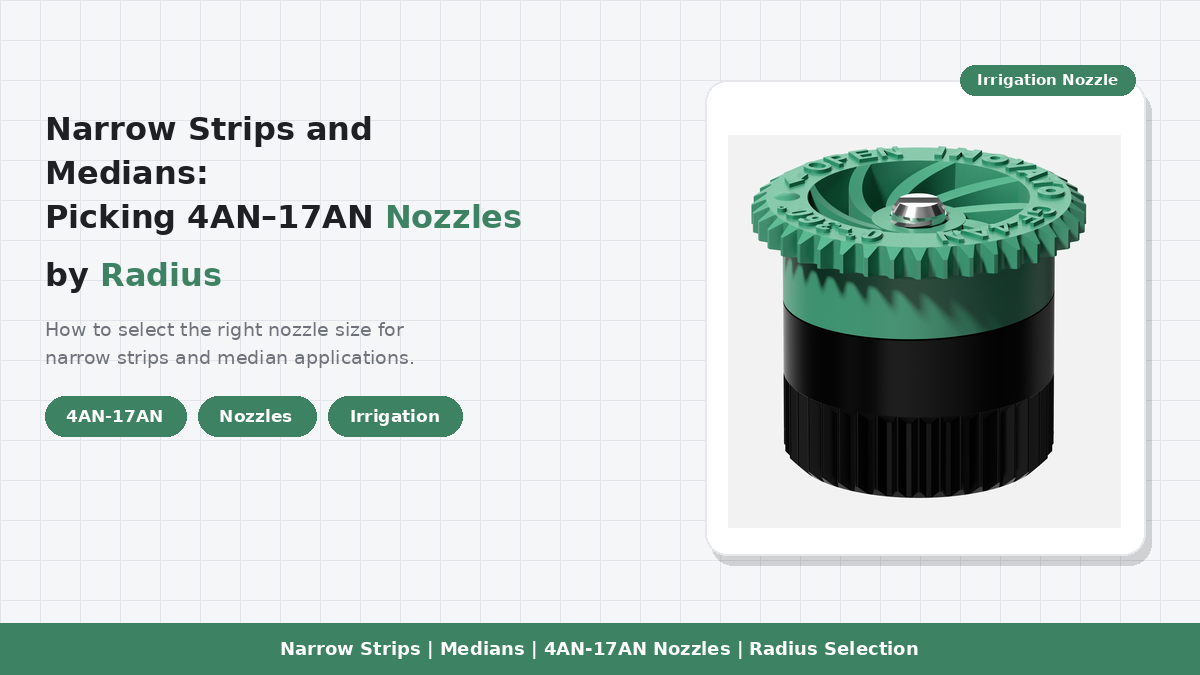
While the RF series offers discrete arc ranges, the INOVATO FN nozzle family takes a different approach by providing continuous 0-to-360-degree adjustability across seven radius options. This means a single nozzle model can be set to any arc from a narrow wedge to a full circle, giving designers maximum flexibility for complex site geometries. The FN series ranges from the FN-4AN with a 1.2-meter radius to the FN-17AN with a 5.2-meter radius, covering residential garden beds, median strips, and larger commercial turf areas.
The seven models in the FN family are the FN-4AN (1.2 m radius, light green), FN-6AN (1.8 m, sky blue), FN-8AN (2.4 m, green), FN-10AN (3.0 m, dark blue), FN-12AN (3.7 m, brown), FN-15AN (4.6 m, black), and FN-17AN (5.2 m, gray). The color coding follows an intuitive logic that helps field crews identify the correct nozzle quickly. According to irrigation engineering references, industry-standard flow rates for adjustable nozzles in this radius class typically range from approximately 0.10 GPM for the smallest radius at narrow arcs to over 1.20 GPM for the largest radius at full circle, assuming an operating pressure of 30 psi.
The FN series is particularly valuable in retrofit projects where the existing pipe sizing and valve capacity constrain the available flow per station. Because the arc can be continuously adjusted, the designer can reduce the arc to lower the station's total flow demand without changing the nozzle body or lateral piping. The Hunter Industries irrigation education resources provide further background on how arc reduction affects station flow and precipitation rate, a principle that applies universally across brands.
How to Specify Variable Coverage Patterns Without Over- or Under-Watering
Specifying variable coverage patterns begins with a scaled site plan that identifies every irrigated area by shape, plant material, soil type, and sun exposure. The designer divides the site into hydrozones, grouping areas with similar water requirements onto shared valve stations. Within each station, the nozzle arc and radius must be selected to cover the zone boundary with minimal overspray onto hardscape or non-irrigated areas. Adjustable nozzles make this boundary matching far more precise than fixed-arc alternatives.
The critical hydraulic step is ensuring that every nozzle within a station delivers the same precipitation rate. If one nozzle covers a 90-degree arc at 0.15 GPM and the adjacent nozzle covers a 270-degree arc at 0.45 GPM, both apply water at the same depth per hour because the 270-degree nozzle sweeps three times the arc but also covers three times the area. The designer must verify this balance by dividing each nozzle's flow rate by its arc fraction and comparing the resulting precipitation rates. Any nozzle whose calculated rate deviates by more than 10 percent from the station average should be reassigned to a different arc setting or moved to a different station.
Run time calculation follows directly from the precipitation rate. The U.S. Environmental Protection Agency WaterSense program recommends matching irrigation run times to the crop coefficient and reference evapotranspiration for the local climate zone, then adjusting downward for system efficiency. Designers who specify adjustable nozzles with documented flow rate curves can plug these values directly into hydraulic calculation software, producing station run times that deliver the target application depth with minimal waste.
Pressure Requirements and System Compatibility Considerations
Every irrigation nozzle performs within a defined operating pressure range. Below the minimum pressure, the spray pattern breaks up into large droplets that fail to cover the outer radius uniformly. Above the maximum pressure, the spray atomizes into a fine mist that drifts on the wind and evaporates before reaching the target area. For typical pop-up spray nozzles used in landscape irrigation, the design operating pressure is 30 psi, with an acceptable range of 25 to 40 psi depending on the manufacturer's published data.
System pressure is determined by subtracting friction losses in the lateral pipes, mainline, and valves from the static pressure available at the point of connection. Designers must verify that the residual pressure at the farthest nozzle on each station falls within the nozzle's operating range. The Hazen-Williams equation or the Darcy-Weisbach equation, both documented in the ASABE standards, provides the friction loss calculations needed for this verification. For adjustable nozzles, the friction loss in the lateral is higher at wider arc settings because the total station flow increases, which reduces the residual pressure at each nozzle.
Compatibility with pop-up bodies is another specification concern. The RF series nozzles are designed to thread onto standard pop-up sprinkler risers, making them direct replacements for fixed-arc nozzles from major brands. The FN series may require specific body types to achieve the published throw radius, and designers should confirm thread compatibility with the chosen sprinkler body before finalizing the bill of materials. INOVATO's manufacturing base of 6,800 square meters with three modern workshops supports production of both nozzle families for export to over 76 countries, and their technical team can advise on compatibility for specific project requirements.
Material Durability, UV Resistance, and Maintenance Considerations
Landscape Irrigation Nozzles are exposed to ultraviolet radiation, temperature cycling, chemical attack from fertilizers and reclaimed water, and mechanical stress from foot traffic and mowing equipment. Material selection directly affects nozzle lifespan and long-term hydraulic performance. Most residential and commercial spray nozzles are molded from acetal copolymer or glass-filled nylon, both of which offer excellent dimensional stability and UV resistance when properly formulated with stabilizer packages.
Over time, UV exposure can cause polymer surfaces to become chalky and brittle, which may alter the internal orifice geometry and change the nozzle's flow rate characteristics. High-quality nozzles incorporate UV stabilizers such as hindered amine light stabilizers (HALS) that extend service life to five to ten years under normal exposure conditions. The color coding used in the RF and FN series also serves a practical maintenance function: when a nozzle is damaged or clogged beyond cleaning, the installer can identify the correct replacement by color without needing to decode serial numbers or measure the orifice diameter in the field.
Clogging is the most common maintenance issue for spray nozzles. Municipal water supplies, reclaimed water, and even well water can carry fine particulates that accumulate in the nozzle orifice and deflector grooves. Designers can mitigate clogging risk by specifying a station-level filter or by selecting nozzles with larger internal passages. Routine maintenance schedules should include visual inspection of spray patterns, with any nozzle exhibiting uneven distribution replaced promptly to prevent dry spots from developing in the landscape zone. Keeping a small inventory of replacement nozzles on site, organized by color code, allows maintenance crews to complete repairs during a single visit rather than requiring a return trip with the correct parts.
Selecting the Right Nozzle for Residential, Commercial, and Sports Turf Applications
The application context determines which nozzle series and radius tier best serves the project. Residential landscapes typically feature narrow planting beds along fences, curved borders around patios, and irregular turf patches between walkways and garden structures. The FN series, with its continuous 0-to-360-degree arc adjustment, excels in these environments because the installer can match any geometry without carrying multiple nozzle types. The smaller radius models, such as the FN-4AN and FN-6AN, are well suited to beds that are only 1.2 to 1.8 meters wide, where a standard 3-meter-radius nozzle would overspray onto hardscape.
Commercial landscapes, including office parks, retail centers, and municipal medians, often feature larger turf areas with more regular geometry. The RF series is a strong choice here because the discrete arc ranges align well with the right angles and straight borders common in commercial site design. The third radius tier (RF301, RF303, RF304) provides longer throw distances that reduce the number of heads per zone, lowering material and installation costs. Sports turf applications demand the highest uniformity coefficients, typically exceeding 75 percent distribution uniformity, which requires careful precipitation rate matching across all nozzles in a zone.
Regardless of the application, the designer should prepare a nozzle schedule that lists every head by station, model number, arc setting, and calculated flow rate. This schedule becomes part of the construction documents and serves as the baseline for commissioning adjustments in the field. INOVATO's product range, exported to over 76 countries and supported by a factory with 3,900 square meters of construction area across three modern workshops, provides the breadth needed to serve residential through commercial-scale projects worldwide.
Frequently Asked Questions
What is the typical flow rate of an adjustable irrigation nozzle at 30 psi?
Industry-standard flow rates for adjustable spray nozzles at 30 psi vary by radius and arc setting. Small-radius nozzles with a 3-meter throw typically deliver 0.10 to 0.50 GPM at quarter-circle to half-circle arcs, while larger-radius nozzles may deliver 0.50 to 1.50 GPM at full circle. Always request the manufacturer's published flow data for the specific model and pressure you intend to use in your design calculations.
How do I match precipitation rates when mixing different arc settings on the same station?
Precipitation rate is calculated by dividing the nozzle flow rate by the area it covers. Because area scales proportionally with arc angle, two nozzles from the same radius family set to 90 and 180 degrees will have matching precipitation rates if the 180-degree nozzle delivers twice the flow of the 90-degree nozzle. Verify this balance using the manufacturer's flow curves before finalizing your station design.
Can I use adjustable nozzles with any pop-up sprinkler body?
Most adjustable nozzles, including the INOVATO RF series, are designed to fit standard half-inch threaded pop-up risers used by major sprinkler body manufacturers. However, you should confirm thread compatibility and pop-up height requirements before specifying, especially when retrofitting an existing system with nozzles from a different brand than the installed bodies.
What operating pressure range is recommended for adjustable spray nozzles?
The standard design operating pressure for pop-up spray nozzles is 30 psi (207 kPa), with an acceptable range of 25 to 40 psi. Operating below 25 psi results in poor spray pattern quality and reduced radius, while operating above 40 psi causes misting and wind drift. Always verify the residual pressure at each nozzle after accounting for friction losses in the lateral piping.
How often should adjustable nozzles be inspected and replaced?
Visual inspection of spray patterns should occur at least once per irrigation season. Nozzles exhibiting uneven spray, visible clogging, or cracked bodies should be cleaned or replaced immediately. Under normal operating conditions with municipal water, quality nozzles last five to ten years before UV degradation and wear necessitate replacement.
What is the difference between the RF and FN nozzle series from INOVATO?
The RF series provides nine models in three radius tiers, each with discrete arc options of 90-210 degrees, 210-270 degrees, or 360 degrees. The FN series provides seven models with continuously adjustable arcs from 0 to 360 degrees across seven radius options from 1.2 meters to 5.2 meters. The RF series is better suited for standardized commercial layouts, while the FN series offers maximum flexibility for irregular residential geometries.