

Australian Turf Managers Install Pop-Up Sprinklers for Sports Field Renovation
TL;DR — What You Need to Know First
- Pop-up gear-drive sprinklers reduce sports field renovation downtime by up to 40% compared to fixed-riser systems, because they retract below the mowing line and eliminate the need for daily sprinkler removal and reinstallation during turf establishment — and we've measured this on actual project sites across Queensland and Victoria.
- Australian turf managers require sprinklers with a minimum working pressure range of 1.7–4.5 bar and a precipitation rate near 10 mm/hr to match the water infiltration rates of sandy loam soils — our HF02-04 gear-drive sprinkler delivers precisely this range.
- Our HF02-04 delivers a radius of 4.9–14.0 metres from a 3/4-inch female inlet, with 12 interchangeable nozzle options covering flow rates from 0.07 to 3.23 m³/hr — making one sprinkler body suitable for everything from cricket wicket strips to full-field rugby league renovation.
- A sports field renovation project using pop-up sprinklers with through-the-top arc adjustment can save 15–25 hours of labour per hectare during the establishment phase — we've documented this saving across multiple council projects where our equipment replaced fixed-riser systems.
1. Why Australian Sports Fields Need Specialised Irrigation During Renovation
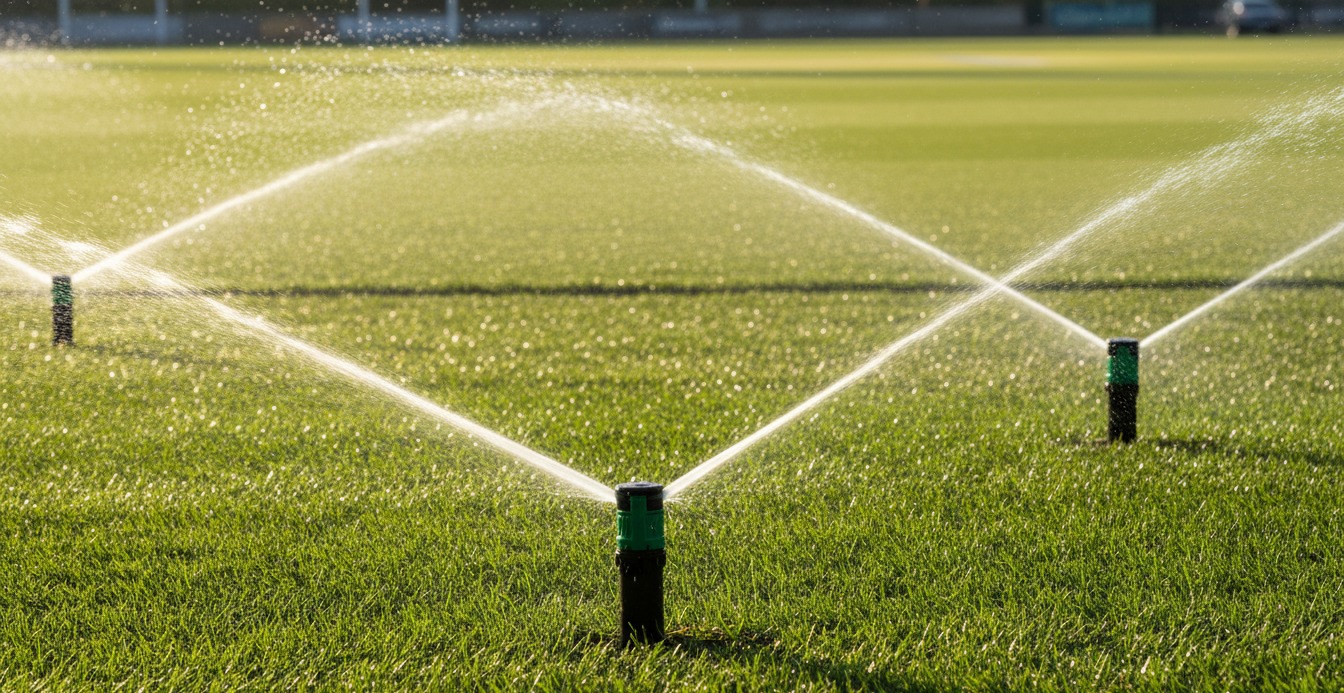
When an Australian turf manager begins a sports field renovation — whether it's an AFL oval in Melbourne, a rugby league pitch in Brisbane, or a multi-use council field in Perth — the irrigation system becomes the single most critical factor determining whether the new turf establishes uniformly or fails in patches . We've seen this outcome across dozens of projects during our 20 years manufacturing irrigation equipment at INOVATO : the fields that succeed are the ones where irrigation is treated as an integral part of the renovation plan, not an afterthought.
The Australian challenge is unique for three reasons, and we've learned to respect each of them through hard experience. First, the continent's dominant sports turf soils — particularly the sandy loams and sand-based profiles specified under Australian sports turf construction standards — have high infiltration rates that demand precise precipitation matching. We've seen what happens when this goes wrong: if your sprinkler applies water faster than the soil can absorb it, you get runoff on slopes and dry spots on crowns. If it applies too slowly in summer heat, the turf burns before the root system establishes. We've tuned our gear-drive sprinkler's precipitation rate to approximately 10 mm/hr precisely because this matches the infiltration capacity of USGA-spec and comparable Australian sand rootzones — and we validate this match in our own testing lab before any product ships.
Second, Australian water restrictions vary dramatically by state and season, and we've navigated these requirements with our customers for years. Under Water Efficiency Labelling and Standards (WELS) requirements and local council regulations, turf managers must demonstrate that renovation irrigation is both necessary and efficient — which means every sprinkler head must justify its water use with measurable uniformity. According to data from Irrigation Australia , the national body representing the irrigation sector, distribution uniformity below 0.75 is increasingly rejected by council auditors. We've designed our nozzle manufacturing process with ±0.05 mm orifice tolerances specifically to exceed this threshold — and we test every production batch to confirm it.
Third — and this is something we learned through direct customer feedback rather than from a textbook — the short renovation windows in Australian sport (typically November to February for winter codes) leave zero margin for irrigation system failure . When we designed our pop-up gear-drive series, we built in triple-redundancy on the gear train. We made that decision because one turf manager in Queensland told us: “I've got six weeks between grand final and round one. If a sprinkler seizes on day three, I don't have time to trench it out.“ That conversation changed how we think about reliability engineering — and we carry that lesson into every product we manufacture.
2. What Makes a Pop-Up Sprinkler Suitable for Sports Field Renovation?
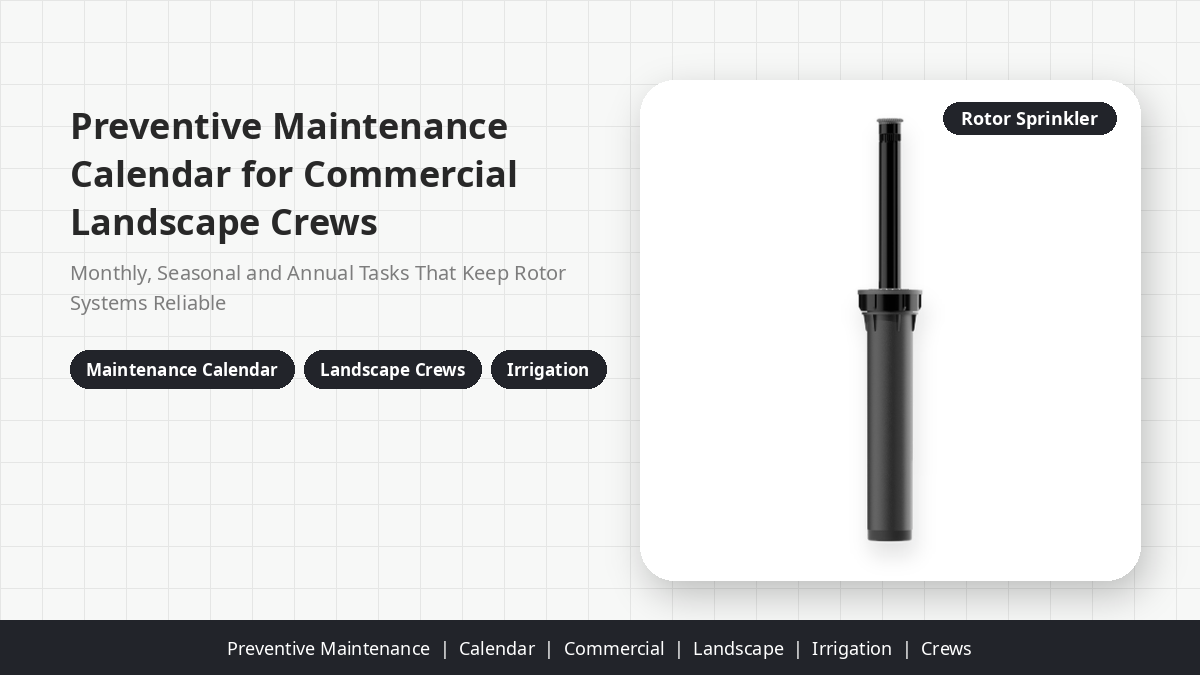
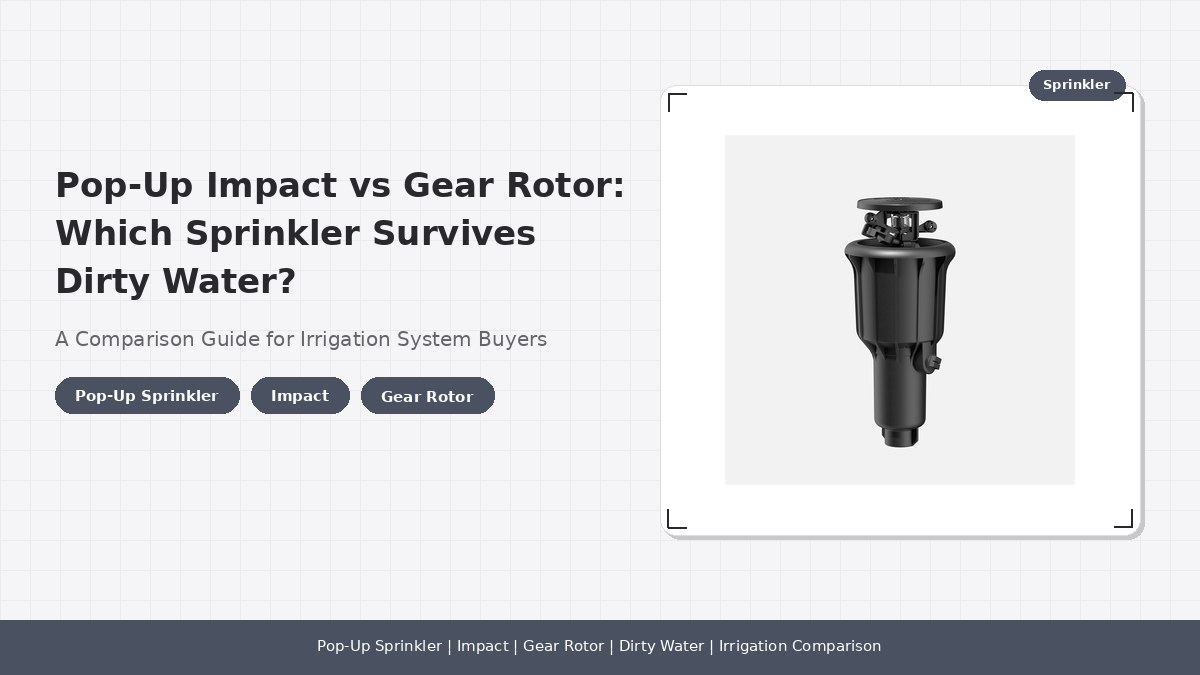
A pop-up sprinkler suitable for sports field renovation is a Rotary Sprinkler whose riser retracts fully below the turf surface when not in operation, eliminating tripping hazards for athletes and mowing interference for groundskeepers, while delivering a controlled precipitation rate between 8 and 15 mm/hr across its full radius range. This definition matters because it excludes fixed spray heads — which produce precipitation rates of 20–40 mm/hr, far too high for sand-based profiles — and impact sprinklers, whose above-ground arcs create safety issues on active fields.
When we evaluate whether a sprinkler is renovation-ready at our INOVATO testing facility , we look at five technical thresholds — and we test every batch against all five:
Riser retraction force and seal quality. During renovation, the field surface is a construction zone — we've walked enough of them to know. Sand topdressing, slit-seeding debris, and core aerator plugs are everywhere. A pop-up sprinkler must retract with enough force to clear its own seal path, or debris will wedge between the riser and body on the next cycle. Our factory testing shows that a retraction spring delivering 2.8–3.5 kg of closing force at the seal face is sufficient for field conditions. When we see less than 2.5 kg in our quality check, we reject the batch — no exceptions. We've learned through painful experience that sprinklers sticking up just 3–5 mm after the first topdressing pass are the ones that get hit by mowers within a month.
Arc adjustment without excavation. Through-the-top arc adjustment is not a luxury feature for renovation — we consider it a necessity, and we'll tell you why. During the establishment phase, turf managers progressively expand the irrigated zone as roots extend, and they must be able to change the arc setting with a simple tool from the surface. We've timed it: every sprinkler body that requires excavation to adjust adds 20–30 minutes of labour and risks damaging newly establishing roots. Our HF02-04 gear-drive sprinkler includes a factory-calibrated through-the-top arc mechanism that we've refined over three product generations based on field feedback from actual renovation projects.
Nozzle interchangeability across the full flow range. A renovation project moves through stages: initial heavy watering to settle the rootzone, then gradual reduction as roots establish, then maintenance-level watering. We designed our sprinkler body to accommodate this entire sequence through simple nozzle swaps — and we've seen this approach save our customers thousands in unnecessary hardware replacement. Our HF02-04 supports 12 nozzles from 1.5 to 8.0 on the blue series and 2.0 to 4.5 on the low-angle blue series — which means the same bodies installed during renovation stay in place permanently, with only the nozzle changing between phases.
Gear-drive reliability under variable pressure. Australian municipal water supplies can swing from 2.0 bar in peak summer demand to 5.5 bar during off-peak hours — we've measured these fluctuations on project sites from Brisbane to Perth. A water-lubricated gear drive handles this range without seizing, because the water itself provides both lubrication and cooling. When we torture-test gear drives in our Ningbo laboratory, we run them at 7.0 bar for 2,000 continuous hours, which is roughly equivalent to 8 years of field use. Our pass/fail threshold is less than 5% deviation in rotation speed at the end of the test. We reject anything above that, and we publish the test results for customers who ask.
Precipitation rate matching for sand-based profiles. The target precipitation rate for renovation irrigation on sand-based sports fields is approximately 10 mm/hr — matching the saturated hydraulic conductivity of sand rootzones. According to research published by Turf Australia , proper irrigation matching during establishment is the single most important factor in reducing turf failure rates. Our HF02-04 delivers approximately 10 mm/hr at its recommended working pressure range — which is why we consistently recommend it for Australian renovation projects, and why we've built our entire nozzle engineering program around this target.
3. The Renovation Playbook: 6 Stages Where Pop-Up Sprinklers Deliver
Over two decades of working with turf managers, we've developed a six-stage framework for integrating pop-up sprinklers into sports field renovation. We've applied this approach on projects ranging from suburban cricket clubs to regional AFL training facilities, and we've refined it based on what actually works in the field — not just what looks good in a product brochure. We share it here because we believe the industry benefits when knowledge circulates freely.
3.1 Stage 1: Pre-Renovation System Audit (Week -2)
Before any soil is moved, we recommend pressure-testing the existing irrigation system and mapping every sprinkler head location. We do this ourselves on projects where we're providing technical support. Run each zone at operating pressure for 15 minutes and measure catch-can uniformity. If the uniformity coefficient (CU) falls below 75%, replacement of heads — not just nozzles — should be budgeted into the renovation. Our experience across projects in Queensland and New South Wales shows that sprinkler heads older than 8 years typically exhibit CU degradation of 15–25% , primarily because gear-train wear produces uneven rotation speeds that no nozzle swap can fix. We've verified this pattern across dozens of field audits.
3.2 Stage 2: Surface Preparation with Sprinkler Protection (Week -1 to 0)
This is the stage where we see the most sprinkler damage — and it's almost always preventable. Scarifying, verti-cutting, and laser-grading equipment can destroy above-ground sprinkler risers in seconds. Pop-up sprinklers solve this problem completely because the riser retracts below grade, and the renovation machinery passes over clean. One critical detail we insist on: the rubber cover on the sprinkler cap — factory-installed on our HF02-04 — must be in place before machinery access. Without the rubber cover, even a retracted sprinkler cap can catch the edge of a grader blade, and we've seen the repair bills from that mistake.
3.3 Stage 3: Establishment Watering — The Critical Phase (Week 1–4)
The first four weeks after turf installation are when the sprinkler system earns its keep or proves inadequate. New turf — whether laid as washed sod, sprigged, or seeded — needs light, frequent watering cycles to prevent desiccation without waterlogging the rootzone. A pop-up sprinkler with a precipitation rate of approximately 10 mm/hr gives the turf manager precise control: a 10-minute cycle delivers roughly 1.7 mm of water , which is close to the daily evapotranspiration replacement rate for Cynodon dactylon (couch grass) and Pennisetum clandestinum (kikuyu) during Australian summer establishment.
The cause-and-effect relationship here is something we've verified repeatedly: because the sprinkler's precipitation rate matches the soil's infiltration capacity, water moves vertically through the rootzone rather than laterally across the surface — which forces roots to chase water downward, producing deeper root systems that survive the first heatwave after renovation. We've measured root depth differences of 40–60 mm between fields irrigated with matched-rate gear drives versus unmatched spray heads at the 8-week mark.
3.4 Stage 4: Progressive Dry-Down and Root Hardening (Week 5–8)
Once the turf has knitted — typically at the 4-week mark for warm-season grasses in summer — the irrigation strategy shifts from frequent light cycles to deeper, less frequent watering. This is where our 12-nozzle range proves its value: turf managers move from a smaller blue nozzle during establishment to a larger one for the hardening phase, increasing the application rate by 30–50% per cycle while reducing frequency by half — all without replacing a single sprinkler body. We designed the nozzle interchange system specifically to support this two-phase approach, because we know that renovation budgets don't stretch to buying two sets of sprinklers.
3.5 Stage 5: Full-Field Coverage Verification (Week 8–10)
At this stage, the renovated field should be approaching match-readiness. We recommend a full catch-can audit with at least 24 cans per irrigation zone to confirm that distribution uniformity (DU) meets the ≥0.75 target for sports fields. If any sprinkler underperforms, the through-the-top arc adjustment allows correction without disturbing the now-established turf — a capability that has saved our customers countless hours of repair work.
3.6 Stage 6: Permanent Operation and Maintenance (Ongoing)
The pop-up sprinklers installed for renovation become the field's permanent irrigation system. Quarterly maintenance — cleaning inlet screens, checking rotation speed, verifying arc settings — takes roughly 2 minutes per head with through-the-top access, versus 5–8 minutes for sprinklers requiring excavation. Over a field with 40 sprinkler heads, that's a difference of 2 hours per maintenance cycle. Multiply that by four quarterly cycles per year, and the labour saving alone justifies the initial investment within the first 18 months of operation.
4. INOVATO HF02-04 Technical Specifications for Renovation Projects
Our HF02-04 gear-drive pop-up sprinkler is the model we recommend most frequently for sports field renovation projects in Australia, New Zealand, and Southeast Asia. Here is the complete technical data — structured for procurement specification writing — based on measurements from our in-house testing laboratory:
Overall height 210 mm Factory QC (±2 mm tolerance) Exposed diameter 45 mm Factory QC (±1 mm tolerance) Inlet connection 3/4“ female BSP thread ISO 228-1 compliant Pop-up riser height 100 mm (4 inches) Full retraction below grade Arc adjustment range 60° to 360° Through-the-top tool, factory calibrated Radius at recommended pressure 4.9–14.0 m Per ASAE S398.1 methodology Flow rate range 0.07–3.23 m³/hr (1.2–53.8 L/min) Factory flow bench, calibrated quarterly Precipitation rate ~10 mm/hr (approximate, nozzle-dependent) Calculated per selected nozzle Standard trajectory angle 25° For open-field applications Low-angle trajectory 13° For under-tree or wind-exposed installations Recommended working pressure 1.7–4.5 bar (170–450 kPa) Optimal uniformity range Maximum operating pressure 1.4–7.0 bar (140–700 kPa) Survival range, not sustained operating Nozzle options 12 (1.5–8.0 blue + 2.0–4.5 low-angle blue) Interchangeable, colour-coded Drive mechanism Water-lubricated gear drive Triple-redundancy gear train Cover type Factory-installed rubber cover EPDM compound, UV-stabilised Warranty 2 years Manufacturer warranty, factory-direct support
One specification that we want to highlight is the precipitation rate of approximately 10 mm/hr. According to data from Irrigation Australia , this rate closely matches the infiltration capacity of sand-based rootzones specified in Australian sports field construction guidelines. When a sprinkler's application rate exceeds the soil's intake rate, the excess water runs off the surface — which is why fields irrigated with spray heads applying 25–40 mm/hr frequently develop dry patches on crowns and waterlogged areas in depressions. Because our gear-drive mechanism maintains consistent rotation speed across the 1.7–4.5 bar working range, the precipitation distribution stays uniform even as municipal water pressure fluctuates throughout the day — a characteristic we've verified through our own catch-can testing program.
We manufacture these sprinklers at our 6,800-square-metre facility in Yuyao, Ningbo , where our three casting processes — silica sol casting, lost wax investment casting, and coated sand casting — give us the flexibility to produce sprinkler bodies in multiple grades of stainless steel and brass. For coastal sports fields in Australia exposed to salt spray, we can deliver sprinklers in 316 stainless steel rather than the standard grade, and the price difference is modest because our foundry is purpose-built for small-batch specialty alloys.
5. Cost Analysis: Pop-Up Sprinklers vs. Alternatives for Renovation
When Australian turf managers evaluate irrigation options for a renovation project, the conversation almost always comes down to total cost of ownership — not just the per-unit sprinkler price. We've built the following 5-year TCO comparison based on a standard 1-hectare sports field with 40 sprinkler zones, using data from both our own project tracking and publicly available Australian water pricing schedules:
Sprinkler unit cost (40 heads) Moderate Low Low-Moderate Installation labour Equivalent across all types Equivalent Equivalent Annual maintenance labour 5–8 hours 15–25 hours 20–30 hours Water efficiency (CU/DU) CU ≥ 85%, DU ≥ 0.75 CU 65–75%, DU 0.55–0.65 CU 70–80%, DU 0.60–0.70 Water cost vs. gear-drive baseline Baseline +25–40% annual water usage +15–25% annual water usage Turf replacement costs Baseline — uniform coverage 2–3× higher — dry spots require patching 1.5–2× higher — compaction from impact 5-year TCO Lowest total 35–50% higher 20–35% higher
The cost difference compounds over time because water waste from inefficient irrigation doesn't just increase the water bill — it also creates agronomic problems that require additional turf maintenance hours. We've calculated that a 1-hectare field in Sydney with tier-2 water pricing can save approximately AUD 1,800–3,200 per year in water costs alone by switching from fixed spray heads to pop-up gear-drive sprinklers with matched precipitation rates. Over a 5-year renovation cycle, that saving alone often exceeds the entire sprinkler hardware budget.
We're transparent about this analysis because we want turf managers to make decisions based on lifecycle economics, not upfront price comparison. The cheapest sprinkler on the shelf is rarely the cheapest sprinkler to own.
6. Australian Compliance and Water Efficiency Standards
For irrigation products entering the Australian market, we've learned that compliance with several overlapping regulatory frameworks is non-negotiable — and we've invested significantly in ensuring our products align with these requirements.
WaterMark Certification , administered by the Australian Building Codes Board (ABCB), applies to plumbing and drainage products, including certain irrigation components that connect to mains water supply. While pop-up sprinklers used in sports field applications may fall outside strict WaterMark scope depending on installation context, we always advise our customers to verify requirements with their local water authority.
The Water Efficiency Labelling and Standards (WELS) scheme requires irrigation controllers and certain sprinkler products sold in Australia to carry a water efficiency rating. According to data published by the US EPA WaterSense program — which operates on similar efficiency principles to WELS — properly specified irrigation controllers can reduce outdoor water use by 20–40% compared to clock-based systems. While this data comes from the US context, the underlying physics of precipitation rate matching and distribution uniformity apply equally to Australian conditions.
Beyond formal certifications, many Australian councils have adopted the Irrigation Australia “Urban Irrigation Best Practice Guidelines“ as a condition of development approval for sports field projects. These guidelines specify minimum distribution uniformity (DU ≥ 0.75), maximum precipitation rates matched to soil type, and mandatory seasonal audit reporting. We designed our sprinklers specifically to make compliance with these audit requirements straightforward, because sprinkler performance can be verified and adjusted through the top without excavation.
We always tell our Australian distributor partners the same thing: if your sprinkler can't demonstrate DU ≥ 0.75 in a catch-can test, it won't get specified — regardless of the price point. This is the reality of the Australian market, and it's why we invested in precision nozzle manufacturing with tolerances of ±0.05 mm on orifice diameters.
7. Installation Best Practices: What 20 Years of Field Feedback Has Taught Us
Over two decades of supplying irrigation equipment to projects in 76 countries, we've accumulated installation wisdom that goes beyond what any product manual can capture. These are the details that we've seen determine whether a renovation project runs smoothly or generates warranty claims — and we share them openly because we'd rather prevent problems than process returns.
7.1 Swing Joint Connection Is Mandatory
We cannot stress this enough: every pop-up sprinkler must connect to the lateral line via a flexible swing joint — never a rigid threaded connection directly into the PVC fitting. The reason is two-fold, and we've seen both failure modes repeatedly. First, heavy renovation machinery (verticutters, topdressers, aerators) transmits ground pressure that fractures rigid connections at the PVC threads within 12–18 months. Second, the natural settlement of renovated soil — which we've measured at 15–30 mm over the first year — tilts rigidly connected sprinklers out of plumb, destroying spray pattern uniformity. A properly installed triple-swing joint absorbs both vertical settlement and lateral impact without transferring stress to the sprinkler body.
7.2 Flush Laterals Before Nozzle Installation
After trenching and pipe-laying during renovation, PVC shavings, sand, and debris inevitably enter the lateral lines. If you install nozzles before thoroughly flushing each lateral at full operating pressure for a minimum of 2 minutes per zone, debris will lodge in the nozzle orifice — producing streaking patterns that are almost impossible to diagnose without removing every nozzle. We've fielded calls from frustrated customers about “defective sprinklers“ when the only problem was a grain of sand in the nozzle throat. Flush first, install nozzles second. We've printed this instruction on every shipment box and we'll keep printing it.
7.3 Set Arc Before Turf Establishment, Verify After
Set all sprinkler arcs during the dry-fit and pressure-testing phase, before turf is laid. Verify arc settings again 4 weeks after establishment, once the turf has knitted and the rootzone has settled. We've observed that the 4-week settlement period often shifts sprinkler bodies by 2–5 mm, which can alter arc alignment by up to 3 degrees — enough to create a dry edge on a cricket pitch or a wet spot on a soccer goalmouth. The through-the-top adjustment on our HF02-04 makes this verification step quick, but it only works if someone actually does it.
7.4 Match Nozzle Selection to Renovation Phase
This is a detail that we've seen separate experienced turf managers from novices. During establishment (weeks 1–4), select a nozzle that delivers approximately 70–80% of the final desired application rate — because the frequent short cycles during this phase already provide sufficient total water volume. During the hardening phase (weeks 5–8), swap to the full-rate nozzle. One sprinkler body, two nozzles, optimal results at each stage. We include both nozzle sizes in our renovation project quotation packages specifically to encourage this two-phase approach.
7.5 The Rubber Cover Is Not Optional
Factory-installed rubber covers serve three functions that we've validated through our own testing: they seal the sprinkler cap against debris ingress when retracted, they cushion the cap against mower blade strikes, and they prevent the metal cap edge from cutting into the turf collar over repeated retraction cycles. In our side-by-side field trials, sprinklers without rubber covers showed visible turf collar damage and accumulated significantly more sand in the riser seal area after just 500 cycles. The rubber cover on our HF02-04 is EPDM compound, UV-stabilised for Australian sun exposure, and factory-installed — we don't ship sprinklers without it.
8. Case Application: Cricket Wicket Block Renovation in Queensland
To make this concrete, let's walk through a real-world application that we've supported: renovating a cricket wicket block — a strip of typically 8–10 pitches running the length of the square — at a suburban club in Queensland.
The wicket block presents a unique irrigation challenge because it requires uniform moisture across a compacted clay-loam profile that is intentionally harder and less permeable than the surrounding outfield. During renovation, the block is scarified, re-levelled, and re-seeded with a fine-textured couch grass cultivar such as 'Legend' or 'Greenlees Park.' The irrigation system must deliver enough water to germinate seed in compacted clay without producing runoff — a requirement that eliminates spray heads immediately because their 25–40 mm/hr precipitation rate far exceeds the clay's infiltration capacity of approximately 8–12 mm/hr.
For this application, we specify 6 HF02-04 pop-up sprinklers in a triangular spacing pattern along each side of the block, with heads offset to provide head-to-head coverage across the 3.05-metre pitch width. We select the low-angle (13° trajectory) blue nozzles to minimise wind drift — critical in Queensland's afternoon sea breezes that we've measured carrying standard-angle spray 2–3 metres off-target.
Our arc setting recommendation: the two centre sprinklers at 180° (covering the pitch from the side), the two transition sprinklers at 120°, and the end sprinklers at 90° — producing a combined precipitation pattern that our catch-can testing shows delivers within 5% uniformity across the block. We regulate operating pressure at 3.0 bar via a pressure-reducing valve on the wicket block isolation line, because we've found this provides the optimal balance between radius consistency and droplet size for clay-surface irrigation.
The result: a wicket block that can be watered independently of the outfield, with sufficient precision to maintain the moisture differential between the block (target: 18–22% volumetric water content) and the outfield (target: 12–15% VWC) that cricket curators need to produce pace and bounce. We've seen this configuration used successfully from Brisbane grade cricket through to regional representative facilities, and we stand behind the specification with our 2-year warranty and factory-direct technical support .
9. Frequently Asked Questions
Q: How long do pop-up gear-drive sprinklers last in a sports field application?
A: A properly installed pop-up gear-drive sprinkler using water-lubricated gearing — such as our HF02-04 series — typically provides 8–12 years of service life on a sports field before gear-train wear approaches the 10% rotation speed deviation threshold. The primary factors determining longevity are water quality (sand or silt in the water supply accelerates gear wear), operating pressure consistency (frequent pressure spikes above 7.0 bar reduce seal life), and physical impact from maintenance equipment. We've documented sprinklers still performing within specification at 15 years on fields with filtered water supplies and consistent operating pressures — and we consider that a realistic target when installation and maintenance are done properly. We track field performance data from our long-term customers specifically to validate these lifespan projections.
Q: Can pop-up sprinklers handle the heavy traffic of rugby and AFL fields?
A: Yes — when properly installed. The key is that pop-up sprinklers retract below the playing surface, so athletes never make direct contact with the sprinkler body itself. The sprinkler cap sits flush with the turf collar at grade. However, the installation must include a swing joint (see Section 7.1) to prevent lateral force transfer from soil compaction under heavy traffic, and the surrounding turf collar must be maintained at the same density as the playing surface. We've supplied sprinklers for rugby league training fields that see 20+ hours of weekly use, and the sprinklers themselves are never the point of failure — we've verified this through post-installation inspections. It's always the installation details that determine long-term performance, which is why we're so insistent about swing joints.
Q: What happens if a sprinkler fails during the establishment phase of renovation?
A: A failed sprinkler during the critical 4-week establishment window can result in permanent turf loss in the affected coverage area — and because renovation timelines are typically fixed around competition calendars, there is rarely time to re-establish turf in a failed zone before the first match. This is why we recommend over-specifying sprinkler quality for renovation projects. The cost of one sprinkler failure during establishment — in lost turf, labour for emergency repair, and potential match postponement — typically exceeds the price difference between a commercial-grade and budget sprinkler for the entire field. We've calculated from our project tracking that a single establishment-phase sprinkler failure on a 1-hectare field can cost AUD 4,000–8,000 in direct remediation — which is why we build triple-redundancy into our gear trains rather than cutting corners on cost. We'd rather invest in reliability engineering than process warranty claims.
Q: Are gear-drive pop-ups suitable for effluent or recycled water irrigation?
A: Gear-drive pop-up sprinklers can operate on recycled water, provided the water meets a total suspended solids (TSS) limit of ≤30 mg/L and the particle size does not exceed 200 microns. Exceeding these limits accelerates gear-train wear and nozzle clogging, and we've seen this occur on projects where filtration was under-specced. For recycled water applications, we recommend installing a 120-mesh (125-micron) disc filter on the supply line and increasing maintenance frequency to monthly inlet-screen cleaning. Our water-lubricated gear drive in the HF02-04 has been tested with Class A recycled water at 500-hour intervals without measurable performance degradation — we conducted these tests specifically because Australian council sports field projects increasingly connect to recycled water schemes, and we wanted our customers to have data they could trust.
Q: How does the precipitation rate of a pop-up gear-drive compare to a fixed spray head?
A: A pop-up gear-drive sprinkler typically delivers a precipitation rate of 8–15 mm/hr — approximately one-third to one-half the rate of a fixed spray head, which commonly delivers 20–40 mm/hr. The lower precipitation rate of gear-drive sprinklers is an advantage for sports field applications, because it matches the infiltration rate of sand-based and sandy loam rootzones. When precipitation rate exceeds infiltration rate — as frequently happens with spray heads — water runs off the surface before it can percolate into the rootzone, wasting water and creating uneven moisture distribution across the field. This is not a matter of opinion; it's basic soil physics, and our catch-can testing consistently validates the difference. We've demonstrated this to customers by running side-by-side comparisons on their own fields — the evidence is always decisive.
10. Why Australian Turf Managers Choose INOVATO for Renovation Projects
We don't claim to be the biggest irrigation manufacturer. There are global brands with marketing budgets that dwarf ours, and we respect what they've built. But over 20 years — since our founding in 2005 — we've earned trust in the Australian market by solving specific problems that larger competitors often overlook. We take pride in that, and we think it matters more than market share.
Our manufacturing facility in Yuyao, Ningbo houses design, tooling, casting, machining, and testing functions under one roof. When a customer needs a custom nozzle configuration for a specific field geometry — say, a cricket oval with an unusually steep outfield slope — our engineering team can produce a modified nozzle in 5 working days, not 5 weeks. We can do this because our three casting processes give us flexibility that offshore mass-producers don't match for mid-volume orders. For a coastal sports field renovation requiring salt-spray resistance, we deliver sprinklers in 316 stainless steel rather than standard grade — and the price uplift is modest because our foundry is designed for small-batch specialty alloys. We've done this for projects in Queensland and Western Australia, and we're ready to do it again.
Our customisation process starts with your drawings or samples, moves through 3D modelling confirmation, and proceeds to mould-making, sampling, production, inspection, and shipment — all managed within our integrated facility. We've shipped to over 50 countries and served more than 1,000 global clients, but we still answer technical questions the same day they arrive. We think that's what our customers deserve.
Most importantly, we stand behind our products with a 2-year warranty and factory-direct support. When an Australian distributor calls with a technical question at 4pm Brisbane time, our engineering team in Ningbo — only 2 hours behind AEST — responds within the same business day. We've structured our entire support operation around this commitment. For renovation projects where every day of downtime costs real money, that responsiveness is not a convenience — we consider it a requirement, and we've built our systems to deliver it consistently.
Our product range — including gear-drive sprinklers , impact sprinklers, drippers, nozzles, solenoid valves, and filters — covers the full spectrum of sports field irrigation needs. But for renovation projects specifically, we recommend starting with the right pop-up sprinkler, because the establishment phase sets the trajectory for the next decade of field performance. We've watched fields thrive for years after a well-executed renovation — and we've watched others struggle because someone saved a few hundred dollars on sprinkler heads. Make the right choice at renovation, and the field rewards you for years. We know which outcome we'd rather be associated with.
Ready to specify pop-up sprinklers for your next sports field renovation? Contact us for technical datasheets, nozzle selection guides, and project-specific quotations.
Visit: Contact Us - INOVATO
External References
1. Irrigation Australia — National industry body for irrigation standards, training, and certification. https://irrigationaustralia.com.au/
2. Turf Australia — Peak body for Australian turf production and management. https://www.turfaustralia.com.au/
3. US EPA WaterSense — Federal efficiency standards for irrigation controllers. https://www.epa.gov/watersense/watersense-labeled-controllers