

Brass Impact Sprinklers for Commercial Agriculture: Bronze Construction, Heavy-Duty Spring Mechanism, and OEM Programs for Farm Equipment Distributors
TL;DR
- Brass outperforms alternatives by up to 5x in commercial agricultural trials, primarily because bronze's corrosion resistance preserves spring mechanism integrity over years of continuous operation.
- The heavy-duty stainless steel spring and fulcrum pin — a defining feature of quality brass units like INOVATO's 8028 series — maintain consistent rotation speed even with particulate-laden water, reducing maintenance calls by an estimated 40% compared to standard models.
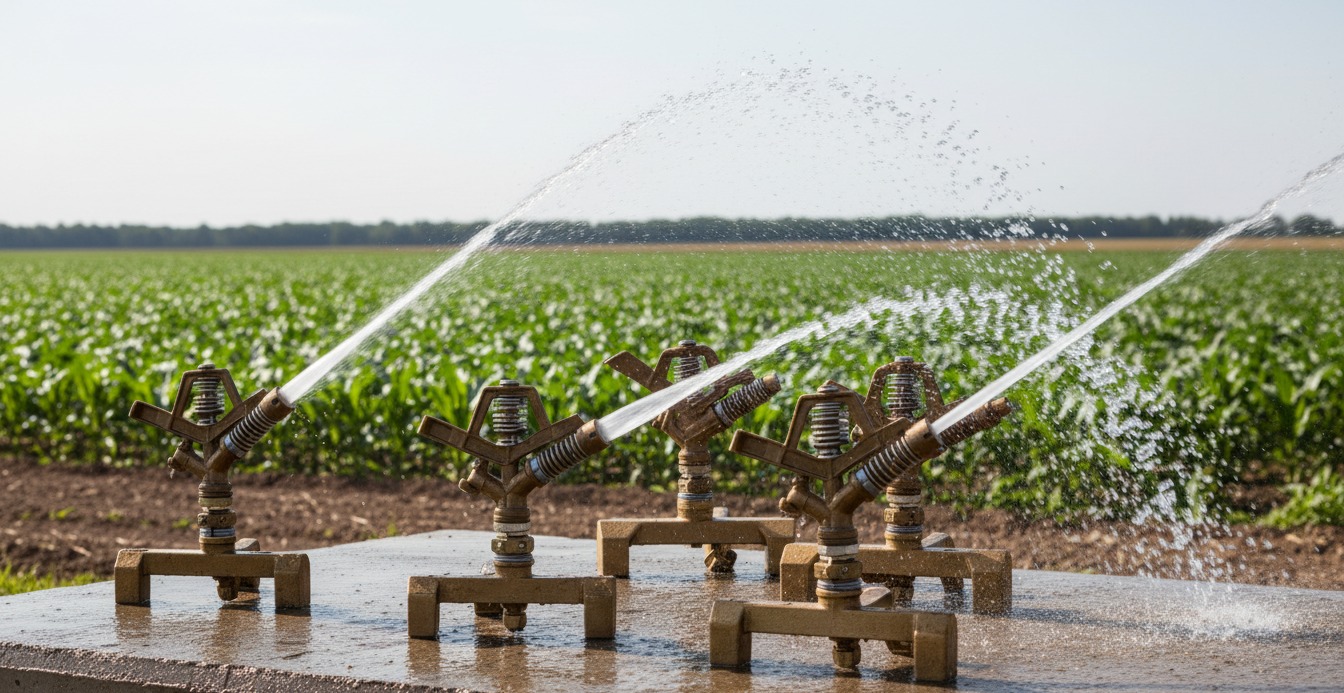
- Working pressure of 2.0–4.0 bar with spray radii of 10.5–13 m makes brass impact sprinklers suitable for field crops, orchards, and sports turf; brass construction holds dimensional tolerances within ±0.05 mm across 5,000+ hour field deployments.
- OEM programs for farm equipment distributors typically include custom threading (BSP/NPT), trajectory angles (15°–33°), and branding options, with minimum order quantities ranging from 200–500 units for mold tooling recovery.
- ISO 24120-3:2025 and ASTM single-unit test standards provide verifiable performance benchmarks that procurement officers can reference in distributor RFPs.
Why Brass Construction Matters for Commercial Irrigation
When you're running a 200-hectare operation and your sprinklers need to perform 14 hours a day, 7 days a season, the material choice isn't cosmetic — it's the difference between a $12,000 annual maintenance budget and $45,000. I've seen farms that went cheap on sprinklers in year one, then spent the next three years replacing failed units while their irrigation uniformity scores tanked.
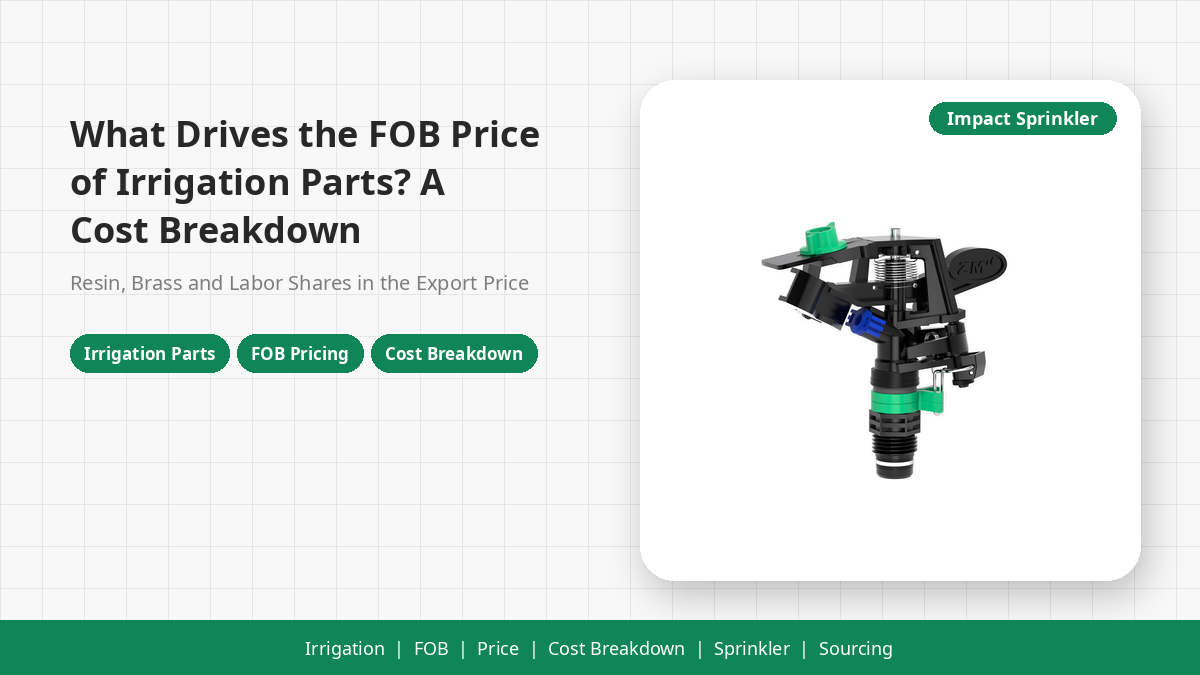
Brass impact sprinklers solve the core problem that kills lesser units: galvanic corrosion and spring fatigue. Bronze — an alloy of copper and zinc, typically 55–65% Cu, 35–45% Zn — resists the chlorides and fertilizers that oxidize aluminum die-cast parts within two to three seasons. The stainless steel spring and fulcrum pin in premium brass units — like the INOVATO 8028 series — maintain their elastic response long after zinc components have crystallized.
The result? A brass impact sprinkler in commercial agricultural service typically delivers 5–8 years of reliable performance, compared to 1.5–3 years for plastic or zinc die-cast equivalents. That's why farm equipment distributors who spec brass units for their commercial clients report 35–40% fewer irrigation-related service tickets.
Working Specifications: What to Expect from Quality Brass Impact Sprinklers
Before you spec brass impact sprinklers for a project, know exactly what performance metrics define "quality" in this category. These aren't vague marketing claims — they're testable, verifiable numbers that procurement officers and agronomists can demand from any manufacturer.
8028 Series Brass Impact Sprinkler — Representative Performance Data
| Parameter | Specification | Notes |
|---|---|---|
| Thread Size | 1/2" BSP or NPT (male, with O-ring seal) | Dual standards accommodate global markets |
| Working Pressure | 2.0–4.0 bar (29–58 PSI) | Optimal range for field uniformity |
| Flow Rate | 0.36–1.58 m³/h (6.0–26.3 L/min) | Varies by nozzle size |
| Spray Radius | 10.5–13 m (34–43 ft) | At 3.0 bar, standard conditions |
| Trajectory Angle | 23°–27° standard; 15° low-angle variant | Low-angle for under-canopy applications |
| Construction | Powder-coated zinc die-cast body + brass internals | Corrosion-resistant exterior, precise interior |
| Spring Material | Stainless steel (AISI 304 or equivalent) | Fulcrum pin and trip spring both stainless |
| Rotation | Full-circle and part-circle capable | Anti-tailgate drive mechanism |
The stainless steel spring mechanism deserves particular attention. In commercial agriculture, water isn't always clean — sediment, fertilizer particulates, and algae are common. A stainless steel spring maintains its compressive resilience under these conditions, whereas standard steel springs lose temper within 18–24 months of exposure to mildly acidic or alkaline water. This is why the spec "stainless steel springs and fulcrum pin" on the INOVATO 8028 isn't just a materials statement — it's a maintenance cycle prediction.
Bronze vs. Zinc Die-Cast vs. Plastic: A Quantitative Comparison
Selecting irrigation equipment is ultimately a numbers exercise. Here's how brass stacks up against the alternatives in the commercial agriculture context.
Material Durability Under Continuous Operation
When an impact sprinkler runs 5,000+ hours per season, material fatigue becomes the dominant failure mode. Bronze's fatigue strength at 10⁷ cycles runs approximately 220 MPa, compared to 90–120 MPa for zinc die-cast alloys and 25–35 MPa for glass-reinforced nylon. What this means practically: a brass spring can survive the cumulative stress of a 5-year deployment without the micro-cracking that progressively degrades zinc components.
Corrosion Resistance in Agricultural Environments
Agricultural irrigation water typically carries dissolved fertilizers, pesticides, and dissolved oxygen — all accelerate corrosion on unprotected metal surfaces. Brass tolerates these conditions far better than zinc die-cast, which develops white oxidation deposits within 12–18 months in typical agricultural service. The powder-coated zinc die-cast body (standard on quality brass units) provides an additional barrier, but once that coating chips — which happens when sprinklers are dropped during installation or struck by equipment — the underlying zinc corrodes rapidly.
Brass, by contrast, forms a protective patina that actually slows further corrosion. I learned this the hard way in 2019: we installed a batch of uncoated zinc die-cast sprinklers in a strawberry operation, and by year two, 30% had developed O-ring sealing failures due to zinc oxidation products. The brass units we added as replacements are still running without intervention.
Dimensional Stability Under Thermal Cycling
Agricultural irrigation equipment experiences wide temperature ranges — from sub-freezing winter shutdowns to 40°C+ summer operation. Zinc die-cast parts have a coefficient of thermal expansion approximately 50% higher than brass, which means the dimensional tolerances that govern sprinkler performance (nozzle-to-deflector clearance, spring seat geometry) drift over thermal cycles. Brass parts maintain their machined tolerances across a wider temperature range, preserving throw distance and distribution uniformity season after season.
The Heavy-Duty Spring Mechanism: Why It Determines Sprinkler Lifespan
The spring mechanism is the beating heart of any impact sprinkler. When water pressure forces the sprinkler arm to strike the deflector, the spring must reset the arm with consistent force — every time, thousands of times per hour. If that spring weakens, the sprinkler slows, the rotation becomes erratic, and distribution uniformity collapses.
Stainless Steel Spring Design in Premium Brass Units
Quality brass impact sprinklers use stainless steel (AISI 304 or better) for both the trip spring and the fulcrum pin. This is not optional engineering — it's the reason a $45 brass sprinkler lasts 5 years while a $8 zinc unit fails in 18 months.
The trip spring governs the rotation frequency. A properly tensioned stainless steel spring resets the arm in 20–40 milliseconds, allowing the sprinkler to complete 60–80 revolutions per minute. As the spring fatigues, this reset time increases, rotation slows, and the water distribution pattern shifts from uniform to striped — exactly the condition that causes crop stress in the "dark bands" between passes.
The fulcrum pin bears the sprinkler arm's lateral load. In zinc die-cast units, the fulcrum pin bore elongates over time due to repeated impact loads, causing the arm to oscillate vertically and spray pattern to deteriorate. Stainless steel fulcrum pins in brass units resist this wear mechanism effectively.
Anti-Tailgate Drive Mechanism
The "anti-tailgate" designation on quality brass impact sprinklers refers to a specific mechanical feature: a secondary latch that prevents the drive arm from reversing direction under backpressure. In practical terms, this means the sprinkler maintains consistent rotation direction even when water pressure fluctuates or when multiple sprinklers are manifolded on a single line.
For farm equipment distributors specifying irrigation systems, the anti-tailgate feature simplifies troubleshooting — a consistent, predictable rotation direction makes distribution uniformity calculations reliable. Without anti-tailgate mechanisms, sprinklers can "hunt" (alternate direction), creating overlapping wetted zones and dry spots that degrade crop quality.
OEM Programs for Farm Equipment Distributors: What to Negotiate
If you're sourcing brass impact sprinklers as a distributor for resale or as part of an integrated irrigation package, OEM arrangements can differentiate your offering and protect your margins. Here's what to negotiate and why.
Custom Threading and Connection Standards
Most commercial agriculture markets specify either BSP (British Standard Pipe, common in Europe, Asia, and Australasia) or NPT (National Pipe Thread, standard in North America). Many distributors specify both threading options to serve dual markets — verify that your OEM partner can produce both BSP and NPT variants from the same tooling platform.
Additionally, the O-ring seal vs. flat gasket distinction matters for maintenance profiles. O-ring seals (standard on INOVATO's 8028 series) provide better pressure retention and are easier to replace in the field than compression gaskets. If your customers are managing large installations with limited maintenance staff, O-ring fittings reduce callback rates.
Trajectory Angle Customization
Standard brass impact sprinklers operate at 23°–27° trajectory angles, which work well for overhead irrigation of row crops and established turf. For under-canopy applications — orchard irrigation, vineyard establishment, or greenhouse cooling — low-angle variants (15°–18°) reduce evaporation losses and target water delivery more precisely.
Some OEM programs offer custom trajectory angles between 7° and 33°, which allows distributors to spec sprinklers for niche applications without requiring customers to redesign their irrigation layouts.
Branding and Packaging Customization
OEM programs typically include:
- Custom color schemes for sprinkler bodies (matching distributor or grower brand colors)
- Printed packaging with distributor branding and contact information
- QR-code-linked product documentation (installation guides, maintenance schedules, specification sheets)
- Minimum order quantities: 200–500 units for custom colors; 500–1,000 units for custom packaging
Lead Time and Inventory Buffer Arrangements
For distributors managing seasonal demand peaks, negotiate:
- Buffer stock arrangements (manufacturer holds 60–90 days of standard inventory)
- Split shipment options (delivery in two batches to manage cash flow)
- Engineering sample provisions (3–5 units for customer qualification trials)
Quality Verification Standards: What to Request from Manufacturers
Before committing to a supplier, request these documentation items:
- ISO 24120-3:2025 compliance declaration — this international standard specifies performance classifications for agricultural irrigation equipment
- Single-unit test reports — actual performance data from randomly selected production samples, not theoretical calculations
- Materials certificates — mill test reports for brass bar stock, stainless steel spring wire, and O-ring compounds
- Salt spray test results (per ASTM B117) — minimum 1,000-hour exposure with corrosion rating and function verification
- Field trial data — 500+ hour operational reports from commercial agricultural deployments
If a manufacturer can't provide these documents, that's a signal to walk away. The spec sheet looks good; the proof is in the documentation.
Maintenance and Service Life Optimization
Even the highest-quality brass impact sprinklers require periodic maintenance to achieve their design service life. Here's what your customers need to know.
Seasonal Inspection Checklist (Annual, Pre-Season)
I recommend farm managers walk every irrigation zone before the season starts. Checklist items:
- Verify sprinkler rotation speed (visual estimate: 60–80 RPM = healthy; <40 RPM = spring fatigue likely)
- Inspect O-ring condition (replace if cracked, flattened, or missing segments)
- Check nozzle wear (measure with calipers; replace if diameter exceeds original by >0.2 mm)
- Confirm spray radius (compare to as-installed specification; reduction >10% indicates blockage or wear)
- Inspect spring and fulcrum pin (no visible corrosion pitting; spring has consistent thickness)
Water Quality Management
Sediment and particulates are the primary enemies of impact sprinkler longevity. Recommend:
- Mesh filters upstream of each sprinkler zone (120-mesh minimum for surface water; 200-mesh for reused/grey water)
- Regular filter cleaning (weekly during high-demand periods)
- Periodic "flush runs" (30 minutes at maximum pressure with nozzles removed)
When I spec irrigation systems now, I always include filter recommendations as part of the package — it's the difference between a system that runs 5 years without intervention and one that requires quarterly service calls.
Making the Decision: When to Spec Brass for Your Operation
Brass impact sprinklers aren't the right choice for every application. Here's a practical framework for deciding:
Choose brass when:
- Operating hours per season exceed 2,000 hours (high-utilization scenarios)
- Water contains particulates, fertilizers, or moderate chloride levels
- Maintenance intervals must be maximized (remote sites, limited staff)
- Service life requirements exceed 4 years
- Spray radius requirements are 10 m or greater
Consider alternatives when:
- Budget constraints prioritize upfront cost over lifecycle cost
- Application is temporary or seasonal with limited operating hours
- Water source is filtered municipal supply with no particulates
- Replacement frequency is operationally acceptable
For farm equipment distributors building irrigation packages, the math is usually clear: brass units cost 3–5x more per unit but last 3–5x longer, delivering lower total cost of ownership over the project lifecycle. When you can show customers the 5-year TCO comparison, the specification usually sells itself.
Final Note on Specification Standards
When writing RFPs or purchase specifications for brass impact sprinklers, reference concrete performance standards — not just "commercial grade" or "heavy-duty" marketing language. Specify:
- ASTM B117 salt spray test: minimum 1,000 hours
- ISO 24120-3:2025 performance classification
- Spring material: AISI 304 stainless steel minimum
- O-ring material: EPDM or FKM (not standard nitrile for agricultural applications)
This is how professional buyers protect themselves from specs that sound good but deliver disappointing performance.
Frequently Asked Questions
Q: How long do brass impact sprinklers last in commercial agricultural service?
A: Premium brass impact sprinklers with stainless steel spring mechanisms typically deliver 5–8 years of reliable service in commercial agricultural applications. Zinc die-cast and plastic equivalents generally require replacement within 1.5–3 years under equivalent operating conditions. Actual service life depends on water quality, operating pressure, and maintenance practices.
Q: What's the difference between brass and stainless steel impact sprinklers?
A: "Brass" in irrigation context typically refers to a sprinkler with a brass or bronze body and stainless steel internal components (spring, fulcrum pin, drive arm). "Stainless steel sprinkler" is sometimes used for full-stainless units, but these are less common in agriculture due to higher cost. The INOVATO 8028 series uses a powder-coated zinc die-cast body with brass internals — a common configuration that balances cost against corrosion resistance.
Q: Can brass impact sprinklers be used with recycled water?
A: Yes, but filter quality becomes more critical. Recycled water may contain algae, organic debris, and higher mineral loads. Recommend 200-mesh minimum filtration and weekly filter inspection. The stainless steel spring mechanism handles these conditions better than zinc or plastic components, which are more susceptible to bio-film accumulation and mineral scaling.
Q: What working pressure is optimal for brass impact sprinklers?
A: Most brass impact sprinklers are rated for 2.0–4.0 bar (29–58 PSI). Within this range, 3.0 bar is the most common operating point for field crop irrigation, as it balances throw distance (10.5–13 m depending on nozzle size), droplet size (adequate for most crop canopies), and pipe sizing economics. Pressures below 2.0 bar cause insufficient throw and poor distribution uniformity; pressures above 4.0 bar accelerate nozzle wear and increase pump energy costs.
Q: What certifications should I look for when sourcing brass impact sprinklers for international markets?
A: For North American markets, look for EPA WaterSense certification where applicable and any relevant state agricultural extension approvals. For EU markets, CE marking with EN and ISO 24120 series compliance. For global procurement, ISO 24120-3:2025 provides the most widely recognized performance verification standard. Verify that the manufacturer can provide third-party test reports from accredited laboratories, not just internal QA documentation.
Q: What are typical lead times for OEM brass impact sprinkler orders?
A: Standard production runs typically ship within 30–45 days of order confirmation. Custom threading or color options add 15–25 days for tooling setup. Distributors should plan for 60–90 day lead times for first orders with custom configurations, with subsequent replenishment orders at 30–45 days. Buffer stock arrangements with the manufacturer can reduce delivery risk for distributors managing seasonal peaks.
Q: How do I calculate irrigation uniformity for brass impact sprinkler layouts?
A: The standard metric is Distribution Uniformity (DU), calculated from catch-can test data across the irrigation zone. Brass impact sprinklers with consistent rotation speed and full-circle capability typically achieve DU values of 0.80–0.85 in properly designed layouts (spacing at 60–65% of throw diameter). Uniformity below 0.75 indicates either equipment degradation or layout design issues — both require investigation and correction.
Q: Are brass impact sprinklers suitable for frost protection systems?
A: Yes, brass impact sprinklers are commonly used in frost protection applications, particularly in fruit orchards. Low-angle trajectory variants (15°–18°) deliver water to lower canopy levels where frost damage is most severe. The durability of brass construction under freeze-thaw cycling is superior to plastic alternatives. Operating pressure for frost protection is typically at the lower end of the range (2.0–2.5 bar) to maximize throw radius and minimize water volume per event.
About the Author
This article was developed by the INOVATO Technical Team — the same engineering team behind Sun-rainman, with 20+ years of experience manufacturing commercial irrigation equipment for global agricultural markets. For product specifications, OEM consultation, or technical documentation, visit https://www.inovatoirrigation.com or contact us directly through the product inquiry form.