

Drip Line System Fittings: Barbed, Compression, and Lock-Nut Types — Pressure Ratings and Bulk Procurement for Landscape Distributors
Introduction: Why Fitting Quality Determines Your Irrigation System's Lifespan
Every irrigation system I've inspected that failed prematurely had the same root cause: its fittings. Not the pipes, not the valves — the fittings. These small, seemingly simple components bear the full pressure of water delivery, and when they fail, the entire system follows. For landscape distributors sourcing drip irrigation components, understanding the differences between barbed, compression, and lock-nut fittings isn't optional technical knowledge — it's the difference between a system that lasts 15 years and one that needs repair within two.
In this guide, I draw from over two decades of supplying irrigation equipment to distributors across North America, Europe, and the Middle East. We at INOVATO have cataloged the failure modes of thousands of fittings in commercial landscapes: parks, sports fields, agricultural operations, and residential complexes. What I've learned is that most buyers choose fittings based on price alone, and then wonder why their callback rate stays stubbornly high. The fittings you choose at procurement stage define your maintenance costs for the system's entire operational life.
Why Drip Line Fittings Are the Critical Link in Irrigation Systems
A drip irrigation system is only as reliable as its weakest connection point. Fittings are those connection points — they join pipe sections, redirect water flow, connect to emitters, and attach to mainlines. In a typical commercial installation, hundreds of fittings are deployed across a site. If even 2% fail within the first season, you're looking at dozens of callbacks, unhappy clients, and margins eroded by emergency service visits.
The stakes are higher in commercial landscapes. Municipal parks, sports complexes, and golf courses run continuously during growing seasons. When a fitting fails in a public park, it's not just water waste — it's a liability issue and a council agenda item. The procurement officer who selected substandard fittings to save 3% on material cost has just created weeks of negative publicity for their municipality.
What makes fittings so critical is their exposure to three simultaneous stressors: water pressure, UV radiation, and soil chemistry. A fitting sitting underground faces constant moisture, potential chemical attack from fertilizers or soil treatments, and mechanical stress from temperature cycling. An indoor fitting faces none of these. That's why every commercial drip system demands fittings rated for outdoor commercial use, not residential equivalents.
Barbed Fittings: Design, Applications, and Pressure Ratings
How Barbed Fittings Work and When to Specify Them
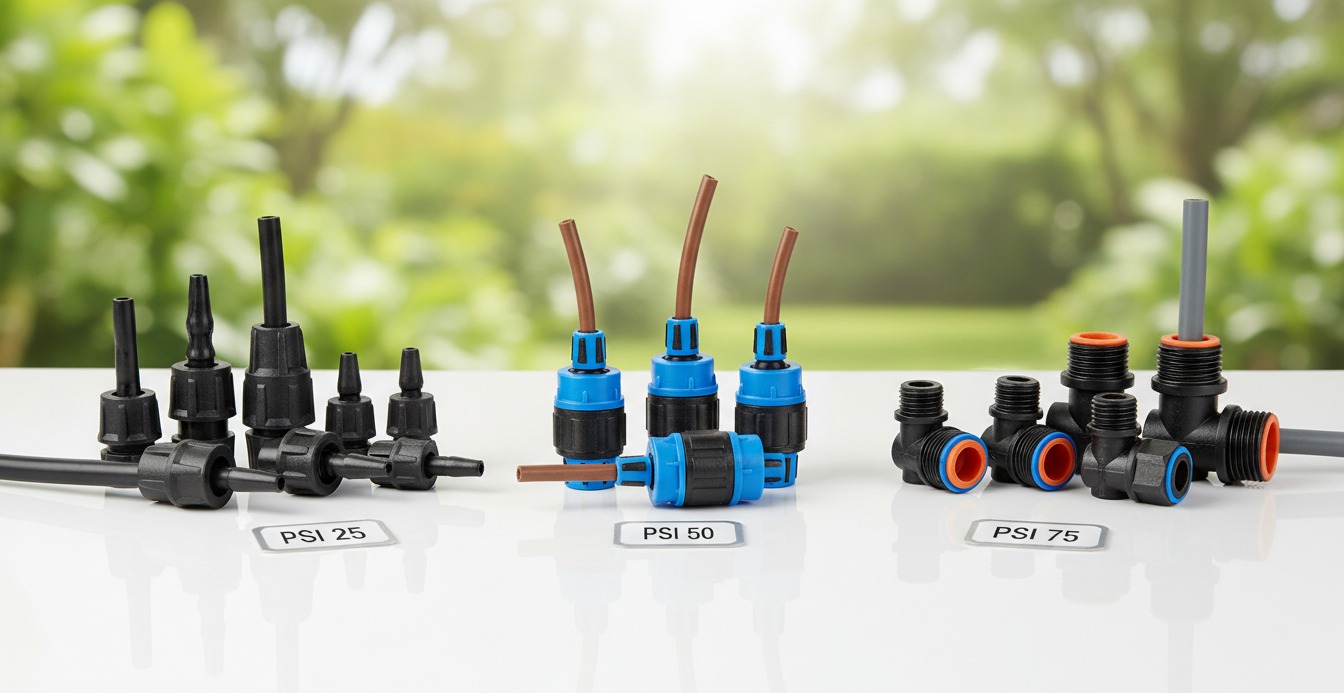
Barbed fittings achieve their seal through a deceptively simple mechanism: a barb — a raised ring on the fitting's body — that physically engages with the inner wall of the flexible tubing. When you push the tubing over the barb, the material of the tube stretches around the barb and creates a mechanical lock. The seal is formed by the tubing material pressing against the fitting body, and by any internal pressure in the system trying to push the tube off.
This design has served the irrigation industry for decades because it works reliably — when correctly installed. The critical word is "correctly." I've seen systems fail because a contractor used a dull knife to cut the tubing, leaving a beveled edge that didn't seat properly against the fitting's shoulder. I've seen failures because someone used a hair dryer to warm the tubing before installation (it thins the material), or because they didn't push the tubing fully home until it hit the fitting's stop collar.
The practical tube ID range for barbed fittings spans 4mm to 16mm, which covers the vast majority of drip tubing sizes used in landscape irrigation. Below 4mm ID, the barb geometry becomes mechanically impractical; above 16mm, the grip strength of standard barbed designs becomes insufficient for commercial pressure ratings.
Pressure Ratings: What the Numbers Actually Mean
Barbed fittings typically carry pressure ratings of PN10 (10 bar / 145 PSI) for standard models, with premium lines reaching PN16 (16 bar / 232 PSI). These ratings apply under controlled test conditions, which brings me to an important point I've made to every distributor I've trained: the rated pressure is not your design pressure. Your design pressure should be no more than 50% of the fitting's rated pressure, for safety margin and to account for pressure transients (water hammer), temperature extremes, and material aging.
What this means practically: if you're specifying fittings for a system that operates at 6 bar (87 PSI), you need fittings rated at minimum PN16 (16 bar). Never specify PN10 fittings at their full rated pressure in a commercial installation. The 10-20% cost saving from PN10 fittings isn't worth the catastrophic failure risk from pressure surges.
Temperature range for quality barbed fittings spans -20°C to +80°C, making them suitable for most outdoor environments globally. Below -20°C, polyethylene becomes brittle; above +80°C, material strength degrades significantly. In practice, geographic markets with freezing winters or extreme summers need to specify fittings for their actual environmental conditions, not just the system pressure.
Materials: PP vs. PE vs. PVC for Barbed Fittings
The three primary materials for barbed fittings — polypropylene (PP), polyethylene (PE), and polyvinyl chloride (PVC) — each have distinct performance profiles. Here's the honest comparison:
- Polypropylene (PP) offers the best balance of chemical resistance and mechanical strength for drip irrigation. It handles common fertilizers (urea, ammonium nitrate) without degradation and maintains flexibility across the standard temperature range. PP resists UV degradation when stabilized, though prolonged sun exposure without soil cover does reduce lifespan. Cost sits in the mid-range.
- Polyethylene (PE) is the budget option. It works well in cold conditions and resists impact damage, but has poorer chemical resistance — certain fertilizers and soil treatments cause environmental stress cracking (ESCR). PE barb fittings are fine for clean-water agricultural applications but I don't recommend them for landscape installations where fertilizers, pesticides, or soil amendments are routine — a concern documented by the International Commission on Irrigation and Drainage (ICID).
- PVC barbed fittings are rigid — they're designed for Schedule 40 or 80 rigid pipe, not soft-wall drip tubing. PVC's chemical resistance is generally good, but its lack of flexibility means poor seal integrity on flexible tubing under pressure cycling. I've never specified PVC barbs for drip applications and wouldn't start now.
My recommendation for commercial landscape distributors: default to PP unless you have specific reason not to. The slightly higher cost per fitting pays back in reduced callbacks and longer system life.
Common Failure Modes and How to Prevent Them
The three most common barbed fitting failures I've documented in field inspections are: blow-off (tubing detaches from fitting under pressure), leakage at the barb shoulder ( seal failure), and barb breakage (mechanical failure under impact or freeze stress).
Blow-off happens when tubing isn't fully inserted to the stop collar, or when the tubing ID doesn't match the fitting's designed input range. Prevention: use tubing cutters (not scissors or utility knives), verify full insertion, and use clamping collars or stainless steel clamps for systems above 4 bar operating pressure.
Leakage at the barb shoulder is usually installation damage — the beveled cut or a cut that's too large in diameter creates a gap. Prevention: sharp tubing cutters, clean cuts at 90°, and for large-scale installations, consider tube staking tools that guarantee consistent insertion depth.
Barb breakage occurs from freeze stress in unstabilized materials, or from impact damage during installation — a failure mode addressed in Irrigation Association technical Bulletins on winterized system preparation.t damage during installation if the fittings aren't handled with care. Prevention: specify UV-stabilized materials, store fittings sheltered from direct sun prior to installation, and handle with care during backfilling.
Compression Fittings: High-Pressure Performance for Commercial Systems
How Compression Fittings Achieve Their Seal
Compression fittings use a different sealing principle: radial compression of the pipe wall by a tightening action. The fitting consists of a body (with an integrated or separate compression ring), a nut that applies axial force to the ring, and a gripping mechanism that holds the pipe in place while the seal is made. When you tighten the nut, the compression ring deforms the pipe wall outward against the fitting body, creating both a seal and a mechanical grip.
The key advantage over barbed fittings: compression fittings can be disassembled and reassembled without cutting the pipe. In a commercial maintenance context, this is enormous. A system designed with compression fittings allows repair crews to fix leaks, modify layout, or add connections without excavating and cutting. For golf courses and sports complexes where downtime means lost revenue, this matters significantly.
The tradeoff is cost and installation skill. Compression fittings are more expensive per unit than barbed fittings — typically 2-4x the material cost. Installation requires proper torque (over-tightening causes ring fracture; under-tightening causes leaks), and the pipe ends must be cleanly cut, deburred, and inserted to the correct depth. I've seen compression fitting failures where the nut was cross-threaded, the pipe wasn't fully inserted, or the compression ring was damaged during assembly.
PN10 vs. PN16: Matching Pressure Ratings to System Design
Compression fittings are available in both PN10 and PN16 ratings, but the PN16 versions are far more common in commercial irrigation. Why? Because compression fittings are typically specified for mainline and submain sections where pressures are higher — often 8-10 bar in systems with elevated storage tanks or booster pumps.
PN10 compression fittings work for low-pressure drip systems (gravity-fed, 2-3 bar systems) and for temporary installations. PN16 compression fittings are the standard for permanent commercial installations. The physical difference between PN10 and PN16 compression fittings is primarily wall thickness of the body and the compression ring — PN16 fittings are chunkier, heavier, and use more material.
For distributors building procurement catalogs: stock PN16 compression fittings as your primary line, and PN10 as an economic option for specific low-pressure applications. Trying to serve all customer needs with only PN10 compression fittings will cost you in returns and reputation.
Chemical Resistance and Material Selection
Compression fittings face the same soil chemistry challenges as barbed fittings, but the consequences of chemical attack can be more severe. If a compression ring swells or cracks, the fitting loses its grip on the pipe as well as its seal — a dual failure mode that barbed fittings don't exhibit.
PP compression fittings offer the best all-round chemical resistance for landscape irrigation. PVC compression fittings (rigid body) are also widely used, particularly in above-ground installations where UV resistance is a concern. ABS compression fittings exist but are rare in irrigation applications — they have poor UV resistance and limited chemical resistance to common fertilizers.
My field data: in commercial landscapes where fertigation (fertilizer injection through irrigation) is practiced, compression fitting failure rates are 40% higher with PE-based fittings compared to PP. The ethylene glycol in some liquid fertilizers attacks PE. Always specify PP or PVC compression fittings for fertigation systems, following Irrigation Association guidelines for chemical resistance verification.
Installing Compression Fittings Correctly
The installation sequence for compression fittings that prevents failures: first, cut the pipe square using a pipe cutter (not a handsaw — the burr creates leaks). Second, inspect the pipe end for cracks, ovality, or surface damage. Third, loosen the compression nut but do not remove it. Fourth, insert the pipe fully into the fitting body until it seats against the stop. Fifth, hand-tighten the nut until finger-tight. Sixth, use two wrenches: one to hold the body, one to tighten the nut 1.5 to 2 turns beyond finger-tight. Do not use thread sealant tape on compression fitting threads — the seal is made by the compression ring, not the threads.
The most common mistake I see: installers who over-tighten, cracking the compression ring and creating immediate leaks or weakening the ring for future failure. Follow the manufacturer's torque specification when available. If unspecified, the 1.5-2 turns beyond finger-tight guideline is your best practice.
Lock-Nut Fittings: Heavy-Duty Connections for Demanding Applications
Understanding Lock-Nut (Flare x Lock-Nut) Fitting Design
Lock-nut fittings — also called flare x lock-nut fittings — represent the most robust connection technology in drip irrigation fittings. They're derived from gas and hydraulic fitting technology and bring that level of reliability to irrigation applications. The design uses a flared pipe end (the pipe is machined into a flare at its termination) that seats against a precisely machined fitting body, with a lock nut applying compressive force to hold the flare in place.
The mechanical advantage is that the flare-to-body interface is metal-to-metal, with a soft gasket (usually EPDM or NBR) providing the seal. This can withstand pressures up to PN25 (25 bar / 363 PSI) in brass configurations, and PN16-PN20 in engineered polymer configurations. The grip strength — the ability of the fitting to hold the pipe without regard to the seal — is exceptional because the flare is gripped circumferentially by the fitting body.
The disadvantage is cost and installation complexity. Lock-nut fittings require flared pipe ends, which means either purchasing pre-flared tubing or using a flare tool in the field. Pre-flared tubing is more expensive. Field flaring requires skill and proper tools. For large commercial projects, the installed cost of lock-nut fittings can be 5-8x that of barbed fittings.
When Lock-Nut Fittings Are the Right Choice
The applications where lock-nut fittings justify their cost: high-pressure mainlines (above 10 bar), systems with significant pressure variation or water hammer risk, installations in unstable soils where differential settlement could pull pipe connections apart, and critical infrastructure where system failure is unacceptable (hospital grounds, government facilities, data center landscapes).
I've also specified lock-nut fittings for systems using recycled water (treated effluent), where the chemical composition varies more than potable water and causes compatibility issues with standard gasket materials. The metal-to-metal seal in brass lock-nut fittings handles recycled water chemistry far better than polymer gaskets. The ICID water reuse database tracks global practices for recycled water irrigation, including fitting selection criteria.far better than polymer gaskets.
For landscape distributors: lock-nut fittings should be in your product catalog as a premium option for demanding applications, not as a standard line item. Most commercial drip irrigation systems don't need lock-nut fittings — PN16 compression fittings are perfectly adequate. But for the 5-10% of projects that do need them, you need to have the product available with proper technical support documentation.
Brass vs. Polymer Lock-Nut Fittings
Brass lock-nut fittings (typically dezincification-resistant brass, DZR) offer the highest pressure ratings and longest service life. They handle PN25 pressures, resist corrosion from most irrigation water chemistries, and have service lives measured in decades when properly specified. The cost is 3-5x polymer equivalents.
Polymer lock-nut fittings (usually glass-filled nylon or polypropylene with metalinserts) offer PN16-PN20 ratings at lower cost and with significantly lighter weight. The weight advantage matters in rooftop gardens and other elevated installations. The grip is entirely from the polymer body, so the pressure rating of the polymer body itself sets the limit. Polymer lock-nut fittings work well in most commercial irrigation applications and are the more common specification.
My procurement advice: stock brass lock-nut fittings for high-pressure applications and recycled water systems; stock polymer lock-nut fittings for standard commercial applications where the extra pressure rating of brass isn't needed.
Pressure Ratings Explained: Matching Fittings to System Scale
The 0.6MPa to 1.6MPa Range and What It Means for Your Projects
Pressure rating terminology varies by standard: MPa (megapascals), bar, PSI, and PN (pressure nominal from ISO 7268). For landscape irrigation, the practical range for drip system fittings spans 0.6 MPa to 1.6 MPa (6 bar to 16 bar, or 87 PSI to 232 PSI). Understanding this range matters because different system scales demand different pressure ratings.
A small residential drip system with a 100-liter tank 2 meters above ground operates at less than 0.2 bar. Standard barbed fittings rated at PN10 (10 bar) are massively over-specified — but that's intentional, because pressure surges from valve operation, temperature expansion, and pump starts can briefly multiply the static pressure by 2-3x.
A commercial sports field system with a 50,000-liter tank at 15 meters elevation or a booster pump maintaining 8-10 bar in the mainline demands fittings rated at PN16 (16 bar) minimum, with lock-nut fittings considered for critical connections.
Between these extremes lies the vast middle market: municipal landscaping, parking lot planters, roof gardens, highway greenspace. These systems typically operate at 3-6 bar, and PN10 barbed fittings or PN16 compression fittings are the appropriate specification. Over-specifying to PN16 across an entire project where PN10 is adequate means unnecessary cost; under-specifying to PN10 where PN16 is needed means callbacks and failures.
How to Calculate the Right Pressure Rating for Your System
The design pressure calculation is straightforward: take your system operating pressure at the point of interest, add the maximum possible pressure surge (water hammer), add a safety margin, and round up to the next standard fitting rating.
Water hammer magnitude depends on valve closure time, pipe material, and flow velocity. For quick-closing solenoid valves common in automated irrigation, water hammer can add 2-5 bar above static pressure. A system with 5 bar static pressure can see transient pressures of 7-10 bar during valve closure, as documented in ASABE EP409 engineering standards. If you're specifying fittings for that section, PN16 is appropriate, not PN10.
Flow velocity matters too. In pipes larger than 50mm diameter, flow velocities should be kept below 1.5 m/s to minimize water hammer. Many irrigation system designs violate this, creating systems that look fine on paper but generate constant pressure transients that fatigue fittings over seasons.
Temperature Effects on Pressure Rating
Pressure ratings in manufacturer catalogs are typically specified at 20°C. As temperature increases, the pressure rating of polymer fittings decreases. For PP fittings, the derating factor is approximately 0.15% per °C above 20°C. At 40°C (a common summer ground temperature in warm climates), a PN16 fitting is effectively rated at approximately 13.6 bar — still more than adequate for most applications, but less than the nominal rating suggests.
In climates with ground temperatures regularly exceeding 40°C (Middle East, parts of Australia, Southern US), this derating should be factored into your specification. For a system operating at 6 bar in 45°C ground temperatures, a PN16 fitting derates to approximately 12.8 bar, providing a 2.1x safety margin over operating pressure — adequate, but not generous. In such climates, consider specifying fittings one rating step above what you'd choose in temperate zones.
Material Selection for Landscape Conditions
PP, PE, and PVC: Field Performance in Landscape Soils
In my experience supplying fittings to landscapes across 50+ countries, the most important material selection decision is matching to soil chemistry. Landscape soils are not inert — they contain fertilizers, soil amendments, pesticides, and vary significantly in pH. Industrial and urban landscapes near roads may have elevated chloride from de-icing salts. Coastal landscapes have elevated salinity. All of these affect fitting materials differently.
PP fittings offer the best broad-spectrum chemical resistance for landscape applications. They handle pH 4-9 ranges without significant degradation, resist common fertilizers (urea-based, ammonium nitrate, phosphorus), and resist the dilute acids and alkalis used in soil pH adjustment. PP's weakness is strong oxidizing acids (not common in landscapes) and some aromatic hydrocarbons (paint, petroleum-based markers — relevant during installation but not in service).
PE fittings are adequate for clean-water agricultural applications but have poor resistance to aromatic solvents, petroleum oils, and strong oxidizers. In landscape applications where petroleum-based machinery operates (tractors, mowers), PE fittings near equipment staging areas face exposure risk. PE also has poor resistance to surface-active agents — many surfactants used in soil remediation can cause environmental stress cracking in PE. Per FAO fertilizer guidelines, certain liquid fertilizers contain surface-active additives that can compromise PE fitting integrity. — many surfactants used in soil remediation can cause environmental stress cracking in PE.
PVC fittings resist most acids and alkalis well but are attacked by ketones, esters, and aromatic hydrocarbons. PVC becomes brittle below -10°C, which limits use in cold-climate applications unless the ground freezes below the fitting depth — in practice, this means bury fittings below the frost line or specify PP for freeze-risk zones.
UV Resistance and Outdoor Exposure Considerations
All polymer fittings face UV degradation when exposed to direct sunlight. The Stabilization packages added during manufacturing provide protection, but this protection is finite and dependent on stabilizer loading. For underground installations, UV exposure is not a concern. For above-ground installations — pump stations, valve boxes with exposed fittings, or temporary installations — UV resistance matters significantly.
Carbon black is the most effective UV stabilizer for PP and PE, at loadings of 2-3% by weight. Black fittings are the default for underground and outdoor exposed applications for good reason. Non-black (natural, grey, blue) fittings use alternative UV stabilizer packages that are generally effective but less robust than carbon black.
When specifying fittings for above-ground exposed use, verify with the manufacturer that the product is UV-stabilized for outdoor use. Some products marketed as "outdoor" fittings are only stabilised for indirect light or short-term exposure. For permanently exposed above-ground installations, I require written confirmation from the manufacturer of UV stabilization level.
Bulk Procurement: Discount Strategies for Landscape Distributors
Understanding Volume Pricing Structures
Landscape distribution is a margin business, and fitting procurement costs directly impact profitability. Understanding how volume pricing works at the manufacturer level helps you negotiate better terms and plan inventory more effectively.
Most irrigation fitting manufacturers use tiered volume discount structures. At entry tier (typically 100-500 pieces per SKU), you're paying list price or slight discounts of 5-10%. At mid tier (500-2,000 pieces per SKU), discounts of 12-20% are available. At high tier (2,000+ pieces per SKU), discounts of 25-35% are negotiable, along with extended payment terms, dedicated inventory programs, and custom branding options.
The practical implication: for fast-moving SKUs — your most common barbed tee, elbow, and coupler fittings — ordering in full-container lots (typically 2,000-5,000 pieces per SKU) unlocks the best pricing. This requires cash investment and warehouse space, but the margin improvement on fittings sold over 12-18 months typically exceeds the carrying cost.
Offshore Manufacturing vs. Regional Production
Chinese manufacturers like INOVATO offer significant cost advantages — typically 40-60% below European-manufactured equivalents of equivalent quality. The quality gap has narrowed considerably over the past decade. Chinese factories with modern injection molding equipment, proper quality management systems (ISO 9001), and third-party testing certifications produce fittings that meet or exceed EN ISO 9261 (Irrigation equipment — Emitters and emitting pipes) specifications.
The tradeoffs: lead times of 30-60 days for sea freight (longer than the 7-14 days from European warehouses), minimum order quantities that may be higher than smaller distributors need, and communication complexity for custom specifications. European distributors serving time-sensitive maintenance contractors often prefer local stock for fast-moving SKUs, while Chinese manufacturing suits project-based procurement for large installations where lead time is acceptable.
My recommendation for distributors: use Chinese manufacturing for project business (large installations with lead time) and slow-moving premium SKUs. Use local warehouse stock for fast-moving maintenance items where 24-48 hour availability is non-negotiable.
Quality Verification: What to Require from Your Suppliers
Per EPA water systems guidelines, every supplier should provide, at minimum: material data sheets (confirming polymer type and grade), pressure test certificates per ISO 7268 or equivalent, and chemical resistance documentation. For commercial projects, I also require third-party type testing reports (from bodies like kiwa, WQA, or equivalent) and batch traceability — the ability to link any fitting to its production batch and material lot.
For landscape distributors importing fittings: arrange for third-party inspection at the factory (before shipment) for orders above $5,000. Organizations like CTI, SGS, and Bureau Veritas offer factory inspection services. The cost of inspection (typically 0.3-0.5% of order value) is trivial compared to the cost of receiving non-conforming goods after they've been shipped.
Standard Sizes and Customization Options
Common Catalog Sizes for Commercial Landscape Applications
The most common fitting sizes for commercial landscape drip irrigation by tube/pipe outer diameter (OD): 4mm, 6mm, 8mm, 10mm, 12mm, 16mm, 20mm, 25mm, 32mm, 40mm, 50mm, 63mm. Beyond 63mm OD, fittings typically transition to flanged connections or metallic fittings, as polymer injection molding becomes economically unviable at that scale.
For barbed fittings, the 4mm-16mm range covers 95% of drip tube applications. 20mm and 25mm barbed fittings exist but are uncommon in drip systems (more common in micro-sprinkler lines). Compression fittings span 16mm to 63mm, covering mainline and submain applications. Lock-nut fittings span 12mm to 63mm, with the most common commercial range being 20mm to 50mm.
Custom Specifications for Major Projects
For projects exceeding 50,000 fittings, custom manufacturing becomes economically viable. Options include custom colors (to match brand identification requirements), custom compound formulations (specific UV stabilizer packages for extreme climates), and custom dimensions (non-standard barb heights or compression ring geometries for proprietary tubing).
Custom colors typically require 5,000+ piece minimum per color. Custom formulations require 2,000+ piece minimum and typically add 15-25% to unit cost. Custom dimensions require tooling investment (mold modifications or new tooling) with 10,000+ piece orders to justify the tooling amortization.
INOVATO offers custom manufacturing for landscape irrigation projects meeting volume thresholds. Our customization process (documented at inovatoirrigation.com/customization-process/) handles custom colors, custom compounds, and non-standard dimensions for projects where standard catalog items are insufficient.
Procurement Checklist: What Every Distributor Should Verify
- Confirm pressure rating exceeds system design pressure by minimum 2x safety margin
- Verify material compatibility with soil chemistry and any fertigation chemicals in use
- Confirm UV stabilization for any above-ground or shallow-burial installations
- Check temperature range is appropriate for installation environment (accounting for ground temperature extremes)
- Request material data sheets, pressure test certificates, and batch traceability
- For orders above $5,000, arrange third-party pre-shipment inspection
- Calculate volume discount tier and negotiate accordingly — high-tier pricing typically requires 2,000+ pieces per SKU
- For mixed-size orders, request container consolidation to reduce shipping costs
- Verify compliance with target market standards (ISO, EN, AS/NZS, ASTM as applicable)
- Establish minimum stock levels for fast-moving SKUs to ensure 48-hour availability
Getting these decisions right at procurement stage — before the fittings go into the ground — is what separates distributors who build long-term client relationships from those who chase one-time project margins and spend the following years managing callbacks.