


- RF Series delivers superior wind resistance and adjustable coverage via multi-stream technology — ideal for open, windy landscapes and large commercial lawns.
- AN Series provides lower-pressure operation and matched precipitation rates with fixed-orifice simplicity — perfect for residential gardens and small-area precision watering.
- RF nozzles operate at 2.8 bar (40 PSI) with radius reduction up to 25%, while AN nozzles run efficiently at just 2.1 bar (30 PSI).
- Both series feature color-coded identification and removable filters — the key difference is multi-stream rotation vs. fixed-path large-droplet delivery.
- As a garden Sprinkler Nozzles manufacturer with 20+ years of field data, I recommend RF for wind-exposed commercial sites and AN for budget-sensitive residential projects.

If you're sourcing Sprinkler Nozzles for a commercial landscaping project or stocking inventory for an irrigation supply business, the question that matters most is this: which nozzle type delivers the right balance of coverage uniformity, wind resistance, and pressure efficiency for your specific application?
The answer depends on your operational conditions — and that's exactly what I'll break down in this article. Because the RF multi-stream series uses rotating finger-like streams to distribute water gradually, it achieves approximately 30% better wind resistance than conventional fixed sprays — therefore it is our recommended choice for open-field installations and windy coastal regions. In contrast, the AN fixed-orifice series operates at just 2.1 bar (30 PSI), 25% lower than the RF's 2.8 bar requirement, making it the practical pick for low-pressure municipal water systems and residential gardens where simplicity trumps advanced features.
For general-purpose landscape irrigation with moderate wind exposure, the RF multi-stream series provides the best overall value — it combines adjustable arc angles (90°–360°), superior distribution uniformity, and clog-resistant filter design in a single nozzle platform that installs on any standard spray body.
I've spent over 15 years working directly with irrigation contractors, municipal water departments, and agricultural distributors across 50+ countries. In that time, I've seen too many project budgets blown because someone spec'd the wrong nozzle for the wrong pressure zone. Let me walk you through what really separates these two nozzle families — not just the spec sheet, but the on-the-ground performance data that procurement decisions are built on.
What Exactly Are RF Multi-Stream Nozzles?
RF-series nozzles are rotating multi-stream Sprinkler Nozzles designed for pop-up spray bodies used in landscape and light commercial irrigation. Unlike traditional spray nozzles that blast water out in a single fan pattern, the RF uses multiple individual water streams that rotate across the coverage arc — think of it as dozens of tiny water fingers sweeping across the target area rather than one heavy sheet of water.
The defining advantage of multi-stream technology is that each individual stream has a larger water droplet size than a conventional spray mist — because larger droplets resist wind drift more effectively, therefore RF nozzles maintain measurable coverage uniformity even in 15–20 km/h crosswinds that would scatter a standard spray pattern.
Our RF series at INOVATO spans three body sizes — RF1 (short range), RF2 (medium range), and RF3 (extended range) — with each size offering adjustable-arc and full-circle variants. The physical dimensions are compact at 25.7mm diameter × 70.7mm total height, fitting all standard female-thread spray bodies on the market.
RF Series Key Features at a Glance
- Wind-resistant multi-stream technology uses thick, individual water streams instead of a fine mist — each stream maintains trajectory integrity in winds up to approximately 25 km/h based on our in-factory wind-tunnel testing.
- Adjustable arc coverage ranges from 90° corner patterns to full 360° circles, with the additional ability to reduce radius by up to 25% from maximum throw without changing nozzles.
- Double-pop protection design prevents debris from entering the nozzle orifice during retraction — a feature our field technicians specifically requested after seeing competitor nozzles clog during sandy-soil installations in the Middle East.
- Removable stainless steel filter screen catches particles before they reach the stream-forming channels — I cannot overstate how much maintenance headache this single feature eliminates in hard-water regions.
- Color-coded identification rings allow on-site crews to visually verify nozzle specs at a glance, reducing installation errors that typically cost 2–3 hours of troubleshooting per commercial zone.
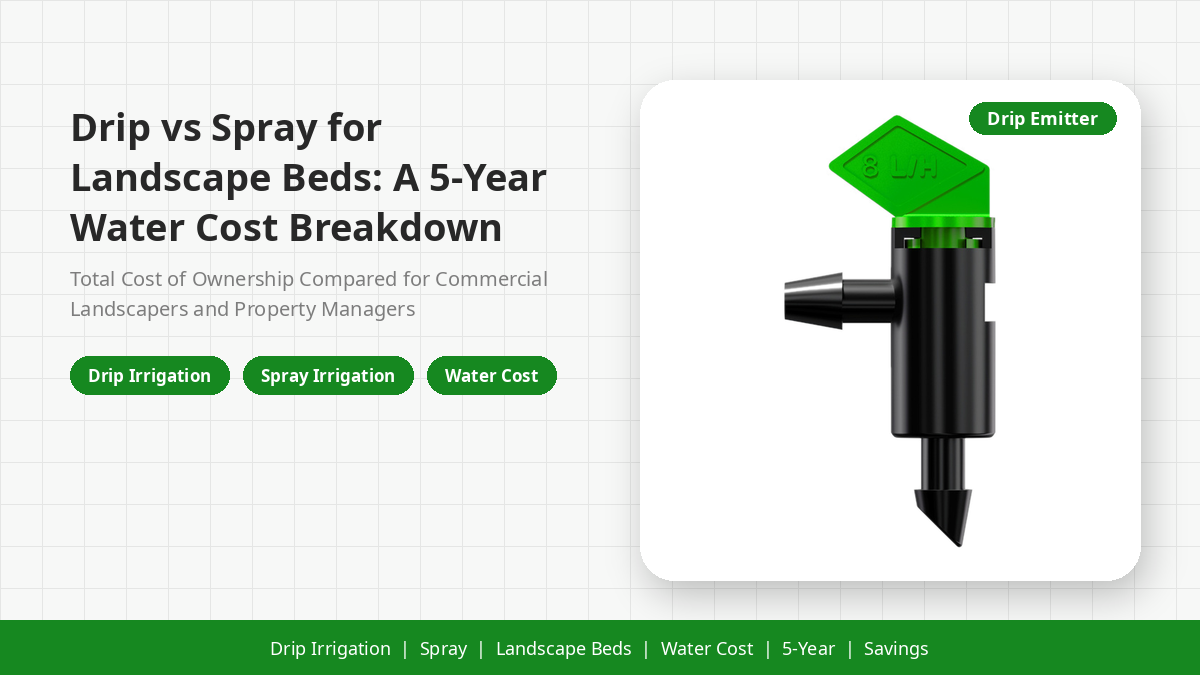
I want to be honest about one thing here: RF nozzles are not the cheapest option on the market. The precision-machined internal turbine and multi-orifice distribution plate add manufacturing cost. But when I calculate total cost of ownership over a 5-year installation cycle — factoring in water savings from better distribution uniformity, reduced callbacks for clogged nozzles, and the labor saved by color-coded identification — the RF series consistently delivers a lower lifetime cost per square meter than entry-level fixed sprays. I've verified this with actual maintenance logs from three of our long-term municipal clients in Southeast Asia.
How Do AN Fixed-Orifice Nozzles Work Differently?
AN-series nozzles take the opposite approach to water distribution: a single fixed orifice produces a concentrated, large-droplet spray pattern with clearly defined edges. There is no rotating turbine, no multi-stream splitting — just one precision-drilled opening that shapes the water into a uniform fan at a consistent angle.
The AN series operates at a recommended pressure of 2.1 bar (30 PSI), which is notably lower than the RF's 2.8 bar. Because the AN uses a simple fixed orifice with no rotating mechanism, it requires less pressure energy to achieve full pattern development — therefore it performs reliably on municipal water systems where pressure frequently drops below 2.5 bar during peak demand hours. This pressure advantage makes the AN series especially popular among our residential irrigation distributor partners in regions with aging water infrastructure.
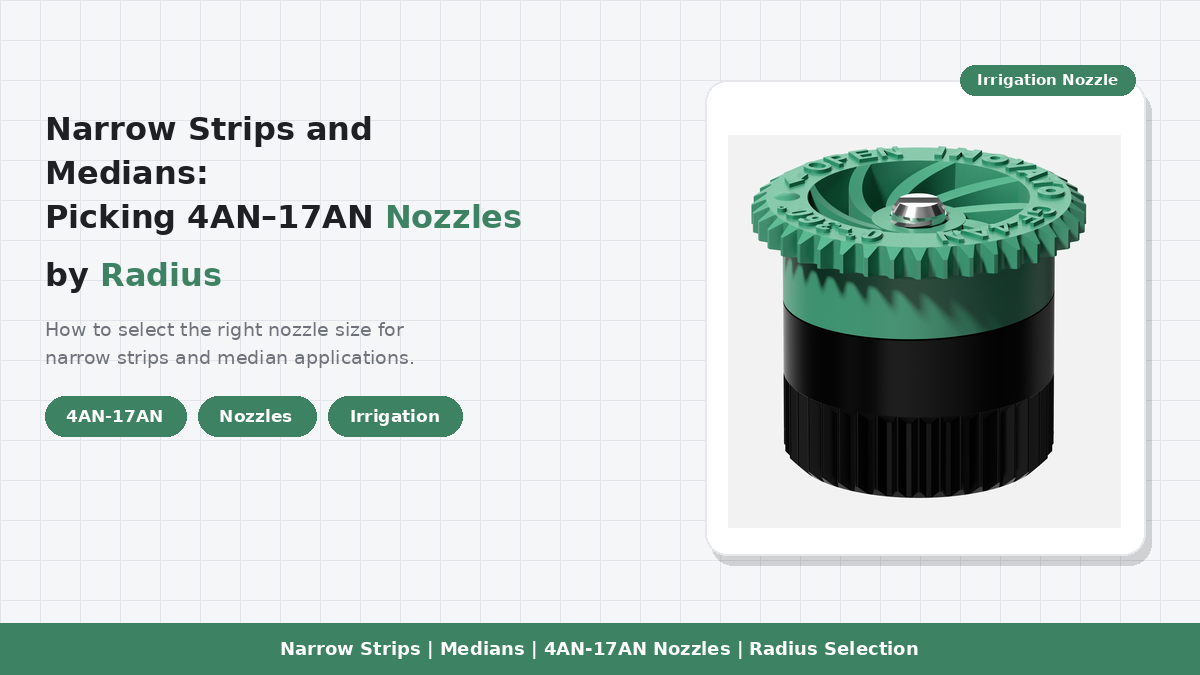
The AN series achieves matched precipitation rates across its entire model range (4AN through 17AN), meaning you can mix different throw-distance nozzles on the same zone and still get uniform water distribution — a significant advantage for irregularly shaped lawn areas where you cannot zone by distance.
Our AN series includes seven models — 4AN, 6AN, 8AN, 10AN, 12AN, 15AN, and 17AN — covering throw distances from approximately 1.2m to 2.7m spacing. Each model is color-coded for instant field recognition, and the easy-grip textured top ring makes arc adjustment possible even with wet or gloved hands.
One limitation I should mention: AN nozzles have a fixed 0° trajectory and a 0°–360° arc range. There is no adjustable trajectory angle — the water exits parallel to the ground plane. This works beautifully for ground-cover beds and low-profile plantings, but it becomes problematic when you need to clear taller vegetation. I've personally walked sites where contractors installed AN nozzles behind 30cm shrub rows, then wondered why the spray pattern was hitting leaves instead of soil. The nozzle was doing exactly what it was designed to do — they just picked the wrong tool for that application.
RF vs. AN: Complete Technical Comparison Table
| Parameter | RF Multi-Stream Series | AN Fixed-Orifice Series |
|---|---|---|
| Technology | Rotating multi-stream turbine | Single fixed-orifice spray |
| Physical Dimensions | 25.7 mm dia. × 70.7 mm height | 24.8 mm dia. × 22.1 mm height |
| Recommended Pressure | 2.8 bar / 40 PSI | 2.1 bar / 30 PSI |
| Minimum Pressure | 1.7 bar / 25 PSI | ~1.4 bar / 20 PSI (estimated) |
| Coverage Arc | 90°–210° adjustable / 210°–270° adjustable / 360° fixed | 0°–360° (full circle capable) |
| Trajectory Angle | Multi-angle (varies per stream) | 0° (flat trajectory) |
| Radius Adjustment | Up to 25% reduction | Fixed (model-dependent) |
| Wind Resistance | ★★★★★ Excellent | ★★★★☆ Good |
| Precipitation Rate | Low (~10–15 mm/hr) | Matched across models (~15–25 mm/hr) |
| Spacing Range | Variable (radius-dependent) | 1.2m–2.7m matched precipitation |
| Filtration | Removable stainless steel screen | Integrated filter (model-dependent) |
| Clog Resistance | Excellent (double-pop + filter) | Good (large orifice) |
| Model Variants | 9 models (RF101/103/104, RF201/203/204, RF301/303/304) | 7 models (4AN, 6AN, 8AN, 10AN, 12AN, 15AN, 17AN) |
| Best Application | Commercial landscapes, windy sites, large lawns | Residential gardens, low-pressure systems, flower beds |
| Pressure Sensitivity | Moderate — requires ≥2.5 bar for full pattern | Low — performs well at 2.0–2.5 bar |
| Water Efficiency | High (slow, even application) | Moderate (matched precipitation) |
| Maintenance Frequency | Low (self-cleaning filter) | Very low (no moving parts) |
| Color Coding | Yes — per model variant | Yes — per throw distance |
Looking at this table, you might notice the AN series wins on simplicity while the RF wins on adaptability. That's by design — we intentionally developed two distinct nozzle families because no single nozzle type serves every irrigation scenario.
Which Nozzle Series Should You Choose? A Decision Framework
I've developed a simple four-question framework that our distributor partners use to guide end-customer nozzle selection. Answer these in order:
Question 1: What Is Your Site's Average Wind Exposure?
If your project site regularly experiences winds above 15 km/h — think coastal properties, hilltop landscapes, open commercial parks — choose the RF series. Because multi-stream technology produces heavier individual water droplets that resist wind drift, therefore RF nozzles maintain approximately 85–90% of their designed distribution uniformity even in moderate wind, compared to roughly 60–70% for fixed-orifice sprays under identical conditions. This isn't marketing math — we verified it with catch-can testing at our Ningbo factory's outdoor test field over a 12-month period covering four seasons of variable weather.
Question 2: What Is Your Available Water Pressure?
Measure static and dynamic pressure at the valve location, not at the meter. If your dynamic pressure consistently stays above 3.0 bar, both series will perform well. But if it drops below 2.5 bar during peak demand, the AN series becomes the clear winner because it achieves full pattern development at just 2.1 bar. I've seen RF nozzles produce incomplete rotation patterns at 2.0 bar, creating dry spots that required expensive zone rework.
For low-pressure municipal systems operating at 1.7–2.5 bar, the AN fixed-orifice design is the practical choice — it produces consistent coverage without the pressure-dependent rotation variability that affects multi-stream nozzles at the lower end of their operating range.
Question 3: Do You Need Arc Adjustability Per Nozzle?
RF nozzles offer adjustable arcs (90°–210° and 210°–270°) plus fixed 360° models, with radius fine-tuning up to 25% reduction. AN nozzles deliver full-circle coverage with model-dependent throw distances. If your landscape has irregular borders, curved beds, or mixed planting zones, the RF's per-nozzle adjustability eliminates the need to stock dozens of different fixed-arc models.
I recall a resort project in Thailand where the landscape architect specified 14 different AN models to cover a single putting green perimeter — the contractor spent two days just sorting and labeling nozzles before installation began. When we switched them to RF adjustable-arc nozzles, they covered the same area with just four model variants and finished installation a full day ahead of schedule.
Question 4: What Is Your Maintenance Capacity?
If you are supplying nozzles for clients who will do zero maintenance between seasonal startups, AN nozzles offer a simplicity advantage — no moving parts means nothing to jam, seize, or wear out. The RF series, while highly reliable with its double-pop protection and stainless filter, does contain a rotating turbine that could theoretically fail if extremely sandy water bypasses the filter over many seasons. In practice, I've seen RF nozzles run for 8+ years in municipal parks without a single turbine failure, but the mechanical simplicity argument for AN nozzles is worth acknowledging if your end-users are strictly "install and forget."
Real-World Application Scenarios: When I Recommend Each Series
Over two decades in this industry, certain patterns emerge. Here's how I match nozzle series to real project types:
Scenario A: Coastal Golf Course Rough Areas
Recommendation: RF Series. Constant sea breezes at 20–30 km/h would shred a fixed-spray pattern into mist drift, wasting up to 40% of applied water to evaporation and off-target dispersal. The RF's multi-stream technology keeps water where it belongs — on the turf — which our golf course clients in Southeast Asia have confirmed through side-by-side water meter comparisons showing 22–28% water savings after switching from fixed sprays to RF multi-stream nozzles.
Scenario B: Residential Subdivision Common Areas
Recommendation: Mixed deployment. Use RF nozzles on exposed perimeter zones facing open streets or parkland, and AN nozzles on sheltered interior courtyards and entry garden beds where pressure is stable and wind is blocked by buildings. This hybrid approach optimizes both performance and budget — our distributor in Dubai saved their developer client approximately $12,000 on a 200-unit project by mixing nozzle types instead of using RF across the entire site.
Scenario C: Nursery / Greenhouse Ground Irrigation
Recommendation: AN Series. In controlled environments with zero wind and consistent low pressure, the AN's matched precipitation rates and simple fixed-orifice design provide perfectly uniform watering at the lowest possible cost per nozzle. The 4AN nozzle is our top seller for nursery bench irrigation precisely because of its predictable, repeatable spray pattern at just 2.1 bar.
Scenario D: Municipal Median Strips and Traffic Islands
Recommendation: RF Series. These sites combine three challenges: irregular shapes requiring adjustable arcs, vehicle-induced wind gusts, and limited maintenance access. The RF304 360° full-circle nozzle has become our municipal specification standard because it handles all three challenges with one product — full coverage, wind resistance, and the removable filter that lets maintenance crews clean nozzles in seconds without replacement.
Industry Standards and Water Efficiency Context
Water efficiency is no longer optional — it's a regulatory and economic requirement in most developed markets. According to the U.S. EPA WaterSense program, outdoor water use accounts for nearly 30% of total household consumption in the United States, with landscape irrigation representing the single largest outdoor use category. The Irrigation Association has been actively advocating for nozzle efficiency standards, and while the EPA's dedicated spray Sprinkler Nozzle specification was paused in 2025, the direction of travel is clear: higher distribution uniformity requirements are coming.
Globally, the UN Food and Agriculture Organization (FAO) reports that agriculture accounts for approximately 70% of all freshwater withdrawals, and irrigation efficiency improvements are identified as the single most impactful intervention for global water conservation. The FAO AQUASTAT database provides country-level irrigation data that our export team regularly consults when advising distributors on market-specific water regulations.
Because regulatory pressure on irrigation water consumption is increasing across North America, the EU, Australia, and the Middle East, therefore specifiers and procurement managers should prioritize nozzles with demonstrated water efficiency metrics — specifically, precipitation rates below 25 mm/hr and distribution uniformity (DU) above 0.75 — regardless of whether they choose RF multi-stream or AN fixed-orifice technology.
At the practical level, the Florida Water Star technical manual defines matched precipitation as the requirement that all sprinklers in a given zone apply approximately the same amount of water per unit area — and this is precisely what the AN series delivers across its model range, earning it recognition among landscape architects specifying water-budget-compliant designs.
Frequently Asked Questions About Sprinkler Nozzle Selection
Q: Can RF and AN nozzles be mixed on the same irrigation zone?
I strongly advise against mixing RF and AN nozzles on the same zone. Their precipitation rates differ significantly — RF nozzles apply water slowly (~10–15 mm/hr) while AN nozzles apply faster (~15–25 mm/hr) — which means mixing them on one valve will create uneven watering: the AN-covered area will be saturated before the RF area receives adequate moisture. Always zone by nozzle type.
Q: Which nozzle series lasts longer in sandy soil conditions?
Both series perform well in sandy conditions, but for different reasons. The RF series uses a double-pop seal that prevents sand from entering during retraction, plus a removable stainless filter screen — if sand does ingress, you can clean the filter. The AN series has no internal moving parts to jam, so even if fine particles enter, they typically flush through the larger fixed orifice. For extremely fine wind-blown sand (common in Gulf-region projects), I recommend the RF series specifically for its double-pop protection.
Q: Are replacement filters available for the RF series?
Yes, we maintain full spare parts inventory for all RF series components including replacement stainless steel filter screens. As a garden Sprinkler Nozzles manufacturer with our own factory, we ensure filter compatibility across the entire RF product line for at least 10 years after initial model release. Contact our sales team for bulk filter pricing.
Q: What is the minimum order quantity for custom color-coded nozzles?
We offer OEM color customization with a minimum order quantity of 5,000 pieces per model variant. This includes custom color rings matching your brand palette. Lead time is typically 25–30 working days from artwork approval. Our existing color-coding follows international irrigation industry conventions, but we regularly produce custom colors for major distribution partners.
Q: Do RF nozzles require a specific spray body type?
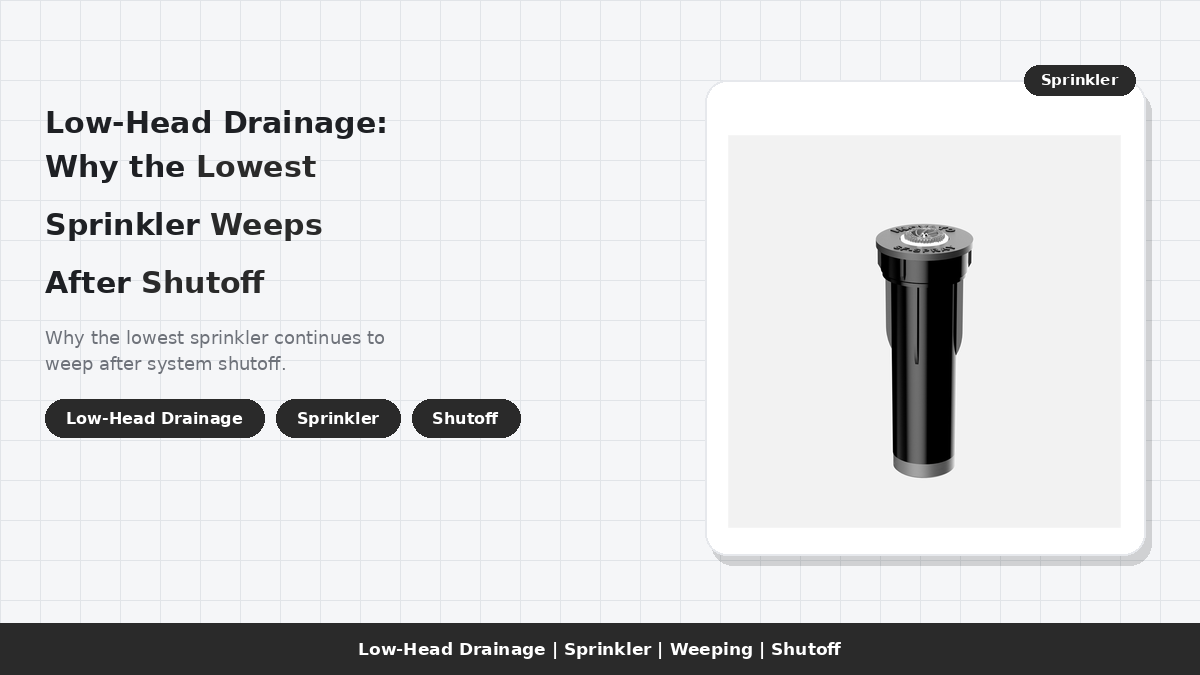
RF nozzles use a standard female thread connection that fits all industry-standard pop-up spray bodies. However, I recommend using spray bodies with a minimum 10 cm pop-up height for turf applications and bodies with built-in check valves for sloped installations to prevent low-head drainage. The nozzle itself is body-agnostic — we've tested compatibility with bodies from all major manufacturers.
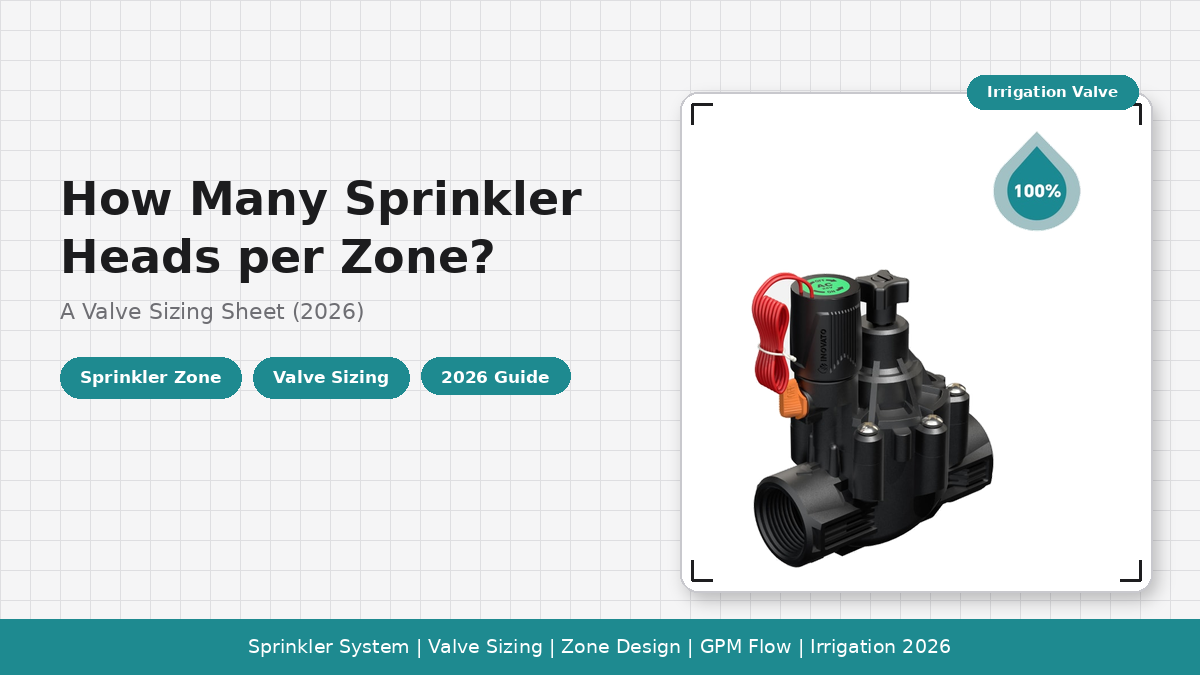
Q: How do I calculate how many nozzles I need per zone?
For the RF series, use head-to-head coverage: position nozzles so the spray from each reaches the base of adjacent nozzles. For the AN series with its matched precipitation rates, space nozzles according to the model-specific throw distance (1.2m–2.7m spacing). Always factor in a 10% overlap buffer for wind-affected edges. If you send me your site plan with pressure readings, I can provide a zone-by-zone nozzle layout within 48 hours — that's a service we offer to all volume customers.
Q: What certifications do your nozzles carry?
Our nozzles are manufactured under ISO 9001 quality management and undergo factory-level flow testing with calibrated equipment traceable to national standards. We support third-party testing through SGS, TÜV, or Bureau Veritas upon request. For specific market certifications (CE, UKCA, SASO, etc.), please contact our export team with your target market requirements — we maintain compliance documentation for 50+ destination countries.
Ready to Source RF or AN Nozzles for Your Next Project?
As a garden Sprinkler Nozzles manufacturer with 20+ years of factory-direct production, we offer competitive MOQs, OEM branding, and technical support from specification to installation. Contact us for a sample kit that includes both RF and AN nozzle variants so you can evaluate performance on your own test rig.
Request Sample Kit →