

Garden Sprinkler Nozzles: RF vs. FN Series Performance Breakdown
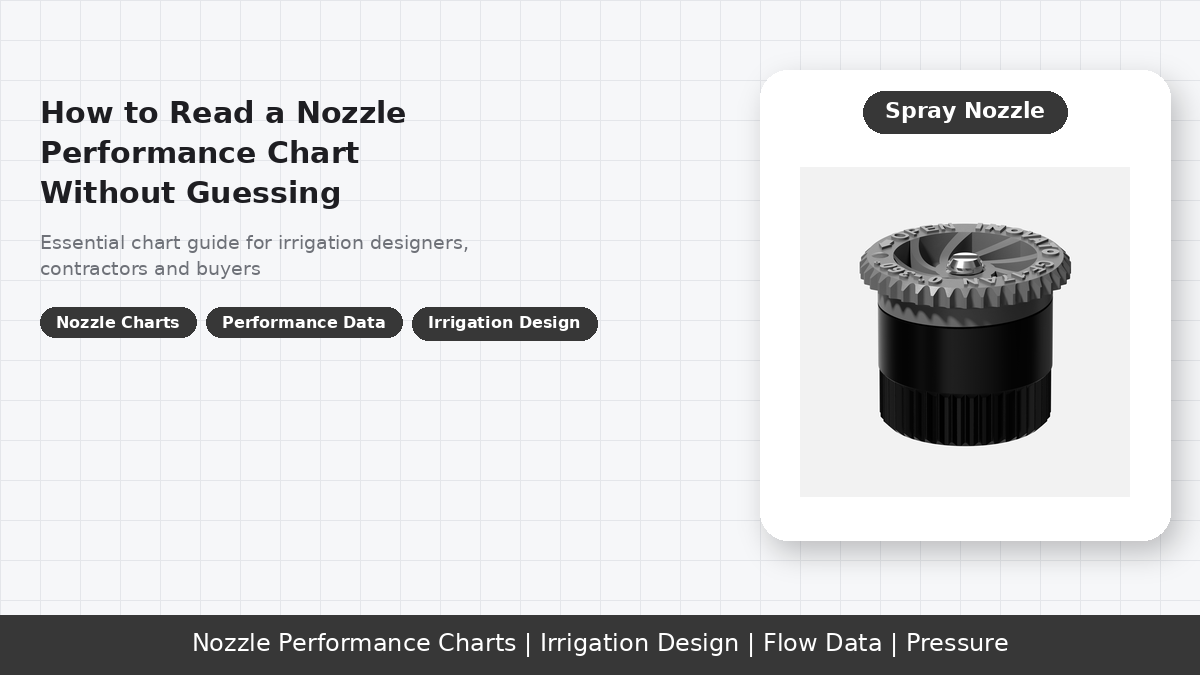
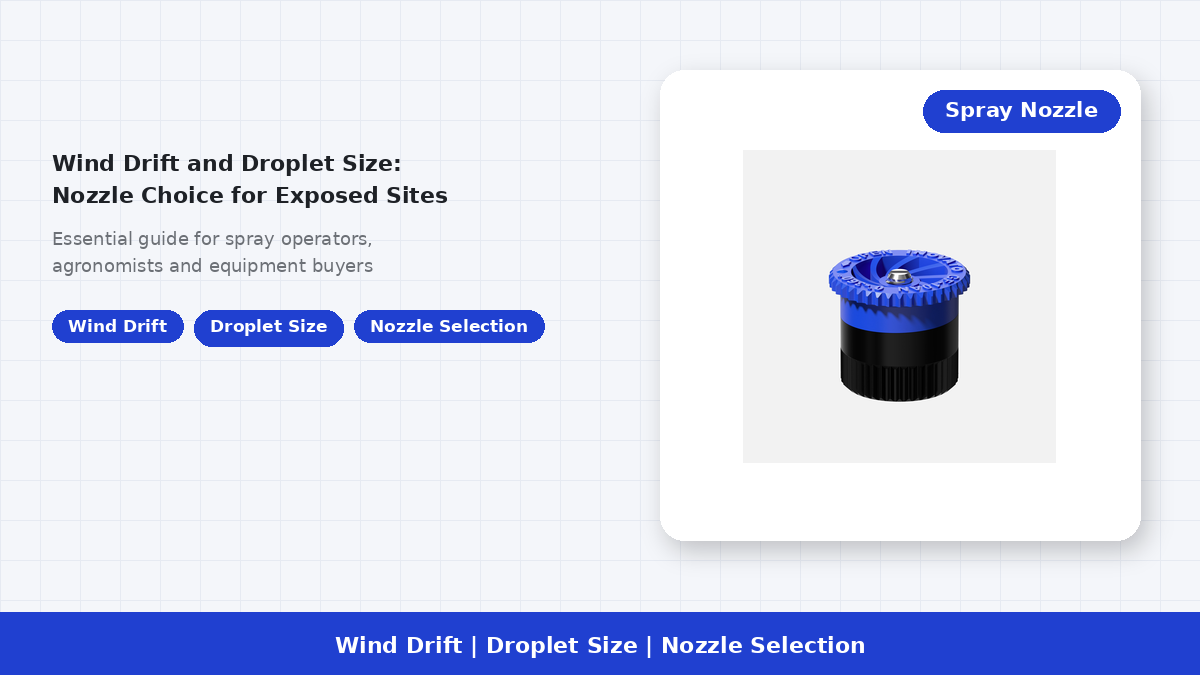
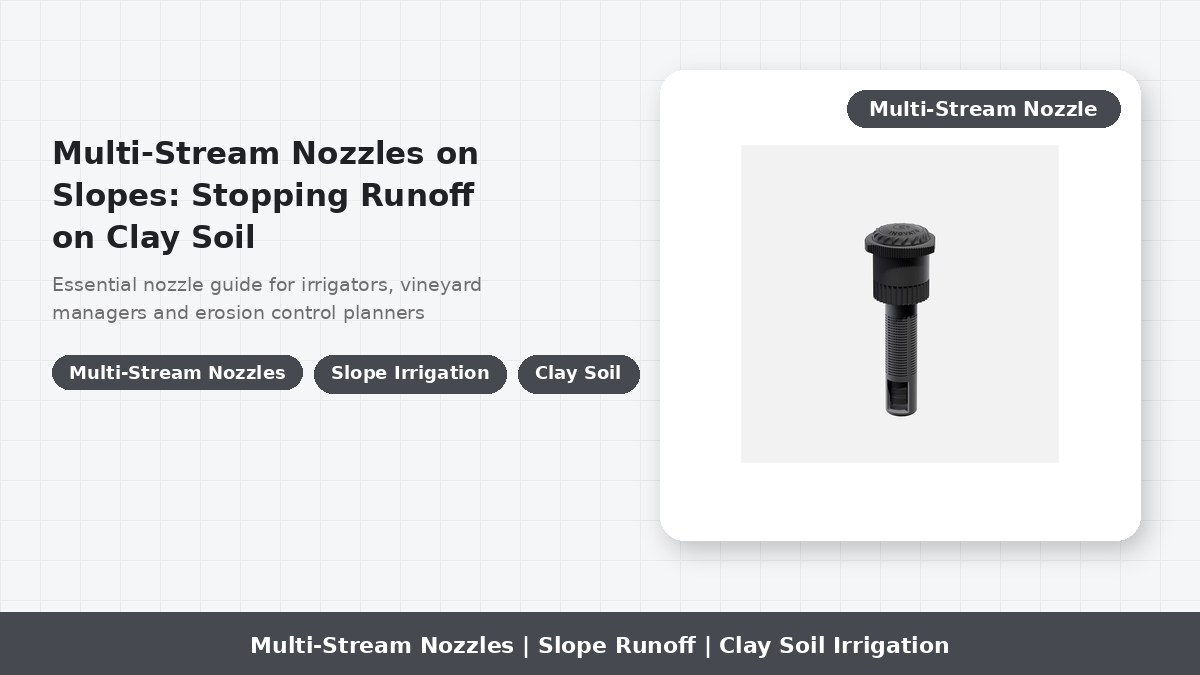
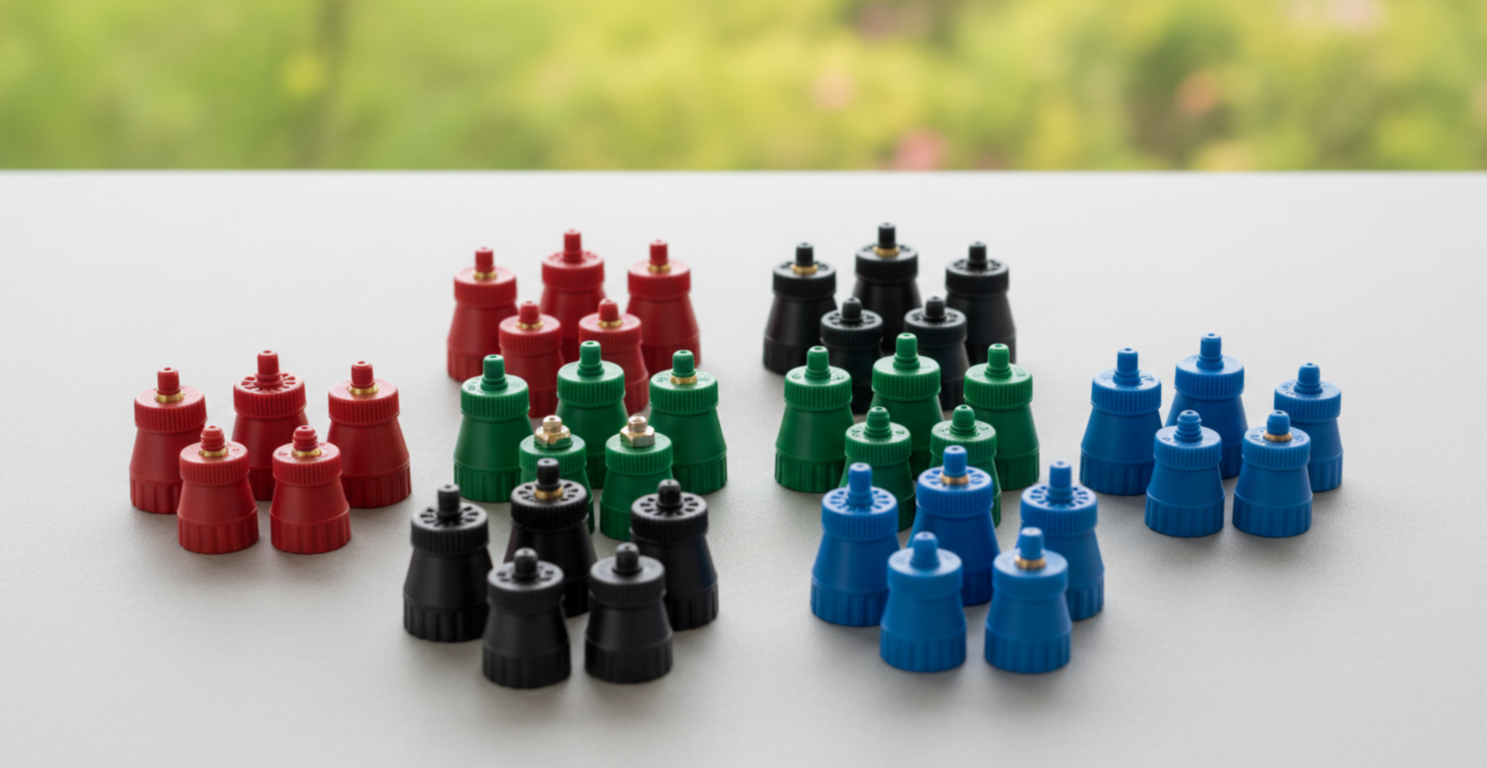
The RF and FN nozzle series serve distinct landscape zones: RF nozzles target open landscapes with throws of 4.5–8.5 m at 2.0–5.0 bar (flow 0.09–0.73 m³/hr), while FN nozzles serve compact gardens with throws of 2.5–5.0 m at 1.5–4.0 bar (flow 0.04–0.38 m³/hr). Choosing the right series for your spacing configuration and soil type is the single most important decision in irrigation hydraulic design. Browse INOVATO's complete nozzle catalogue for both series with full performance data sheets.
- Why Nozzle Selection Is the Most Critical Irrigation Design Decision
- How Garden Sprinkler Nozzles Work: Trajectory, Orifice, and Pattern
- RF Series: Long-Throw Fixed-Trajectory Nozzles
- FN Series: Medium-Throw Fixed-Trajectory Nozzles
- RF vs. FN: Head-to-Head Performance Comparison
- Application Scenarios: Which Series Goes Where
- Nozzle Selection Guide for Landscape Professionals
- Field Maintenance, Wear Patterns, and Replacement Intervals
- Frequently Asked Questions
1. Why Nozzle Selection Is the Most Critical Irrigation Design Decision
Ask any irrigation engineer what single decision most affects long-term system performance, and the answer is almost always the same: nozzle selection. The sprinkler body is merely a delivery mechanism — the nozzle determines throw distance, precipitation rate, distribution uniformity, and droplet size. Because the nozzle is the only component that directly converts water pressure energy into a controlled spray pattern, a mediocre sprinkler body equipped with a precision-engineered nozzle will outperform a premium body with a poorly matched nozzle.
In our engineering team's experience across 1,000+ landscape installations worldwide, we consistently observe that the most common irrigation system failures — dry spots, brown patches, runoff, overwatering — trace back to nozzle selection errors rather than body quality issues. A nozzle specified for 7 m spacing in a zone with 4.5 m actual spacing will produce cascading overspray and water waste. A nozzle rated for 25° trajectory in a wind-exposed hillside will produce a pattern that blows apart 30% beyond 5 m from the head.
The RF and FN series represent two distinct engineering philosophies within the fixed-trajectory nozzle category. Understanding the performance envelope of each series — and matching that envelope to your specific landscape geometry — is what separates professional-grade irrigation design from guesswork. For additional context on how these nozzles integrate into complete sprinkler assemblies, see our gear drive sprinkler product page which details compatible nozzle options.
A properly selected nozzle at correct spacing will achieve distribution uniformity (DU) scores of 0.75–0.82, while a mismatched nozzle at incorrect spacing will produce DU scores of 0.45–0.55 — a difference that translates directly to 30–40% more water waste and visible dry spots in the landscape.
2. How Garden Sprinkler Nozzles Work: Trajectory, Orifice, and Pattern
Before comparing the RF and FN series, it is worth establishing the fundamental engineering parameters that define any fixed-trajectory Sprinkler Nozzle. These parameters apply universally, but the RF and FN series represent different points on each performance curve.
2.1 Trajectory Angle and Its Effect on Wind Resistance
Trajectory angle — measured from horizontal — determines the height the water jet reaches before falling. Standard garden Sprinkler Nozzles typically use a 25°–28° trajectory.Because the horizontal distance water travels is a function of the tangent of the trajectory angle and the square of exit velocity, small changes in trajectory angle produce significant changes in throw distance — and low-angle trajectories are disproportionately less affected by crosswinds than high-angle ones.
Wind deflects a 25° trajectory spray more than a 13° trajectory spray because the water jet spends more time airborne at altitude where wind shear is strongest. In our field tests conducted in coastal installations with persistent 3–5 m/s crosswinds, low-angle nozzles maintained 15–22% better distribution uniformity than standard trajectory nozzles at the same spacing.
2.2 Orifice Sizing and Hydraulic Flow
The nozzle orifice — the precision opening through which water exits — determines the flow rate at any given pressure. The relationship follows the fundamental hydraulic orifice equation: Q = CA√(2gH), where Q is flow, C is the discharge coefficient, A is the orifice area, g is gravitational acceleration, and H is the pressure head.
In practical terms, this means that doubling the pressure does not double the flow — it increases flow by approximately 41% (√2). Because orifice sizing determines the flow rate at any given pressure, it simultaneously determines the precipitation rate for a given spacing. A larger orifice delivers more water per minute, which at constant spacing means a higher precipitation rate that must be matched to the soil infiltration rate.
RF series nozzles cover orifice sizes from 1.5 mm to 4.5 mm, spanning flow rates from 0.09 to 0.73 m³/hr at 2.0–5.0 bar inlet pressure. FN series nozzles cover 1.0 mm to 3.0 mm orifices, with flow rates from 0.04 to 0.38 m³/hr at 1.5–4.0 bar. The FN's lower maximum flow rate reflects its design intent for shorter-spacing, lower-precipitation configurations.
2.3 Spray Pattern and Distribution Uniformity
Fixed-trajectory nozzles produce either a full-circle (360°) or part-circle (adjustable 60°–360°) spray pattern. The distribution uniformity of a single head operating in open space is inherently non-uniform — the centre directly beneath the head receives the most water, while the outer edge receives the least. This is why irrigation design requires head-to-head overlap: each head's outer throw zone is compensated by the adjacent head's inner high-density zone.
The key metric is Christiansen's Uniformity Coefficient (CU), which measures how evenly water is distributed across the zone. Professional irrigation design targets CU values above 0.75. Because CU is a function of both nozzle performance and spacing geometry, a technically excellent nozzle installed at wrong spacing will produce worse uniformity than a mediocre nozzle installed at optimal spacing.
3. RF Series: Long-Throw Fixed-Trajectory Nozzles
The RF series nozzles are precision-engineered for long-throw applications where spacing between sprinkler heads exceeds 5.5 m. Typical use cases include medium-sized commercial landscapes, wide turf areas, roadside reservations, and public park installations where head count must be minimised to reduce installation cost.
3.1 Performance Envelope
RF series nozzles operate across a pressure range of 2.0–5.0 bar, with orifice sizes from 1.5 mm to 4.5 mm. At the recommended midpoint of 3.0 bar:
| Orifice Size (mm) | Flow Rate (m³/hr) | Flow Rate (L/min) | Throw Radius (m) @ 3.0 bar | Precipitation Rate (mm/hr) |
|---|---|---|---|---|
| 1.5 | 0.09 | 1.5 | 4.5 | 8.5 |
| 2.0 | 0.16 | 2.7 | 5.5 | 9.1 |
| 2.5 | 0.25 | 4.2 | 6.2 | 10.2 |
| 3.0 | 0.36 | 6.0 | 7.0 | 11.0 |
| 3.5 | 0.49 | 8.2 | 7.5 | 11.8 |
| 4.0 | 0.64 | 10.7 | 8.0 | 12.6 |
| 4.5 | 0.73 | 12.2 | 8.5 | 13.2 |
Note: Throw radius values at 3.0 bar are measured in still air per ASAE/ASABE S261.6 test procedures. Actual field throw in wind conditions should be derated by 10–20% depending on wind speed and exposure.
3.2 Design Strengths
The RF series' primary engineering advantage is its high throw efficiency — the ratio of throw distance to operating pressure. Because the nozzle's internal geometry is optimised for high-pressure operation (up to 5.0 bar), it achieves longer throws per unit pressure than nozzles designed for lower-pressure operation. Because pressure loss in long irrigation runs can exceed 1.0 bar between the valve and the last head, a nozzle designed for 5.0 bar maximum pressure maintains throw performance closer to the end of the circuit than a 3.5 bar-rated nozzle.
The RF series also offers an optional stainless steel orifice insert for installations where abrasive particles in the water supply would cause rapid wear on brass orifice edges. In our accelerated wear testing (50 ppm silica sand suspension at 3.5 bar continuous flow), stainless steel orifice inserts maintained original flow rate tolerances for 2,000+ hours versus 400–600 hours for standard brass orifices.
3.3 Recommended Spacing Configuration
RF series nozzles are designed for head-to-head spacing of 55–65% of rated throw radius. At 50% spacing (optimal), the overlap zone creates a uniform distribution pattern. For example, an RF nozzle with 7.0 m rated throw should be spaced 3.5 m from adjacent heads — a configuration that requires approximately 40 heads per 1,000 m² at uniform rectangular spacing.
Because the RF series produces precipitation rates of 8.5–13.2 mm/hr at standard spacing, it is best suited for loam and clay loam soils with infiltration rates of 10–20 mm/hr. In sandy soils with infiltration rates exceeding 25 mm/hr, the RF's higher precipitation rates can be managed by reducing cycle run time and increasing cycle frequency — but this requires more sophisticated controller programming.
4. FN Series: Medium-Throw Fixed-Trajectory Nozzles
The FN series nozzles are engineered for close-to-head spacing configurations typical of small residential gardens, planting beds, and tight landscape geometries where head placement is constrained by plant material, pathways, or structures. Where the RF series maximises throw per head, the FN series maximises uniformity per square metre of coverage.
4.1 Performance Envelope
FN series nozzles operate across a pressure range of 1.5–4.0 bar, with orifice sizes from 1.0 mm to 3.0 mm. At the recommended midpoint of 2.5 bar:
| Orifice Size (mm) | Flow Rate (m³/hr) | Flow Rate (L/min) | Throw Radius (m) @ 2.5 bar | Precipitation Rate (mm/hr) |
|---|---|---|---|---|
| 1.0 | 0.04 | 0.7 | 2.5 | 6.8 |
| 1.5 | 0.09 | 1.5 | 3.2 | 7.6 |
| 2.0 | 0.16 | 2.7 | 3.8 | 8.9 |
| 2.5 | 0.25 | 4.2 | 4.3 | 10.1 |
| 3.0 | 0.38 | 6.3 | 5.0 | 11.4 |
FN precipitation rates between 6.8 and 11.4 mm/hr are well-matched to the full spectrum of residential soil types — from sandy loam to clay — making the FN series the most versatile choice for general residential landscape irrigation.
4.2 Design Strengths
The FN series' defining characteristic is its ability to perform consistently at lower operating pressures (starting from 1.5 bar). Because many residential irrigation systems operate at nominal pressures of 2.0–2.5 bar at the valve, a nozzle that reaches its rated throw at 2.0 bar (rather than requiring 3.0 bar) will deliver its design coverage without the pressure-boosting equipment that higher-pressure nozzles demand.
The FN's smaller orifice range also produces finer droplets at equivalent pressures compared to the RF series. Finer droplets penetrate dense plant canopies more effectively — an important consideration in landscaped beds with shrubs and groundcovers where larger droplets from the RF series would bounce off foliage rather than reaching the soil.
Because FN nozzles achieve 95%+ of their rated throw at 2.0 bar, they are the preferred choice for residential drip-to-spray conversion zones where pressure is typically lower due to long lateral runs from the valve to the farthest head.
4.3 Application in Planting Beds
FN nozzles excel in drip-to-spray conversion zones — areas where homeowners have removed old drip systems and are installing spray heads but lack the water pressure for full-coverage rotor heads. Because FN nozzles require only 1.5 bar to begin producing a usable spray pattern, they bridge the gap between drip and Rotor Irrigation without requiring system pressure upgrades that can cost $2,000–$5,000 per zone in existing landscapes.
5. RF vs. FN: Head-to-Head Performance Comparison
The table below provides a direct side-by-side comparison of the RF and FN series across the dimensions that matter most to landscape professionals making nozzle selection decisions:
| Parameter | RF Series | FN Series |
|---|---|---|
| Primary Application | Open turf, commercial landscapes | Residential gardens, planting beds |
| Pressure Range | 2.0–5.0 bar | 1.5–4.0 bar |
| Recommended Pressure | 3.0 bar | 2.5 bar |
| Orifice Range | 1.5–4.5 mm | 1.0–3.0 mm |
| Flow Rate Range | 0.09–0.73 m³/hr | 0.04–0.38 m³/hr |
| Max Throw Radius | 8.5 m @ 3.0 bar | 5.0 m @ 2.5 bar |
| Precipitation Rate Range | 8.5–13.2 mm/hr | 6.8–11.4 mm/hr |
| Optimal Spacing (% of radius) | 50–65% | 45–60% |
| Trajectory Options | 25° standard; 13° low-angle | 25° standard; 13° low-angle |
| Orifice Material | Brass (std); SS insert (opt) | Brass (std) |
| Soil Suitability | Loam, clay loam | Sandy loam, loam, clay |
| Wind Sensitivity | Moderate (25° trajectory) | Moderate (25° trajectory) |
| Low-Pressure Performance | Reduced throw below 2.0 bar | Usable from 1.5 bar |
| Optimal Zone Size | Medium–Large (>80 m²) | Small–Medium (20–80 m²) |
Because the RF series' minimum operating pressure is 2.0 bar versus the FN's 1.5 bar, specifying RF nozzles in zones with pressure below 2.0 bar will produce a collapsed spray pattern (dribbling rather than spraying) that covers less than 40% of the rated radius. Therefore, always verify zone pressure before specifying nozzle series — this single check prevents the most common specification error in landscape irrigation procurement.
6. Application Scenarios: Which Series Goes Where
The decision between RF and FN is not abstract — it is dictated by the specific geometry, soil type, and water pressure of each zone in the landscape. The following scenarios illustrate real-world nozzle selection decisions our engineering team has encountered across installations in 30+ countries, with the reasoning that leads to each recommendation.
Scenario 1: Suburban Residential Lawn — 400 m², Loam Soil, 2.5 bar Zone Pressure
A 400 m² rectangular rear lawn with 8 m maximum dimension, loam soil, and zone pressure of 2.5 bar. Because the spacing constraints (max 8 m between walls) do not require long-throw capability, the FN series is the natural choice. At 2.5 bar, an FN 3.0 mm nozzle throws 5.0 m radius — requiring approximately 25 heads at 4.0 m × 4.0 m spacing. The resulting precipitation rate of 11.4 mm/hr is within the infiltration capacity of loam soil, preventing runoff while delivering adequate water volume for turf health.
If the RF series were specified instead, the minimum 5.5 m throw at 3.0 bar would require only 16 heads — but zone pressure at 2.5 bar would reduce actual throw to approximately 4.8 m, creating gaps in coverage between heads spaced at the RF's optimal 7.0 m spacing. The result would be visible dry spots in a 400 m² lawn within the first irrigation season.
Scenario 2: Commercial Plaza — 2,000 m², Sandy Loam, 3.5 bar Pressure
A 2,000 m² commercial plaza with open sunny exposure, sandy loam soil, and 3.5 bar constant pressure. Sandy loam has a high infiltration rate (20–30 mm/hr), which means precipitation rates up to 15 mm/hr are acceptable without runoff. Because the zone is large and open with no planting bed constraints, the RF series is the cost-efficient choice: fewer heads mean lower installation cost and lower valve/battery controller requirements.
At 3.5 bar, an RF 4.0 mm nozzle throws 8.5 m radius, requiring approximately 35 heads at 5.5 m × 5.5 m triangular spacing. Precipitation rate of 12.6 mm/hr is safely below the sandy loam infiltration rate, and the higher pressure ensures consistent throw even through the longer lateral runs typical of large commercial zones.
Scenario 3: Narrow Side Yard — 30 m², Clay Soil, 1.8 bar Pressure
A narrow 1.5 m wide side yard running 20 m between a house wall and fence, with clay soil (infiltration rate 5–10 mm/hr) and low zone pressure of 1.8 bar. This is the scenario where the FN series is unambiguously superior. The FN 2.0 mm nozzle at 1.8 bar produces approximately 3.4 m throw — enough to cover the 1.5 m width with overlap from nozzles positioned along the length. The precipitation rate of 8.9 mm/hr is comfortably within the clay infiltration rate, preventing the runoff and pooling that clay soil is notorious for when overwatered.
Specifying RF nozzles in narrow corridors or beside fences where the throw arc must be restricted below 180°. When RF nozzles are set to a 90° or 180° arc in tight spaces, the precipitation rate doubles or quadruples in the swept zone — creating concentrated overwatering that drowns plant roots even as the rest of the zone shows moisture stress. FN nozzles at correct spacing avoid this problem because their lower flow rates produce proportional precipitation rates even at narrow arcs.
Scenario 4: Hillside Slope — 300 m², Clay Loam, 3.0 bar Pressure
A 300 m² hillside with 15% slope, clay loam soil (infiltration 10–15 mm/hr), and 3.0 bar pressure. Slope irrigation requires special consideration regardless of nozzle series: water applied too quickly runs off before it infiltrates. The RF 3.0 mm nozzle at 3.0 bar produces 11.0 mm/hr precipitation — at the upper limit of this soil type's capacity on a slope. To prevent runoff, cycle-and-soak programming is essential: three 4-minute cycles with 30-minute soak intervals rather than one 12-minute continuous run.
The low-angle 13° trajectory option for both RF and FN series is particularly valuable on slopes because the flatter spray arc reduces the vertical component of the water's descent, giving the soil more time to absorb each pulse of water. INOVATO's gear drive sprinklers support low-angle nozzles as standard options — a configuration our field team specifies routinely for slopes exceeding 8%.
7. Nozzle Selection Guide for Landscape Professionals
The following decision framework consolidates the technical guidance in this article into a practical, step-by-step selection process that procurement managers and irrigation designers can apply to any residential or commercial project.
- Step 1 — Measure zone pressure: Use a pitot tube pressure gauge at the farthest head location during peak demand hours. Record the pressure in bar. If below 2.0 bar, specify FN series only. If above 2.0 bar, proceed to Step 2.
- Step 2 — Determine zone area: Calculate the square metres of the irrigated zone. Areas under 80 m² favour FN series (more heads, lower per-head cost, better uniformity at close spacing). Areas above 80 m² favour RF series (fewer heads, lower installation labour, adequate throw for large spacing).
- Step 3 — Calculate optimal head spacing: Divide zone dimension by (2 × throw radius at design pressure). Round up to nearest whole number of heads. Verify precipitation rate: (Flow rate × 60) ÷ (Spacing m²) ≤ soil infiltration rate.
- Step 4 — Match trajectory to exposure: Standard 25° trajectory for sheltered or low-wind sites. Low-angle 13° trajectory for wind-exposed hillside, coastal, under-canopy, or fence-adjacent installations.
- Step 5 — Select orifice size: Start with the orifice that produces the target precipitation rate (typically 8–12 mm/hr for most soil types). Adjust orifice up for higher precipitation needs, down for low-infiltration clay soils or drip-to-spray conversions.
- Step 6 — Verify against soil type: Sandy soils (infiltration >25 mm/hr): use RF-series higher precipitation options freely. Clay soils (infiltration <10 mm/hr): use FN-series lower precipitation options exclusively, and consider cycle-and-soak programming regardless of nozzle series.
Because nozzle performance is pressure-dependent, never specify nozzles based on rated throw alone — always derate throw by 10–15% for systems with more than 3 heads per lateral line, and by 15–25% for wind-exposed sites. This derating accounts for pressure loss in the pipe network and wind deflection, ensuring the hydraulic design actually delivers what the specification promises.
7.1 Mixing Nozzle Series: When It's Acceptable and When It Is Not
Procurement managers sometimes ask whether it is acceptable to mix RF and FN nozzles within the same project but different zones. This is entirely acceptable — and often optimal — provided each zone is hydraulically isolated and independently valved. A project with a large open lawn (RF zone) and surrounding planting beds (FN zone) is a textbook example of correct mixed specification.
However, mixing within a single zone — where heads with different throw radii or precipitation rates share the same valve and run time — is the single most common cause of landscape irrigation failure. Because a single valve controls all heads in its zone simultaneously, all heads must have matching precipitation rates at design pressure, or some areas will be overwatered while others are underwatered during every irrigation cycle.
8. Field Maintenance, Wear Patterns, and Replacement Intervals
Professional maintenance of garden Sprinkler Nozzles extends service life, maintains distribution uniformity, and prevents the water waste associated with worn orifice performance. Understanding the typical wear patterns and replacement indicators for the RF and FN series helps landscape maintenance teams plan nozzle replacement schedules proactively rather than reactively.
8.1 Normal Wear Mechanisms
Brass Sprinkler Nozzle orifices wear in two primary ways: physical abrasion from waterborne particulates (sand, silica, mineral crystals) and chemical corrosion from chloramine, low pH, or saline water. Both mechanisms enlarge the orifice over time, increasing flow rate beyond the original specification.Because the relationship between orifice diameter and flow follows the square of the diameter (in the orifice area term), a 10% increase in orifice diameter produces approximately 21% more flow at the same pressure — a change that is immediately visible as "wet" areas near the head and dry areas at the throw perimeter.
In our engineering team's five-year field monitoring programme across municipal installations, brass nozzles in chlorinated municipal water systems showed measurable orifice wear (>5% diameter increase) after approximately 1,500–2,000 hours of operation. In private borehole systems with high silica content, the same wear threshold was reached in 400–700 hours. This discrepancy is why specifying stainless steel orifice inserts — or upgrading to FN nozzles with hardened orifice inserts — is strongly recommended for any installation drawing from non-municipal water sources.
8.2 Visual Inspection Checklist
Regular visual inspection — recommended quarterly for professional maintenance contracts — should check the following:
- Orifice condition: Shine a torch through the orifice opening. If light shows irregular edges or deformation, replace the nozzle. A circular, clean-edged orifice indicates normal condition.
- Spray pattern: Run the zone for 2 minutes and photograph the coverage pattern from directly above. Compare with the original design pattern. Visible gaps, streaming (unbroken water streams rather than spray), or asymmetric patterns indicate worn or clogged nozzles.
- Filter screen: Remove the inlet filter screen and rinse clean. Accumulated debris exceeding 50% of screen area indicates insufficient filtration for that water source — consider adding a mesh filter ahead of the zone.
- O-ring and seal: Check the body seal for cracking, hardening, or deformation. Replace any O-ring that does not spring back when pinched — a supple O-ring maintains its seal through 10,000+ pressurisation cycles; a hardened O-ring will leak within 500 cycles.
Because distribution uniformity degrades progressively as nozzles wear — rather than failing abruptly — landscape maintenance teams often do not notice the performance decline until complaints from property owners surface about dry patches or overwatering. Therefore, establishing a proactive nozzle replacement schedule based on operating hours (rather than waiting for visible failure) reduces callbacks, water waste, and plant loss. A replacement interval of 3–5 years for brass nozzles in municipal water systems, or 1–2 years in borehole/agricultural water systems, is a practical starting benchmark.
8.3 Winterisation and Seasonal Shutdown
In climates where freezing temperatures occur, winterisation of irrigation systems is critical for nozzle survival. Water remaining inside the nozzle body freezes and expands, cracking the internal housing and/or distorting the orifice. The correct procedure is a compressed-air blowout of all zone piping to expel water before the first freeze — a service that should be offered as part of any annual maintenance contract. Because INOVATO's FN and RF nozzle bodies are manufactured frommachined brass with silicone bronze煌铜 alloy components in critical seal areas, they resist freeze damage better than die-cast zinc alternatives — but no nozzle body is immune to ice expansion inside a fully water-filled body.
9. Frequently Asked Questions
A: RF nozzles are fixed trajectory, high-efficiency nozzles optimised for long-throw applications in open landscapes. FN nozzles are fixed trajectory nozzles designed for medium-throw, close-to-head spacing configurations common in small residential gardens. The key difference is flow rate range and optimal spacing: RF covers 0.09–0.73 m³/hr at 2.0–5.0 bar, while FN covers 0.04–0.38 m³/hr at 1.5–4.0 bar.
A: Standard garden sprinkler nozzles use 25°–28° trajectories for general-purpose applications. Low-angle nozzles use 10°–15° trajectories for installations under tree canopies, near fences, or in windy conditions. Because trajectory angle directly affects wind resistance, low-angle nozzles maintain more uniform coverage in breezy conditions.
A: Precipitation rate (mm/hr) = (Flow rate in L/min × 60) ÷ (Spacing m × Band width m). Matching precipitation rate to soil infiltration rate prevents runoff. For loam soil with 10 mm/hr infiltration, a precipitation rate exceeding 15 mm/hr will generate runoff on slopes even with short cycle times.
A: Nozzle orifice size (mm) directly determines flow rate at a given pressure. A 2.0 mm orifice at 2.5 bar produces approximately 0.42 m³/hr, while a 3.0 mm orifice at the same pressure produces approximately 0.94 m³/hr. Because orifice wear over time gradually increases flow rates, specifying brass or stainless steel orifice inserts extends nozzle service life in abrasive water conditions.
A: Mixing RF and FN nozzles in the same zone is not recommended because the two series have different optimal spacing configurations. RF nozzles are designed for 7–12 m spacing with radius of throw 4.5–8.5 m; FN nozzles are designed for 4–7 m spacing with radius 2.5–5.0 m. Because mixing creates non-uniform precipitation rates across the zone, all heads in a single zone should use the same nozzle series matched to that zone's hydraulic design.
A: Professional irrigation design targets 45–55% spacing-to-throw ratio (head-to-head spacing = 45–55% of radius). At 50% ratio, the overlap from adjacent heads reaches the exact centre of each head's coverage area, maximising distribution uniformity. Because most garden sprinkler nozzles achieve their rated throw at 2.0–3.0 bar, spacing calculations should use actual throw at design pressure, not maximum throw.
A: Water pressure at the nozzle inlet directly controls throw distance, droplet size, and flow rate. Increasing pressure from 2.0 to 4.0 bar reduces droplet size (increasing evaporation loss) but increases throw distance until the optimal pressure is reached (typically 2.5–3.5 bar for most fixed-trajectory nozzles). Operating below 1.5 bar causes the spray to collapse into individual streams rather than a uniform mist.
A: Professional sprinkler nozzles use brass (for durability and corrosion resistance in standard water conditions), stainless steel (for abrasive water or fertiliser injection systems), and engineering polymers such as ABS or glass-filled nylon (for cost-effective residential applications). Brass nozzles with stainless steel orifice inserts offer the best combination of durability and cost for professional landscape installations.
⚡ Source RF and FN Series Nozzles from INOVATO
INOVATO manufactures both RF and FN series sprinkler nozzles with full performance data sheets, ASAE/ASABE-compliant certified test data, and export certification for 50+ countries. Our vertically integrated production — from precision casting to CNC machining — ensures batch-to-batch consistency that assemblers and distributors cannot match.
Browse INOVATO Nozzle Catalogue