


Garden Sprinkler Nozzles: RF vs. FN Series — Spray Patterns, Precipitation Rates, and Retrofit Compatibility for Existing Systems
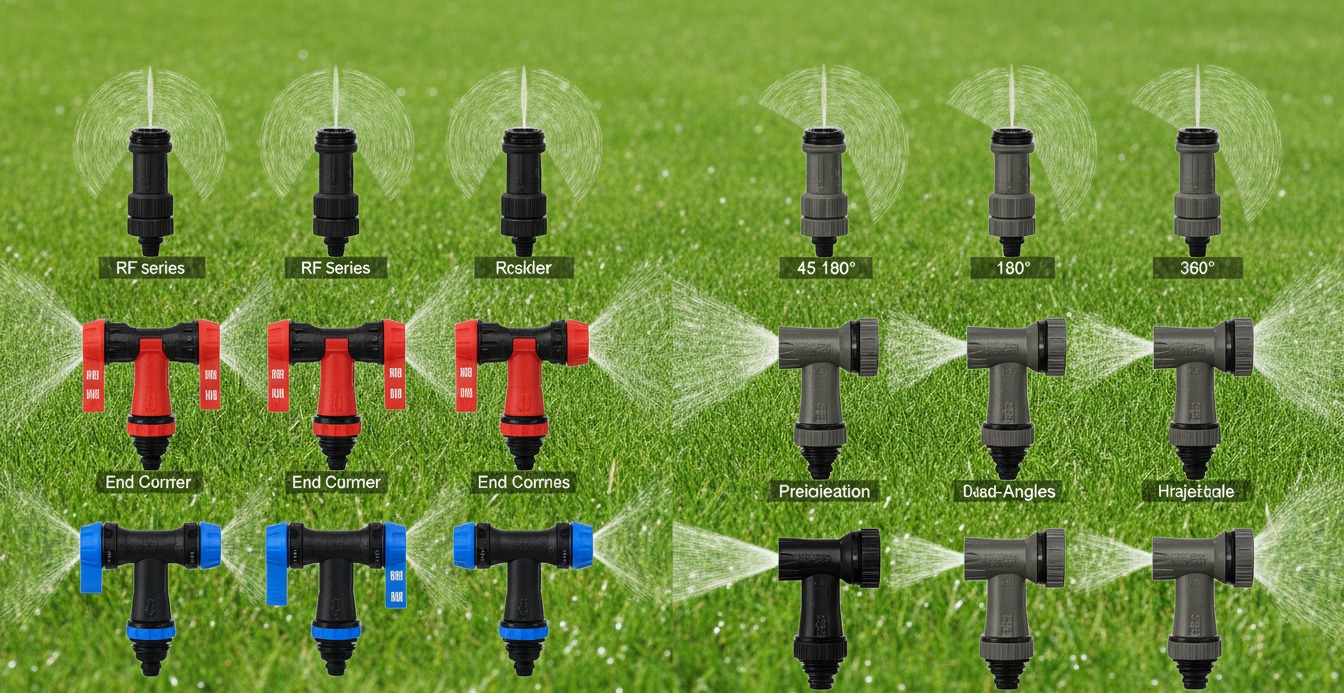
When retrofitting an existing pop-up sprinkler system, the nozzle choice is the single biggest lever for changing hydraulic performance. Swap a fixed RF spray nozzle for an FN rotary nozzle on the same body, and you can cut system flow by 40–60% while maintaining or improving coverage uniformity. The catch is that all nozzles are not interchangeable on all sprinkler bodies — and choosing the wrong series can create dry spots, overspray, or hydraulic override in the zone design.
This article provides a head-to-head technical comparison of INOVATO's RF and FN nozzle series, covering spray pattern geometry, precipitation rate behavior, thread compatibility, retrofit considerations, precipitation rate calculation methodology, spacing optimization math, water conservation economics, nozzle flow coefficients, soil intake rate matching, and wind drift correction factors for existing commercial and residential landscape systems.
RF Series Nozzles: Fixed Spray Pattern
INOVATO's RF series (Rotary-Fixed) nozzles are designed as a direct replacement for standard fixed spray nozzles, using a gear-driven rotary stream mechanism that produces multiple slow-rotating streams rather than a single fan pattern. The RF series includes models in quarter-circle, half-circle, and full-circle configurations.
| Model | Arc | Nozzle Pressure (bar) | Flow Rate (L/min) | Radius (m) | Thread |
|---|---|---|---|---|---|
| RF304 | 90°–210° adjustable | 1.5–4.0 | 1.5–7.6 | 3.0–4.9 | 1/2" BSP |
| RF101 | 90°–210° adjustable | 1.5–4.0 | 0.6–2.8 | 2.1–3.7 | 1/2" BSP |
| RF103 | 210°–360° adjustable | 1.5–4.0 | 1.8–9.0 | 3.0–4.9 | 1/2" BSP |
INOVATO's RF304 nozzle (RF304 product page) is the most widely used model for medium-radius retrofit applications, providing adjustable arc from 90° to 210° with a stream count ranging from 4 to 6 depending on the selected arc setting. The gear-driven rotation mechanism produces a cyclical pattern that distributes water more evenly than fixed-spray nozzles, reducing the peak application rate that causes runoff on compacted or sloped soils.
FN Series Nozzles: Precision Nozzle Application
The FN series uses a different internal geometry — multi-orifice fixed-spray with matched precipitation. These nozzles are designed for applications requiring a flat, even fan pattern with sharp pattern edges to minimize overspray onto adjacent hardscape.
| Model | Arc | Nozzle Pressure (bar) | Flow Rate (L/min) | Radius (m) | Thread |
|---|---|---|---|---|---|
| 4AN | Fixed 90° | 1.5–4.0 | 0.5–1.2 | 1.2–2.1 | 1/2" BSP |
| 6AN | Fixed 90° | 1.5–4.0 | 0.9–2.0 | 1.8–3.0 | 1/2" BSP |
| 8AN | Fixed 90° | 1.5–4.0 | 1.5–3.2 | 2.4–3.7 | 1/2" BSP |
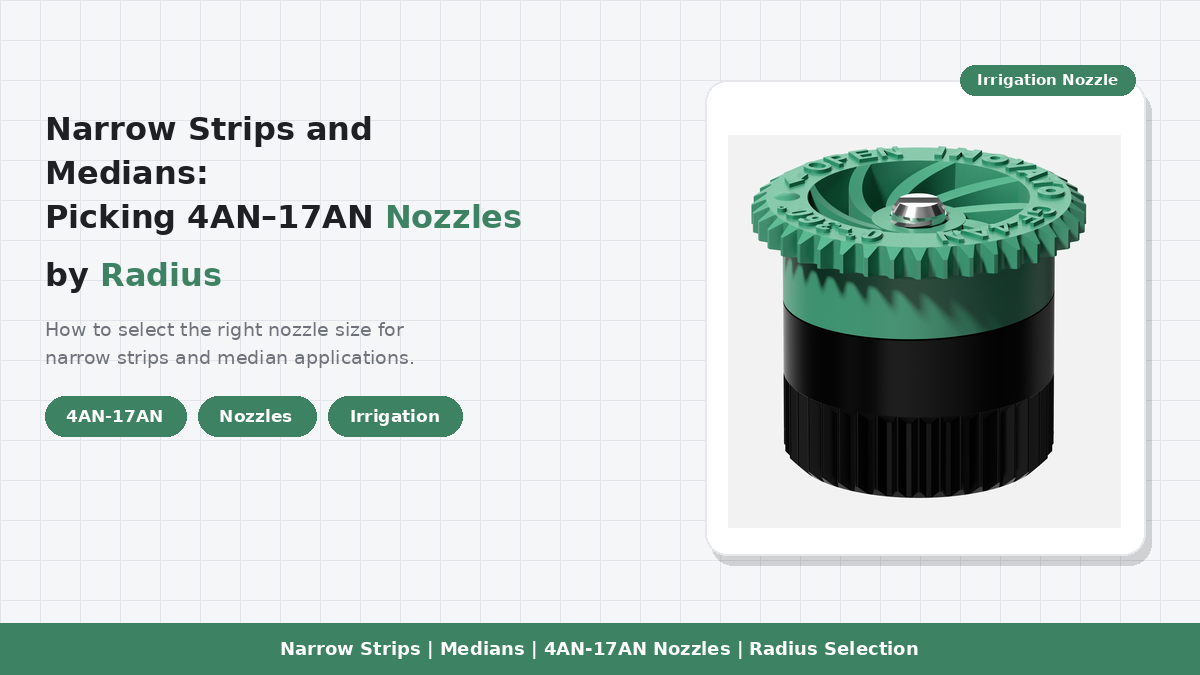
INOVATO's 4AN nozzle (4AN product page) is typically used in narrow strip applications where precise boundary demarcation is critical — median strips, pathways, and building perimeters. The fixed fan angle produces a rectangular or trapezoidal spray footprint with well-defined edges, making it suitable for landscapes with geometrically tight planting beds adjacent to paving.
RF vs. FN: Precipitation Rate Comparison
The most impactful difference between the RF and FN series is their precipitation rate (PR) behavior. At 2.5 bar:
- RF304 (quarter-circle): ~15–22 mm/h depending on radius setting
- 4AN (quarter-circle): ~18–25 mm/h at matched flow
- Standard fixed spray nozzle (comparison): ~30–45 mm/h
The RF series achieves lower precipitation rates because the rotating stream mechanism distributes the same volume over a longer dwell time per area. This means:
- Less runoff on clay and compacted soils
- Better infiltration on sloped terrain
- Longer allowable zone run times without exceeding soil intake rate
The FN series, while producing higher precipitation rates, offers sharper pattern edges and is better suited for small, geometrically constrained areas where the spray pattern must match the planting bed shape precisely.
Precipitation Rate Calculation Methodology
To calculate precipitation rate accurately for a given nozzle, use the standard formula:
PR (mm/h) = (Q × 1000) / (A × 60)
Where Q = flow rate in L/min and A = wetted area in m². For a quarter-circle nozzle with 180° pattern, A = (π × r²) / 2. For a 4.0 m radius: A = (3.1416 × 16) / 2 = 25.1 m². At 5.0 L/min flow, PR = (5.0 × 1000) / (25.1 × 60) = 3.32 mm/min or 199 mm/h — which is clearly excessive. This illustrates why matching nozzle flow to the wetted area (head spacing) is critical.
The Irrigation Association's classification for maximum allowable precipitation rate by soil type:
- Sand: Up to 50 mm/h
- Loam: 15–30 mm/h
- Clay: 5–15 mm/h (or lower on compacted clay)
RF series nozzles with PR in the 15–22 mm/h range are suitable for loam soils. For clay soils, the lower end of the RF304 range (15 mm/h) should be selected, and zone run times may need to be extended with cycle-and-soak scheduling to prevent runoff between cycles.
Nozzle Flow Coefficient (Cv) and Pressure Relationship
Every Sprinkler Nozzle has a discharge coefficient (Cv) that defines its flow characteristics as a function of pressure. The flow equation is:
Q = Cv × A × √(2gh)
Where Q = discharge flow rate, A = orifice cross-sectional area, g = gravitational acceleration, and h = operating pressure head. In practical irrigation terms, this simplifies to the commonly used relationship:
Q (L/min) = Kc × √P (bar)
Where Kc is the flow coefficient for that specific nozzle at a given arc setting. For the RF304 nozzle at its mid-arc setting of 180°, Kc is approximately 4.8 (L/min)/√bar. This means at 2.5 bar: Q = 4.8 × √2.5 = 4.8 × 1.58 = 7.58 L/min — consistent with the published 7.6 L/min specification.
Understanding the Cv relationship is critical when troubleshooting system performance. If a pressure gauge at the zone inlet reads lower than design pressure, the actual flow from each nozzle will be reduced proportionally to the square root of the pressure ratio. A 20% drop in pressure (from 2.5 bar to 2.0 bar) reduces flow to 89% of design flow — which means the precipitation rate drops by the same factor, potentially creating water-stressed zones.
Conversely, if zone pressure is higher than design (a common issue when fewer heads are installed than originally designed), the flow and throw radius increase beyond specifications. The throw radius relationship follows:
R ∝ √P
This means a 20% pressure increase yields approximately 10% greater throw radius. On an RF304 with a 4.0 m design radius, this becomes 4.4 m — pushing water beyond the intended pattern boundary and causing overspray.
For mixed FN/RF zone designs, the different Kc values of each series mean they respond differently to the same pressure change. FN nozzles (fixed multi-orifice) typically have a lower Kc than RF series nozzles at equivalent flow, making them more sensitive to small pressure deviations. A pressure-regulating valve at the zone inlet is the most reliable mitigation, maintaining stable operating pressure regardless of upstream fluctuations.
Soil Intake Rate vs. Precipitation Rate Matching
Precipitation rate calculation is only meaningful when compared against the soil's infiltration rate, also known as the soil intake rate. If the PR applied by the sprinkler exceeds the soil's ability to absorb water, the result is runoff — water pooling on the surface or moving laterally to drains, sidewalks, and streets rather than reaching the root zone.
The USDA NRCS soil classification system defines intake rates as follows:
- Sandy soils: 25–50 mm/h (high infiltration, requires higher application rates)
- Loamy soils: 10–30 mm/h (moderate infiltration)
- Clay or compacted soils: 2–10 mm/h (low infiltration, requires lower application rates)
For an existing irrigation system with standard fixed-spray nozzles applying 35–45 mm/h on clay soil, the mismatch is severe. Water arrives faster than the soil can absorb it, and typical cycle times of 10–15 minutes produce runoff within the first 3–5 minutes. The remaining cycle time is effectively wasted — the sprinkler continues to apply water that simply runs off.
Cycle-and-soak scheduling directly addresses this mismatch. The principle is straightforward: divide the total runtime into multiple shorter cycles with time between them for water to infiltrate. Instead of one 15-minute cycle at 40 mm/h on clay soil:
- Total water applied in 15 minutes: 40 mm/h × (15/60) = 10 mm
- Soil intake capacity per cycle: 5 mm/h × (5/60) = 0.42 mm per 5-minute cycle
A properly designed cycle-and-soak approach might use three 5-minute cycles, each separated by 20–30 minutes. Each cycle applies ~1.7 mm, which the soil can absorb. After three cycles, total applied water = ~5.1 mm, all infiltrated rather than running off.
RF series nozzles reduce the severity of this problem by operating at 15–22 mm/h — still above the intake rate of compacted clay but close enough that cycle-and-soak intervals become practical rather than requiring very short cycles every 3–4 minutes.
Wind Drift Correction Factors
Nozzle performance data is established under controlled test conditions with negligible wind. In real landscape installations, wind is a persistent factor that degrades distribution uniformity and effective throw radius. Applying a wind drift correction factor (WDF) is essential for accurate system design in exposed sites.
The distribution uniformity degrades approximately as follows relative to wind speed:
- 0–5 km/h (calm): No significant correction required
- 5–15 km/h (light breeze): Reduce effective throw radius by 5–10%; increase overlap to 55–60% of radius
- 15–25 km/h (moderate wind): Reduce effective throw radius by 10–20%; increase overlap to 60–65% of radius
- >25 km/h (strong wind): Postpone irrigation or use wind-tolerant FN strip nozzles; fixed-spray uniformity becomes unacceptable
For RF series rotary nozzles, wind has a more complex effect than for fixed-spray nozzles. The rotating multi-stream pattern is inherently more tolerant of light wind because each stream spends only a fraction of its cycle time in any given direction. However, at wind speeds above 15 km/h, the rotational asymmetry introduced by prevailing wind can cause the pattern to "lean," reducing coverage on the downwind side even as overspray increases on the upwind side.
Correcting for wind in spacing calculations involves adjusting the effective wetted area. Under a 15 km/h crosswind, the effective coverage area of a quarter-circle nozzle oriented into the wind may shrink by 10–15% on the downwind side while extending 5–8% on the upwind side. The net result is a distorted precipitation pattern with a lower uniformity coefficient.
Practical correction steps:
- Identify the prevailing wind direction during typical irrigation hours (usually early morning)
- Orient quarter-circle and half-circle heads so their open arc faces into the wind
- Increase head density (reduce spacing) by 10–15% on exposed sides
- For full-circle heads, accept average performance and focus on maintaining adequate overlap at the design spacing
Spacing and Layout Optimization
Proper head spacing determines whether the precipitation rate calculated for a nozzle is achievable in practice. The industry-standard spacing method is the "spacing to 50% of throw radius" rule, which ensures adequate overlap for uniform distribution.
For RF series nozzles with a 4.0 m radius at the mid-range pressure setting, heads should be spaced no more than 2.0 m apart in a triangular or square grid pattern. At 2.0 m spacing in a square grid, each head covers 4 m², and the system applies 7.6 L/min / 4 m² = 1.9 L/min/m². Converting to PR: (1.9 × 1000) / (60) = 31.7 mm/h — above the acceptable range for loam and clay soils.
This is why RF series nozzles should be evaluated with the actual installed spacing in the design, not just the nozzle's bare performance data. Adjusting the nozzle to a smaller radius setting (e.g., from 4.0 m to 3.0 m) reduces the covered area and changes the PR calculation — but also requires closer head spacing to maintain overlap.
Triangular (hexagonal) spacing generally provides better uniformity than square spacing for circular sprinklers because each head's wetted circle overlaps with six neighbors rather than four, creating a more continuous coverage pattern. For RF series quarter-circle heads arranged in a triangular grid, the optimal within-row spacing is 0.55 × diameter (D), and the between-row spacing is 0.73 × D, where D is the effective throw diameter.
Water Conservation and Flow Reduction Potential
One of the strongest arguments for RF series retrofit is the direct water savings achievable through flow reduction. A typical residential zone with 8 fixed-spray quarter-circle heads at 2.0 GPM each draws 16 GPM total. Replacing with RF304 nozzles at equivalent coverage reduces per-head flow to approximately 1.2 GPM, cutting total zone flow to 9.6 GPM — a 40% reduction.
This has cascading benefits:
- Pipe sizing can be reduced (smaller diameter mainlines and laterals)
- A smaller pump or booster can be specified for new installations
- Existing infrastructure can support more zones on the same manifold
- Water utility bills decrease proportionally with flow reduction
For commercial properties where irrigation constitutes 40–60% of water consumption, a full RF-series retrofit on a 20-zone system can reduce annual irrigation water use by 15–30% — meaningful both economically and from a municipal water use compliance perspective.
Beyond flow reduction, RF series nozzles also contribute to water conservation through improved application efficiency. Fixed spray nozzles typically apply water at rates exceeding soil infiltration, resulting in 15–30% runoff losses. RF series nozzles at 15–22 mm/h reduce — but do not eliminate — runoff losses. When combined with cycle-and-soak scheduling, application efficiency can reach 85–90%, compared to 60–70% for fixed spray systems without cycle management.
Water conservation economics can be quantified: if a zone applies 400 L/day through fixed-spray nozzles at 65% efficiency, effective root-zone delivery is 260 L/day. Achieving the same effective delivery with RF series nozzles at 85% efficiency requires only 306 L/day of applied water — a 24% reduction in actual water consumption. At a utility rate of CNY 4.50/m³, a 20-zone commercial property saving 94 L/day per zone (1,880 L/day total) saves CNY 8.46/day or approximately CNY 3,088/year in water costs alone, before accounting for reduced pumping energy.
Retrofit Compatibility
Both RF and FN series nozzles use the standard 1/2" BSP male thread (also known as 15/21" in some markets), which is compatible with virtually all standard pop-up sprinkler bodies on the market — including brands such as Hunter, Rain Bird, Toro, and Orbit. However, there are three compatibility factors to verify before bulk ordering:
1. Sprinkler Body Flow Capacity
RF series nozzles at high arc settings (270° or 360°) can draw up to 9.0 L/min (2.4 GPM). Some small pop-up bodies rated for 1.0–1.5 GPM minimum flow may not provide sufficient turbulence suppression for proper stream formation. In these cases, stepping up to a larger pop-up body or adding a pressure-regulating stem may be necessary.
2. Filter Requirements
RF series nozzles, being gear-driven, require cleaner water than fixed spray nozzles. A 100-mesh or finer filter is recommended at the zone valve. The standard pop-up body screen may not be sufficient, especially in systems using well water or pond water. Particulate matter entering the gear mechanism causes wear and eventual failure of the rotation mechanism — typically manifesting as uneven rotation speed and irregular spray pattern distribution.
3. Pressure Matching Across Zones
When retrofitting only part of a zone (e.g., replacing every other nozzle), the flow reduction from RF nozzles changes the pressure profile across the entire zone line. The remaining standard spray nozzles will receive higher-than-designed pressure and throw farther, potentially overspraying. The safest approach is full-zone retrofitting — replace all nozzles in a zone with the same RF or FN series. If partial retrofit is unavoidable, add pressure compensating nozzles to the remaining heads or install a pressure-regulating valve at the zone inlet to maintain design pressure.
Nozzle Selection Decision Matrix
| Landscape Condition | Recommended Series | Rationale |
|---|---|---|
| Large turf areas (> 15 m² per head spacing) | RF304, RF101 | Lower PR reduces runoff; wider radius coverage reduces head count |
| Narrow strips (< 2 m wide) | FN (4AN, 6AN) | Sharper pattern edges prevent overspray onto pavement |
| Slopes (> 10% grade) | RF series | Lower application rate allows infiltration before runoff begins |
| Mixed flower beds + turf | FN series | Fixed spray pattern allows precise placement between plant zones |
| Retrofit of existing fixed-spray zones | RF series | 40–60% flow reduction extends existing zone capacity or reduces pipe sizing |
For landscape designers and irrigation system integrators, the INOVATO RF304 (RF304 product page) and 4AN (4AN product page) nozzles represent the two ends of the retrofit spectrum — the RF for area coverage optimization and the FN for boundary precision. Both share the same thread standard, enabling mixed-specification zones with appropriate zoning.
Industry reference: Irrigation Association — Turf and Landscape Irrigation Best Management Practices provides the industry-standard methodology for precipitation rate calculation and zone matching. For hydraulic design guidelines, ASABE S398.1 covers performance test methods for Sprinkler Nozzles, applicable to both RF and FN series testing.
Conclusion
The choice between RF and FN series garden Sprinkler Nozzles should be driven by the dominant constraint in each zone: if the problem is flow capacity or runoff, go RF; if the problem is precision edge control or tight planting beds, go FN. Both series are thread-compatible with standard 1/2" BSP pop-up bodies, but always convert entire zones at once to avoid pressure-matching issues.
Understanding the full technical picture — including precipitation rate calculation, nozzle flow coefficients, soil intake rate matching, and wind drift correction — separates a properly designed retrofit from a simple nozzle swap. Each affects the others: the Kc determines how flow responds to pressure changes; pressure determines throw radius; throw radius determines spacing; spacing determines precipitation rate; and precipitation rate must be matched to soil intake rate to avoid runoff.
INOVATO's nozzle range covers the full spectrum of residential and commercial landscape applications, with published Cv, precipitation rate, and radius data for each model to support accurate hydraulic design.
Planning a nozzle retrofit for an existing landscape irrigation system?
INOVATO offers RF and FN series nozzles with compatible thread standards for all major pop-up sprinkler bodies.
Browse RF304 Nozzle Specs