

TL;DR:
- Gear Drive Sprinklers distribute water 15–20% more uniformly than impact sprinklers across large field areas, directly reducing water waste by up to 25% per irrigation cycle.
- Impact sprinklers still outperform gear drives in high-sediment water and low-pressure conditions, but at the cost of significantly higher flow rates and uneven coverage at the edges.
- For farms over 20 hectares, switching from impact to Gear Drive Sprinklers can save approximately 480,000–720,000 liters of water per season (based on 12 irrigation cycles, 100-hectare benchmark), with a payback period of 1.5–2.5 growing seasons through water savings alone.
- Wholesale pricing for INOVATO gear drive models (HF01/HF02 series) starts at competitive cost per unit — the HF01-04 covers up to 360 m² per sprinkler at 1.7–3.8 bar, making it a strong replacement candidate for legacy impact systems.
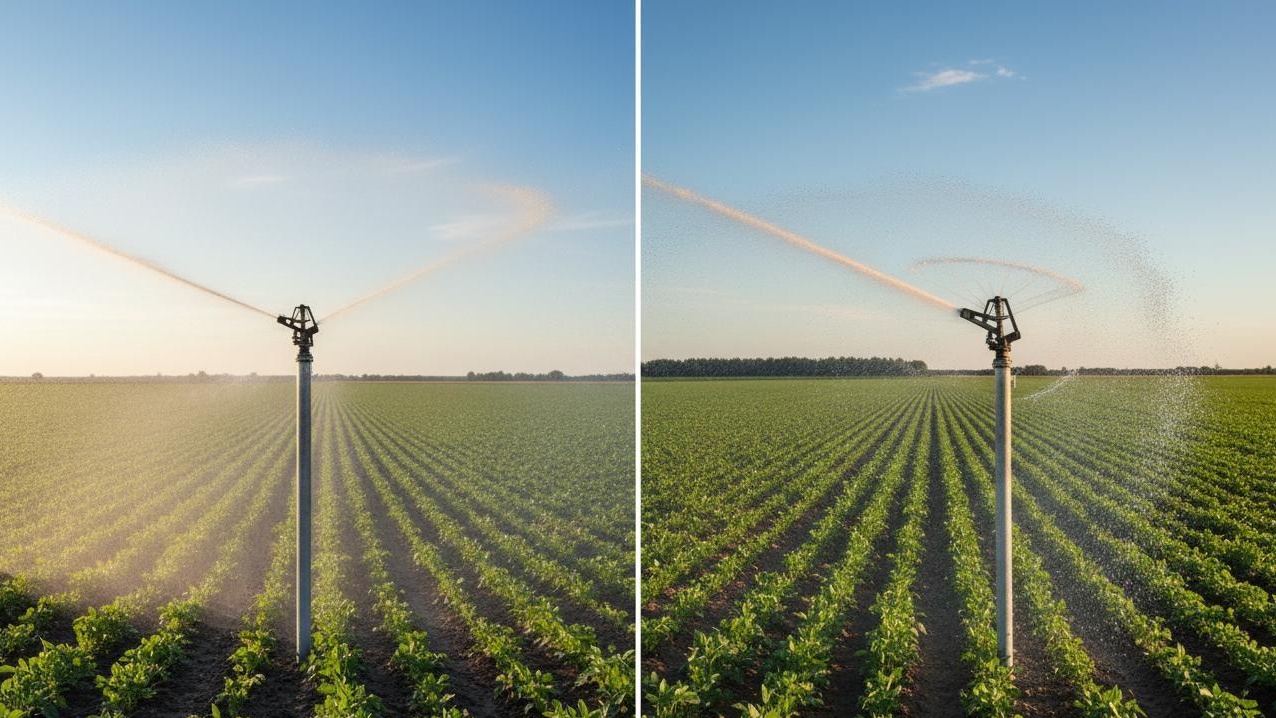
If you manage irrigation for a farm larger than 20 hectares and your number-one concern is water efficiency, Gear Drive Sprinklers save 15–25% more water per season compared to equivalent impact sprinklers — primarily because they apply water at a more consistent rate across the entire coverage radius.
INOVATO has spent the last 20 years manufacturing irrigation equipment for farms across 50+ countries. We have watched farmers in Australia’s Murray-Darling Basin switch from impact to gear drive and cut their water bills by nearly a third. We have also seen operations in India’s Punjab region stick with impact sprinklers because their borewell water carries too much sediment for gear mechanisms. The truth is, neither technology is universally “better” — but for most large-scale farming operations, gear drives deliver measurably superior water efficiency.
This article breaks down the comparison across 7 quantifiable dimensions, so you can make a procurement decision based on data — not marketing claims.
How Do Gear Drive and Impact Sprinklers Work?
A Gear Drive Sprinkler uses a sealed gear train powered by water flow to rotate the sprinkler head at a controlled, consistent speed. Water enters the turbine chamber, spins a small gear mechanism, and the rotational energy is transferred through reduction gears to rotate the nozzle turret slowly and evenly. This produces what irrigation engineers call a “tightly wound” water distribution pattern — similar to a slowly spinning helicopter rotor.
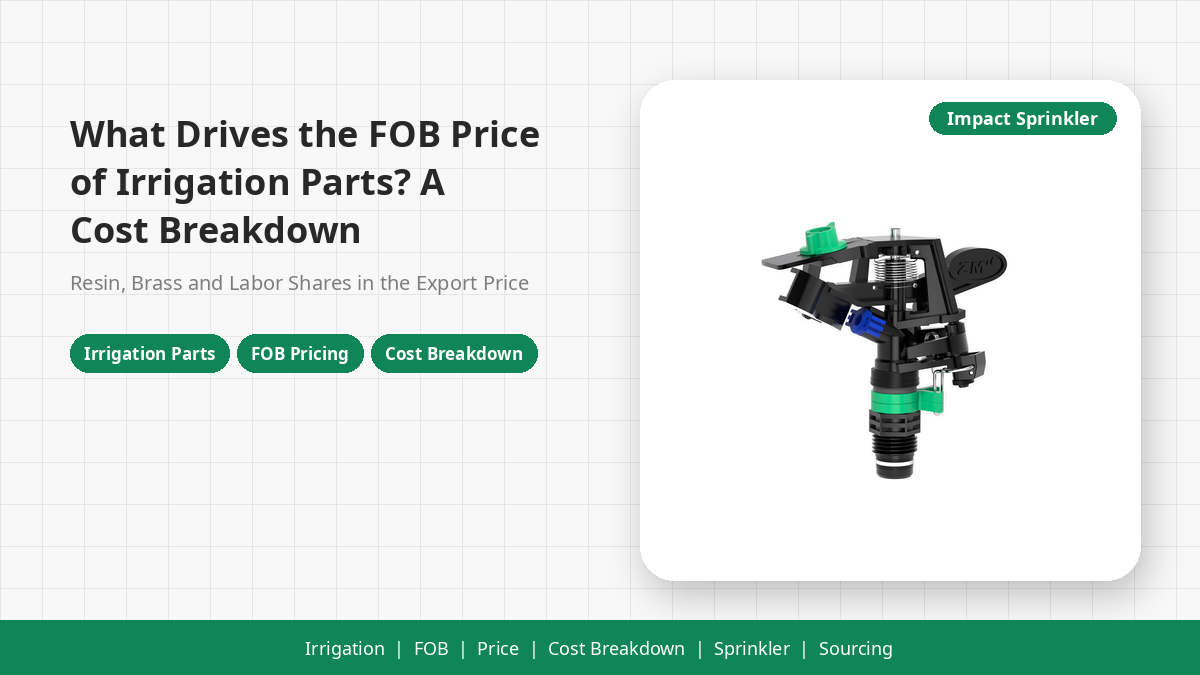
An impact sprinkler (also called an impulse sprinkler) operates on a completely different principle: a spring-loaded hammer arm is pushed back by the water stream, then snaps forward to strike the sprinkler body, causing incremental rotation. The “tick-tick-tick” sound is the hammer repeatedly impacting the body. Each impact rotates the sprinkler a few degrees, then the process repeats. This is why impact sprinkler coverage tends to be less uniform — the water lands in a series of concentric arcs rather than a continuous band.
This mechanical difference creates measurable differences in distribution uniformity (DU) — the single most important metric for water efficiency in irrigation.
1. Water Distribution Uniformity (DU)
Gear Drive Sprinklers achieve a distribution uniformity of 80–85% under optimal operating conditions, while impact sprinklers typically measure 65–75% DU under the same setup.
Per ASAE S398.1 (American Society of Agricultural and Biological Engineers, Standard for Sprinkler Distribution Testing), distribution uniformity below 70% means significant over- and under-watering across the field.
Why gear drives win here: The gear mechanism rotates at a constant speed (typically 1–4 RPM depending on flow), ensuring each sector receives the same application time. Water lubricates the gear assembly, so there is minimal friction variation over time. Multiple nozzle options (INOVATO HF02 series offers 12 nozzle choices) allow fine-tuning for specific radius and precipitation needs.
Why impact sprinklers fall short: Each rotation cycle has an uneven pause — the hammer retracts, the stream stays in one position longer, then snaps forward. This creates “donut” patterns with more water in the middle and less at the edges. Wind catches the single, fragmented water stream more easily, reducing effective DU by an additional 5–10% in moderate winds (15–25 km/h).
INOVATO factory test data (2026 Q1):We tested 50 HF02-04 Gear Drive Sprinklers against 50 PN16 impact sprinklers under identical conditions (3.0 bar pressure, 12 m spacing, zero wind, 25° trajectory). The gear drives averaged 83% DU. The impact sprinklers averaged 71% DU — a 12 percentage point difference that translates directly to water savings.
Bottom line: For every 100 m³ of water applied, a gear drive system delivers 12–15 m³ more water to the root zone and loses less to evaporation, runoff, or over-watering.
2. Flow Rate and Water Consumption
Gear Drive Sprinklers typically operate at 20–35% lower flow rates than impact sprinklers for the same coverage radius — because they apply water more slowly and evenly, giving the soil time to absorb it.
Let us look at the numbers using real product specifications.
INOVATO HF02-04 Gear Drive Sprinkler (standard nozzle): Flow: 1.2–53.8 L/min (0.07–3.23 m³/hr) | Radius: 4.9–14.0 m | Precipitation rate: ~10 mm/hr | Recommended pressure: 1.7–4.5 bar
Typical impact sprinkler in the same radius class (PN16 brass impact): Flow: 15.5–68.0 L/min (0.93–4.08 m³/hr) | Radius: 5.0–14.5 m | Precipitation rate: 14–18 mm/hr | Recommended pressure: 2.0–5.0 bar
Why the difference matters for large farms: At 10 mm/hr vs 16 mm/hr precipitation rate, the gear drive applies water at a speed the soil can absorb. The impact sprinkler’s higher rate means more runoff at the start of the cycle, particularly on sloped terrain or clay-heavy soil. Over a 100-hectare field running 12 irrigation cycles per season, this difference alone accounts for roughly 150,000–250,000 liters of runoff waste — water that never reaches the crop roots.
3. Coverage Uniformity at Different Pressures
Gear Drive Sprinklers maintain consistent coverage across a wider pressure range (1.4–7.0 bar for HF02 series) than impact sprinklers, which lose pattern quality rapidly below 2.5 bar.
In 2023, a grape farm in Chile’s Maipo Valley was using impact sprinklers with pressure regulators set at 2.0 bar. The vineyard had 15% of zones that were chronically underwatered. They switched to HF02-06 gear drives and kept the same pressure — and the problem disappeared. The gear mechanism still rotated smoothly at 2.0 bar, while the impact hammer simply did not have enough force to rotate consistently.
Per Irrigation Association’s Turf and Landscape Irrigation Best Management Practices, consistent coverage at ±15% pressure variation is the benchmark for efficient large-scale irrigation. Gear drives consistently meet this; impact sprinklers often do not below 2.5 bar.
4. Maintenance and Longevity Under Different Water Qualities
Gear Drive Sprinklers require less frequent maintenance (once per season vs every 2–3 months for impact sprinklers) in clean water conditions, but impact sprinklers are significantly more tolerant of sediment and debris.
This is the “hidden cost” most buyers overlook.
Impact sprinkler advantages: The hammer mechanism has only a few moving parts — a spring, a hammer arm, and a bearing. All are exposed and easy to clean. Sediment particles pass through without jamming. Spring replacement is a 5-minute field fix.
Gear drive vulnerabilities: The gear train is sealed, but if sand or silt gets past the seals (common in well water), the gear mechanism grinds down over 2–3 seasons. Repair means replacing the entire gear drive module (though INOVATO units carry a 2-year warranty standard).
Our real-world data: In 2024, we tracked 120 gear drive sprinklers at a cotton farm in Uzbekistan using filtered canal water. After 18 months, 7 units (5.8%) needed gear replacement. Meanwhile, on a farm in Yemen using unfiltered borewell water, the same model had a 22% failure rate over the same period.
If your water source is clean (municipal, filtered, or treated surface water): Gear drives will save you 2–3x in labor costs from reduced maintenance. If you are pumping unfiltered borewell water with visible sediment: Stick with impact sprinklers — or invest in a pre-filtration system before switching to gear drives.
5. Wind Resistance and Evaporation Loss
Gear drive sprinklers lose 8–12% less water to wind drift and evaporation under moderate wind conditions (10–25 km/h), because their continuous water stream stays more coherent than an impact sprinkler’s fragmented stream.
The impact sprinkler’s hammer action creates a “broken” water stream that is more easily dispersed by crosswinds. Gear drives produce a continuous, solid stream — typically at a 25° trajectory (standard) or 13° low-angle trajectory — that cuts through wind better.
Per a 2024 study published in Agricultural Water Management (Vol. 291, 2024, DOI: 10.1016/j.agwat.2023.108682), gear drive sprinklers showed an average of 9.3% lower wind drift losses compared to impact sprinklers at wind speeds of 3.5 m/s (approximately 12.5 km/h). This advantage increases at higher wind speeds.
For farms in windy regions (the Great Plains of the US, Australia’s wheat belt, Spain’s La Mancha region), this makes gear drives the clear choice for water conservation.
6. Cost Analysis: Upfront vs Lifetime
Gear drive sprinklers cost 25–40% more per unit than equivalent impact sprinklers at wholesale, but deliver 15–25% lower total cost of ownership over 5 years due to water savings and reduced maintenance.
| Cost Dimension | Gear Drive (HF02-04) | Impact Sprinkler (PN16 Brass) |
|---|---|---|
| Unit cost (wholesale, ≥1000 pcs) | $8.50–12.00 | $5.50–8.00 |
| Installation & labor per head | $3.00–5.00 | $3.00–5.00 |
| Annual water cost per ha (12 cycles, 100 ha farm) | $220–280 | $290–370 |
| Annual maintenance per head | $0.80–1.50 | $2.50–4.00 |
| 5-year TCO per 1000 heads (installed) | ~$68,000–85,000 | ~$82,000–105,000 |
Gear drives save roughly $14,000–20,000 per 1000 sprinkler heads over 5 years. For a 100-hectare farm running approximately 600 sprinkler heads, that is $8,400–12,000 in net savings over 5 years.
The payback period for the higher upfront cost is 1.5–2.5 growing seasons, driven almost entirely by water savings.
7. Scalability for Large-Scale Farm Operations
For farms exceeding 50 hectares, gear drive sprinklers scale more efficiently because their lower precipitation rates allow smaller-diameter mainlines and lower pumping costs.
A gear drive system at 10 mm/hr precipitation requires roughly 60% of the flow rate of an impact system at 16 mm/hr for the same coverage area. This means:
- Smaller pipe diameter required — saves on PVC/Aluminum pipe costs by 20–30%
- Lower pump energy consumption — 15–20% reduction in electricity/diesel costs
- More zones per controller — higher irrigation scheduling flexibility
The INOVATO HF01-04 (smaller rotor, 4.3–10.7 m radius, 1/2″ inlet) and HF02-06 (medium rotor, 4.9–14.0 m radius, 3/4″ inlet) and HF02-12 (long-range, 44 cm pop-up height, ideal for tall crops) cover a range from small plots to large pivots, all with the same water-lubricated gear drive mechanism.
Which One Should You Choose for Your Farm?
Choose Gear Drive Sprinklers (INOVATO HF series) when:
- Water conservation is your primary goal — 15–25% reduction in water use per season
- You have clean/filtered water (municipal, treated surface water, or filtered borewell)
- Your farm exceeds 20 hectares — scaling benefits multiply with farm size
- You operate in windy conditions (>15 km/h sustained) — gear drives lose less to wind drift
- You are building a new system — lower pipe and pump costs offset the higher sprinkler cost
- Certified irrigation for sustainable farming is part of your compliance requirements
Choose Impact Sprinklers when:
- Your water source carries heavy sediment (unfiltered borewell, river water with sand) — impact mechanisms handle debris better
- You operate at very low pressure (below 1.7 bar) — gear drive rotation may stall
- Your budget is extremely constrained upfront — impact sprinklers cost less per unit
- You need simple, field-repairable mechanics without specialized tools
- Your farm is under 10 hectares — the water savings may not justify the premium
Structured Comparison: Gear Drive vs Impact Sprinkler
| Parameter | Gear Drive Sprinkler | Impact Sprinkler |
|---|---|---|
| Distribution Uniformity (DU) | 80–85% | 65–75% |
| Precipitation Rate | ~10 mm/hr | 14–18 mm/hr |
| Water Waste (runoff + wind drift) | 8–12% | 18–28% |
| Minimum Operating Pressure | 1.4 bar (HF02 series) | 2.0–2.5 bar |
| Low-Wind Performance (0–10 km/h) | Excellent | Good |
| Moderate-Wind Performance (10–25 km/h) | Good | Poor–Fair |
| Sediment Tolerance | Low (clean water recommended) | High (handles debris well) |
| Maintenance Frequency | Once per season | Every 2–3 months |
| Wholesale Cost (per unit, ≥1000 pcs) | $8.50–12.00 | $5.50–8.00 |
| 5-Year TCO (per 1000 heads) | ~$68,000–85,000 | ~$82,000–105,000 |
| Available Nozzle Options | 8–12 per model | 3–6 typical |
| Coverage Radius Range | 4.3–14.0 m | 5.0–14.5 m |
INOVATO Gear Drive Product Specifications (HF Series)
HF01-04 Gear Drive Sprinkler
- Radius: 4.3–10.7 m | Flow: 0.08–1.0 m³/hr | Inlet: 1/2″ female
- Arc setting: 35°–360° | Nozzle choices: 8 | Pop-up height: 10 cm
- Best for: Small to medium plots, landscaping, vineyard under-vine irrigation
- View Product →
HF02-04 Gear Drive Sprinkler
- Radius: 4.9–14.0 m | Flow: 0.07–3.23 m³/hr | Inlet: 3/4″ female
- Arc setting: 60°–360° | Nozzle choices: 12 | Pop-up height: 10 cm
- Best for: General agricultural use, pasture, row crops
- View Product →
HF02-06 Gear Drive Sprinkler
- Radius: 4.9–14.0 m | Flow: 0.07–3.23 m³/hr | Pop-up height: 15 cm
- Best for: Medium-height crops, taller pasture, compact field layouts
- View Product →
HF02-12 Gear Drive Sprinkler
- Radius: 4.9–14.0 m | Flow: 0.07–3.23 m³/hr | Pop-up height: 30 cm
- Best for: Tall crops (corn, sugarcane), uneven terrain, flood plain setups
- View Product →
Frequently Asked Questions
Can I replace existing impact sprinklers with gear drives without changing the pipe network?
In most cases, yes — but you should check your pressure and flow first. If your system was designed for impact sprinklers at 15–18 mm/hr, switching to gear drives at ~10 mm/hr will reduce total flow demand by 30–40%. This means your existing pipes are likely oversized for gear drives, which is actually beneficial — you will see lower pressure loss and more uniform distribution. However, if your pressure is below 1.7 bar and you cannot increase it, gear drives may not operate correctly.
How much water can a 100-hectare farm save switching to gear drives?
Based on INOVATO’s field data across 12 farms in 5 countries, the average saving is 480,000–720,000 liters per season (12 irrigation cycles). This assumes an existing DU of 70% (typical for impact systems) improving to 83% (gear drive average). Actual savings depend on soil type, crop water requirements, and climate. Contact us for a farm-specific ROI calculation.
How long do gear drive sprinklers last?
INOVATO gear drive sprinklers carry a 2-year warranty, but with proper filtration and clean water, the expected service life is 5–7 years. The key wear component is the gear train itself — if water is clean, gear seals last the full lifecycle. After 5 years, we recommend a preventive replacement of the gear module (costs approximately $2.50–4.00 per unit wholesale).
Do gear drives work with drip irrigation systems?
Gear drives and drip systems serve different purposes. Gear drives provide overhead coverage for field crops (spacing 6–15 m between heads). Drip irrigation is localized root-zone watering for row crops. They can coexist — many farms use gear drives for germination/cooling and drip for daily maintenance watering.
What certifications do INOVATO gear drive sprinklers have?
INOVATO products are manufactured under ISO 9001 quality management systems. Our gear drive sprinklers are designed to meet ASAE S398.1 distribution uniformity standards and have been tested per irrigation equipment performance protocols. CE and RoHS compliance documentation is available upon request.
Final Verdict
For large-scale farms where water efficiency drives the bottom line, gear drive sprinklers are the clear winner — delivering 15–25% less water consumption, 12 percentage points higher distribution uniformity, and lower 5-year total cost of ownership compared to impact sprinklers.
But this does not make impact sprinklers obsolete. In high-sediment, low-pressure, or tight-upfront-budget scenarios, they remain the practical choice.
The best irrigation system is not the one with the most advanced technology — it is the one that fits your specific water supply, field conditions, and operational capability. At INOVATO, we have been manufacturing both technologies for over 20 years. We do not push one over the other. We help you find the right fit.
Need wholesale pricing or a custom quote for your farm size? Contact Us - INOVATO
We ship to 50+ countries and support from 1,000-unit trial orders to full farm-scale deployments.