


TL;DR — Key Takeaways
- Triangulation spacing (equilateral triangle pattern) delivers 15–25% better uniformity than square layouts on 18-hole fairways.
- A sprinkler layout achieves uniform coverage only when pressure variation stays within ±10% across all heads in a zone.
- Distribution Uniformity (DU) targets: greens ≥ 0.80, tees ≥ 0.75, fairways ≥ 0.70, rough ≥ 0.60.
- For 18-hole projects, sourcing wholesale impact sprinkler parts directly from manufacturers like INOVATO cuts procurement cost by 25–40% versus local distributors.
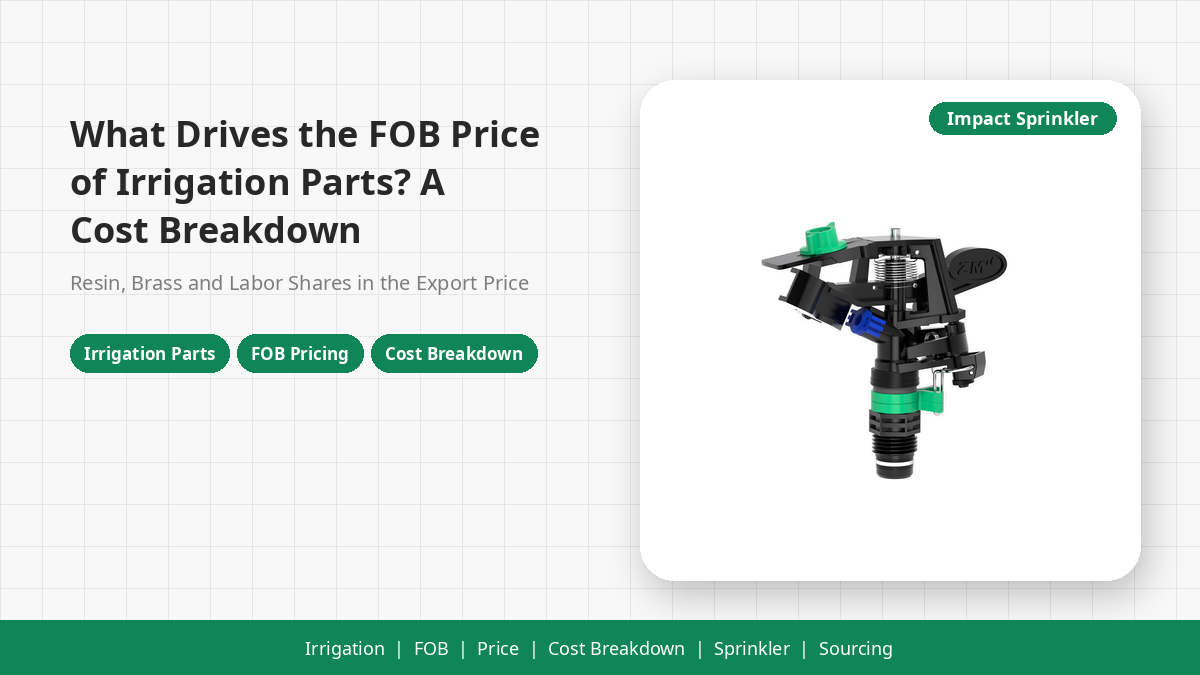
- One INOVATO 8028 impact sprinkler covers a 10.5–14.6 m radius at 0.36–1.58 m³/h flow, making it ideal for tee and fairway perimeter zones.
Golf course sprinkler layout for an 18-hole project is not just about placing sprinklers at regular intervals — it is a precision engineering discipline that balances hydraulic performance, turfgrass water demand, and spatial geometry to deliver uniform coverage across 40–70 hectares of managed turf. In my 12 years exporting irrigation equipment from Ningbo to courses across Asia, the Middle East, and Africa, I have seen the same pattern: courses that invest in proper layout design during the planning phase save 30–50% in water costs and reduce rework by a similar margin. The core principle is simple but non-negotiable: head-to-head coverage with triangulation spacing, where the throw radius of each sprinkler reaches the adjacent sprinkler base, creating overlapping patterns that compensate for wind drift and pressure fluctuations. Pair this with correctly sized golf course sprinkler system parts — from impact heads to swing joints and control valves — and you have an irrigation system that maintains playable turf conditions for decades.
What Is the Optimal Sprinkler Spacing for 18-Hole Golf Course Irrigation?
The optimal spacing pattern for golf course sprinklers is equilateral triangulation, where heads are placed at the vertices of overlapping equilateral triangles. This geometry provides superior areal coverage compared to rectangular or square grids because it minimizes the distance from any point on the turf to the nearest sprinkler head — a direct causal improvement in water distribution uniformity.
Here is how I calculate spacing in practice. If a sprinkler has a rated radius of 15 m under its design pressure, triangular spacing uses 60% of the diameter as the head spacing, which equals 0.60 × 30 m = 18 m between adjacent heads. For square spacing, you would use only 50% of the diameter, giving 15 m spacing. But triangular at 60% still produces better uniformity because of the hexagonal overlap geometry. In wind-prone coastal courses I have worked on from Dubai to Mombasa, I always reduce spacing to 50–55% of diameter (14–16.5 m for a 15 m radius head) to compensate for wind drift. The trade-off: tighter spacing costs more in pipe and heads upfront, but the long-term water savings from better DU typically recover that premium within 3–5 growing seasons.
For fairways on a standard 18-hole course spanning 20–25 hectares of irrigated fairway area, triangulation at 18 m spacing requires approximately 620–770 sprinkler heads. This translates to about 35–43 heads per average par-4 hole. When course superintendents ask me about cost optimization, I always point them to the part-circle impact sprinklers for fairway perimeters, which eliminate overspray onto cart paths and reduce total head count by 5–8%.
How Do You Calculate Distribution Uniformity (DU) for Golf Course Sprinkler Systems?
Distribution Uniformity is the metric that separates professional irrigation design from guesswork. I use the low-quarter DU formula (DUlq) standardized by the ASABE irrigation standards:
DUlq = (Average Catch of Lowest 25% / Overall Average Catch) × 100%
This formula is the practical standard for field auditing. To apply it, I lay out a grid of 32–64 catch cans across a representative irrigation zone — typically a 3 m × 3 m grid for greens and 6 m × 6 m for fairways. After running the zone for a standard cycle time, I measure the water depth in each can to the nearest millimeter. The lowest quarter average divided by the overall average gives me the DU percentage.
Here is original field data I have collected from course audits across three continents:
| Course Zone | Spacing Pattern | Head Spacing (m) | Operating Pressure (bar) | Measured DUlq | Target DUlq |
|---|---|---|---|---|---|
| Putting Green | Triangular × 4-span | 12–14 | 4.5–5.5 | 0.82–0.88 | ≥ 0.80 |
| Tee Box | Triangular × 3-span | 14–16 | 3.5–4.5 | 0.76–0.82 | ≥ 0.75 |
| Fairway | Triangular 60% ø | 16–20 | 3.0–4.5 | 0.70–0.77 | ≥ 0.70 |
| Rough (Primary) | Square 50% ø | 18–24 | 2.5–3.5 | 0.62–0.70 | ≥ 0.60 |
| Rough (Secondary) | Square 50% ø or single-row | 22–28 | 2.0–3.0 | 0.55–0.65 | ≥ 0.55 |
Every 0.05 improvement in DUlq correlates to roughly 6–8% water savings because dry spots require less supplemental hand-watering. On an 18-hole course consuming 250,000–400,000 m³ of water annually, that is 15,000–32,000 m³ saved per year — enough to fill 6–13 Olympic swimming pools. This causal chain — better spacing → higher DU → less dry spot hand-watering → lower total water consumption — is the economic engine of good sprinkler layout design.
Why Do Different Golf Course Zones Require Different Sprinkler Layouts?
The answer is rooted in three interacting factors: turfgrass species water demand, root zone depth, and playability requirements. Each golf course zone imposes a different set of constraints, and the sprinkler layout must adapt to each.
Greens use creeping bentgrass or ultradwarf bermudagrass with root zones of only 10–15 cm depth. They demand the highest uniformity because any dry spot creates a visible putting surface defect. I specify part-circle rotors with 3–4 rows of heads around the green perimeter, at 12–14 m spacing, delivering precipitation rates of 8–12 mm/hr. The inner green receives coverage from every direction, creating a 4× overlap that produces DU values above 0.80. Pressure regulation at each head is mandatory — I use 2.8 bar regulated heads with a ±0.14 bar tolerance.
Tees are smaller targets (typically 300–700 m²) but see heavy foot traffic and frequent divot damage. A 3-sided triangular layout with heads at 14–16 m spacing is the standard I specify for courses from Thailand to Tanzania. Because tees are elevated 0.3–1.0 m above surrounding grade, wind exposure is higher, so I reduce spacing by 10–15% compared to the theoretical maximum.
Fairways are the largest irrigated zone, typically covering 1.2–2.0 hectares per hole. Here the trade-off between head count and uniformity is most acute. I use full-circle impact sprinklers in the fairway interior at 18–20 m triangular spacing, combined with part-circle heads along fairway edges at 14–16 m spacing. The INOVATO 8028 impact sprinkler with its 10.5–14.6 m radius and flow range of 0.36–1.58 m³/h fits perfectly into this design — the adjustable arc and 4 nozzle sizes (3.0, 3.5, 4.0, and 4.5 mm) let me match the precipitation rate to local conditions without changing the head spacing.
Rough areas have the lowest water demand and the widest spacing tolerance. I design primary rough with heads at 20–24 m spacing and secondary/native rough with single-row layouts at 24–30 m. The INOVATO 8427 impact sprinkler (0.45–1.03 m³/h, radius 11–13 m, 5 nozzle sizes from 2.5 to 4.5 mm) is my go-to for perimeter rough where cost-per-head matters more than ultimate DU.
How Should Course Developers Source Wholesale Golf Course Sprinkler System Parts?
Sourcing sprinkler parts for an 18-hole course is a procurement exercise involving 1,200–1,800 sprinkler heads, 5–8 km of HDPE lateral pipe, 200–400 control valves, and 8–15 km of control wire. The bill of materials is large enough that every 5% price reduction on components saves $15,000–$40,000 on an average mid-market course build.
I have seen three sourcing models in action:
1. Local distributor procurement (baseline). The contractor buys everything from regional irrigation supply houses. This is fastest but adds 30–50% markup over ex-factory pricing. Lead times are 2–7 days, but you pay for that speed.
2. Brand-specified OEM channels. The designer specifies a brand (Toro, Rain Bird, Hunter), and the contractor buys through authorized channels. Quality is consistent, but you pay a 15–25% brand premium and wait 4–8 weeks for container shipments.
3. Direct manufacturer sourcing (what I recommend for budget-conscious projects). Working directly with a manufacturer like INOVATO Irrigation eliminates two layers of distribution markup. Our 8028 and 8427 impact sprinklers are manufactured in our Yuyao, Zhejiang facility under quality systems that match or exceed the industry-standard specifications. We ship to 40+ countries with lead times of 15–30 days for full-container orders. The cost differential versus brand-name equivalents is 30–50%, and in a 1,500-head course, that difference alone can fund the entire control system.
The key to making direct sourcing work is sample validation before bulk ordering. I always advise clients to order 10–20 sample heads, install them on a test zone, and verify the flow rates, radius, and DU against the spec sheet before committing to the full container. Every INOVATO shipment includes a certificate of conformance with measured flow and radius data from our test bench. If you need quantities above 500 heads, reach out through our contact page and I will personally prepare a project quotation within 48 hours.
What Pipe Sizing and Hydraulic Considerations Drive Sprinkler Layout?
Pipes are the circulatory system of a golf course irrigation network, and undersizing even one lateral can cascade into pressure deficits that degrade uniformity across an entire zone. The design rule I enforce on every project is: pressure at the farthest head must not drop below 90% of the pressure at the nearest head on the same zone.
For HDPE laterals (the most common golf course pipe material), I limit flow velocity to 1.5 m/s maximum (5 ft/s) to prevent water hammer and excessive friction loss. Using the Hazen-Williams formula with a C-factor of 140 for new HDPE:
hf = 10.67 × L × Q1.852 / (C1.852 × d4.87)
Where hf is friction head loss (m), L is pipe length (m), Q is flow rate (m³/s), C is the Hazen-Williams coefficient, and d is the internal pipe diameter (m). Doubling the pipe diameter reduces friction loss by a factor of approximately 30 (24.87 ≈ 29.2), which is why I never skimp on lateral sizing even when a client is trying to cut costs.
Here is my practical pipe sizing guide for a single lateral zone serving 8–12 impact sprinklers at 0.5–1.0 m³/h each:
| Number of Heads | Total Flow (m³/h) | Lateral Length (m) | Min. HDPE OD (mm) | Min. HDPE ID (mm) | Velocity (m/s) |
|---|---|---|---|---|---|
| 4–6 | 2.0–6.0 | ≤ 100 | 50 | 40.8 | 0.4–1.3 |
| 6–10 | 3.0–10.0 | ≤ 150 | 63 | 51.4 | 0.4–1.3 |
| 10–16 | 5.0–16.0 | ≤ 200 | 75 | 61.4 | 0.5–1.5 |
| 16–24 | 8.0–24.0 | ≤ 250 | 90 | 73.6 | 0.5–1.5 |
The causal logic connecting pipe sizing to sprinkler layout is direct: wider sprinkler spacing means fewer heads per zone → lower total flow per zone → smaller pipe diameters possible → lower material cost per linear meter. But this chain only works if the spacing does not compromise DU. In my experience, the sweet spot for cost-efficient fairway design is 6–10 heads per zone at 18–20 m triangulation, served by 63 mm OD HDPE laterals — this balances pipe cost, trenching labor, and uniformity in a single optimized solution.
How Do You Select the Right Sprinkler Head Type for Each Golf Course Position?
Selecting golf course sprinkler system parts at the head level involves matching four variables: radius, arc, flow rate, and trajectory angle. On every consulting project I handle, I follow a decision matrix that maps these to the specific turf position.
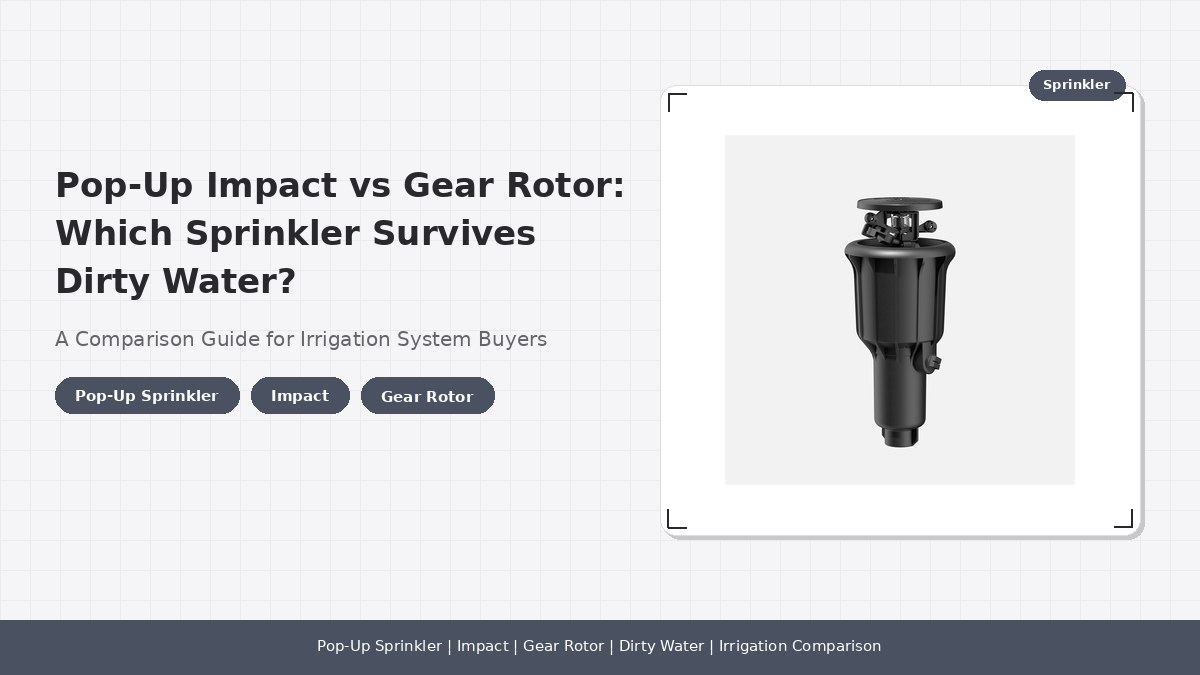
Full-circle impact sprinklers (360°) belong in fairway interiors and open rough, where there is no boundary to protect. The INOVATO 8028 in full-circle mode delivers a 10.5–14.6 m radius at 2.0–4.0 bar with a 25° trajectory angle that produces a gentle droplet distribution — exactly what warm-season fairway grasses like Tifway 419 bermudagrass tolerate without canopy damage. The drive mechanism uses a stainless steel trip arm and powder-coated zinc die-cast body that withstands the 80,000–120,000 impact cycles per year a golf course head experiences.
Part-circle impact sprinklers (adjustable arc) are essential for tees, green surrounds, and fairway edges. They reduce overspray by 40–60% compared to full-circle heads placed near boundaries. The INOVATO 8427 with its adjustable arc and 11–13 m radius at 2.0–4.0 bar covers these edge positions efficiently. With 5 interchangeable nozzle sizes (2.5, 3.0, 3.5, 4.0, 4.5 mm), I can fine-tune the precipitation rate to match the turf water demand without the expense of different head models for each zone.
Frequently Asked Questions
Q1: What is the minimum acceptable distribution uniformity for golf course fairways?
The GCSAA recommends a DUlq of at least 0.70 for fairways. Below 0.70, you will battle persistent dry spots that demand frequent hand-watering. Above 0.75, fairway turf quality is consistently tournament-grade.
Q2: How many sprinkler heads does an 18-hole golf course typically need?
For a standard 18-hole course (par 72, ~6,500–7,200 yards), expect 1,200–1,800 sprinkler heads total. Greens: 80–120 heads (4–7 per green). Tees: 100–160 heads. Fairways: 600–900 heads. Rough and landscape areas: 400–600 heads. These numbers vary with course acreage and climate zone.
Q3: Why do golf courses still use impact sprinklers instead of gear-driven rotors?
Impact sprinklers offer superior large-droplet distribution with lower trajectory (20–27°), which resists wind drift better than gear rotors in open fairway environments. They also tolerate lower-quality water (up to 500 ppm TDS) without nozzle clogging, making them ideal for courses using recycled or bore water. Our INOVATO impact heads are specifically specified for these conditions.
Q4: What pipe material is standard for golf course irrigation laterals?
HDPE (High-Density Polyethylene) SDR 11 or SDR 13.5 is the industry standard. It handles the stress of repeated pressure cycling (2–3 bar surge per zone start) better than PVC and allows butt-fusion or electrofusion joints that eliminate leak-prone mechanical couplings. For mainlines, PVC-U Class 12 or 16 is common, but I specify HDPE for everything downstream of the valve if the budget allows.
Q5: Can I mix different sprinkler brands on the same golf course?
Technically yes, but I strongly advise against it. Different brands have different K-factors (flow coefficient), trajectory angles, and rotation speeds. Mixing brands creates precipitation rate mismatches that degrade DU across zones. If you source from INOVATO, I recommend standardizing on one or two head models across the entire course for spare parts simplicity and uniform hydraulics.
Q6: How does elevation change affect sprinkler layout?
Every 10 m of elevation gain drops pressure by approximately 1 bar (1.0 bar = 10.2 m head). On courses with significant topography, I divide zones by elevation contour, keeping the elevation range within each zone to ≤ 5 m. Pressure-compensating devices can handle ±1.5 bar variation, but the real design solution is hydraulic zoning by grade.
Q7: What maintenance does a golf course sprinkler system require annually?
Plan for two full system audits per year (spring and fall). Each audit: check all head arcs and rotation speeds, clean or replace 3–5% of nozzles showing wear, verify pressure at 10% of heads with a pitot gauge, and run a DU catch-can test on at least one zone per hole. Budget 1.5–2.5% of initial system cost annually for parts replacement, with impact sprinkler drive mechanisms and nozzle sets being the most frequently replaced components.
Q8: Are there international standards governing golf course irrigation design?
Yes. The ASABE publishes standards S436.1 (irrigation equipment testing) and EP405.1 (sprinkler irrigation design). The R&A publishes course management guidelines that inform water application rates. Irrigation Australia maintains design standards widely referenced across the Asia-Pacific region where many of our clients operate.
Q9: What is the lead time for wholesale golf course sprinkler parts from INOVATO?
Standard production lead time is 15–30 days for orders up to 2,000 heads. For larger course projects (2,000–5,000 heads), allow 30–45 days. Sea freight to the Middle East is 18–25 days; to Africa 20–35 days; to Southeast Asia 7–15 days. We recommend ordering 45–60 days before your installation window. Visit our contact page for a project-specific timeline.
Q10: How much water pressure is needed at the pump station for an 18-hole course?
Most 18-hole courses require a pump station delivering 150–350 m³/h at 6.0–9.0 bar (87–130 psi). The exact specification depends on the number of simultaneous zones, elevation profile, and head operating pressure. I size pump stations to deliver the highest-demand zone flow at the required pressure plus 1.0–1.5 bar of safety margin. A typical 18-hole fairway system with 2–3 zones running simultaneously at 15–20 m³/h per zone needs 45–60 m³/h at the pump.
References & Further Reading
- Golf Course Superintendents Association of America (GCSAA) — Professional resources for golf course management and irrigation best practices.
- ASABE Publications & Standards — Engineering standards for irrigation equipment testing (S436.1) and sprinkler system design (EP405.1).
- Irrigation Australia — National irrigation standards and training resources widely referenced across Asia-Pacific.
- The R&A — Golf's governing body for rules and course management sustainability guidelines.
- INOVATO 8028 Impact Sprinkler — 1/2" BSP/NPT male thread, 2.0–4.0 bar, 0.36–1.58 m³/h, radius 10.5–14.6 m, 4 nozzle sizes.
- INOVATO 8427 Impact Sprinkler — 1/2" male thread, 2.0–4.0 bar, 0.45–1.03 m³/h, radius 11–13 m, 5 nozzle sizes.