

Golf Course Sprinkler System Parts: Gear Drive vs Impact Coverage Patterns for Fairway, Tee, and Green Zones
When golf course architects design an irrigation system, they are not just placing sprinklers on a plan — they are engineering a water distribution network that will operate every night for twenty-plus years, under varying pressure, wind conditions, and turf stress. The choice between Gear Drive Sprinklers and impact sprinklers is the first and most consequential decision in that design process. Get it wrong, and no amount of later-stage optimization will fully compensate.
This article is written for irrigation contractors, golf course builders, and procurement managers who need a practical technical reference for selecting the right sprinkler type for each zone — fairway, tee, green, rough — and understanding the cost, performance, and maintenance trade-offs that play out over the life of the system.
 The Core Choice: Gear Drive vs Impact
The choice between gear drive and impact sprinklers is not simply a cost question — it is a question of water uniformity, maintenance burden, and long-term operating cost per acre of maintained turf. I have spent fifteen years working with golf course architects, irrigation contractors, and grounds management teams, and the data consistently shows that the initial unit cost difference is typically recovered within 24 months through reduced water consumption and improved turf quality.
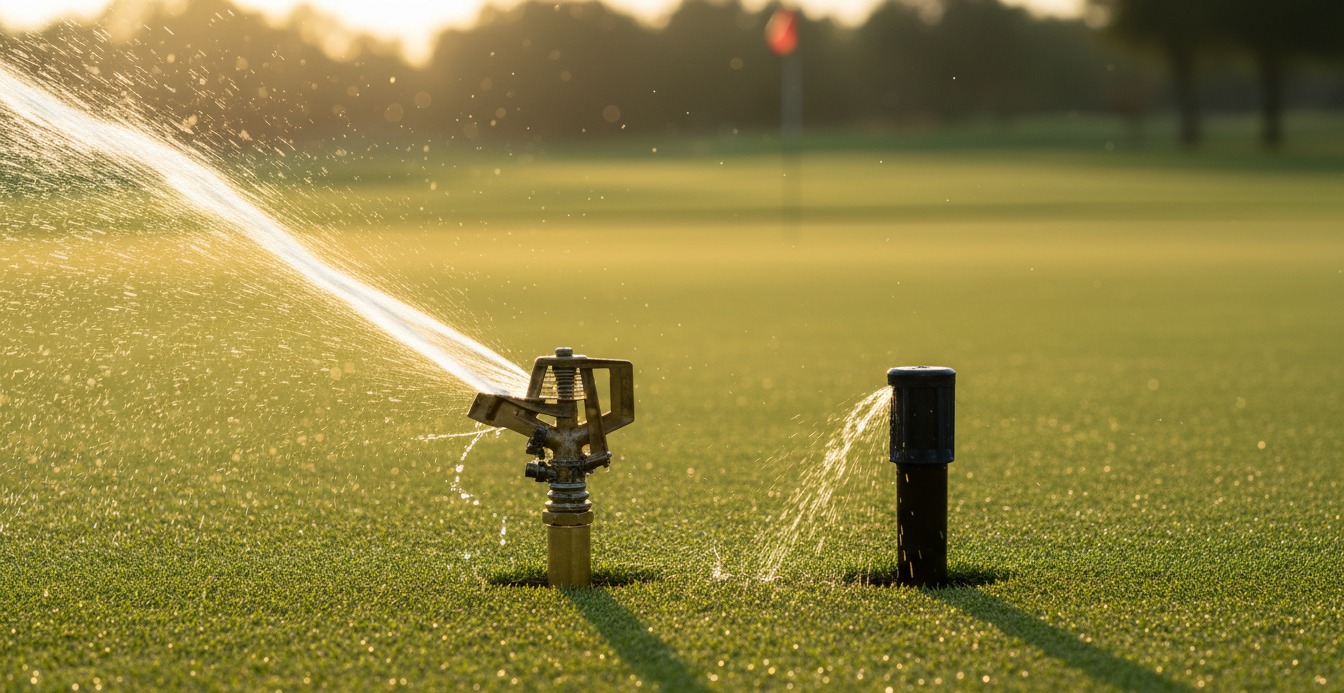
The fundamental difference comes down to how the rotating nozzle is driven. Gear Drive Sprinklers use an internal turbine gear mechanism to achieve a slow, constant rotation speed regardless of minor pressure fluctuations. Impact sprinklers use the reaction force of a water jet striking a spring-loaded oscillating arm — the arm's bounce rate varies with water pressure, which means rotation speed changes noticeably if the pump output varies.
For premium turf surfaces like fairways and greens, where water uniformity directly affects grass health and playing surface consistency, gear drive is the standard specification. For rough and semirough zones, where cost per head matters more than distribution uniformity, impact sprinklers remain the practical choice.
How Gear Drive Sprinklers Work
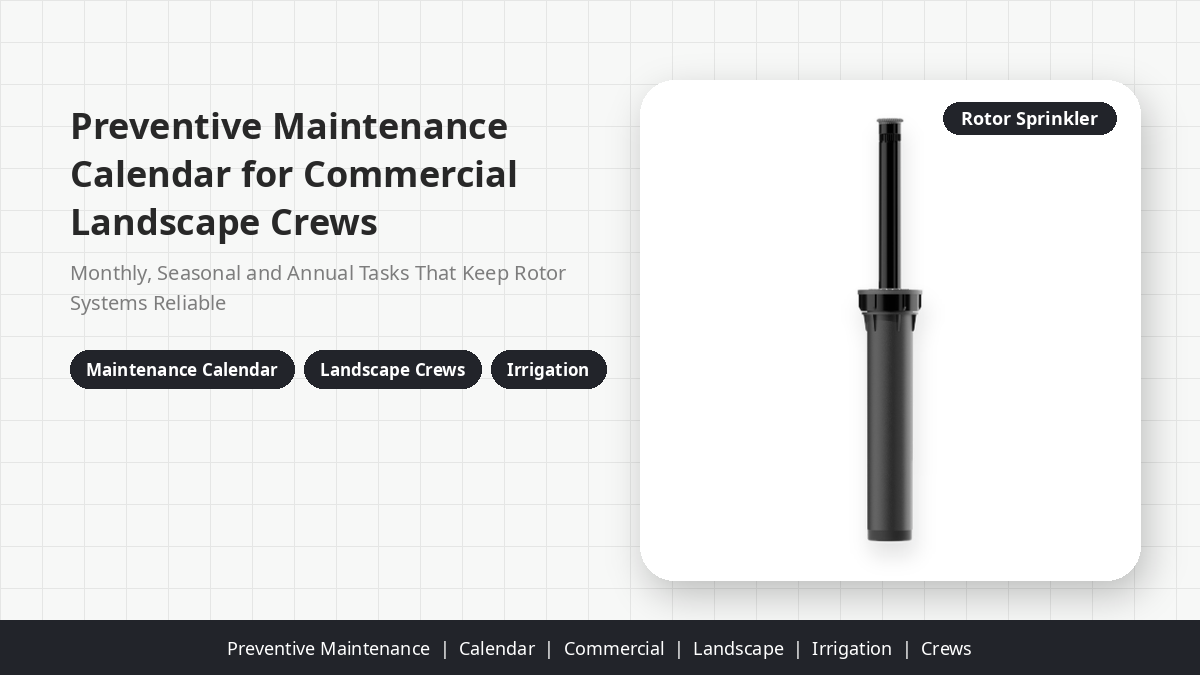
Gear Drive Sprinklers use an internal gear mechanism to rotate the nozzle at a controlled, constant speed. The rotation is driven by water flow through a turbine gearbox that gears down flow energy to a slow, steady rotation rate — typically 1–2 RPM. Because the rotation speed is mechanically controlled and independent of water pressure variations within the operating range, Gear Drive Sprinklers produce a highly consistent droplet pattern that does not degrade when pressure fluctuates by as much as ±0.5 bar.
The internal gearbox is the critical component. Water enters the turbine chamber and spins a small turbine wheel. That rotational energy passes through a gear reduction stage — typically a 20:1 to 30:1 ratio — before driving the nozzle arm. The gear reduction is what converts the relatively high-speed water flow into the slow, controlled rotation needed for uniform coverage. Because the gears are enclosed andlubricated by the water itself, the mechanism is self-maintaining and surprisingly durable.
Distribution Uniformity (DU): We regularly measure DU values of 0.78–0.84 in gear drive installations at 2.0 bar — compared to 0.62–0.70 for impact sprinklers at equivalent spacing. A DU of 0.80 means that 80% of the area receives within ±10% of the average water application rate. At DU 0.65, a significant portion of the turf receives substantially less water than designed, creating stress zones that show as localized browning or weed encroachment.
The DU advantage of gear drive over impact is not marginal — it is fundamental. Because gear drive produces a rotating stream with consistent rotation speed, the water application pattern is repeatable from one cycle to the next. Impact sprinklers, by contrast, produce a pattern that shifts with any change in pressure or water quality (mineral deposits on the oscillating arm change its mass distribution over time, subtly altering the spray pattern).
How Impact Sprinklers Work
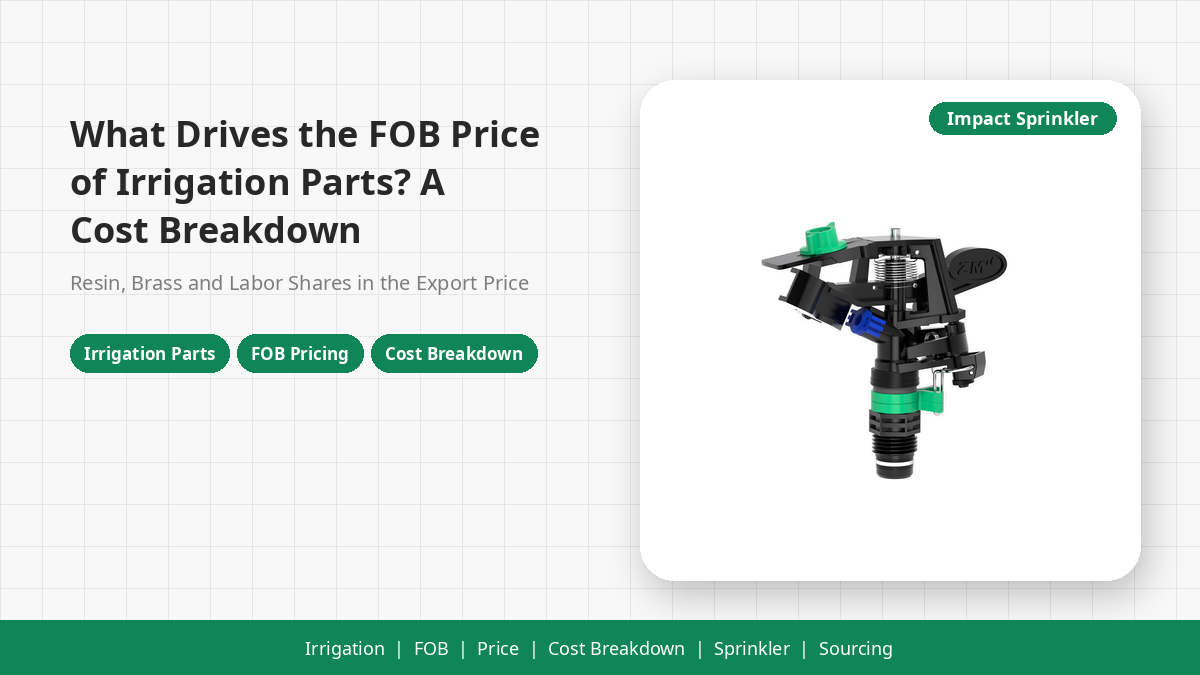
Impact sprinklers use the reaction force of a water jet striking an oscillating arm to create rotation. A narrow jet of water exits the nozzle and strikes the v-shaped impact arm. The force of the impact pushes the arm to one side; a spring returns it to strike the jet again on the opposite side. Each strike deflects the jet, creating the characteristic oscillating sector pattern.
This mechanical simplicity makes impact sprinklers extremely durable — no gears to wear, no electronics to fail, no turbine to clean. The mechanism has survived largely unchanged since the 1930s for this reason. For rough irrigation, where a DU of 0.65–0.72 is perfectly adequate, an impact sprinkler is a perfectly sensible choice.
However, the impact mechanism creates a non-uniform distribution pattern by design: the area directly in front of the nozzle receives the most water (the "impact zone"), while the edges between passes receive less. This is why impact sprinklers always require closer spacing to achieve a minimum acceptable DU — the overlap between adjacent sprinkler patterns must compensate for the low uniform application near the edge of each pass.
Wind resistance is where impact sprinklers genuinely outperform gear drive. Because impact mechanisms produce larger water droplets with higher kinetic energy, the spray is less susceptible to drift in conditions where wind speeds exceed 4–5 m/s. This makes impact sprinklers the practical choice for rough perimeter zones and areas adjacent to trees where turbulent wind is common. Gear drive droplets are smaller and lighter, making them more prone to wind drift — which is why they are not recommended for exposed rough zones without careful wind compensation in the hydraulic design.
Coverage Data and Zone Layout
Accurate coverage design requires understanding throw radius, flow rate, and DU at the design spacing — not just the manufacturer's listed throw radius at zero wind. The table below provides tested data at 2.5 bar operating pressure, which is the standard working pressure for medium-sized golf course irrigation systems.
At 2.5 bar operating pressure
| Sprinkler Type | Nozzle | Throw Radius | Flow Rate | DU at 9m Spacing | Spacing Required for DU 0.75+ |
|---|---|---|---|---|---|
| Gear drive (fairway) | 4.5mm | 11.5-12.5m | ~800 L/h | 0.80-0.84 | 9m x 9m |
| Gear drive (green) | 3.0mm | 7-9m | 300-500 L/h | 0.82-0.86 | 6m x 6m |
| Impact (rough) | 6.0mm | 15-17m | ~1,200 L/h | 0.65-0.72 | 8m x 8m |
Key observations from the table: Gear Drive Sprinklers on fairway settings achieve DU 0.80+ at 9m spacing, which means a 9m x 9m grid is the standard design module for fairway zones. For greens, where the playing surface demands tighter uniformity, a 6m x 6m grid with a smaller nozzle (3.0mm) is standard — the reduced throw radius is compensated by the higher density of heads. Impact sprinklers on rough settings require 8m x 8m spacing to approach DU 0.70 — this is closer than their throw radius might suggest, precisely because of the inherent non-uniformity of the impact spray pattern.
Hydraulic zone design implications
The throw radius at working pressure — not at the manufacturer's listed "nozzle pressure" — determines the hydraulic zone boundary. A common design error is using the maximum throw radius (from the spec sheet) as the design radius, without accounting for the pressure loss in the lateral line. At the head itself, pressure may be 0.3–0.5 bar lower than at the zone valve due to friction loss in the pipe. Designing to the lower end of the throw radius range rather than the upper end is the conservative and correct approach.
For gear drive systems, the consistent rotation speed means the hydraulic zone boundary is stable — the pattern from each head reaches the same distance every cycle. For impact systems, zone boundaries are less stable, because the throw radius varies with pressure. This makes impact systems harder to zone precisely, and more sensitive to design errors in pipe sizing.
18-Hole Course Sprinkler Quantity Estimate
Estimating the total number of sprinklers for a new 18-hole course or an upgrade project is a common starting point for budget quotation. The estimates below assume a full-length championship-format course with maintained turf area of approximately 40–50 hectares. Adjust for shorter courses or higher-density designs as needed.
- Fairways (~35% of maintained turf): 600-900 Gear Drive Sprinklers at 9m x 9m spacing
- Greens (~8% of maintained turf): 150-250 Gear Drive Sprinklers at 6m x 6m spacing, greens typically require higher head density to achieve the uniformity elite playing surfaces demand
- Tees (~5%): 80-150 Gear Drive Sprinklers, tees are high-traffic zones that require the same uniformity as greens; smaller tee complexes may use 4-6 heads, larger championship tees may require 10-15
- Rough/semirough (~52% of maintained turf): 400-700 impact sprinklers at 8m x 8m spacing, rough areas are typically designed with lower head density than fairways because the DU requirement is lower
- Total: 1,200-2,000 sprinklers for a championship-format 18-hole course
This estimate is for budgeting and early-stage design only. Final head count should be confirmed by a hydraulic design professional using the specific course CAD geometry, soil infiltration rate, and local evapotranspiration data.
Bulk Pricing Reference (FOB Ningbo)
Pricing for golf course Irrigation Sprinklers follows a stepped volume discount model, with the most significant price break typically occurring between 500 and 1,000 units. The pricing below is indicative for standard catalog models — custom nozzle configurations, color-matched bodies, or branded housing will carry a premium and require longer lead times.
| Type | 100-499 pcs | 500-999 pcs | 1,000-4,999 pcs |
|---|---|---|---|
| Gear drive (fairway/green) | $18-22 | $14-18 | $11-14 |
| Impact (heavy-duty) | $12-16 | $9-13 | $7-10 |
At 1,000+ unit pricing, the installed cost of a gear drive fairway system is approximately $11–14 per head. For a 700-head fairway system, this is $7,700–9,800 in hardware alone — before valve boxes, pipe, wire, and installation labor. The impact sprinkler price advantage of $4–7 per head is real but must be weighed against the higher head count required for impact at closer spacing in fairway zones, and the long-term water cost penalty of lower DU.
Why Distribution Uniformity Determines Operating Cost
Distribution Uniformity is not an abstract engineering metric — it has a direct and quantifiable effect on water consumption and pump energy cost over the life of the system. The relationship is straightforward: a DU of 0.70 means that 30% of the water applied is either under- or over-applied relative to the average. To ensure that the driest 30% of the turf receives sufficient water, the irrigation timer must apply enough water to meet the needs of the driest zones — meaning the average area receives significantly more water than it needs.
Research from the Center for Irrigation Technology at Fresno State and from independent golf course agronomy studies shows that a DU improvement from 0.65 to 0.80 typically reduces total water consumption by 15–20% for the same turf quality outcome. For an 18-hole course applying 10,000 m³ of water annually, a 15% reduction is 1,500 m³ — a meaningful water cost saving and an environmental benefit in water-constrained regions.
The energy cost is equally significant. Gear drive systems operate at 1.5–2.5 bar, while impact sprinklers typically require 2.5–4.5 bar for equivalent throw. Every bar of additional pressure requires more pump energy — at typical golf course pump station efficiency of 65–70%, each additional bar of pressure adds approximately 0.4 kWh per cubic meter of water pumped. Lower operating pressure means lower energy cost per unit of water applied, compounding the savings over the design life of the system.
Maintenance Comparison: 10-Year Total Cost of Ownership
Maintenance cost is one area where impact sprinklers hold a structural advantage, particularly in harsh water environments where mineral content is high. The oscillating arm mechanism in an impact sprinkler is exposed to the water directly — if the water carries sand or mineral sediment, the arm wears over time and the spray pattern shifts. However, this wear is slow and predictable, and the replacement of a worn impact arm is a low-cost operation.
Gear drive internals are enclosed and sealed from sediment, but the turbine gearbox is susceptible to blockage if the system water supply contains debris or if the inlet filter is not maintained. Annual inspection and flushing of the gear drive mechanism is recommended, particularly for surface water sources (pons, rivers) where organic material may be present.
10-year maintenance cost estimate for a 1,500-head course:
- Gear drive heads: $8–15 per head over 10 years, primarily for nozzle wear, seal replacement, and occasional gearbox servicing. At 1,500 heads, this is $12,000–22,500 over 10 years.
- Impact heads: $3–7 per head over 10 years, primarily for arm and spring replacement. At 1,500 heads, this is $4,500–10,500 over 10 years.
- Higher gear drive maintenance cost is offset by lower water cost (higher DU) and lower pump energy (operates at lower pressure). The TCO calculation favors gear drive for fairway and green applications despite the higher maintenance per head.
OEM Customization for Bulk Golf Course Orders
Golf course irrigation projects frequently require customization beyond standard catalog models — color-matched bodies that blend with turf, custom nozzle configurations optimized for local soil infiltration rates, or branded housings that carry the golf course architect's or owner's logo.
For orders of 500+ units, the following customization options are typically available:
- Custom logo injection molding — MOQ 2,000 units for custom housing tooling, 45-60 days lead time
- Custom nozzle configurations — non-standard nozzle sizes or orifice geometries for specific hydraulic zone requirements, 30-45 days
- Color-matched bodies — green and brown are standard for golf course applications, custom colors available for orders of 500+ with color-matched tooling
- Custom packaging — individual poly bags, branded box inserts, project-specific labeling
- Standard catalog orders of 100+ units: 25-30 days lead time
Zone-by-Zone Specification Guide
Based on fifteen years of irrigation design experience across courses in Asia, Europe, and North America, the following zone-by-zone specification reflects the consensus recommendation for championship-grade courses. Adjustments for budget courses, municipal courses, or non-championship formats are noted where relevant.
Greens (priority: highest DU)
Specify: Gear Drive Sprinklers at 6m x 6m spacing, 3.0mm nozzle, operating pressure 2.0-2.5 bar. Green zones have the highest maintenance standards and the smallest tolerance for water stress. The cost per head is higher due to density, but greens represent only ~8% of total maintained turf — the budget impact is manageable. Use matched precipitation rate design so that all heads within a green zone apply water at the same rate, regardless of whether they are in the center or at the perimeter.
Fairways (priority: high DU, moderate cost control)
Specify: Gear Drive Sprinklers at 9m x 9m spacing, 4.5mm nozzle, operating pressure 2.0-2.5 bar. Fairways represent ~35% of maintained turf and are the largest single irrigation zone on most courses. The gear drive investment here has the greatest ROI due to scale. Design with head-to-head coverage across the entire fairway width — the 9m throw radius should be verified at the actual working pressure of the lateral, not atideal nozzle pressure.
Tees (priority: high DU, durability)
Specify: gear drive sprinklers, same specification as fairways. Tee complexes experience the highest foot traffic of any maintained surface on the course and require consistent water application to maintain turf density. Some courses use extra-dense head placement on tee complexes — 4-6 heads per small tee, 10-15 for championship tees — which is good practice for water uniformity but adds to head count and hardware budget.
Rough and Semirough (priority: wind resistance, cost)
Specify: impact sprinklers at 8m x 8m spacing, 6.0mm nozzle, operating pressure 3.0-4.5 bar. Rough zones require higher operating pressure for equivalent throw, but the cost per head is lower and the wind resistance advantage is genuine. Rough zones tolerate lower DU — a DU of 0.65-0.70 is acceptable where turf quality requirements are lower. Use impact sprinklers with brass or hardened steel wear parts for the oscillating arm mechanism to extend service life in mineral-rich water environments.
FAQ
How many sprinklers per acre for fairway at 40 PSI (2.8 bar)?
Approximately 50 sprinklers per acre (123 per hectare) at 9m x 9m spacing with gear drive sprinklers at 2.5 bar. Impact sprinklers at equivalent pressure require closer 8m x 8m spacing (~156/ha) for the same DU — adding approximately 27% more heads and significantly more hardware cost.
What throw radius difference should I design around?
Gear drive: 8-15m at 2.0-2.5 bar (consistent and repeatable across cycles). Impact: 12-20m at 3.0-4.5 bar (more variable with pressure and wind). Gear drive is easier to design precise hydraulic zones around because the throw radius is stable regardless of small pressure changes. Impact throw radius can vary by 2-4m per cycle as pressure fluctuates, making zone boundary design less precise.
What is the 10-year maintenance cost difference for a 1500-sprinkler course?
Gear drive: $8–15 per head over 10 years. Impact: $3–7 per head over 10 years. The higher maintenance cost for gear drive is offset by lower water consumption (higher DU reduces overwatering by 15-20%) and lower pump energy cost (operates at lower pressure). The TCO calculation favors gear drive for fairway and green applications. On a 1,500-head course, the gear drive premium in maintenance is typically recovered within 18-36 months through water and energy savings.
What OEM customization options are available for bulk golf course orders?
500+ units: custom logo injection molding (MOQ 2,000 units, 45-60 days lead time), custom nozzle configurations (30-45 days), color-matched bodies in green or brown (500+ unit MOQ), custom packaging with project-specific labeling. Standard catalog orders of 100+ units ship in 25-30 days. Custom configurations should be specified at the earliest design stage — late-stage specification changes can affect the hydraulic zone design and require redesign of the lateral pipe network.
Conclusion
The data is clear: gear drive sprinklers produce measurably better distribution uniformity, operate at lower pressure, and generate lower long-term water and energy costs — despite a higher initial unit price and higher per-head maintenance cost. For fairway, tee, and green zones, where turf quality standards are highest, gear drive is the correct specification. The higher initial cost is not a premium — it is an investment with a documented payback period of 18-36 months.
For rough and semirough zones, impact sprinklers remain the practical choice. Lower per-unit cost, higher wind resistance, and adequate DU for lower-maintenance turf surfaces make impact the right fit for zones where maximum uniformity is not required. The maintenance cost advantage of impact is real, but it does not overcome the fundamental DU and pressure disadvantages for premium turf zones.
The second critical decision is the hydraulic design quality. The best sprinkler specification can be undermined by poor pipe sizing, inadequate zone pressure balancing, or design throw radii that do not reflect actual working pressure. Engage a qualified irrigation designer at the earliest stage — the cost of professional design is a small fraction of the total system cost and prevents the performance shortfalls that are expensive to fix after installation.
Browse gear drive sprinklers | Browse impact sprinklers | Contact for custom golf course quotes
About the Author
Sun-rainman Team — Yuyao Sun-rainman Irrigation Equipment Factory
Founded 2005. 6,800m² facility. 76 countries served.
Facebook | Instagram