

TL;DR — Key Takeaways
- Flag drippers paired with mini ball valves give greenhouse operators per-row flow isolation — a flag dripper delivers a precise 4 or 8 L/h to each plant, while a mini ball valve at the row header lets the grower shut off individual lines for crop rotation, maintenance, or disease quarantine without depressurizing the entire zone.
- Pressure-compensating (PC) flag drippers maintain flow uniformity within ±5% across a 50-meter drip line even on sloped greenhouse benches — and in our experience, non-PC drippers on a 2% slope can show 25-30% flow variation between the first and last emitter.
- Mini ball valves with barbed or threaded fittings install in seconds at the drip-line header and cost approximately $0.50-1.20 per unit in OEM volumes — which means a grower can add per-row isolation to a 100-row greenhouse for under $120 in components.
- INOVATO manufactures both products — flag drippers and mini ball valves — from a single factory in Yuyao, Zhejiang, which means compatible fitting dimensions, consistent material specifications, and a single supplier for the two components that greenhouse irrigation designers combine most frequently.
Why Greenhouse Drip Irrigation Demands Both Precision Delivery and Per-Row Control
Commercial greenhouse irrigation is fundamentally different from open-field drip systems. In a field, a 5% variation in emitter flow rate across a 100-meter lateral is acceptable — the soil acts as a buffer, redistributing moisture through capillary action, and the crop's root zone extends well beyond the emitter's wetting pattern. In a greenhouse growing tomatoes, peppers, or cucumbers in rockwool slabs or coco-coir bags, the entire root zone is confined to a substrate volume of 5-15 liters, and the plant has zero access to moisture beyond what the dripper delivers. A flag dripper that under-delivers by 10% for a week produces a measurable yield reduction and — in recirculating hydroponic systems — distorts the nutrient balance of the return solution, triggering corrective actions that cascade through the entire fertigation program.
In our work with greenhouse operators and irrigation system integrators, we have observed that the two most common failure points in greenhouse drip systems are emitter flow inconsistency and the inability to isolate individual rows for maintenance or crop-changeover without shutting down an entire irrigation block. These two problems share a common solution architecture: a pressure-compensating flag dripper at each plant position, paired with a mini ball valve at the header of every row. The dripper handles precision delivery; the valve handles operational flexibility. Together, they give the grower control over every liter of water and every plant position in the greenhouse — the kind of precision that the International Commission on Irrigation and Drainage (ICID) advocates for in protected cultivation environments — and that level of control is what separates a system that produces uniform Grade A fruit from one that produces a mix of grades with higher labor cost for sorting and grading.

Flag Dripper Technology: How the Emitter Works and Why Design Matters
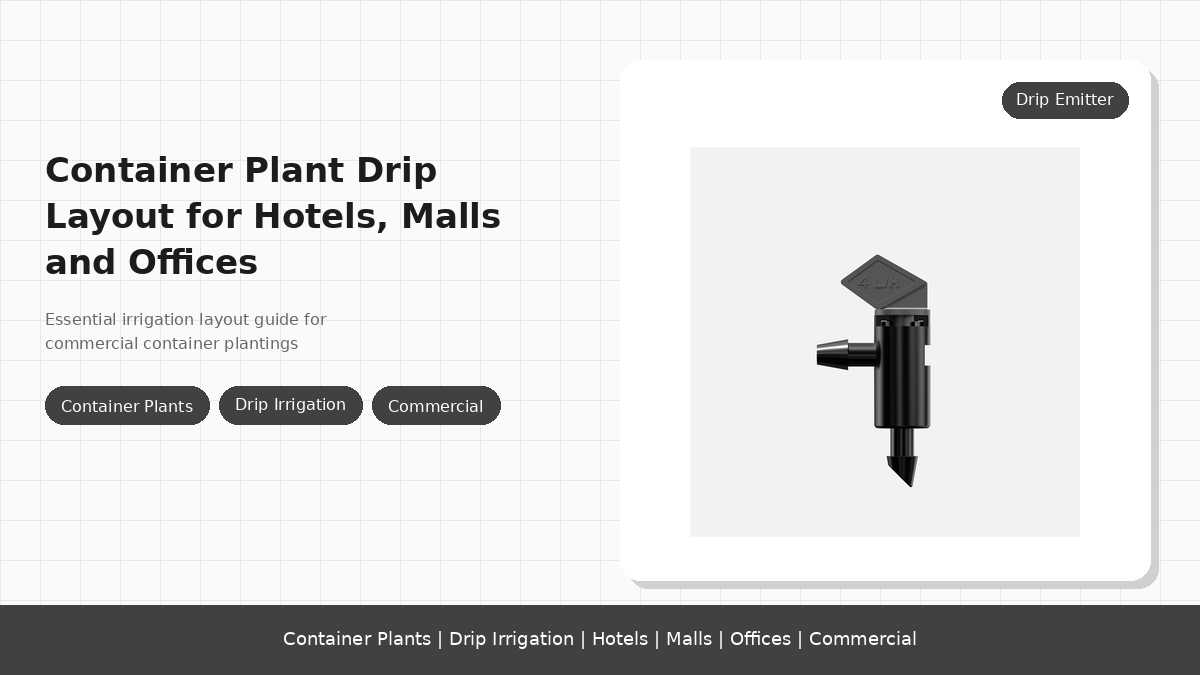
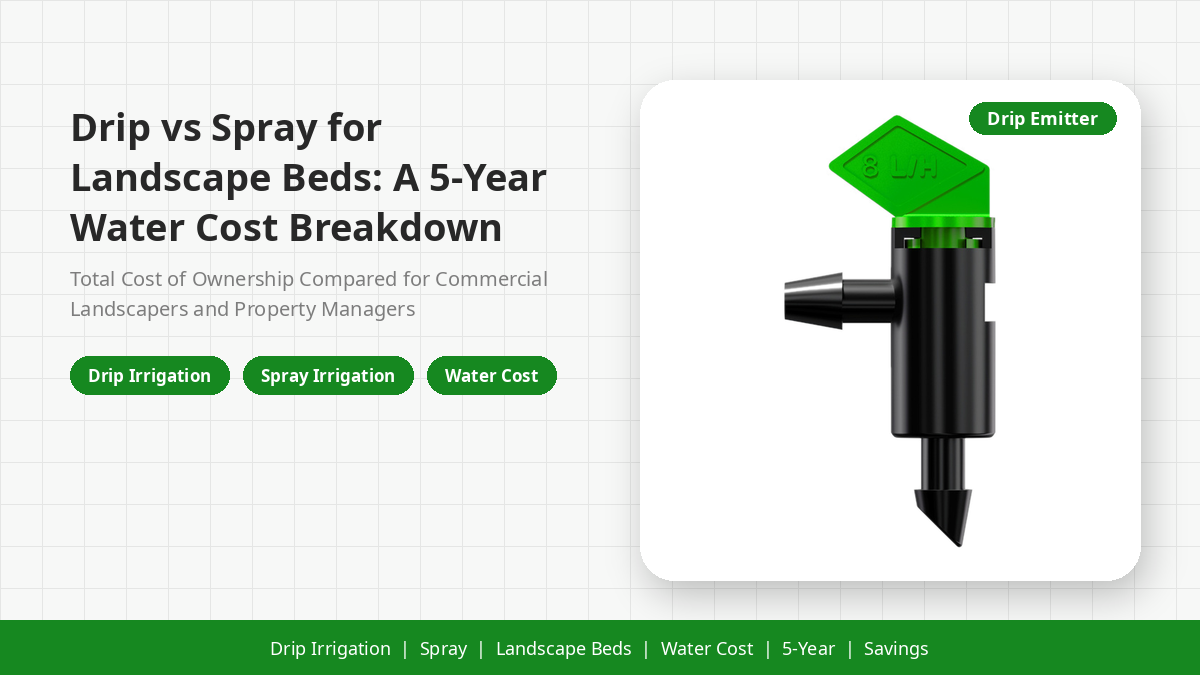
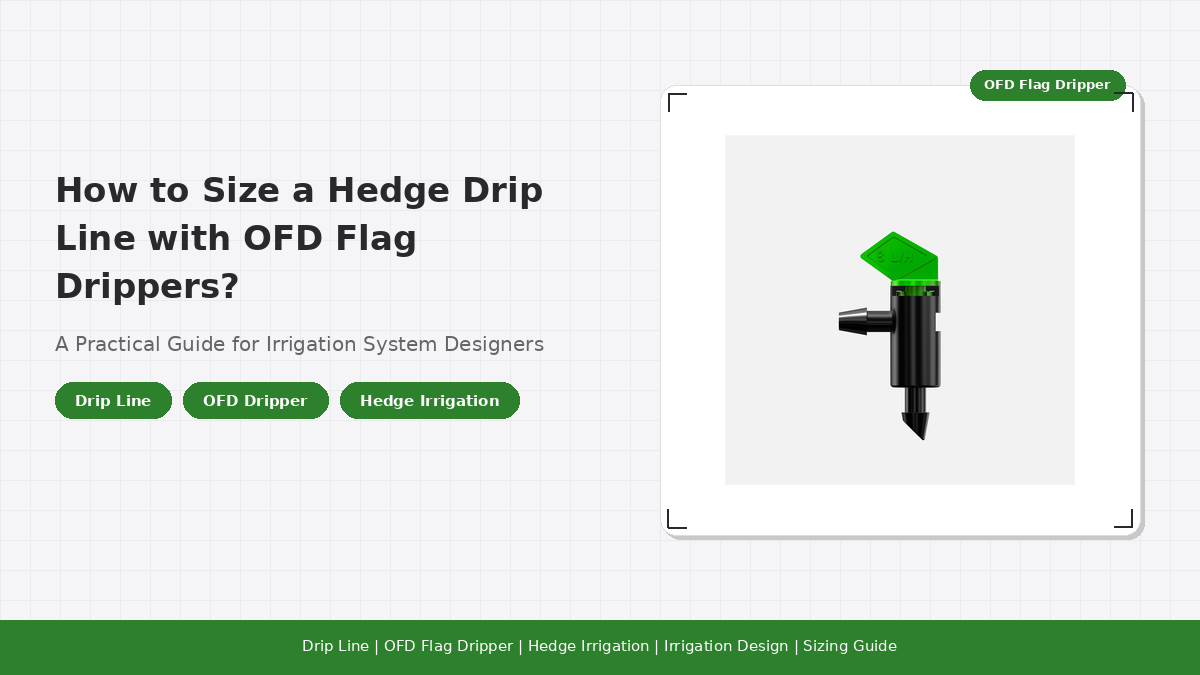
A flag dripper gets its name from its physical form: a flat, flag-shaped body that houses a labyrinth flow path, with a barbed inlet that punches directly into a PE lateral pipe and an outlet that delivers water at a controlled rate to the plant's root zone. The "flag" shape is functional — it provides enough surface area to house a sufficiently long labyrinth channel to achieve the target flow rate at the design pressure, while remaining compact enough to install without interfering with plant stems, substrate bags, or drip stakes.
The critical component inside every flag dripper is the labyrinth flow path — a serpentine channel molded into the dripper body that dissipates pressure through turbulence. Water enters at line pressure (typically 1.0-3.5 bar in greenhouse systems) and exits at near-atmospheric pressure after traveling through a channel approximately 50-150mm in total developed length, depending on the target flow rate. Because the labyrinth creates turbulent flow rather than laminar flow, it is self-flushing — suspended particles that would clog a simple orifice are swept through the channel by the turbulence and expelled. This self-flushing characteristic is the reason flag drippers typically achieve longer service life between cleanings than simple-orifice emitters, particularly in greenhouse systems where fertilizer salts can precipitate inside the emitter if flow stagnates.
INOVATO offers flag drippers in two primary flow rates — 4 L/h (OFD-04) and 8 L/h (OFD-08) — with a third high-flow variant at 16 L/h (OFD-16) for crops with high transpiration rates or for pulse-irrigation strategies that deliver larger volumes in shorter irrigation windows. In my experience visiting greenhouse operations, the 4 L/h dripper is the workhorse for most substrate-grown vegetable crops, while the 8 L/h variant is preferred for larger container-grown ornamentals and for greenhouses in hot climates where evaporation rates during summer push the required irrigation volume above what a 4 L/h dripper can deliver in a reasonable irrigation window.
Pressure-Compensating vs. Non-PC: The Specification That Determines Row Uniformity
The single most important specification decision when selecting flag drippers is whether to use pressure-compensating (PC) or non-PC emitters. I recommend PC drippers for any greenhouse application where the elevation difference between the first and last dripper on a lateral exceeds 0.5 meters, or where the lateral length exceeds 30 meters. Here is why.
In a non-PC dripper, the flow rate is proportional to the square root of the inlet pressure. On a perfectly level 30-meter lateral running at 2.0 bar inlet pressure, the pressure drop due to pipe friction is typically 0.15-0.25 bar between the first and last emitter — which translates to a flow variation of approximately 4-6%. On a greenhouse bench with a 2% slope (a 1-meter elevation change over a 50-meter row), the hydrostatic pressure difference alone adds 0.1 bar, pushing the flow variation to 7-10%. Add a partially clogged filter that drops system pressure by 0.3 bar, and the variation can exceed 15%. Because greenhouse crops on a single irrigation line share the same nutrient solution and irrigation schedule, flow variation directly translates to growth variation — and in a market where uniform fruit size commands a price premium, growth variation is lost revenue.
A PC flag dripper contains a flexible diaphragm that deforms in response to inlet pressure changes, automatically adjusting the flow-path cross-section to maintain a constant flow rate across a specified pressure range — typically 0.8-3.5 bar. Our PC flag drippers maintain flow within ±5% of nominal across that entire pressure range, which means the grower can run a 50-meter lateral on a sloped bench without measurable yield variation between the first and last plant. The trade-off is that PC drippers cost approximately 30-40% more than non-PC drippers and require a minimum inlet pressure (typically 0.8 bar) to activate the compensating mechanism. For very low-pressure gravity-fed systems, non-PC drippers may be the only viable option.
Mini Ball Valves: The $1 Component That Unlocks Per-Row Control
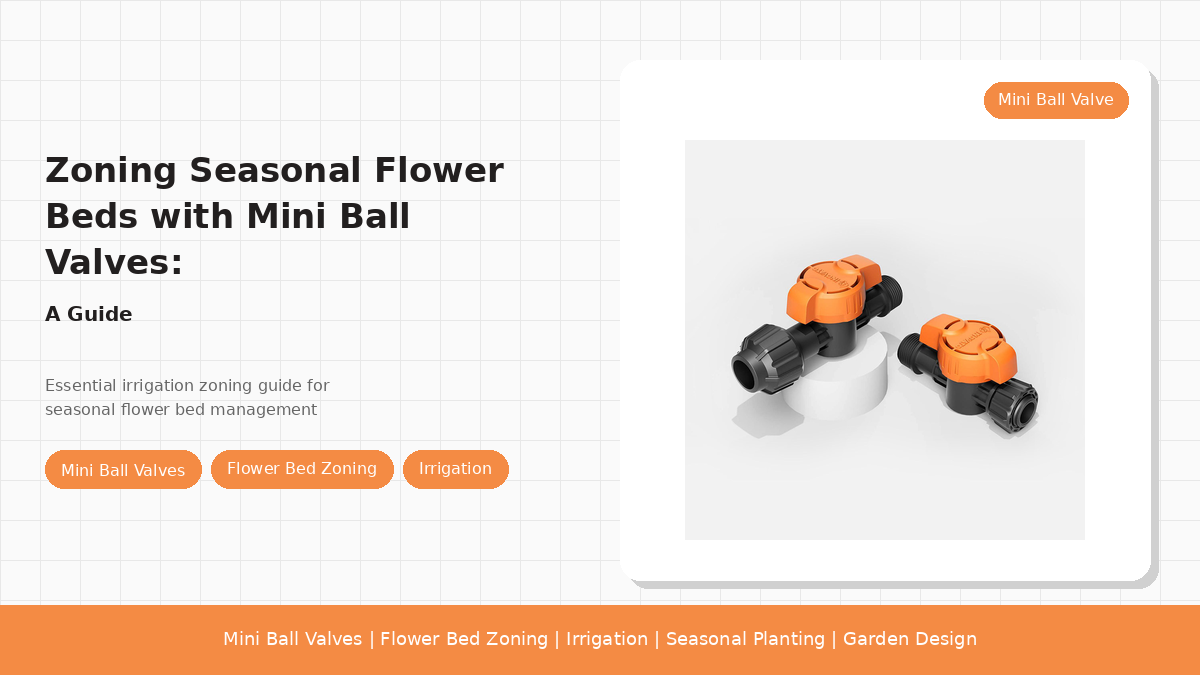
A mini ball valve is exactly what it sounds like: a small (typically 16-25mm) PVC or polypropylene ball valve with barbed or threaded fittings that installs in seconds at the header of a drip line. The valve body contains a quarter-turn ball with a bore diameter matched to the lateral pipe, and the handle position provides instant visual confirmation of whether the line is open or closed. In a greenhouse running 100+ drip lines, the ability to isolate a single row by reaching down and turning a valve handle — without tools, without shutting down a pump, and without affecting the pressure in adjacent lines — transforms how the growing team manages the crop.
I want to walk through the three operational scenarios where mini ball valves deliver the most value, because these are the scenarios that greenhouse operators describe as "the moment we knew we should have installed them from day one."
Scenario 1: Crop rotation between cycles. A tomato greenhouse typically runs two crop cycles per year, with a 2-4 week gap between cycles for removing old plants, sterilizing substrate or replacing grow bags, and replanting. During this gap, the irrigation system in the replanted rows needs to run at a lower frequency than the still-producing rows. Without per-row valves, the grower runs the entire block on a compromise schedule that over-waters the replanted rows and under-waters the mature rows. With mini ball valves, the grower closes the valves on the replanted rows, runs the irrigation block on the mature crop's schedule, and manually opens the replanted-row valves for a short irrigation pulse once per day — precise control, zero compromise.
Scenario 2: Disease quarantine. When a soil-borne pathogen (Fusarium, Pythium, Verticillium) appears in a greenhouse row, the standard protocol is to stop irrigating that row immediately to prevent pathogen spread through leachate or drain water in recirculating systems. Without per-row valves, stopping irrigation to one row means shutting down the entire block — potentially 10-20 rows — and either hand-watering the unaffected rows or accepting the yield loss from interrupted irrigation. With mini ball valves, the grower closes one valve, tags the row for treatment, and the remaining 99% of the greenhouse continues irrigating on its normal schedule.
Scenario 3: Maintenance and leak repair. Drip lines develop leaks — a rodent chews through a lateral, a dripper gets knocked out of its stake by a passing harvest cart, a fitting cracks after three years of UV exposure. Every hour that a leak runs is an hour of wasted water, wasted fertilizer, and — in greenhouses with concrete floors — a slip hazard and algae growth on the walkway. Without per-row isolation, repairing a mid-line leak means shutting down the pump and depressurizing the entire zone for 15-30 minutes — during which time no crop in that zone receives irrigation. With mini ball valves, the grower closes the affected row's valve, repairs the leak at leisure, and the rest of the greenhouse continues uninterrupted.
Our mini ball valves are manufactured in 16mm, 20mm, and 25mm sizes with barbed fittings for PE lateral pipe, and they are pressure-rated to 4 bar — well above the 1.0-3.0 bar operating range of most greenhouse drip systems. The ball and seat are precision-molded to provide a drip-tight seal after thousands of open-close cycles, and the handle is designed to be operable with one hand while wearing greenhouse work gloves. When combined with our flag drippers on the same lateral, the two components create a complete per-row irrigation control solution from a single supplier — which simplifies procurement, ensures fitting compatibility, and gives the grower one point of contact for technical support on both products.
System Design: Integrating Flag Drippers and Mini Ball Valves in a Greenhouse Layout
A well-designed greenhouse drip system using flag drippers and mini ball valves follows a straightforward hierarchy: main line → zone solenoid valve → sub-main → mini ball valve (per row) → PE lateral → flag drippers (per plant). I will walk through each connection point in order, because the most common installation errors I see in customer photos all occur at the transitions between components.
Main line to zone solenoid: The main line (typically 50-63mm PVC or HDPE) feeds a solenoid valve per irrigation zone. Each zone typically covers 10-20 rows — the exact number depends on the total system flow rate, which is determined by the sum of all dripper flow rates in the zone. A zone with 15 rows × 40 plants per row × 4 L/h drippers requires 2,400 L/h (2.4 m³/h) at the zone valve. I recommend sizing the zone for no more than 80% of the available pump capacity to allow for pressure-compensating dripper activation and future expansion.
Sub-main to mini ball valve: The zone sub-main (typically 32-40mm LDPE) runs perpendicular to the crop rows along one end of the greenhouse bay. At each row position, a saddle clamp or tee fitting branches off the sub-main and feeds a short length of 16mm or 20mm PE pipe terminated with a mini ball valve. In my experience, installing the valve on the inlet side of the row (at the sub-main connection) rather than the outlet side is critical — a closed valve at the inlet depressurizes the entire lateral, while a closed valve at the outlet leaves the lateral pressurized and turns any leak into a continuous discharge until someone notices.
Mini ball valve to flag drippers: The PE lateral runs from the mini ball valve down the length of the crop row, typically 16mm diameter for rows up to 50 meters. Flag drippers are punched into the lateral at each plant position using a standard punch tool — the dripper's barbed inlet creates a watertight interference fit in the 3mm punched hole. Because flag drippers install by hand without tools beyond the punch, a 50-meter row with 40 plants can be fitted with drippers in under 30 minutes by one person — and the same person can replace a failed dripper in under 30 seconds without draining the line.
The total component cost for this architecture — sub-main, mini ball valves, PE laterals, and flag drippers — for a 20-row greenhouse block of 50 meters per row with 40 plants per row typically runs $800-1,200 in OEM volumes from INOVATO, depending on whether PC or non-PC drippers are specified. The labor to install the system typically runs 2-3 person-days for a skilled greenhouse crew.
Frequently Asked Questions
What is the difference between a flag dripper and a button dripper?
A flag dripper has a flat, flag-shaped body with the labyrinth flow path molded into the body itself, and it typically connects directly to the lateral pipe with a barbed inlet. A button dripper (also called a PC online dripper) has a cylindrical or disc-shaped body that often threads onto a separate barbed connector. Flag drippers are generally lower-profile — sitting closer to the lateral pipe — which makes them less prone to being knocked off by passing equipment or harvest carts. Both types can be pressure-compensating or non-PC. In greenhouse applications, we recommend flag drippers for substrate-grown vegetables where the dripper sits close to the substrate bag, and button drippers for container-grown ornamentals where the emitter may need to be positioned on a stake or weight above the container.
How do I choose between 4 L/h and 8 L/h flag drippers for my greenhouse?
The choice depends on three factors: crop transpiration rate, substrate volume, and irrigation window duration. For high-wire tomato and cucumber crops in rockwool slabs with 3-5 irrigation pulses per day, 4 L/h drippers provide adequate flow while producing a larger wetted volume in the substrate per pulse — which is beneficial for root distribution. For crops with high transpiration (e.g., peppers in hot-climate greenhouses) or for growers who prefer fewer, larger irrigation pulses, 8 L/h drippers deliver the required daily volume in shorter windows. A practical test: measure the drain percentage from your substrate after an irrigation pulse. If drain is less than 20% of applied volume with 4 L/h drippers, increasing to 8 L/h may improve substrate moisture uniformity.
Do pressure-compensating flag drippers require a minimum inlet pressure?
Yes — PC flag drippers typically require a minimum inlet pressure of 0.8-1.0 bar to activate the compensating diaphragm. Below this pressure, the diaphragm does not fully engage and the dripper behaves like a non-PC emitter with lower-than-rated flow. For gravity-fed greenhouse systems with less than 0.8 bar available pressure (e.g., tanks elevated less than 8 meters above the dripper elevation), non-PC flag drippers are the appropriate choice. Our technical team can help calculate whether your system pressure is sufficient for PC operation — share your tank elevation, pipe diameters, and row lengths and we will provide a pressure-at-emitter calculation within 24 hours.
How often do flag drippers need to be cleaned or replaced?
Flag drippers with labyrinth flow paths are self-flushing under normal operation — the turbulent flow through the channel prevents sediment accumulation. In greenhouse systems using filtered water (120-mesh or finer) and soluble fertilizers, flag drippers typically operate for 3-5 years without cleaning. The most common cause of clogging is not sediment but fertilizer salt precipitation — this occurs when the system is not flushed after the final irrigation pulse of the day, and salts crystallize inside the dripper as residual water evaporates. A 30-second line flush at the end of each irrigation day (opening the end cap and running the pump for 30 seconds) prevents this and extends dripper life significantly. If a dripper does clog, it can be cleaned by soaking in a mild acid solution (pH 4-5 citric acid) for 30 minutes.
Are the mini ball valves compatible with standard PE irrigation pipe?
Yes — our mini ball valves are designed with barbed fittings for standard 16mm, 20mm, and 25mm PE lateral pipe (OD-controlled polyethylene irrigation tubing). The barb profile creates a watertight seal without requiring clamps at greenhouse operating pressures (up to 4 bar). For main-line connections above 4 bar or with larger pipe diameters (32mm+), we recommend threaded or compression fittings rather than barbed connections. If you are unsure about fitting compatibility with your existing pipe specification, send us the pipe manufacturer and external diameter and we will confirm compatibility — usually within the same business day.