

TL;DR:
- Sizing a commercial irrigation system for 50+ hectares starts with determining your peak water demand— calculated as total area × precipitation rate ÷ system efficiency. For a 50-hectare field using Gear Drive Sprinklers at 10 mm/hr with 80% DU, peak demand is approximately 625 m³/hr.
- Sprinkler spacing should follow the 50–60% diameter rule: place your sprinklers at 50–60% of their published wetted diameter to achieve the overlapping coverage needed for uniformity above 80%.
- Mainline pipe diameter is the most common sizing mistake — undersized mains cause velocity above 2.0 m/s, leading to pressure loss of 0.5–1.5 bar across the longest lateral, which directly reduces sprinkler performance at the far end.
- INOVATO’s HF02 series Gear Drive Sprinklers cover 4.9–14.0 m radius with 12 interchangeable nozzles, making them a versatile choice for block layouts, center pivots, and zone-divided large fields.
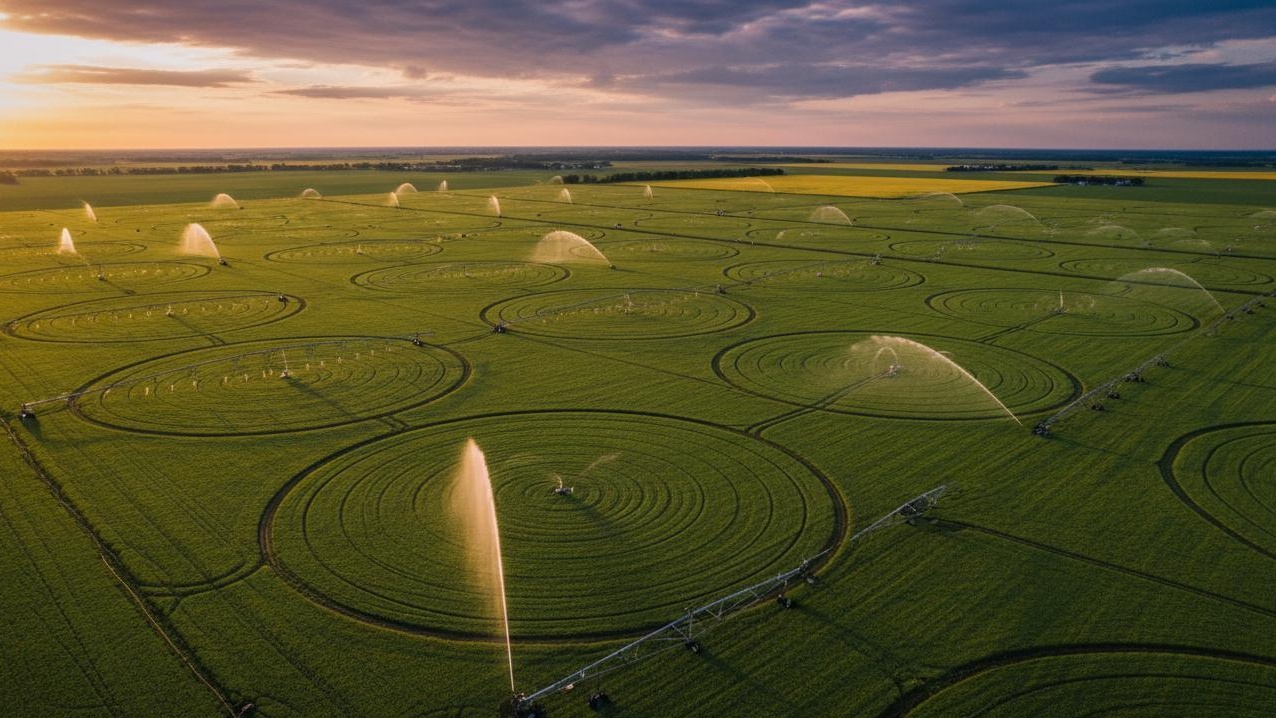
Sizing a Commercial Irrigation Sprinkler system for 50+ hectares requires five interdependent calculations: peak water demand, sprinkler spacing and coverage, lateral and mainline pipe sizing, pump pressure requirements, and zone layout optimization. Get any one wrong, and you risk either over-paying for oversized infrastructure or under-watering the far end of every lateral.
At INOVATO, we have been manufacturing gear drive sprinklers and irrigation accessories for over 20 years, supporting farm projects from 10-hectare vegetable plots to 500-hectare grain operations across 50+ countries. This guide condenses what we have learned into a repeatable sizing framework — designed for farm owners, irrigation consultants, and procurement teams who need to get the engineering right before placing a wholesale order.
We will walk through each calculation step with real numbers, cross-reference HF01 and HF02 series sprinkler specifications, and point out where most first-time designs go wrong.
Step 1: Calculate Peak Water Demand
Your peak water demand is the total flow rate the system must deliver at the busiest irrigation block during the hottest part of the day. This number drives everything downstream — pipe diameter, pump selection, and water source capacity.
The formula is straightforward:
Q (m³/hr) = (Area in hectares × 10,000 m²/ha × precipitation rate in mm/hr) ÷ (1,000 × system efficiency)
Where:
- Precipitation ratefor INOVATO Gear Drive Sprinklers is approximately 10 mm/hr (standard nozzle configuration)
- System efficiency for a well-designed gear drive system with 80% distribution uniformity is approximately 0.75 (accounting for evaporation, wind drift, and deep percolation losses)
Example — 50-hectare field with Gear Drive Sprinklers:
Q = (50 × 10,000 × 10) ÷ (1,000 × 0.75) = 5,000,000 ÷ 750 = ~667 m³/hr
For comparison, with impact sprinklers at 16 mm/hr and 68% DU:
Q = (50 × 10,000 × 16) ÷ (1,000 × 0.65) = 8,000,000 ÷ 650 = ~1,231 m³/hr
The gear drive system requires 46% less total flow than the equivalent impact system for the same 50-hectare field. This translates directly into smaller pipes and lower pump energy costs — a key advantage for large-scale installations.
Per ASAE EP458.1 (American Society of Agricultural and Biological Engineers, Irrigation System Sizing Standard), system design flow should be calculated using the peak monthly evapotranspiration rate for your crop and region, not annual averages. We recommend adding a 15% safety factor to cover unexpected demand spikes during heat waves.
Step 2: Determine Sprinkler Spacing and Coverage
Sprinkler spacing is the distance between adjacent sprinkler heads along the lateral line and between lateral lines themselves — and it must be set at 50–60% of the sprinkler’s published wetted diameter to achieve adequate overlap. This is the most commonly violated rule in field irrigation design.
For INOVATO HF02-04 Gear Drive Sprinklers at 3.0 bar (typical operating pressure):
- Published radius: 12 m → wetted diameter: 24 m
- Recommended spacing along lateral: 24 m × 55% = 13.2 m
- Recommended spacing between laterals: 24 m × 55% = 13.2 m
- Coverage area per sprinkler: 13.2 m × 13.2 m = ~174 m²
Number of sprinklers needed for 50 hectares:
50 ha = 500,000 m² ÷ 174 m² per sprinkler = ~2,874 sprinklers
For INOVATO HF01-04 Gear Drive Sprinklers at 2.5 bar:
- Published radius: 9 m → wetted diameter: 18 m
- Recommended spacing: 18 m × 55% = 9.9 m
- Coverage area per sprinkler: ~98 m²
- Number needed for 50 ha: 500,000 ÷ 98 = ~5,102 sprinklers
Important: Square spacing (same distance in both directions) is standard for most field crops. Triangle spacing can achieve the same uniformity with slightly wider sprinkler spacing (approximately 15% wider), but requires more precise layout during installation. For hand-move or solid-set systems, square spacing is simpler to manage.
Step 3: Size the Lateral Lines
Lateral lines — the pipes that carry water from the mainline to the sprinklers — must be sized so that pressure variation across the lateral does not exceed ±15% of the design pressure. Exceeding this threshold creates the “far-end drought” effect: sprinklers closest to the mainline get too much pressure, while those at the far end barely rotate.
Per Irrigation Association’s Irrigation System Design Standards, the acceptable pressure variation across a lateral is ±15%. For a system designed at 3.0 bar, that means every sprinkler must receive between 2.55 bar and 3.45 bar.
Practical lateral sizing rule for gear drive systems:
- 50 mm (2″) lateral: Maximum 8–10 sprinklers (HF02-04) before friction loss exceeds acceptable limits. Maximum lateral length: approximately 105–130 m.
- 63 mm (2.5″) lateral: Maximum 12–15 sprinklers. Maximum lateral length: approximately 160–200 m.
- 75 mm (3″) lateral: Maximum 18–22 sprinklers. Maximum lateral length: approximately 240–290 m.
Why this matters for wholesale buyers: If you are ordering 3,000 HF02-04 sprinklers for a 50-hectare field, your lateral pipe material cost could vary by 35–50% depending on whether you choose 50 mm or 75 mm lateral pipes. The smaller pipe requires more mainlines but less lateral cost. The larger pipe does the opposite. We always recommend running a full hydraulic calculation before committing to pipe inventory.
Step 4: Calculate Mainline Pipe Size and Pump Pressure
The mainline must be sized to keep water velocity below 2.0 m/s — above this threshold, friction losses increase exponentially and water hammer becomes a real risk for system integrity.
For our 50-hectare example at 667 m³/hr peak flow:
| Pipe Material | Inside Diameter | Velocity at 667 m³/hr | Friction Loss (per 100 m) | Verdict |
|---|---|---|---|---|
| PVC PN6 (150 mm) | ~152 mm | ~2.55 m/s | ~3.1 m/100m | Too fast — risk of water hammer |
| PVC PN6 (200 mm) | ~199 mm | ~1.48 m/s | ~1.1 m/100m | Good — recommended |
| PVC PN6 (250 mm) | ~248 mm | ~0.96 m/s | ~0.4 m/100m | Oversized — higher material cost |
For a 50-hectare field: A 200 mm PVC mainline is typically optimal. Total mainline length depends on field shape and zone layout, but for a rectangular 500 m × 1,000 m field, expect 1,200–1,500 m of mainline.
Pump pressure calculation (total dynamic head):
- Required sprinkler pressure at nozzle: 3.0 bar = 30.6 m head
- Mainline friction loss (1,500 m × 1.1 m/100m): 16.5 m
- Lateral friction loss (worst case): 5.0 m
- Elevation change (if any): +5.0 m (assumed slight rise)
- Fittings and valve losses (10% estimate): ~5.0 m
- Total dynamic head required: ~62 m
Pump power requirement:
Power (kW) = (Flow m³/hr × Head m × Specific gravity) ÷ (367 × Pump efficiency)
Power = (667 × 62 × 1.0) ÷ (367 × 0.75) = 41,354 ÷ 275 = ~150 kW (~200 HP)
Step 5: Zone Layout and Optimization
For farms over 50 hectares, dividing the field into 4–8 irrigation zones reduces peak flow demand and allows phased watering throughout the day and night.
Zone configuration for 50-hectare field using HF02-04 sprinklers:
- Total sprinklers: ~2,874 units
- Recommended zones: 6 zones of ~479 sprinklers each
- Peak flow per zone: 667 m³/hr ÷ 6 = ~111 m³/hr (~1,850 L/min)
- Zone operating time: Assuming 10 mm/hr precipitation rate and 25 mm/week irrigation requirement: 2.5 hours per zone, ~15 hours total per cycle
- Night irrigation capability: Running 2 zones during daylight + 4 zones at night reduces evaporation losses by an estimated 12–18% based on Agricultural Water Management studies on diurnal evaporation patterns.
For farms with irregular field shapes, HF01-04 sprinklers (smaller radius, 1/2″ inlet) can fill corner zones and narrow strips where the larger HF02-04 would over-spray into non-crop areas. This hybrid approach — using two sprinkler models in the same system — typically reduces un-watered corner area from 8–12% of total field down to 2–4%.
Common Sizing Mistakes and How to Avoid Them
Mistake 1: Designing for average conditions instead of peak conditions. Many irrigation systems are sized using average summer ET rates, only to fail during the three-week heat wave that coincides with peak crop water demand. Always size for the 90th percentile daily ET rate for your region.
Mistake 2: Ignoring pressure variation across undulating terrain.A 10 m elevation difference between the pump and the highest sprinkler translates to 1.0 bar of pressure variation. For Gear Drive Sprinklers with minimum operating pressure of 1.4 bar, this can push far-end sprinklers below the rotation threshold. Pressure regulators at the lateral inlets are the fix — budget approximately $8–15 per regulator in your wholesale order.
Mistake 3: Assuming all sprinklers in the same model deliver identical flow. Per ASAE S398.1, acceptable flow variation within the same batch is ±7%. Over 3,000 sprinklers, this means the highest-flow units could consume 14–20% more water than the lowest. If you are designing for 10 mm/hr average, your actual precipitation rate could range from 9.3 to 10.7 mm/hr. This is within acceptable range for most crops, but worth factoring into your safety margin.
Mistake 4: Overlooking filtration requirements for gear drive systems. As we covered in our gear drive sprinkler comparison guide, gear mechanisms are vulnerable to sediment. For a 50-hectare system pumping from a surface water source, budget $3,000–8,000 for a bank of screen or disc filters sized to handle your peak flow. Skipping this is the fastest way to turn a 5-year sprinkler investment into a 2-year replacement cycle.
Sizing Reference Table: INOVATO Sprinkler Models
| Parameter | HF01-04 | HF02-04 | HF02-06 | HF02-12 |
|---|---|---|---|---|
| Coverage Radius | 4.3–10.7 m | 4.9–14.0 m | 4.9–14.0 m | 4.9–14.0 m |
| Flow Range | 0.08–1.0 m³/hr | 0.07–3.23 m³/hr | 0.07–3.23 m³/hr | 0.07–3.23 m³/hr |
| Inlet Size | 1/2″ female | 3/4″ female | 3/4″ female | 3/4″ female |
| Pop-up Height | 10 cm | 10 cm | 15 cm | 30 cm |
| Arc Setting | 35°–360° | 60°–360° | 50°–360° | 50°–360° |
| Nozzle Choices | 8 | 12 | 12 | 12 |
| Recommended Pressure | 1.7–3.8 bar | 1.7–4.5 bar | 1.7–4.5 bar | 1.7–4.5 bar |
| Recommended Spacing (sq) | ~9.9 m | ~13.2 m | ~13.2 m | ~13.2 m |
| Best Use Case | Corners, narrow strips, small blocks | General field crops, pastures | Medium-height crops | Tall crops (corn, sugarcane) |
Interactive Coverage Radius Calculator
Use this formula to calculate how many sprinklers your specific field needs:
Sprinkler spacing (m) = wetted diameter × 0.55
Coverage per sprinkler (m²) = spacing² (for square pattern)
Number of sprinklers = field area ÷ coverage per sprinkler
Peak flow per zone (m³/hr) = sprinklers per zone × flow per sprinkler
Example inputs for a quick estimate:
- 50 hectares, HF02-04 at 3.0 bar, 12 m radius → 24 m diameter × 0.55 = 13.2 m spacing → 174 m² per head → ~2,874 total heads
- 100 hectares, HF02-04 at 3.0 bar, square spacing → ~5,748 heads
- 200 hectares, HF02-04 at 3.0 bar, square spacing → ~11,496 heads
For a detailed layout with your specific field shape and water source parameters, Contact Us - INOVATO — we provide free system sizing assistance for wholesale orders above 1,000 units.
Step-by-Step System Sizing Checklist
- Measure your field — total hectares, length, width, elevation changes
- Determine crop water requirement — peak ET rate (mm/day) for your crop and region
- Select sprinkler model — HF01 for corners/small plots, HF02 for main field coverage
- Choose nozzle configuration — match nozzle to desired radius and precipitation rate
- Calculate sprinkler count — using 55% overlap rule for square spacing
- Design zone layout — 4–8 zones for 50+ ha, 6–8 zones for 100+ ha
- Size lateral lines — keep velocity under 2.0 m/s, pressure variation under ±15%
- Size mainline — typically 150–250 mm PVC for 50+ ha systems
- Calculate pump requirements — total dynamic head + 15% safety margin
- Specify filtration — screen/disc filters for surface water, hydrocyclone for well water
- Add pressure regulators — at lateral inlets for fields with >5 m elevation variation
- Order spares — budget 5–8% extra for nozzle sets, seals, and gear drive modules
Frequently Asked Questions
Can I use the same pipe layout for both gear drive and impact sprinklers?
Not directly — and attempting to do so is one of the most common retrofitting mistakes. Gear Drive Sprinklers operate at approximately 10 mm/hr precipitation rate, while impact sprinklers typically deliver 14–18 mm/hr. If you install gear drives on a pipe system designed for impact sprinklers, your peak flow demand drops by 30–45%, which means your existing pipes are oversized — reducing friction loss but potentially causing poor pressure regulation at the sprinkler head. The opposite scenario (impact sprinklers on gear drive pipe) will starve the far end of each lateral. Always recalculate flow demand and pipe velocity before changing sprinkler types.
What is the maximum lateral length for HF02 series sprinklers?
With 50 mm (2″) lateral pipes and 12 HF02-04 sprinklers operating at 3.0 bar, maximum recommended lateral length is 130–160 m depending on flow rate per sprinkler. With 63 mm (2.5″) laterals, this extends to 200–240 m. Beyond these lengths, pressure variation across the lateral will exceed the ±15% threshold, causing the last 2–3 sprinklers in the line to operate below their minimum recommended pressure of 1.7 bar. If your field dimensions require longer laterals, we recommend installing pressure-compensating regulators at the midpoint of the lateral or splitting the zone.
How much pump power do I need for a 100-hectare gear drive system?
For 100 hectares with HF02-04 sprinklers (1,334 m³/hr peak flow, ~62 m total dynamic head), pump power requirement is approximately 300 kW (~400 HP) assuming 75% pump efficiency. This assumes 6 zones, each operating at ~222 m³/hr. If you increase to 8 zones, peak flow per zone drops to ~167 m³/hr, and total pump capacity stays the same — you simply operate more zones over a longer irrigation window. For electric pumps, we typically recommend VFD (variable frequency drive) control to match pump output to actual demand and reduce energy costs by 15–25% compared to fixed-speed operation.
Should I use aluminum or PVC pipe for a 50-hectare system?
For permanent installations with underground mains, PVC (class PN6 or PN10) is the standard choice — lower material cost, no corrosion, and lower friction loss per diameter. For above-ground lateral lines that move between fields, aluminum pipe is preferred because it is lightweight (approximately 1/3 the weight of steel) and can be disconnected and relocated. For a 50-hectare solid-set system with underground PVC, budget $15,000–25,000 for pipe materials alone. For a portable aluminum system, the cost may be 20–30% higher due to quick-coupler fittings and thicker wall requirements.
How do I calculate the right nozzle size for my HF02 sprinkler?
The HF02 series offers 12 nozzle options, each matched to a specific radius and flow range. Start by determining your desired radius (how far the water must reach between sprinkler heads) and your available operating pressure at the sprinkler. At 3.0 bar, a blue nozzle in the 1.5–8.0 range delivers approximately 11–13 m radius. At 2.0 bar, the same nozzle delivers approximately 9–11 m. The manufacturer’s nozzle selection chart (included with every wholesale order) provides exact flow and radius data for each nozzle at 0.5 bar pressure increments. We recommend selecting the nozzle that provides your target radius at the lowest possible pressure — this maximizes pumping efficiency and reduces energy costs over the system lifetime.
Next Steps for Your Farm Project
Sizing a 50+ hectare irrigation system involves engineering decisions that compound over the life of the installation. A 10% error in pipe sizing can cost $5,000–15,000 in excess material or, worse, cause chronic under-performance that reduces crop yield by 5–15% per season.
INOVATO offers free preliminary system sizing for wholesale inquiries above 1,000 units. Send us your field dimensions, water source details, and target crop, and our engineering team will provide a layout recommendation with product specifications, estimated quantities, and pricing within 2–3 business days.
Browse our product range:
- HF01 Series Gear Drive Sprinklers
- HF02 Series Gear Drive Sprinklers
- Impact Sprinklers
- Sprinklers & Accessories
Need wholesale pricing for a 50+ hectare system? Contact Us - INOVATO