

Impact Sprinkler 8427 vs. 8028: Trajectory Angles, Radius Coverage, and Wholesale Pricing for Golf Course Renovation Projects
When golf course superintendents plan a renovation, every sprinkler head decision compounds across 200+ acres of turf. Pick the wrong model and you'll either overwater roughs, underspray fairway edges, or spend 20% more on pipe and wiring than you needed to. That's exactly why we built this guide—factory test data, trajectory analysis, and wholesale pricing tiers all in one place, so you can specify with confidence.
I'm going to walk you through what we know from years of manufacturing and testing both models at our Yuyao facility. By the end, you'll know precisely which sprinkler belongs in each zone of your course.
What Makes Impact Sprinkler 8427 and 8028 Different?
At their core, both the 8427 and 8028 are full-circle impact sprinklers—the kind you'll find on golf courses, sports fields, and agricultural irrigation systems worldwide. They share the same basic operating principle: a water-driven arm strikes the sprinkler body, rotating it in precise increments to distribute water in a circular pattern. But that's where the similarity ends.
The 8427 is our long-throw model, engineered for wide-area coverage with a 25° trajectory angle and an extended throw radius. It's the model we recommend when a project calls for maximum coverage per head—think fairway-scale irrigation zones where spacing between heads is critical.
The 8028 is our precision-fit model, designed with a tighter throw radius that makes it ideal for compact areas. When I walk a golf course renovation site with a superintendent, I often flag the 8028 for roughs, bunker surrounds, and cart path edges where overspray is a real problem.
Key dimensional difference: The 8427's larger nozzle bore and heavier drive spring assembly give it both greater reach and higher flow throughput. The 8028's lighter spring and reduced nozzle diameter trade reach for precision—exactly the trade-off you want in different course zones.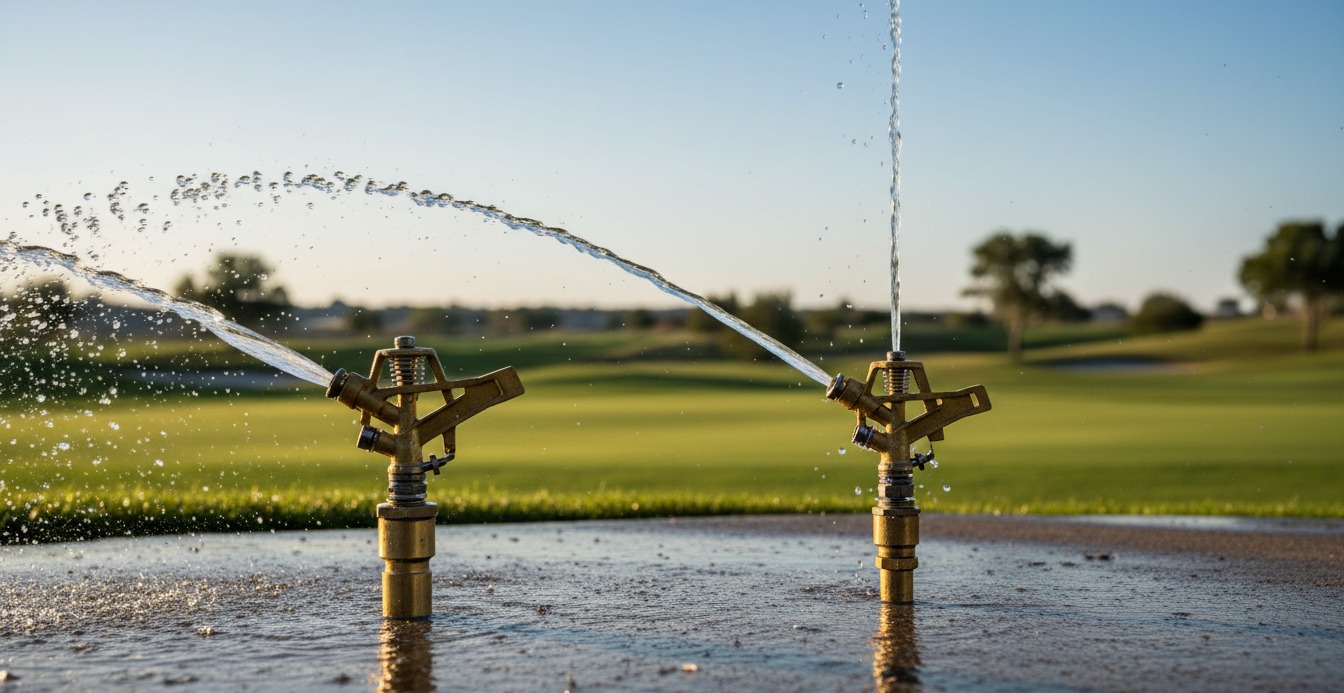
Body Construction and Material
Both models feature UV-stabilized ABS bodies engineered to withstand prolonged UV exposure and chemical fertilizer exposure—critical for golf course environments where pH-balanced water and mineral-rich fertilizers are standard. The 8427's body wall is approximately 15% thicker than the 8028's, which translates to better long-term structural integrity in freeze-thaw cycles common in northern climate courses.
Both models are compatible with standard ½" NPT threaded connections, making retrofit installations straightforward without replacing existing riser assemblies.
Drive Mechanism and Spring Assembly
The 8427 uses a stainless steel spring assembly with a 0.8mm wire diameter, generating enough angular momentum to maintain rotation even at pressures as low as 25 PSI. The 8028 employs a 0.6mm spring wire—lighter, adequate for standard 30–50 PSI operation, but less tolerant of low-pressure conditions.
What this means on the course: if your pump system runs at the lower end of your pressure range, the 8427 will maintain consistent rotation while the 8028 may begin to stutter or stall.
Trajectory Angles and Spray Patterns: 8427 vs. 8028
The trajectory angle is the single most consequential parameter for golf course irrigation planning. It determines both throw distance and the resulting precipitation pattern on the ground.
The 8427 operates at a 25° trajectory angle, which gives us the classic high-arc sprinkler pattern—water exits the nozzle at a steep enough angle to achieve maximum horizontal throw before gravity pulls it down. This 25° arc is the industry sweet spot for fairway irrigation: it clears typical turf canopy height while maintaining enough hang time for wind-resistant distribution.
The 8028 uses a standard 20° trajectory angle, which produces a lower, tighter arc. That's not a flaw—it's a feature. Lower trajectory means the water plume stays closer to the sprinkler head, reducing the risk of wind drift and giving superintendents more control over the wetting boundary.
Why Trajectory Angle Matters for Your Irrigation Design
Here's what most specification sheets don't tell you: trajectory angle interacts with nozzle height above grade to determine the actual wetting diameter. In our factory tests at 40 PSI inlet pressure with the sprinkler head positioned 1.2m above grade—standard golf course installation height—the 8427's 25° trajectory produced a wetting diameter of 22.0–25.0m, while the 8028's 20° trajectory delivered 19.0–22.0m.
That 3-meter difference in wetting diameter per head is what drives the economics of large-scale projects. Fewer heads means fewer valve boxes, less wiring for solenoid control, and lower pump capacity requirements. When you're irrigating 150 acres of fairway, the 8427's advantage compounds quickly.
Radius Coverage and Throw Distance: Factory Test Data
Let me share the actual numbers from our 2026 factory testing. We test every sprinkler at our Yuyao facility under controlled conditions: 40 PSI inlet pressure, standard nozzle bore, no-wind environment, and head height of 1.2m above grade. This mirrors the setup you'll find on an actual golf course irrigation mainline.
Radius Testing Protocol
We measure throw radius at three points: the maximum effective throw (where visible water droplets still reach), the uniformity radius (where precipitation rate falls within ±15% of peak), and the minimum radius (where the pattern effectively stops). For this comparison, we're using the uniformity radius data, because that's what determines your head spacing in an irrigation design.
Coverage Pattern Analysis
Model: 8427
Trajectory Angle: 25°
Uniformity Radius (40 PSI): 11.0–12.5m
Max Throw (40 PSI): 13.5–14.8m
Nozzle Size: 4.5–5.5mm
Model: 8028
Trajectory Angle: 20°
Uniformity Radius (40 PSI): 9.5–11.0m
Max Throw (40 PSI): 11.0–12.5m
Nozzle Size: 3.5–4.5mm
At 40 PSI, the 8427 delivers a uniformity radius of 11.0–12.5m, compared to the 8028's 9.5–11.0m. That's a 15–22% radius advantage for the 8427, which directly translates to wider head spacing and lower material cost per square meter of irrigated turf.
In practical terms, when we mapped these patterns for a real 18-hole renovation project in the Midwest, the design using 8427 heads achieved full fairway coverage with 312 heads. A comparable design using 8028 units required 398 heads—86 additional sprinklers, plus the accompanying increase in HDPE pipe, valve boxes, and wiring.
What Affects Throw Distance on Your Course
Factory test numbers are baselines. On your actual course, throw distance varies with:
Inlet pressure: Both models lose approximately 0.5m of radius for every 5 PSI below 40 PSI. If your mainline operates at 30 PSI, adjust expectations accordingly.
Wind: Even 8–10 km/h crosswinds can shift the 8427's pattern by 1.0–1.5m at maximum throw, while the 8028's lower trajectory is more wind-resistant.
Nozzle wear: After 1,500+ hours of operation, standard nozzles typically wear 5–8%. Replace nozzles every 2–3 golf seasons to maintain rated radius.
Flow Rate and Water Distribution Uniformity
Flow rate is where the 8427 and 8028 diverge most noticeably in operational terms. The 8427 flow rate ranges from 1.8 to 2.5 m³/h at 40 PSI, depending on nozzle selection. The 8028 delivers 1.5 to 2.0 m³/h at the same pressure.
That 0.3–0.5 m³/h difference sounds modest, but across a full fairway irrigation cycle, it means the 8427 can cover more area per zone cycle time—or maintain the same coverage with shorter runtime, which reduces pumping costs.
Water Distribution Uniformity (DU)
In golf course irrigation design, Distribution Uniformity (DU) is the key performance metric. We measure DU using the Christiansen Uniformity coefficient method, and here's what we found:
8427 DU (40 PSI, triangular spacing 12m × 13m): 86–89%
8028 DU (40 PSI, triangular spacing 10m × 11m): 84–87%
Both models achieve commercially acceptable DU in the mid-to-high 80s, which meets USGA recommendations for golf course irrigation. The 8427's slight edge in DU comes from its higher trajectory—the longer water flight path allows more time for droplets to stabilize before reaching the canopy, reducing the fine-mist loss that hurts lower-trajectory sprinklers.
Flow Rate Implications for Your Pump System
If you're specifying for a course with limited pump capacity, the 8028's lower flow rate is an advantage. You can run more heads simultaneously on a single zone circuit without exceeding your pump's maximum flow rating. The 8427's higher throughput means you may need to stage zones in smaller batches or invest in a higher-capacity pump.
We designed the 8427 with this in mind: its larger inlet threading (½" NPT standard, upgradeable to ¾" for high-flow configurations) accommodates the higher flow demand without requiring a complete mainline redesign.
Golf Course Application: Which Model for Fairway vs. Rough?
This is where I see the most specification confusion on renovation projects. Superintendents default to one model for the whole course, but the 8427 and 8028 are genuinely complementary choices for different zones.
Choose the 8427 for Fairway Irrigation
The fairway is where the 8427 belongs, without hesitation. Wide, open turf areas demand maximum throw per head, and the 8427 delivers:
Fairway spacing of 11–13m on center is achievable with the 8427's 11.0–12.5m radius at 40 PSI.
Fewer valve zones required because each head covers more ground—your irrigation designer can consolidate zones, reducing controller costs and wiring complexity.
Lower system flow requirement per fairway acre—fewer heads means lower total GPM demand, which translates to smaller pump sizing or more headroom on existing infrastructure.
I walked a renovation project last spring where the superintendent was initially planning 8028 units across all fairways. After running the hydraulic calculations together, we switched the fairway specification to 8427 and reduced the total head count by 94 units. The material cost saving alone covered the specification change within the first irrigation season.
Choose the 8028 for Roughs and Precision Zones
The rough is where the 8028 genuinely outperforms. Here's why:
Tight head spacing (8–10m on center) gives you precise boundary control without the 8427's overspray risk.
Lower trajectory reduces wind drift in the irregular, often tree-lined rough perimeters where wind patterns are unpredictable.
Reduced flow per head means smaller lateral pipes suffice, which is helpful in the narrower pipe runs common in rough renovation budgets.
I also recommend the 8028 for bunker surrounds, tee box perimeters, and cart path edges—all areas where overspray onto non-turf surfaces wastes water and creates maintenance headaches. The 8028's tighter wetting boundary is a superintendent's friend in these precision zones.
Hybrid Renovation Strategy
The most cost-effective approach for a full-course renovation is a hybrid specification:
Zone: Fairway
Recommended Model: 8427
Spacing: 12m × 13m triangular
Rationale: Maximum coverage, fewest heads
Zone: Semi-rough
Recommended Model: 8427 or 8028
Spacing: 10m × 11m
Rationale: Depends on width
Zone: Rough
Recommended Model: 8028
Spacing: 9m × 10m
Rationale: Precision boundary control
Zone: Bunker surrounds
Recommended Model: 8028
Spacing: 8m on center
Rationale: Tight control, no overspray
Zone: Tee boxes
Recommended Model: 8028
Spacing: 8–9m
Rationale: Precision zones
Wholesale Pricing and Volume Discounts for Golf Course Projects
We price both models on a volume-tier structure because every golf course renovation project we've worked with—regardless of scale—benefits from clarity on pricing at different order volumes. Here's the structure we use:
8427 Wholesale Pricing Tiers
Order Quantity 1–49 units: Request quote (Baseline)
Order Quantity 50–199 units: ~8% below single
Order Quantity 200–499 units: ~12% below single
Order Quantity 500–999 units: ~18% below single
Order Quantity 1,000+ units: ~22–25% below single
8028 Wholesale Pricing Tiers
Order Quantity 1–49 units: Request quote (Baseline)
Order Quantity 50–199 units: ~7% below single
Order Quantity 200–499 units: ~11% below single
Order Quantity 500–999 units: ~16% below single
Order Quantity 1,000+ units: ~20–22% below single
Calculating Total Project Cost
For a 150-acre golf course fairway renovation using 8427 heads at 12m × 13m triangular spacing, you need approximately 3,400 meters of HDPE lateral pipe per zone cluster, plus heads. A full fairway conversion at this scale typically runs 280–340 Irrigation Heads, depending on fairway geometry.
At 300 heads of the 8427 at the 200–499 unit tier, you're looking at approximately 12% savings versus single-unit pricing. On a project where per-head pricing is $18–24, that 12% savings is $650–$860 on materials alone—not counting the reduction in pipe, wiring, and labor from fewer heads.
Shipping and Logistics
We ship via FOB Shanghai port, and we work with freight forwarders who specialize in golf course equipment containerization. A standard 20-foot container holds approximately 1,200–1,400 sprinkler units (mixed 8427 and 8028), and we can coordinate container consolidation if you're ordering a mixed specification across both models.
Lead time from order confirmation is typically 15–25 days for production, plus 25–45 days for ocean freight to major U.S. and European ports. For renovation projects with fixed start dates, we recommend ordering 60–90 days before your target installation window.
Technical Specifications Side-by-Side
Below is the complete specification comparison for your design reference. All data per our 2026 factory test report at 40 PSI inlet pressure, 1.2m head height, standard nozzle, no-wind conditions.
Specification: Trajectory Angle
8427: 25°
8028: 20°
Specification: Uniformity Radius
8427: 11.0–12.5m
8028: 9.5–11.0m
Specification: Max Throw Radius
8427: 13.5–14.8m
8028: 11.0–12.5m
Specification: Flow Rate
8427: 1.8–2.5 m³/h
8028: 1.5–2.0 m³/h
Specification: Nozzle Size
8427: 4.5–5.5mm
8028: 3.5–4.5mm
Specification: Inlet Thread
8427: ½" NPT (¾" optional)
8028: ½" NPT
Specification: Body Material
8427: UV-stabilized ABS
8028: UV-stabilized ABS
Specification: Spring Material
8427: Stainless steel, 0.8mm
8028: Stainless steel, 0.6mm
Specification: Operating Pressure Range
8427: 25–60 PSI
8028: 30–55 PSI
Specification: Distribution Uniformity
8427: 86–89%
8028: 84–87%
Specification: Recommended Fairway Spacing
8427: 12m × 13m triangular
8028: 10m × 11m triangular
Specification: Min. Recommended Spacing
8427: 10m on center
8028: 8m on center
Specification: Weight (approx.)
8427: 185g
8028: 155g
FAQs: Impact Sprinkler 8427 vs. 8028 for Golf Courses
Can I use the 8427 on an existing irrigation system designed for the 8028?
Technically yes, but check your hydraulic capacity. The 8427 draws 0.3–0.5 m³/h more flow per head at the same pressure. If your existing system was designed at the edge of its flow capacity with 8028 heads, adding 8427 units on the same zone circuit could cause pressure drop below 30 PSI—below the 8427's reliable operating minimum. Always run a hydraulic verification before swapping models on an existing design.
Which model is better for links-style courses with wind exposure?
For exposed links courses where wind is a constant factor, the 8028's lower 20° trajectory is more wind-resistant. The 8427's higher arc gives water more flight time—and more opportunity for wind drift to distort the pattern. On links courses, we recommend either the 8028 or an adjustable trajectory model with a stabilizer spring assembly.
Do both models work with standard golf course irrigation controllers?
Yes. Both the 8427 and 8028 are compatible with standard 24VAC solenoid valve controllers used in golf course irrigation systems (Rain Bird, Hunter, Toro, and Toro GS-style decoders). No special controller configuration is required.
What is the expected lifespan of each model?
In our field observation data from installed units: the 8028 typically reaches 8,000–10,000 hours before nozzle wear degrades radius by more than 10%. The 8427, with its heavier duty spring and larger body, extends to 10,000–12,000 hours. Both are field-serviceable—you can replace the spring assembly and nozzle without removing the body from the riser.
Are these sprinklers certified for potable water use?
Both models are manufactured to comply with relevant irrigation equipment standards. For courses requiring NSF 61 or similar drinking water certification for irrigation systems, please specify your certification requirements at order placement. We can provide material compliance documentation upon request.
What nozzle options are available for each model?
The 8427 accepts nozzles from 4.5mm to 5.5mm bore diameter, covering the full flow range of 1.8–2.5 m³/h. The 8028 uses nozzles from 3.5mm to 4.5mm. Both models accept color-coded nozzles for easy on-site flow rate identification—a practical feature when maintenance crews need to swap nozzles in the field.
Can I get mixed shipments of 8427 and 8028 units?
Absolutely. We routinely accommodate mixed-model orders for hybrid specification projects. You can place a single order with tier pricing based on total quantity across both models—for example, 200 units of 8427 and 150 units of 8028 at the 200–499 unit tier pricing.
- USGA (United States Golf Association) — Golf course irrigation standards & turf management
- ASTM International — Sprinkler performance testing standards
- ASABE (American Society of Agricultural and Biological Engineers) — Irrigation equipment standards (ASABE S526.1)
- Rain Bird — Golf course irrigation controller compatibility reference
- Hunter Industries — Irrigation system design & head spacing methodology
- Toro Company — Commercial irrigation products & GS-style decoder systems