


Irrigation Swing Joints: SJ Series Flexibility, Pressure Ratings, and Installation Best Practices for Commercial Sprinkler Systems
Introduction: The Swing Joint's Role in Commercial Irrigation System Reliability
If you've ever walked through a commercial landscape and noticed how perfectly sprinkler heads align along a straight line, despite the pipes beneath them following a slightly different path — that's the swing joint at work. These unassuming flexible connectors are the silent heroes of professional Irrigation Installations, and in my two decades supplying commercial irrigation equipment globally, I've seen more system failures from swing joint neglect than from any other single cause. Not because swing joints are inherently unreliable, but because they're systematically undervalued during procurement and installation.
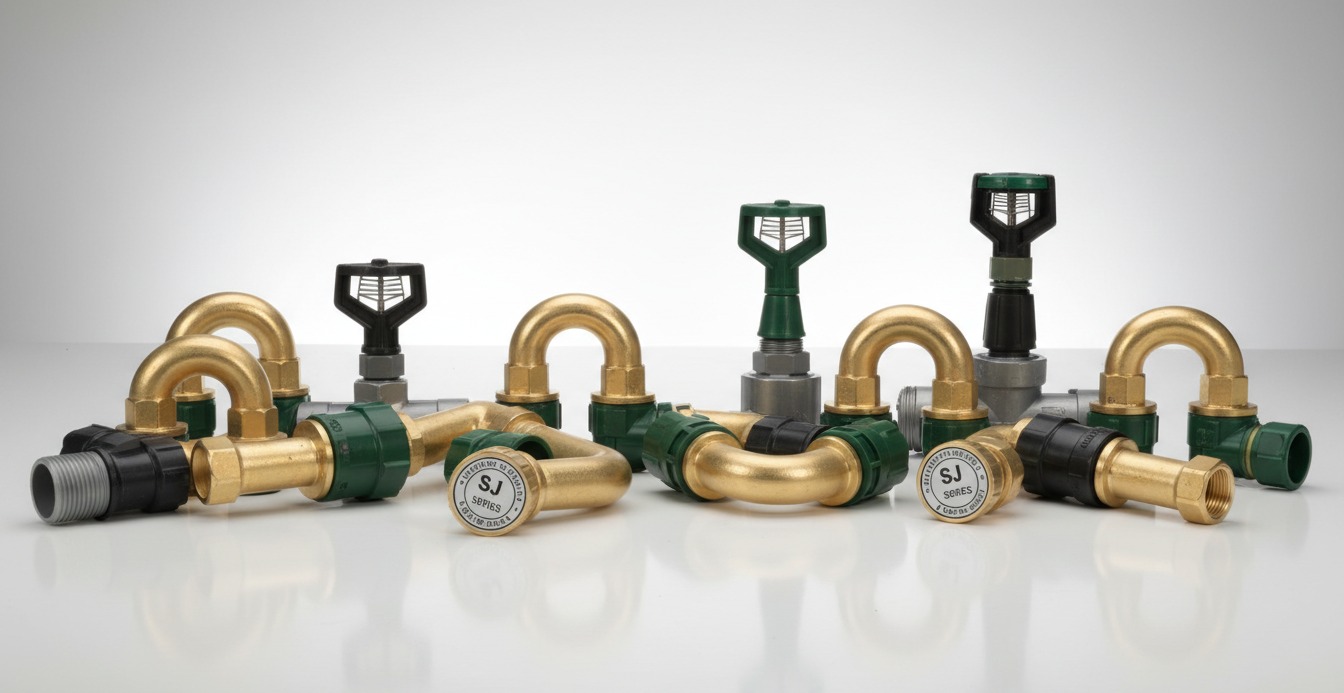
A swing joint — specifically an SJ series (swing joint) assembly — connects a rigid underground pipe to a sprinkler head while allowing three-dimensional adjustment of the head's position. It compensates for pipe misalignment, provides the lateral flexibility needed to set precise head height and alignment, and critically, isolates the sprinkler head from mechanical stresses transmitted through the underground piping. Without swing joints, every thermal expansion cycle, every settlement event, every root growth would transfer directly to the sprinkler body — and those sprinkler bodies would fail, catastrophically and expensively.
In this article, I'll walk through SJ series design, pressure and temperature ratings, proper installation practice, and procurement guidance for commercial landscape distributors. This is the technical depth I wish every contractor and procurement officer had before specifying swing joints on their projects.
What Is a Swing Joint? Understanding the SJ Series Architecture
The Ball Joint Mechanism: How 360-Degree Adjustment Works
The core of a swing joint is a ball joint — a mechanical connection that allows rotation and pivoting in multiple planes simultaneously. In an SJ series swing joint, this is achieved through a male-threaded spigot that inserts into a female-threaded socket, with a sealing surface at the interface and a retaining mechanism that holds the assembly together while allowing free movement.
The design allows 360-degree rotation around the pipe axis (horizontal plane) and typically 30-45 degrees of deflection from the pipe axis in any radial direction (vertical plane). This three-dimensional freedom means a single swing joint can compensate for up to 15cm of pipe misalignment in any direction — a range validated by ASABE landscape irrigation engineering guidelines., eliminating the need for precision excavation that would otherwise be required to achieve perfect pipe-to-head alignment.
What makes this engineering elegant is that the sealing mechanism is simultaneous with the articulation — the same surfaces that provide sealing also bear the mechanical loads. In quality SJ series swing joints from manufacturers like INOVATO, the ball seat is precision-machined from virgin polymer (typically glass-filled nylon or polypropylene) to maintain a bubble-tight seal across the full range of articulation angles, under pressure, over thousands of thermal cycles.
The practical field benefit: a contractor can set a sprinkler head within 2cm of perfect grade alignment in any direction, even when the supply pipe is 10cm off position. This flexibility dramatically reduces installation labor and eliminates the need for short-radius elbows or custom pipe fabrication to achieve alignment.
Pressure Ratings: Why 1.0MPa to 1.6MPa Is the Commercial Standard
SJ series swing joints for commercial irrigation are rated across a pressure range of 1.0 MPa to 1.6 MPa (10 bar to 16 bar, or 145 PSI to 232 PSI). Understanding why this range is standard — and why it matters for system design — requires understanding the actual pressures in a commercial irrigation mainline.
Most commercial irrigation systems operate their mainlines at 5-8 bar (72-116 PSI). A sprinkler head's operating pressure at the head itself (accounting for friction loss in the lateral pipe) is typically 2-4 bar (29-58 PSI). Given this, a swing joint with a 1.0 MPa (10 bar) rating would seem more than adequate — so why do commercial-grade SJ series swing joints start at 1.6 MPa (16 bar) for many applications?
The answer is pressure transients. When a solenoid valve closes rapidly — as in virtually every automated irrigation system — the water column in the pipe comes to an abrupt stop, a hydraulic transient also tracked in ICID technical resources on irrigation network design. That momentum creates a pressure wave that travels back through the system. In commercial systems with PVC or HDPE pipes, this water hammer (surge pressure) can add 3-6 bar above the operating pressure momentarily. A system running at 6 bar static can see transient peaks of 9-12 bar. An SJ series swing joint that was specified at 1.0 MPa (10 bar) would be operating at or beyond its rating during every valve closure cycle.
INOVATO's SJ series swing joints are rated at 1.6 MPa (16 bar) as the standard commercial product per ISO 7268, which provides a 2.7x safety factor over a 6 bar operating pressure — sufficient margin to handle the combined effects of water hammer, temperature derating, and material aging. For systems with booster pumps or elevated tanks creating pressures above 7 bar static, or for zones with known aggressive water hammer characteristics, PN20 (2.0 MPa) rated swing joints are available as an upgrade option.
Temperature Range: Why -20°C to 80°C Matters for Year-Round Landscapes
The standard SJ series temperature range of -20°C to +80°C encompasses virtually every commercial landscape installation on Earth. This range is not arbitrary — it represents the practical service limits of the polymer materials used in swing joint construction, accounting for both mechanical strength retention and elastomer (seal) performance at temperature extremes.
At the cold end (-20°C), the concern is impact strength. Polypropylene and nylon both become more brittle as temperature decreases. The impact strength of PP at -20°C is approximately 60% of its value at room temperature. In cold climates (Northern Europe, Canada, Russia's temperate zones, high-altitude installations), this is relevant for fittings installed in unheated valve boxes or in systems that may be subject to frost heave. Proper installation below the frost line and adequate backfill compaction mitigate frost damage risk.
At the hot end (+80°C), the concern is material strength and seal performance. As PP or nylon approaches its heat deflection temperature (typically 100-110°C for glass-filled PP), mechanical strength decreases significantly. At 80°C — which can be reached in above-ground installations in direct sun — the material retains approximately 70% of its room temperature strength. This is why INOVATO specifies a maximum continuous service temperature of 80°C for SJ series swing joints, with short-term peaks to 95°C acceptable if they occur infrequently.
For installers in extreme climates — Middle Eastern summers where black valve box surfaces can reach 85°C+, or Scandinavian winters with -30°C frost — special installation practices are needed. In hot climates, above-ground swing joints should be shielded from direct sun — a practice recommended by FAO land and water division guidelines for irrigation system longevity in tropical regions.; in cold climates, they should be buried below the frost line with compacted granular backfill to prevent frost heave forces from damaging the joint.
Installation Best Practices: Getting Every Swing Joint Right
Pre-Setting the Swing Joint Before Backfilling
The most common installation error I observe in the field: swing joints are installed in the trench and immediately backfilled without the contractor setting the joint to its neutral or midpoint position. This is critical. A swing joint that is backfilled while fully deflected in one direction will experience stress from the moment the system is pressurized — stress that accelerates seal wear and can cause premature failure.
The correct procedure: before backfilling, set the swing joint to its neutral (centered) position — guidance aligned with Irrigation Association installation standards for commercial systems. — the configuration where the ball joint is neither deflected nor rotated from its design center. This is typically indicated by an alignment mark on the male spigot (a flat or arrow that should point toward the socket's reference direction). In this neutral position, the sealing surfaces are evenly loaded and the mechanical stress on the joint is minimized. When the sprinkler head is ultimately positioned, the joint is adjusted from its neutral position rather than from an already-stressed extreme position.
Then: thread the sprinkler head onto the swing joint's top connection. Position the head at the correct grade — flush with or 1-2cm above finished soil surface, depending on the head type and mowing equipment in use. Check the head for vertical plumb using a level. Adjust the swing joint articulation to achieve this alignment, noting that the deflection should be distributed: the final position should be within the middle 60% of the joint's total articulation range, not in the outer 20% at any connection. This middle-zone positioning provides adjustment margin for future settlement or grade changes without reaching the joint's mechanical limits.
Sealing the Joint: Ensuring a Leak-Free Connection
The SJ series swing joint sealing mechanism relies on the compression of an elastomer seal — typically EPDM (ethylene propylene diene monomer) or NBR (nitrile butadiene rubber) — between the male spigot and female socket. This seal is a pressure-activated seal: system pressure pushes the spigot slightly into the socket, increasing seal compression and improving the seal. A swing joint that is only pressurized during testing (low pressure, short duration) may not show a leak that will appear when the system runs at full operating pressure for extended periods.
No thread sealant tape or liquid sealant compound should be used on the ball joint thread connection. The thread is a mechanical retaining feature, not a sealing feature. Applying sealant tape to the thread increases the assembly torque required to reach the rated clamping force and may cause the joint to be under-clamped — which leads to joint failure. The seal is made by the elastomer o-ring or gasket, not by the thread. I cannot stress this enough: never use PTFE tape on swing joint ball joint threads.
The correct procedure for assembly: hand-tighten the male spigot into the female socket until the threads are fully engaged and the seal is visibly seated. Then, using a strap wrench or chain wrench (never damage the fitting body with open-ended wrenches), tighten to the manufacturer's specified torque. If no torque specification is given, tighten until the spigot's anti-rotation feature seats against the socket's stop, plus one additional quarter turn. The joint should not be able to be disassembled by hand but should come apart with moderate tool force.
Protecting Swing Joints During Backfilling
Backfilling around a swing joint requires the same care as backfilling around any buried fitting — but with the added concern that mechanical impact or point loading on the swing joint body can damage the seal or fracture the polymer. Standard practice: backfill in layers of 15-20cm, compacting each layer with hand tamping within 30cm of the fitting. Power tamping or mechanical compaction equipment should not be used within 50cm of a buried swing joint until adequate cover has been established.
The backfill material itself matters. Sharp angular stones can concentrate stress on the fitting body, creating point loads that cause stress cracking over seasons. The standard specification is: clean, screened, well-graded granular material (sand, pea gravel, or fines-free crushed stone) within 15cm of the fitting, with native soil or structural fill beyond that. This is the same backfill specification used for buried valves and meters, and it's equally important for swing joints.
For installations in rocky or stony soils, a geotextile fabric sock around the fitting provides additional protection against stone point loading. This is a standard practice in municipal Irrigation Installations where rocky native soil is common, and I recommend it for any commercial landscape where backfill quality cannot be guaranteed.
The Double O-Ring Seal: Why Two Seals Are Better Than One
Understanding Dual-Seal Design and Its Performance Implications
Quality SJ series swing joints use a double O-ring seal design — two elastomer O-rings seated in grooves on the male spigot, providing sealing at two independent points along the bore. This is not redundancy for redundancy's sake; it's a specific performance solution for the demanding conditions in irrigation systems.
The primary seal (closest to the ball joint's interior) provides the primary pressure seal. The secondary seal (closer to the thread end) provides backup sealing if the primary seal is compromised and also serves as a pressure-equalization feature — system pressure acts on both seals, but if the primary seal is momentarily disturbed (during articulation, for example), the secondary seal maintains containment.
The practical field benefit: a swing joint with double O-ring sealing can tolerate a primary seal wear event without immediately leaking. The system continues operating, and the leak manifests gradually rather than catastrophically. This gradual-leak characteristic allows maintenance scheduling rather than emergency response. In a municipal park or sports complex where 4am emergency callouts are expensive and disruptive, this matters enormously.
Single O-ring swing joints (typically lower-cost or older designs) lack this backup. A worn or damaged single O-ring means immediate leak, usually at the worst possible time — during a weekend tournament, the day before a property inspection, or in the middle of peak summer when the system runs longest.
When specifying or procuring SJ series swing joints, always verify that the product uses dual O-ring sealing. It's a feature that costs almost nothing to add in manufacturing but provides significant field reliability improvement. INOVATO's SJ series standard configuration includes dual EPDM O-rings, with NBR (nitrile) O-rings available as an option for petroleum-contaminated water or oil-contact applications.
O-Ring Material Selection: EPDM vs. NBR vs. Viton
EPDM (ethylene propylene diene monomer) is the default O-ring material for Irrigation Swing Joints because it handles the water chemistry range found in most irrigation systems — pH 6-9, temperatures up to 80°C, and resistance to the dilute acids and alkalis common in fertigation. EPDM has poor resistance to petroleum oils and hydrocarbon solvents, which limits its use in applications with recycled water containing oil residues.
NBR (nitrile butadiene rubber, also called Buna-N) handles petroleum oils and hydrocarbons well, making it the choice for recycled water systems or installations where incidental oil contact is possible. NBR has poorer UV resistance than EPDM and is not recommended for above-ground installations with direct sun exposure. NBR's temperature limit is 100°C (higher than EPDM's 80°C), which can be relevant in high-temperature water applications.
Viton (fluorocarbon elastomer) handles the broadest chemical range — acids, bases, hydrocarbons, and high temperatures — but at 3-4x the cost of EPDM. Viton O-rings in swing joints are specified for industrial applications, chemical processing landscapes, or marine environments where salt spray is a concern. For standard commercial landscape irrigation, Viton is overkill and cost-prohibitive.
For most commercial landscape distributors: default to EPDM O-ring swing joints, specify NBR for recycled water or petroleum-contact applications, and keep Viton O-ring options as a specialty item for documented specific requirements.
Connecting to Sprinkler Heads: Rotor vs. Fixed Spray Configurations
Rotor Sprinklers: Higher Pressure, Greater Swing Joint Load
Rotor sprinklers — gear-driven Rotating Sprinklers covering radii of 5-30m — impose significantly different mechanical loads on swing joints compared to fixed spray heads. The primary load is reverse thrust: as the rotor's internal gear train drives the sprinkler head to rotate, it creates a reaction torque that pushes back against the swing joint. Over thousands of rotation cycles, this cyclic reverse thrust fatigues the swing joint's mechanical connections.
The magnitude of this reverse thrust varies by rotor brand and model. High-quality rotors with precision-machined gears (Hunter, Rain Bird, Torpedo) generate reverse thrust of 0.5-2 Nm — manageable for standard SJ series swing joints. Budget rotors with lower-quality gear trains can generate reverse thrust of 3-5 Nm, which significantly accelerates swing joint wear at the ball joint interface.
For rotor installations, I recommend specifying swing joints one pressure rating above what the static system pressure would suggest: if the system operates at 5 bar, specify PN16 (1.6 MPa) rather than PN10 (1.0 MPa), and verify the swing joint's torque resistance specification exceeds the rotor's documented reverse thrust. Most premium SJ series swing joints are rated to handle 10+ Nm of reverse thrust — adequate for virtually all commercial rotors.
Fixed Spray Heads: Lower Pressure, Different Adjustment Needs
Fixed spray heads — stationary sprinklers with fixed pattern nozzles covering radii of 1.5-5m — generate minimal reverse thrust. The swing joint's primary function in fixed spray installations is alignment adjustment rather than thrust resistance. A standard PN16 SJ series swing joint is more than adequate for any fixed spray installation.
The installation concern with fixed sprays is different: the nozzles are fragile and prone to damage from foot traffic, mower impact, and turf aeration. A swing joint that positions the spray head above grade risks nozzle damage; a head installed below grade risks pattern obstruction by grass. The correct position is flush with the finished grade, which requires precise adjustment of the swing joint's vertical setting. This is exactly what swing joints are designed for, but contractors often set them too high initially and then must re-adjust — which means additional articulation cycles that incrementally wear the joint.
My recommendation for fixed spray installations: set the head at finished grade minus 2mm during installation, knowing that the first season's settlement will bring it to grade. This avoids the callbacks from above-grade heads while preventing the pattern obstruction complaints from below-grade heads.
Bulk Procurement: SJ Series for Large Commercial Projects
Logistics Planning for Project-Scale Swing Joint Orders
Commercial irrigation projects at scale — sports complexes with 200-500 sprinklers, municipal parks with 1,000+ heads, agricultural frost protection systems covering hectares — require swing joint procurement that accounts for logistics as much as technical specifications. Getting the technical specifications right (pressure rating, seal material, connection size) is necessary but not sufficient; procurement logistics can make or break a project's economics.
Sea freight timelines from Asian manufacturers (including China-based producers like INOVATO) to North American or European ports run 25-45 days, plus inland transport and customs clearance. This means project procurement must begin 60-90 days before installation start. For projects with aggressive construction schedules, this timing pressure creates a common failure mode: swing joints arrive late, installation is delayed, and the project finishes behind schedule. Building 30-45 days of swing joint buffer stock into the procurement timeline is essential for large projects.
For distributors managing large project procurement: consider sea freight consolidation with other products from the same manufacturing region. INOVATO's factory in Yuyao, Zhejiang, produces both fittings and swing joints, and consolidated container shipments reduce per-unit freight costs by 40-60% compared to air freight or less-than-container-load sea shipments. The tradeoff is longer lead time — typically 30 days of production plus 30 days of sea freight, totaling 60 days from order confirmation to port arrival.
Project Bundling: Combining Swing Joints with Complementary Products
Most large irrigation projects require swing joints alongside numerous other products: mainline fittings, lateral line fittings, sprinklers, valves, controllers, wire, and pipe. Consolidating procurement from a single manufacturer or distributor reduces transaction costs, simplifies logistics (single delivery, single customs entry), and creates leverage for better pricing across the full product basket.
INOVATO supplies the full range of irrigation equipment — swing joints, drip fittings, sprinkler heads, gear drives, valves, and accessories — which allows distributors to source the complete project BOM from one supplier. The pricing benefit from consolidated procurement typically exceeds 10-15% compared to sourcing each component category separately from different suppliers.
For distributors who work with multiple manufacturers by product category: evaluate whether the price advantage of specialist sourcing outweighs the logistics complexity, supplier management overhead, and missed volume discount potential of consolidated procurement. In my experience managing supply chains for multi-product irrigation projects, consolidation typically wins on total cost of ownership even when individual product prices are marginally higher from a full-range supplier.
Procurement Checklist for SJ Series Swing Joints
- Confirm system operating pressure per ASABE PN ratings and specify PN16 (1.6 MPa) as minimum for commercial applications, PN20 (2.0 MPa) for systems above 7 bar or with known water hammer
- Verify temperature range matches installation environment — -20°C to +80°C covers most outdoor applications, but above-ground installations in hot climates may need additional sun protection measures
- Confirm dual O-ring sealing is standard on the specified product — single O-ring designs sacrifice reliability for cost
- Match seal material to water chemistry: EPDM for standard potable/recycled water without petroleum content, NBR for recycled water with oil content or petroleum-contact applications
- For Rotor Sprinkler connections, verify the swing joint's reverse thrust resistance exceeds the specific rotor brand's documented torque
- Confirm connection thread standard matches your pipe system (BSP or NPT — critical for international projects, as mixing BSP and NPT threads causes leaks that appear after pressurization)
- Request pressure test certificates and material data sheets with each shipment
- For orders above $3,000, arrange third-party pre-shipment inspection
- Build 30-45 days of logistics buffer into project timelines when ordering sea freight from Asian manufacturers
- Consider consolidated procurement (swing joints + fittings + sprinklers) to unlock volume discounts and simplify logistics
The swing joint is not the most glamorous component in an irrigation system, yet the Irrigation Association technical library documents hundreds of case studies where swing joint failure caused system-wide problems.. It's small, it's buried, and it's out of sight. But it's the component that makes every sprinkler head's alignment possible, every pipe misalignment tolerable, and every thermal expansion cycle survivable. Specify them right, install them correctly, and they'll outlast the system's other components. Cut corners on them, and you'll spend years managing the callbacks.