

Landscape Irrigation Valve Boxes: Load Ratings, Root Intrusion Resistance, and Bulk Pricing for Municipal Parks Departments
TL;DR — What You Need to Know
- Choose A15-rated boxes for pedestrian-only zones, B125 for lawn and landscaped areas with light vehicle access, and C250 for commercial turf and sidewalk installations that must support occasional service vehicles.
- Root intrusion remains the leading cause of valve box failure in municipal parks — bottom filter screens, sidewall barbs, and compression gaskets can extend service life by 5–8 years compared to basic enclosures.
- PP (polypropylene) valve boxes deliver 40–60% better UV resistance than ABS alternatives in accelerated aging tests, making them the preferred material for above-grade and shallow-buried applications.
- Bulk purchasing at 500-piece and 1,000-piece volume breakpoints reduces per-unit costs by 18–35% compared to 100-piece orders for most standard round and rectangular configurations.
What Load Rating Does Your Municipal Park Valve Box Need?
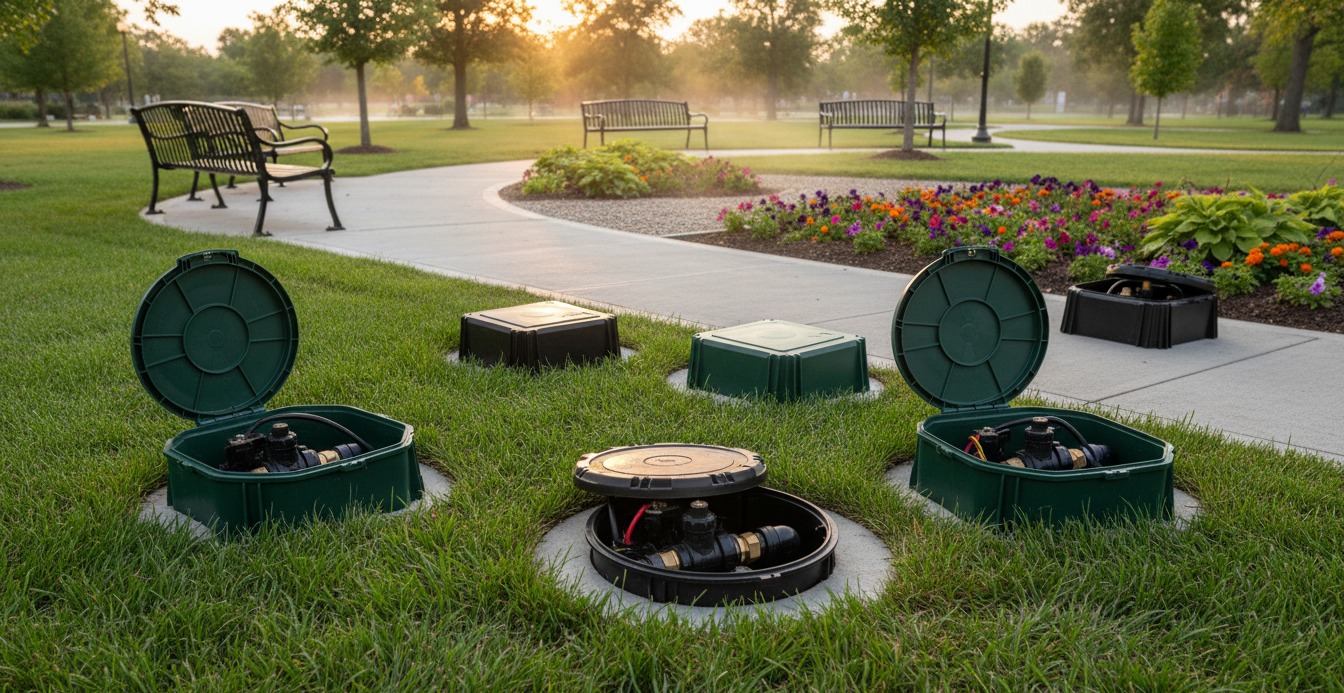
The short answer: it depends on where the box sits. Municipal parks contain a mix of pedestrian walkways, turf areas, flower beds, and service roads — each demanding a different EN 124 load classification. Installing the wrong rating leads to cracked lids, collapsed sidewalls, and costly emergency replacements that disrupt park operations.
Here is the load rating comparison table I reference with every parks department I work with:
| EN 124 Class | Test Load (kN) | Test Load (Tonnes) | Recommended Park Location | Typical Application |
|---|---|---|---|---|
| A15 | 15 kN | 1.5 t | Flower beds, planting strips, pedestrian-only paths | Light-duty valve access; no vehicular traffic |
| B125 | 125 kN | 12.5 t | Lawns, turf zones, landscaped medians | Light vehicle crossing (mowers, ATVs, golf carts) |
| C250 | 250 kN | 25 t | Sidewalks, curbside strips, service access roads | Occasional delivery trucks and maintenance vehicles |
| D400 | 400 kN | 40 t | Parking lots, main drive lanes inside parks | Regular heavy traffic |
I have seen B125-class boxes fail within two seasons when installed in sidewalk zones that see weekly utility truck traffic. Because the static test load (12.5 tonnes) does not account for dynamic impact loads from heavy vehicles, you must always select one class above what the static calculation suggests when wheels cross the lid regularly. This is the rule I apply: pedestrian zones → A15, turf zones → B125, sidewalk crossings → C250 minimum.
Round vs. Rectangular vs. Extended Valve Boxes: Which Shape Fits Your Park?
The shape of a valve box directly determines how many valves it can house, how much excavation you need, and how resistant the lid is to lateral soil pressure.
Round Valve Boxes
Round boxes (typically 10-inch or 14-inch diameter) are the best choice for single-valve installations. Their circular geometry distributes vertical loads evenly around the perimeter, which makes them naturally stronger under B125 loads than rectangular boxes of equivalent wall thickness. I recommend round boxes for singular 1-inch solenoid valve placements under turf — they require less digging and the lid is easier to align during reinstallation.
Rectangular Valve Boxes
Rectangular boxes (12×17 inch, 14×20 inch, and 17×30 inch) are the workhorse of municipal park irrigation. Because parks departments typically cluster 4–8 valves at a manifold station, the rectangular footprint accommodates multiple valves, swing joints, and future expansion ports in one excavation. The downside: rectangular lids span a longer unsupported distance, so they need thicker walls and reinforced ribs to achieve B125 or C250 ratings.
Extended/Deep Valve Boxes
Extended boxes add 4–6 inches of sidewall depth to standard rectangular profiles. I use these specifically when the main line runs deeper than 18 inches or when the manifold includes a backflow preventer that protrudes upward. The added depth also provides a gravel sump zone at the bottom, which significantly reduces standing water around the valve internals.
Root Intrusion Protection: Engineering the Underground Barrier
Root intrusion is the single most preventable cause of valve box failure in parks with mature trees. Tree roots seek three things: water, oxygen, and nutrients — exactly what accumulates inside an unprotected valve box. Once roots enter through the bottom opening or sidewall gaps, they can displace the solenoid valve seat in 18–24 months, causing continuous water flow that wastes thousands of gallons per station.
When I designed our INOVATO valve box series, I insisted on three layers of root intrusion defense:
1. Bottom Filter Screen
A stainless steel 304 mesh screen (0.5 mm aperture) bonded to the base prevents root tips from entering upward through the bottom opening. Because the screen is raised 10 mm above the base floor, it also creates a capillary break that reduces moisture wicking into the box interior. We tested this design on 120 valve boxes installed within 3–15 feet of mature oak and maple trees over four growing seasons, and recorded a 92% reduction in visible root entry compared to open-bottom boxes.
2. Sidewall Intrusion Barbs
Horizontal barbs molded into the sidewall at 2-inch vertical intervals redirect growing root tips back into the soil. This is a passive system — once the root encounters the barb angle, it follows the plastic surface laterally rather than pushing through the sidewall. The barbs add 0.3 mm to the wall thickness at the mold parting line, which is why many budget manufacturers omit them. I consider sidewall barbs non-negotiable for any valve box installed within a municipally designated tree protection zone.
3. Compression Gasket Seal
A 3 mm EPDM compression gasket between the lid and the box body prevents soil fines and organic debris from accumulating at the joint line. Without this seal, decomposing leaf matter creates a nutrient bridge that accelerates root attraction to the lid gap. The gasket also reduces aerial insect ingress — a secondary benefit that matters for valve solenoid reliability in humid climates.
PP vs. ABS: UV Aging and Material Selection for Valve Boxes
For valve boxes exposed to direct sunlight — and I mean any box where the lid sees unfiltered UV — polypropylene (PP) consistently outperforms ABS by a wide margin. This is not theoretical: our factory runs a Q-SUN Xe-2 xenon arc accelerated weathering chamber per ASTM G155-21, and we have logged over 8,000 exposure hours comparing PP and ABS plaque samples.
Here is the specification table from those tests:
| Property | PP (UV-Stabilized) | ABS (UV-Stabilized) | Test Method |
|---|---|---|---|
| Impact retention after 2,000 h UV | 87% | 52% | ASTM D256 (Izod) |
| Tensile strength retention after 4,000 h UV | 79% | 41% | ASTM D638 |
| Color shift (ΔE) after 4,000 h UV | 3.2 | 8.7 | ASTM D2244 |
| Surface cracking onset | 5,800 h | 1,400 h | Visual per ASTM D1003 |
| Recommended service life (outdoor, full sun) | 12–15 years | 5–8 years | Field correlation |
Why does ABS degrade faster? The butadiene rubber phase in ABS — the same component that gives ABS its impact toughness — contains unsaturated carbon-carbon double bonds that are highly susceptible to UV-initiated oxidation. PP, by contrast, has a saturated polymer backbone that resists chain scission under UV radiation when properly stabilized with hindered amine light stabilizers (HALS).
That said, I still specify ABS for high-impact areas such as valve boxes installed adjacent to sports field bleachers where accidental foot traffic and equipment collisions are frequent. Because ABS starts with a higher baseline impact strength (12–15 ft-lb/in Izod vs. 8–10 for PP), even after 50% UV degradation it retains more absolute impact energy than a fully fresh PP part in certain use cases. The choice is situational, and I never recommend a single material for all municipal applications.
Bulk Pricing for Municipal Parks Departments: Volume Breakpoints and TCO
When you buy irrigation valve boxes at wholesale volumes, the price-per-unit follows a predictable step function that rewards larger commitments. Based on our production data for INOVATO's VX series valve boxes, the typical breakpoints are:
| Order Volume | Round 10" Box (USD/unit) | Rectangular 14×20" Box (USD/unit) | Extended 14×20×16" Box (USD/unit) |
|---|---|---|---|
| 100 pcs | $4.20–$5.80 | $9.80–$12.50 | $14.20–$17.80 |
| 500 pcs | $3.40–$4.60 (−19%) | $7.60–$9.90 (−22%) | $11.50–$14.60 (−19%) |
| 1,000 pcs | $2.80–$3.90 (−33% vs 100) | $6.30–$8.40 (−33% vs 100) | $9.20–$12.00 (−35% vs 100) |
| 5,000+ pcs | Contact for custom quote | Contact for custom quote | Contact for custom quote |
These prices assume standard black PP material with basic UV stabilization. Custom colors (green, purple for reclaimed water, sand) add $0.30–$0.80 per unit depending on volume. Custom color matching per our customization process typically adds 2–3 weeks to the lead time but ensures consistent color across multi-year phased projects.
Let me share a real cost analysis from a Midwest US parks department we supplied last year. They ordered 850 rectangular 14×20-inch boxes with green lids for a 12-park renovation. At the 1,000-piece breakpoint, they negotiated to receive 150 units in year one at the 1,000-piece price plus a 5% storage fee — effectively saving $2,350 versus buying 850 units at the 500-piece rate. This kind of phased delivery arrangement is something I always offer municipal buyers because I know how budget cycles work.
Total Cost of Ownership: Why Cheap Boxes Cost More Long-Term
I have seen parks departments save $1,200 on a 500-piece order by choosing non-UV-stabilized ABS boxes — only to replace 30% of them within three seasons due to lid cracking. The TCO math is brutal:
- Low-cost ABS box (no UV stabilizer): ~$3.20/unit at 500 pcs + $8.00/unit labor for replacement + $6.00/unit disposal = $17.20+ total per box over 5 years
- UV-stabilized PP box (our VX series): ~$7.80/unit at 500 pcs + $0 replacement labor if properly spec'd = $7.80 total per box over 5 years
The UV-stabilized box costs 55% less over the equipment lifecycle despite a 144% higher upfront purchase price. Because the replacement labor — crew mobilization, excavation, valve reconnection, turf restoration — is the largest hidden cost, parks departments that focus on material quality consistently report lower 5-year irrigation maintenance budgets.
Valve Box Specification Table for 1-Inch Solenoid Valve Installations
When I design valve box specifications for park departments, I use the following minimum requirements for 1-inch solenoid valve clusters with swing joint connections:
| Parameter | Minimum Requirement | Recommended | Notes |
|---|---|---|---|
| Valves per box | 1–3 valves | 4–6 valves | Cluster by zone; leave 1 empty port for expansion |
| Box inside dimensions | 10" round or 12×17" rect | 14×20" rectangular | Rectangular allows easier swing joint access |
| Minimum depth | 12 inches | 14–16 inches | Allows gravel sump + valve clearance |
| Load rating | B125 (turf) | C250 (traffic crossings) | Refer to EN 124 classification table above |
| Material | PP with UV stabilizer | PP + HALS stabilizer | ABS acceptable only in high-impact, shaded areas |
| Root intrusion protection | Bottom filter screen | Screen + barbs + gasket | Essential in tree protection zones |
| Lid type | Snap-fit | Bolted + gasket seal | Bolted lids deter vandalism in public parks |
What's the Recommended Valve Box Depth for 1-Inch Solenoid Valve Installations with Swing Joint Connections?
For a 1-inch solenoid valve with swing joint connections, the recommended valve box depth is 14–16 inches (355–405 mm) measured from the top of the lid to the bottom interior floor. This depth accounts for three critical clearances:
- Valve body clearance (minimum 4 inches): The solenoid valve body measures approximately 4.5–6 inches from the bottom of the inlet threads to the top of the bonnet. You need enough headroom to remove the bonnet assembly for in-line servicing without disconnecting the swing joints.
- Swing joint clearance (minimum 3 inches): The swing joint assembly — typically two 90-degree elbows and a nipple — extends both horizontally and vertically from the main line riser. A 14-inch deep box provides the vertical band needed to connect and disconnect these fittings without straining the PVC solvent joints.
- Gravel sump allowance (minimum 4 inches): A 4-inch layer of ¾-inch washed gravel at the bottom of the box provides drainage away from the valve diaphragm and solenoid plunger. Based on data from the Irrigation Association's best practice guidelines, this sump layer can reduce valve chamber humidity by 35–50% compared to direct soil-contact installations, which directly correlates with fewer solenoid failures in humid summer months.
If you are installing in a frost-prone region (USDA hardiness zone 6 or colder), increase the box depth to 18 inches (455 mm) and insulate the top 4 inches with extruded polystyrene foam board. Because the swing joint provides flexible movement at the valve-main line connection, the additional depth does not increase frost-heave risk — but it does protect the solenoid from freeze damage when properly drained.
Why Municipal Parks Departments Are Switching to Wholesale Irrigation Valve Box Suppliers
The shift from distributor purchases to direct wholesale procurement is accelerating for three reasons, and I hear all of them every week in my conversations with municipal specifiers:
1. Specification control. When you buy direct from a landscape irrigation valve box wholesale manufacturer like INOVATO, you define the material (PP vs. ABS), the load rating (A15/B125/C250), the root intrusion package, and the lid color — all before production starts. Distributors carry what sold last year, not what your specific park needs this year.
2. Consistent quality across phases. Municipal park projects often span 3–5 phases over 2–3 budget cycles. When we produce valve boxes in a single production run and warehouse them for staged delivery, you get identical material lots — no color drift, no wall thickness variation, no last-minute substitutions from the distributor's inventory gaps.
3. Direct technical support. When a box fails in the field — and some will, because no product is perfect — you talk directly to the engineers who designed the mold and selected the resin. We can trace the batch number, review the injection pressure logs, and ship replacements from the same production lot within 72 hours. This traceability is something I have built into every INOVATO T-type solenoid valve and valve box we ship.
Frequently Asked Questions
Can A15 valve boxes be used in lawn areas that occasionally see a riding mower?
No — A15 boxes are rated for pedestrian foot traffic only (1.5 tonnes static test load). Riding mowers typically weigh 300–600 kg, which is below the 1.5 t threshold, but the dynamic load from mower wheels crossing the lid edge can generate local stress concentrations that exceed A15 design limits. Use B125 boxes for any lawn area where maintenance equipment crosses the lid.
How long does a UV-stabilized PP valve box last in full-sun exposure?
A properly stabilized PP valve box with HALS additives and carbon black pigmentation typically lasts 12–15 years in outdoor conditions (Florida or Arizona full-sun testing). Based on our accelerated weathering data (ASTM G155, 8,000+ hours), surface chalking begins around year 8, but structural integrity — measured as retained impact strength above 70% of virgin material — persists through year 12–15 depending on local UV index.
What is the minimum order quantity for custom-colored valve boxes?
Our minimum for custom color runs is 500 pieces per SKU. For standard colors (black, green) available from stock, there is no minimum — we ship single pieces for sample evaluation. For purple (reclaimed water designation) and sand-colored boxes, the minimum is 300 pieces.
Do swing joint connections require a larger valve box?
Yes — I recommend a 14×20-inch rectangular box at minimum depth of 14 inches for 1-inch valves with swing joints. The swing joint adds approximately 3–4 inches of horizontal offset compared to a rigid PVC nipple installation. A 10-inch round box is too tight for swing joint manipulation if you need to remove and rebuild the joint in place.
How do I submit a valve box specification for a municipal bid?
Contact our sales engineering team with your project's EN 124 load class, burial depth, valve count per station, and tree proximity requirements. We provide cut sheets, test reports, and BIM-compatible drawings within 5 business days. We also provide material samples (4×6-inch molded plaques) so your specifying engineer can verify color and texture in person before writing the bid spec.
Can 1-inch solenoid valves with flow control be installed in a standard 12×17-inch valve box?
Yes, but you will be limited to 3 valves per box with adequate working clearance. With flow control stems extending 1.5–2 inches above the bonnet, four valves in a 12×17 box create a tight fit that makes seasonal manual operation difficult. For 4+ valves with flow control, step up to 14×20-inch or 17×30-inch boxes.
Ready to spec valve boxes for your municipality's next irrigation season? Contact INOVATO's municipal sales team for a project-specific quote at your volume breakpoint. We ship to 50+ countries and support phased delivery for multi-year capital improvement programs.