


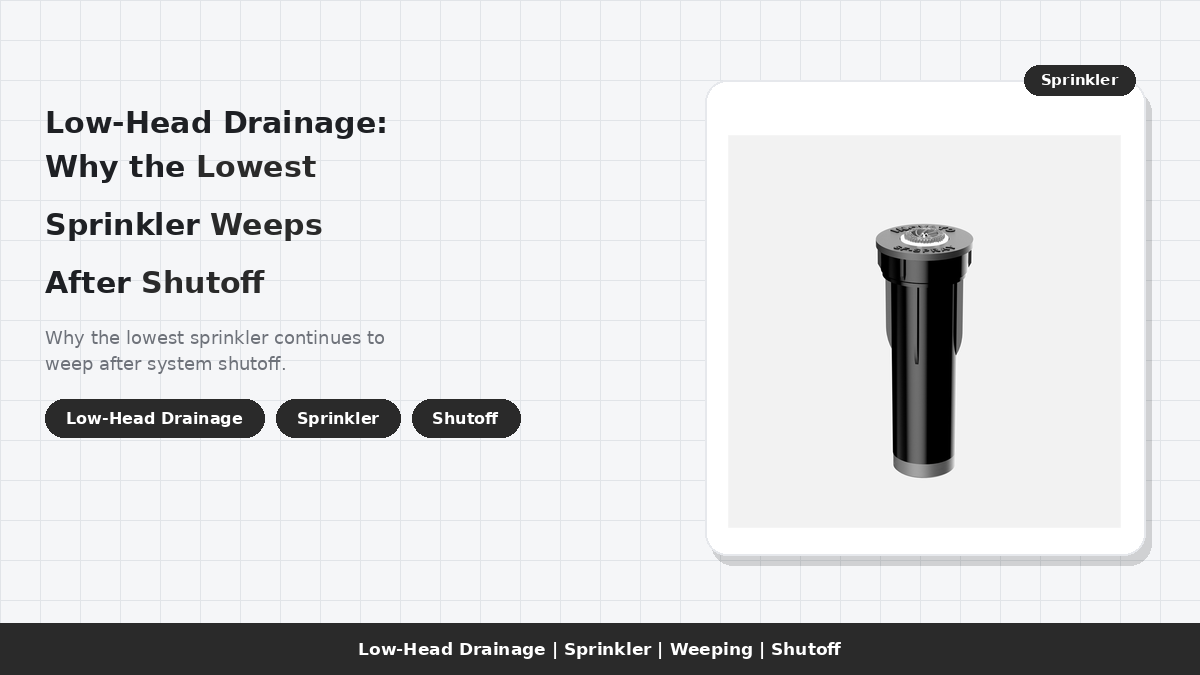
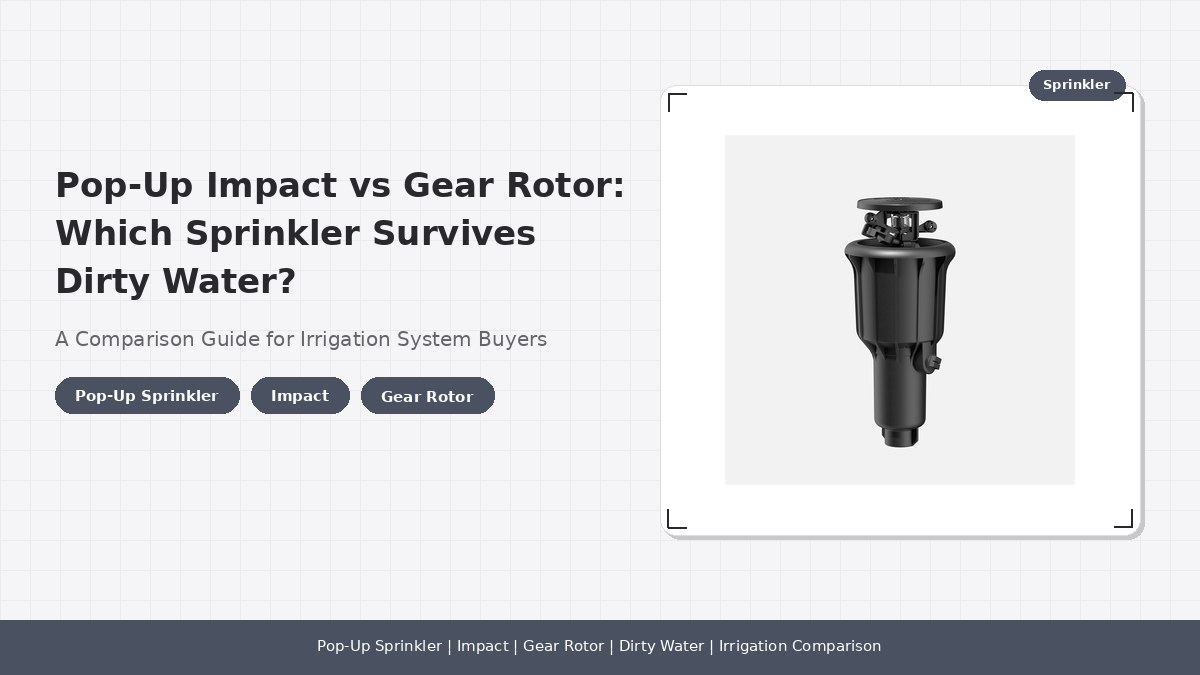
- Low-head drainage is the water that drains out of the lowest pop-up sprinkler in a zone after the valve closes, because the lateral pipe stays full and any sprinkler below the zone's high point acts as a low-point drain.
- Any elevation difference above about 0.3 m to 0.5 m triggers visible weeping on a standard non-check valve body; above 1 m, you can see the puddle within 30 seconds of shutoff.
- Check-valve sprinkler bodies (also called Seal-A-Matic or anti-drain bodies) hold back 1.5 m to 3.0 m of elevation and stop the weeping at the head, but they do not eliminate the water-hammer spike that the trapped column can produce.
- The right fix depends on the elevation spread: under 1 m of drop, a check-valve body at every head is enough; 1 m to 3 m, you need a check-valve body plus a slow-closing valve or anti-hammer device at the zone valve; above 3 m, you should split the zone by elevation.
- On sloped sites and in raised planter beds, low-head drainage is one of the leading causes of wasted water, drowned turf, and cracked PVC fittings at the zone valve.
The lowest pop-up on a sloped residential zone is, more often than not, the last one the contractor remembers before the homeowner calls back about the soggy patch that never dries out. The puddle around the can is not a leaking lateral. It is the lateral draining out through the only head whose path to atmosphere is its own nozzle — the lowest head in the zone. We see this on roughly one in every six residential sites we walk, and on most sloped commercial sites where the contractor did not specify a check valve at every head.
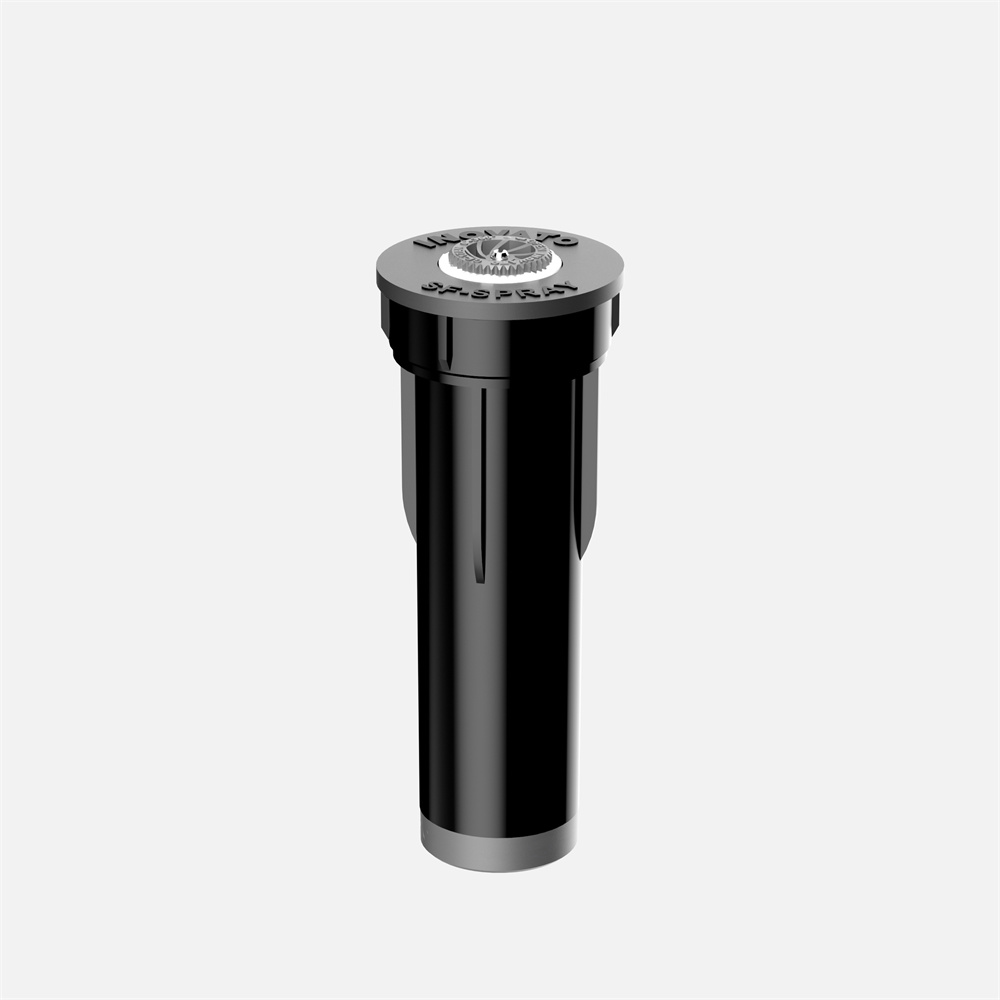
This guide is the field walkthrough we use on those sites. We cover why the lowest head drains, how to measure the elevation spread that triggers it, what a check-valve body does (and does not do), and the specifying logic by elevation band. The piece is written around the working spec for our SF04 sprinkler body with check valve, the body we ship most often for low-head drainage remediation, but the same logic applies to any pop-up sprinkler with a built-in check valve rated for at least 2.0 m of holdback.
What Low-Head Drainage Actually Is
Low-head drainage is the water that drains out of the lowest pop-up sprinkler in a zone after the zone valve closes. It is sometimes called "weeping," "low-head weeping," or "post-shutoff drainage," and it is a normal hydraulic consequence of any sprinkler lateral that has more than a small elevation spread between its heads.
At the moment the zone valve closes, the lateral is full of pressurized water and the air in the sprinkler bodies is at the same pressure as the supply. Within a second, the air in the canisters relaxes to atmospheric pressure, but the water in the pipe does not move because the valve is closed. The system is now a sealed vessel with a row of pop-up sprinklers at different elevations, and the highest sprinkler in the zone is the point at which the water level will eventually stabilize. Every sprinkler below that high point sits in a column of water whose hydrostatic pressure exceeds what the riser seal can hold.
Because the only path to atmosphere is through the sprinklers' nozzles, the lowest head is the first to lose its seal and start draining. As the lateral empties to the next-highest head's elevation, the second-lowest head starts weeping, then the third, and so on. The puddle grows until the lateral has drained down to the second-highest head, at which point the lowest head stops flowing because the water level has fallen below its riser. The total volume lost is roughly the volume of the lateral between the highest and lowest heads, and on a typical residential zone with 1.5 m of elevation spread that volume can reach several litres per cycle.
This is not a defect. It is the consequence of putting a closed pipe at different elevations, and it is entirely preventable — the sprinkler industry has shipped check-valve bodies for this exact problem for over three decades.
How Much Elevation Difference Triggers Low-Head Drainage
The threshold is lower than most contractors expect. Any elevation spread above about 0.3 m to 0.5 m is enough to trigger visible weeping on a standard non-check valve body. Below 0.3 m, the hydrostatic pressure at the lowest head cannot push water through the nozzle seal, and the puddle is invisible. Above 0.5 m, you can usually see a wet ring around the lowest can within 30 seconds of shutoff. Above 1 m, the puddle forms within 10 seconds and the lateral drains for several minutes. Above 2 m, the puddle is large enough to drown the turf and drainage continues for 5 to 10 minutes after shutoff.
These numbers are based on standard 100 mm pop-up riser seals, which hold back roughly 30 to 50 kPa of pressure (about 3 m to 5 m of water column) before the seal starts to weep. The 0.3 m to 0.5 m threshold is the practical trigger because the seals also have to overcome surface tension, the weight of the water column in the nozzle, and any debris that prevents a clean shutoff. The Irrigation Association's landscape irrigation standards treat any zone with more than 0.5 m of elevation spread as a low-head drainage case, and the relevant industry practice is to specify a check-valve body at every head in that zone. The FAO Irrigation and Drainage Paper on modernizing irrigation management uses the same 0.5 m threshold, and we agree with the second half of that guidance from field experience: zones with more than 3.0 m of spread are hard to manage with check valves alone, and any small leak becomes a large puddle over a 6- to 10-minute drain window.
Quick Field Test for the Threshold
Walk the zone at shutoff and watch the lowest head. A puddle within 30 seconds means more than 0.5 m of elevation spread; a puddle still growing at 2 minutes means more than 1.5 m; flow at 5 minutes means more than 3.0 m and you should split the zone. The puddle size is a useful proxy: a 100 mm wet ring is roughly 1 L of lost water, a 300 mm ring is roughly 3 L, and a 600 mm puddle is roughly 10 L — already at the threshold of turf damage.
Why the Lowest Head Drains and the Others Do Not
The lateral is a closed vessel at shutoff, and the highest sprinkler in the zone is the point at which the water level stabilizes. Every sprinkler below that high point sits in a column of water whose hydrostatic pressure exceeds what the riser seal can hold, and the lowest head has the most pressure acting on it. It is the only head whose path to atmosphere is through its own nozzle.
To make this concrete, take four pop-up sprinklers on a slope, with heads at 1.0 m, 0.7 m, 0.4 m, and 0.1 m relative to the zone valve. The highest head is the water-table reference. The second head sits in 0.3 m of water column (about 3 kPa), the third in 0.6 m (about 6 kPa), and the lowest in 0.9 m (about 9 kPa). The riser seal is rated for roughly 3 to 5 kPa. The third head is at the limit of its seal, the lowest head is well past it, and the lateral drains out through the lowest head until the water level falls below 0.4 m.
This is why the puddle always forms at the same head, every cycle, until the elevation spread changes or a check valve is added. The lowest head is not failing. It is doing exactly what the physics of a closed vessel with one open outlet demands, and the fix is to give that outlet a one-way valve.
What a Check-Valve Sprinkler Body Does
A check-valve sprinkler body holds back a fixed column of water after shutoff, so the head does not drain through the nozzle. The check valve is a small diaphragm or flapper at the inlet of the riser, and it seats against the riser opening the moment the supply pressure drops below the holdback rating. Common ratings are 1.5 m, 2.0 m, and 3.0 m of elevation (about 15 kPa, 20 kPa, and 30 kPa). Above the rating, the check valve opens and the head drains. Below the rating, the check valve seals and the head does not weep.
The body we ship most often for this application is the SF04 series with a 3.0 m holdback check valve, which covers the majority of mixed-elevation residential and small commercial zones. Above 3.0 m, the lowest SF04 will drain — at which point the zone is large enough to split by elevation anyway.
One point that is often missed in the field: a check-valve body stops the weeping at the head, but it does not stop the lateral from pressurizing against a closed outlet. When the zone valve closes, the water in the lateral decelerates, and the lowest head with a check valve is now a closed outlet with a column of water in motion behind it. The kinetic energy converts to a pressure spike when the check valve seats — the water-hammer pulse that can fracture PVC fittings and crack solenoid valves. A slow-closing valve at the zone valve is the right pair for a check-valve body on a high-elevation site, letting the column decelerate over 2 to 5 seconds and keeping the spike inside the system's rated working pressure.
The Three Specifying Bands by Elevation Spread
Low-head drainage is solved by elevation band, not by a single fix. The right answer for a 0.5 m spread is different from the right answer for a 2.5 m spread, and the right answer for a 4 m spread is to split the zone. Here is the band-by-band logic we use on quotes, with the SF04 as the reference body where applicable.
| Elevation Spread | Risk Level | Spec at the Head | Spec at the Zone Valve | Notes |
|---|---|---|---|---|
| 0 to 0.3 m | Negligible | Standard non-check body | Standard solenoid valve | Puddle is below visible threshold; no action needed unless the site has a problem |
| 0.3 m to 1.0 m | Visible puddle at the lowest head | Check-valve body rated 1.5 m or 2.0 m | Standard solenoid valve | Lowest head will weep without a check valve; check valve stops the weeping |
| 1.0 m to 3.0 m | Significant puddle and water-hammer risk | Check-valve body rated 3.0 m (e.g. SF04) | Slow-closing solenoid valve or anti-hammer device | Check valve stops the weeping; slow-close valve prevents water-hammer spike from the trapped column |
| 3.0 m and above | Pipe-burst risk at the zone valve, drowned turf at the lowest head | Split the zone at the elevation midpoint | Each sub-zone uses the appropriate band above | One check-valve body cannot hold back more than 3 m reliably; two zones at the midpoint is the durable fix |
The middle band (1.0 m to 3.0 m) is where most residential and small commercial sites land, and it is the band where the wrong choice has the largest consequences. A standard non-check body in a 2 m spread will weep several litres per cycle, leaving a permanent wet spot at the lowest head. A check-valve body alone, without a slow-closing valve, will stop the puddle but may still produce a water-hammer pulse strong enough to crack a thin-wall swing joint or a solenoid valve diaphragm. The complete fix is the pair, not the single component.
Why Slow-Closing Valves Matter Once You Have Check-Valve Bodies
Once every head in the zone has a check valve, the lateral becomes a closed vessel at shutoff, and the only exit for the moving column of water is through the solenoid valve at the zone valve. Slow-closing solenoid valves close over 2 to 5 seconds, letting the column decelerate gradually and keeping the pressure spike inside the system's working pressure. Standard solenoid valves close in 0.2 to 0.5 seconds — fast enough to produce a 200 kPa to 400 kPa spike on a 1.5 m elevation column, well above the working pressure of most Class 125 PVC.
The Irrigation Association's landscape irrigation standards and the USDA NRCS irrigation practice standards both call out water hammer as the primary failure mode for solenoid valves in sloped zones and recommend a slow-closing valve with check-valve bodies in any zone above 1.0 m of elevation spread. Our additional rule is a pressure regulator at the zone valve above 2.0 m of spread, because the spike plus working pressure can exceed the rated pressure of the lowest-rated component.
What Happens If You Skip the Slow-Closing Valve
The first symptom is a solenoid valve that fails to open on the next cycle, because the diaphragm has been pinched by repeated pressure spikes. The second is a cracked PVC fitting at the zone valve on the downstream side where the spike peaks. The third is a burst swing joint at the lowest head. None of these are visible at install, and all of them show up in the first 50 to 100 cycles of the system — the first full season.
How to Diagnose an Existing Site in 10 Minutes
For a contractor walking an existing site, the diagnosis is fast. Run the zone for 5 minutes, then shut it off and walk the zone in order of elevation. The head that weeps within 30 seconds is the lowest head; measure its elevation relative to the highest head with a hand level or a phone inclinometer. That measurement is the elevation spread, and the specifying band table above gives you the fix.
For a new site, the elevation spread is on the grading plan: take the highest and lowest head elevation in each zone, subtract, and the difference is the band. Flat-pad residential sites are usually 0 to 0.3 m and need no check valve. Side-yard slopes and raised planter beds are usually 1.0 m to 2.0 m and call for the SF04 with a slow-closing valve. Multi-tier commercial sites are often 3.0 m or more and should be split by elevation. If you do not have a grading plan, a rough proxy: 1 m of elevation corresponds to about 4 to 5 riser heights in a typical residential zone — enough to know whether to write a check valve into the quote.
Common Field Mistakes When Fixing Low-Head Drainage
The most common mistake is to fix only the lowest head. The contractor sees the puddle, replaces the lowest can with a check-valve body, and walks away. The puddle is gone, but the second-lowest head is now the lowest unvalved head, and the second cycle produces a new puddle there. The fix has to be every head in the zone, because once one head is valved the next one in line takes the hydraulic role of the lowest head.
The second most common mistake is to overspec the check valve. A 4.5 m holdback body is sold for high-elevation sites, but the body is larger, the seal surface is harder to clean, and the body is not field-serviceable in most cases. On a 2.5 m spread, the 3.0 m body is the right call and the 4.5 m body adds cost without field benefit. The third most common mistake is to specify a check valve on the zone valve instead of at the sprinkler. A check valve at the zone valve stops the lateral from draining back through the valve — a different problem (drain-back through the valve) and a real one — but it does not stop the lateral from draining out through the lowest head. The two checks fix two different drainage paths, and a sloped site often needs both.
When a Check Valve Is the Wrong Answer
There are three cases where a check valve is the wrong call. The first is when the elevation spread is so small (under 0.3 m) that the puddle is invisible and the water loss is negligible. Adding a check valve in that case is wasted cost, and the seals will eventually leak as the rubber ages, returning to the original problem in 5 to 8 years. The second is when the spread is so large (over 3.0 m) that no check valve will hold it — the right answer is to split the zone. The third is when the supply is dirty water, because sand and silt lodge in the diaphragm and prevent it from seating. On dirty water, the check valve has to be a serviceable type — and the SF series with a field-serviceable check valve assembly is the body we use on those sites.
There is also a less obvious case: drip irrigation zones. Drip laterals do not have low-head drainage in the same way, because pressure-compensating emitters spread the loss across the whole lateral. The drip fix is either pressure-compensating emitters or a check valve at the zone valve plus air-vacuum relief valves at the high points — a different specifying problem from pop-up sprinklers.
Frequently Asked Questions
What is low-head drainage in an irrigation system?
Low-head drainage is the water that drains out of the lowest pop-up sprinkler in a zone after the zone valve closes. It happens because the lateral pipe is full of pressurized water at shutoff, and any sprinkler that sits below the highest point in the lateral acts as a low-point drain until the pipe empties to that sprinkler.
How much elevation difference causes low-head drainage?
Any elevation difference greater than about 0.3 m to 0.5 m between the highest and lowest sprinkler in a zone is enough to trigger low-head drainage on a standard non-check valve body. Above 1 m of elevation difference the weeping is visible within 30 seconds of shutoff; above 2 m the head can drain several litres before the lateral equalizes.
Do check-valve sprinkler bodies really stop low-head drainage?
Yes, when the check valve is intact and the elevation difference is within the body's rated holdback. Most pop-up sprinklers with built-in check valves (often called Seal-A-Matic, anti-drain, or CNL bodies) are rated to hold back 1.5 m to 3.0 m of elevation. Below that rating, the valve seals and the head does not weep. Above the rating, the check valve opens and drainage resumes.
Why does the lowest head drain and the others do not?
Because the lateral is a closed vessel at shutoff. The highest sprinkler in the zone is the point at which the water level stabilizes. Every sprinkler below that point sits in a column of water whose hydrostatic pressure exceeds what the riser seal can hold, and the lowest head has the most pressure acting on it. It is the only head whose path to atmosphere is through its own nozzle.
Can low-head drainage cause water hammer?
Yes. When the zone valve closes, the column of water in the lateral decelerates rapidly. If a check valve is sealing one of the heads, the trapped column can slam the valve closed at high velocity, producing an audible hammer and a pressure spike that can fracture PVC fittings, crack solenoid valves, and burst thin-wall swing joints. Anti-hammer devices at the zone valve help but do not eliminate the problem when the elevation spread is large.
Is low-head drainage a problem on flat sites?
On sites with less than about 0.3 m of elevation spread across the zone, low-head drainage is usually invisible and the water loss is negligible. On sloped sites, in raised planter beds, and on any zone that mixes high and low heads, low-head drainage is one of the leading causes of water waste, turf drowning at the lowest head, and customer complaints about soggy spots.
Specifying a check-valve body for a sloped zone? Send us your elevation spread and zone valve detail, and we will quote the SF04 with check valve in the right holdback rating for your site. We also stock the matching SF series bodies for the rest of the system, and our engineering team can review a full zone layout for a 3 m to 5 m spread that needs to be split by elevation.