


TL;DR
- Pressure-compensating (PC) drip tape maintains uniform emitter flow across elevation changes of up to 40 meters, making it the only viable drip irrigation technology for vineyard slopes where gravity-fed systems produce 35-60% flow variation between top and bottom rows.
- Australian wineries verify three critical specifications before bulk orders: emitter flow rate at the specific slope gradient of their vineyard block, the pressure compensation range (typically 50-350 kPa), and UV stabilisation additives rated for Australian sunlight conditions (UV index 10-14 during summer months).
- Non-PC drip tape on slopes wastes 15-25% more water through over-irrigation at lower elevations while starving upper rows — a cost that Australian water allocation pricing (AUD 2,500-4,500 per megalitre in premium wine regions) makes economically painful.
- The bulk-order verification process should include a 500-meter trial installation across the steepest section of the vineyard, run for one full irrigation season, with flow-rate measurements taken at minimum 20 sampling points distributed across the elevation gradient.
The Slope Irrigation Problem That Keeps Australian Vineyard Managers Awake
I have walked enough Australian vineyard rows — from the Barossa Valley's gentle eastern slopes to the Margaret River's rolling terrain to the Hunter Valley's undulating blocks — to understand that slopes create an irrigation problem that flat-land farmers simply never encounter. When you lay drip tape along a 15% gradient, the hydrostatic pressure at the bottom of the slope is substantially higher than at the top. In a standard non-compensating drip tape, this means the emitters at the bottom deliver more water than those at the top — sometimes twice as much.
The math is straightforward and unforgiving. Every meter of elevation change adds approximately 10 kPa of hydrostatic pressure. On a vineyard block with 30 meters of elevation difference — a modest slope by Australian viticulture standards — the emitters at the bottom experience 300 kPa more pressure than those at the top. A non-PC emitter rated at 1.6 litres per hour at 100 kPa might deliver 2.4 L/h at 200 kPa and 3.0 L/h at 300 kPa. Meanwhile, the top-row emitters are receiving barely enough pressure to open their diaphragms. The result: the bottom third of the vineyard gets overwatered — encouraging vegetative growth at the expense of fruit quality, increasing disease pressure from canopy humidity, and wasting water — while the top third struggles with moisture stress that reduces berry set and limits yield potential.
This is not a theoretical concern. I have reviewed irrigation uniformity test data from a Coonawarra vineyard where non-PC drip tape produced a Christiansen Uniformity Coefficient (CU) of 0.62 on a 12% slope — meaning the irrigation was effectively 38% non-uniform. After switching to pressure-compensating drip tape from the same manufacturer, the CU improved to 0.91. That 29-percentage-point improvement translates directly to more consistent grape ripening, fewer quality downgrades at harvest, and measurable water savings.
How Pressure-Compensating Drip Tape Actually Works Inside the Emitter
The term "pressure-compensating" is thrown around freely in irrigation catalogs, but the mechanism inside each emitter deserves a clear explanation — because not all PC drip tape is created equal, and Australian vineyard conditions expose the differences ruthlessly.
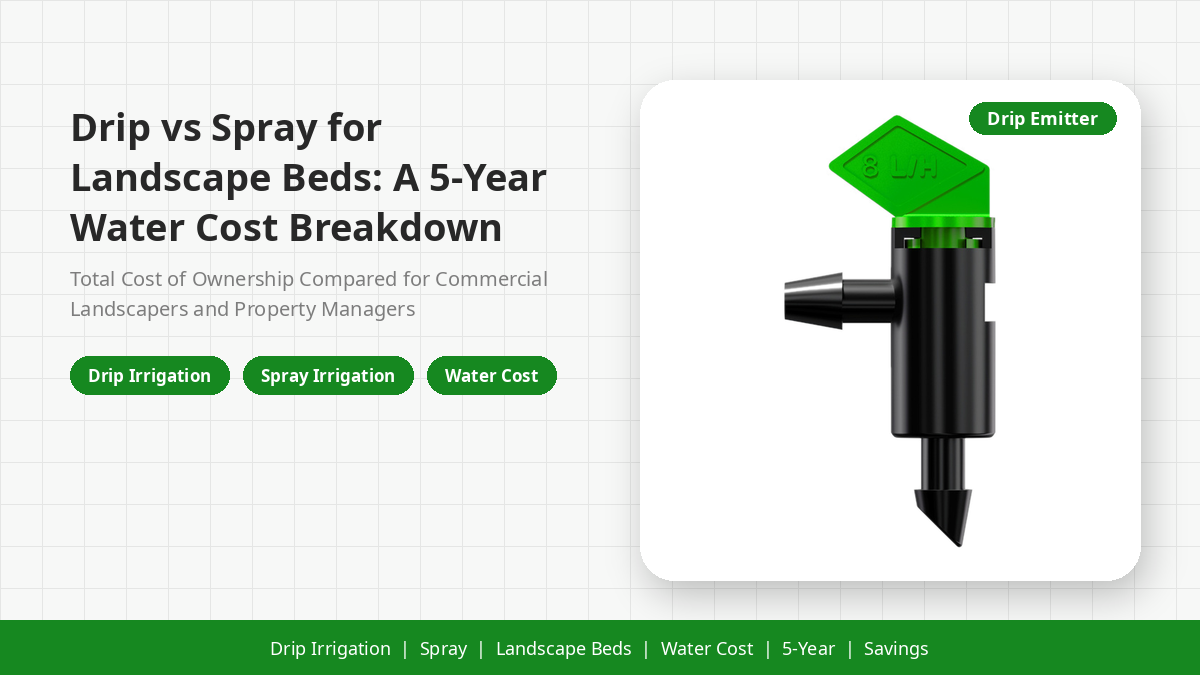
Inside each PC emitter, a flexible silicone diaphragm presses against a precision-molded flow channel. As inlet pressure increases, the diaphragm deflects further into the channel, reducing the cross-sectional area available for water flow. As pressure decreases, the diaphragm relaxes, opening the channel wider. This dynamic balance — more pressure = narrower path, less pressure = wider path — maintains a nearly constant flow rate across the manufacturer's specified pressure compensation range, typically 50-350 kPa for vineyard-grade drip tape.
The physical mechanism sounds simple, but the manufacturing tolerances are anything but. The diaphragm material must maintain consistent elasticity across temperature ranges from 5 C (early-morning irrigation in a cold snap) to 45 C (surface tape temperature under Australian summer sun). The flow channel dimensions — typically 0.6-1.2 mm wide and 0.3-0.8 mm deep — must be held to tolerances of approximately plus or minus 0.02 mm. A deviation of 0.05 mm in channel depth can shift the emitter's flow rate by 8-12%. This is why I tell buyers that the manufacturer's quality control documentation matters at least as much as their catalog specifications.
The second critical component is the inlet filter grid — a fine mesh screen at each emitter's water entry point that prevents particles from lodging in the flow channel and disrupting the compensation mechanism. In Australian vineyard conditions, where irrigation water often carries fine silt from dam storage or bore water with elevated iron content, the inlet filter grid determines whether the PC emitters maintain uniform flow for one season or five. A grid rated for 120-mesh filtration (125 micron) is standard; for water sources with known particulate issues, 200-mesh (74 micron) provides additional protection at the cost of slightly higher clogging risk if water filtration upstream is inadequate.

Key Specifications Australian Wineries Must Verify Before Bulk Orders
When an Australian winery prepares to order drip tape by the kilometer — a typical 40-hectare vineyard requires 120-160 kilometers of drip tape with 2.5-meter row spacing — the procurement team needs a verification checklist that goes beyond the glossy product brochure. Based on what I have seen successful buyers do versus what I have seen cause expensive retrofits, here are the non-negotiable verification items.
First, request the manufacturer's ISO 9261 test report for the specific emitter model. ISO 9261 is the international standard for agricultural irrigation equipment — emitters and emitting pipe — specification and test methods. It defines how emitter flow rate variation is measured and reported. The manufacturer should provide a test report showing the coefficient of variation (Cv) for a sample of at least 25 emitters. For vineyard-grade PC drip tape, a Cv below 0.05 (5%) is the industry benchmark; above 0.07, you will see measurable flow non-uniformity even on flat ground. A manufacturer unwilling to share ISO 9261 test data is one I would not buy from.
Second, verify the pressure-compensation range against your vineyard's actual hydraulic conditions. The compensation range — say, 50-350 kPa — defines the inlet pressure window within which the emitter maintains its rated flow. But you need to map this against your irrigation system design. Calculate the pressure at the tape inlet at the highest elevation point during maximum simultaneous zone operation. If that pressure drops below 50 kPa when multiple zones are running, your emitters at the top of the slope will under-deliver regardless of compensation. Similarly, calculate the inlet pressure at the lowest point — if your pump and pressure regulation system deliver more than 350 kPa at the bottom of the slope, you exceed the compensation ceiling and emitters will over-deliver. The solution is proper pressure regulation at each submain, but you need the numbers to specify the regulators correctly.
Third, request accelerated UV ageing test data. Australian sunlight is not the same as European or North American sunlight. The UV index in Australian wine regions regularly reaches 10-14 during summer months — roughly 30-40% higher peak UV intensity than most European wine regions. Drip tape that performs adequately in French or Italian vineyards may experience premature embrittlement, cracking, and emitter housing failure after 2-3 Australian seasons. The manufacturer should provide test data following ASTM G154 or ISO 4892-2 accelerated weathering protocols, with total UV exposure equivalent to at least 5 years of Australian conditions (approximately 450-500 MJ/m^2 of UV-A radiation). The drip tape wall thickness specification — typically 0.2-0.4 mm for vineyard applications — should be validated under these UV exposure conditions, not under milder European test protocols.
Emitter Flow Rate and Spacing: Matching the Vine to the Tape
The selection of emitter flow rate and spacing is where agronomy meets engineering — and where I have seen wineries make expensive mistakes by copying a neighbour's specification without adapting it to their own soil, rootstock, and trellis system.
For Australian vineyard slopes, the most common PC drip tape configurations use emitter flow rates of 1.0, 1.6, or 2.0 litres per hour, with emitter spacings of 300, 400, or 500 mm. The choice depends on three interacting factors: soil infiltration rate, vine spacing, and the irrigation strategy (deficit vs full irrigation). On the heavy clay soils of the Barossa Valley, a 1.6 L/h emitter at 400 mm spacing typically provides adequate water without surface ponding, because the clay's low infiltration rate (2-5 mm/hour) limits how fast water can enter the soil profile. On the sandy loams of Margaret River, with infiltration rates of 15-25 mm/hour, a 2.0 L/h emitter at 300 mm spacing may be more appropriate to ensure adequate wetting depth without excessive deep percolation below the root zone.
The slope adds a complication: on steeper gradients (above 10%), water applied at the soil surface tends to run downhill before infiltrating — a phenomenon called surface runoff or sheet flow that is distinct from subsurface lateral movement. To counter this, some vineyard managers specify closer emitter spacing on steeper sections — moving from 500 mm to 300 mm spacing, for example — so that individual wetting patterns overlap more quickly and create a continuous wetted strip rather than isolated wetting bulbs with dry gaps where runoff channels can form. This is an empirically observed practice, not a textbook rule, but the wineries that do it report measurably better soil moisture uniformity across the slope.
The vine spacing itself matters because the drip tape typically runs along the trellis row, with one or two tape lines per row depending on the trellis system. A widely spaced vineyard at 3.0 meters between rows with a single drip line places more irrigation demand on each emitter than a densely planted block at 2.0 meter row spacing. The calculation: multiply the emitter flow rate by the number of emitters per vine, then divide by the area per vine to get the application rate in mm/hour. This number must not exceed the soil's saturated hydraulic conductivity, or you will see runoff on slopes regardless of how well the drip tape compensates for pressure.
Material Durability Under Australian Conditions
Australian vineyards expose drip tape to conditions that manufacturers in temperate climates sometimes underestimate. The combination of intense UV radiation, widely fluctuating temperatures (diurnal ranges of 20-25 C are common during the growing season), and water quality that varies from pristine catchment supplies to highly mineralized bore water means that material selection matters enormously.
The drip tape body — typically low-density polyethylene (LDPE) or linear low-density polyethylene (LLDPE) — must contain UV stabilisers at concentrations appropriate for the target service life. For Australian conditions, I recommend specifying a carbon black content of 2.0-2.5% by weight for black drip tape, which provides the most effective UV absorption across the full UV-A and UV-B spectrum. Some manufacturers offer "UV-stabilised" tape with lower carbon black content combined with chemical UV absorbers; these formulations can work but the long-term performance data in high-UV environments is less extensive than for simple high-carbon-black formulations.
The emitter itself — typically injection-molded from polypropylene or polyoxymethylene (POM) — faces different stresses. The silicone diaphragm that provides pressure compensation is the most chemically sensitive component. Chlorine, commonly used for irrigation system sanitation in Australian vineyards to control bacterial slime and root intrusion, attacks silicone through gradual oxidation. A silicone diaphragm rated for 5 years of service in clean water may last only 3 years with continuous low-level chlorine exposure (1-2 ppm free chlorine residual). If your vineyard uses chlorination for system maintenance, specifically ask the manufacturer for diaphragm material compatibility data with chlorinated water — and be prepared to budget for earlier tape replacement if they cannot provide it.
Physical durability also matters in vineyard operations. Drip tape on the soil surface is vulnerable to damage from kangaroos, foxes, vineyard machinery during undervine cultivation, and seasonal workers' boots during pruning and harvest. Thicker wall tape — 0.3-0.4 mm vs the standard 0.2 mm — adds approximately 15-20% to the material cost but can extend service life by 2-3 seasons in high-traffic vineyard blocks. For premium wine regions where a single vintage can be worth AUD 20,000-40,000 per hectare, the incremental tape cost is negligible relative to the risk of irrigation failure during critical phenological stages.
Installation Best Practices for Vineyard Slope Systems
The best pressure-compensating drip tape in the world will perform poorly if installed without attention to the hydraulic realities of slope irrigation. The following practices come from direct observation of Australian vineyard installations that worked well — and a few that did not.
Run drip tape along the contour, not down the slope. This is the single most important installation decision. When drip tape runs perpendicular to the slope — along contour lines — the hydrostatic pressure variation along each tape line is minimal (the tape itself is nearly level), and the pressure-compensating emitters only need to handle the relatively small pressure variations from friction loss along the tape length. When tape runs down the slope, each meter of tape experiences a different inlet pressure, and the PC mechanism must compensate across the full elevation range of that single line. Contour installation also minimizes the surface runoff problem described earlier, because water is applied along a nearly level line rather than flowing downhill across emitter positions.
Use pressure-regulating valves at each submain connection point. Even with PC drip tape, large pressure variations between different submain zones — caused by elevation differences or pump cycling — can push some tape sections outside their compensation range. A pressure-regulating valve set to the midpoint of the tape's compensation range (typically 150-200 kPa) at each submain entry smooths out these system-level variations and ensures the tape operates within its design envelope.
Flush the system thoroughly before connecting drip tape, and install flush valves at the end of each tape run. Construction debris, PVC shavings from pipe cutting, and sand from trench backfill will find their way into drip tape emitters and defeat the pressure-compensation mechanism. A proper flushing protocol — running water through all submains and laterals at minimum 0.5 metres per second flow velocity for at least 5 minutes before connecting tape — is tedious but essential. After connection, end-of-line flush valves allow periodic purging of accumulated sediment without disconnecting tape from fittings.
Water Efficiency Metrics and Australian Regulatory Context
Australian water policy adds a compliance layer to vineyard irrigation that procurement teams must consider. The Murray-Darling Basin Plan, state-level water allocation frameworks, and catchment-specific sustainable diversion limits mean that water use is both metered and priced — and in many premium wine regions, water entitlements trade at prices comparable to the land itself.
In the Barossa Valley, water allocation prices reached AUD 4,500 per megalitre in 2024 — meaning every 10% improvement in irrigation efficiency saves roughly AUD 450 per megalitre of entitlement, or AUD 180-270 per hectare per season for a typical vineyard. Across a 40-hectare vineyard, a 15% improvement in water use efficiency — the difference between non-PC and PC drip tape on slopes — represents approximately AUD 7,200-10,800 in annual water cost savings, plus the avoided cost of purchasing additional water entitlements if the vineyard is expanding planted area.
Beyond cost, the Australian wine industry's voluntary sustainability framework — Sustainable Winegrowing Australia, which now covers over 40% of Australian vineyard area — includes irrigation efficiency as a scored metric. Wineries seeking certification or maintaining existing certification need to demonstrate continuous improvement in water use efficiency. Switching from non-PC to PC drip tape on sloped vineyard blocks typically improves the water use efficiency score by 8-15 points on the SWA assessment scale — often the difference between a bronze and silver rating for the water management module.
From a practical compliance standpoint, Australian state water authorities increasingly require irrigators to demonstrate that they are using "best available irrigation technology" as a condition of water licence renewal. While this requirement is currently enforced inconsistently across states, the trend is toward stricter enforcement. Having documentation that your vineyard uses pressure-compensating drip tape with ISO 9261 test certification provides a straightforward compliance response if your water licence comes up for review.
Planning a Bulk-Order Trial and Verification Protocol
Before committing to 120 kilometers of drip tape, I strongly recommend running a structured trial that generates data you can actually use to make the procurement decision. The trial does not need to be academically rigorous, but it does need to be representative of your vineyard's worst-case conditions.
Select a trial block that includes the steepest slope section and the poorest water quality source that the full vineyard will use. Install a minimum of 500 meters of the candidate PC drip tape — enough to cover at least three full rows across the elevation gradient. Install flow meters at the submain feeding the trial block, and place at least 20 catch cans or graduated cylinders at emitter positions distributed across the full elevation range: top of slope, mid-slope at two intermediate elevations, and bottom of slope. Five sampling points per elevation level gives you enough data to calculate a meaningful distribution uniformity for each elevation band.
Run the trial for a full irrigation season — or at minimum, through the peak-demand months of December through February in Australian conditions. Take flow-rate measurements at least monthly, and also measure after any significant system event: pump maintenance, filter cleaning, chlorination treatment, or extreme heat events. These event-triggered measurements reveal how the tape performs under stress conditions that the ISO 9261 laboratory test does not simulate.
At the end of the trial, calculate the distribution uniformity (DU) separately for each elevation band and for the trial block as a whole. The formula: DU = (average of the lowest quarter of flow measurements / average of all flow measurements) x 100. A DU above 0.85 (85%) is the minimum I would accept for a vineyard block where fruit quality depends on irrigation uniformity; above 0.90 is excellent. If the manufacturer's catalog claims a specific DU value, the trial data should come within 5 percentage points of that claim. If it does not — and the discrepancy cannot be explained by identifiable installation or water quality issues — that is a legitimate reason to negotiate or walk away.
For wineries ready to explore PC drip tape solutions for slope vineyard blocks, our engineering team can provide ISO 9261 test data and material specifications for your specific operating conditions. Visit our dripline systems page or browse our full irrigation product range to review product specifications and request technical documentation.
Frequently Asked Questions
What is the minimum slope gradient where pressure-compensating drip tape becomes necessary?
There is no universal threshold, but the practical answer based on Australian vineyard experience is approximately 3-5% slope. Below 3%, the hydrostatic pressure variation across a typical row length (150-250 meters) is small enough that non-PC drip tape with proper pressure regulation at the submain can achieve acceptable uniformity. Between 3% and 8%, non-PC tape requires careful zoning — splitting long rows into separate irrigation blocks so that each block covers a limited elevation range — which adds cost in submain piping and control valves. Above 8%, PC drip tape is the clear economic choice because the cost of the tape premium (typically AUD 0.03-0.05 per meter over non-PC) is less than the cost of the additional piping, valves, and controllers required to zone a non-PC system for acceptable uniformity.
How does PC drip tape perform with variable water quality — specifically high iron or calcium carbonate content?
Water with high iron content (above 0.5 mg/L) or high calcium carbonate hardness (above 150 mg/L as CaCO3) increases the risk of emitter clogging regardless of whether the tape is pressure-compensating or not. However, PC emitters are more vulnerable to clogging than simple turbulent-flow labyrinth emitters because the PC mechanism adds a narrow flow channel and a flexible diaphragm that can trap precipitates. The solution is upstream water treatment — oxidation and filtration for iron, acid injection for calcium carbonate — not a different tape specification. If your water quality cannot be treated to acceptable levels, PC drip tape is not the right choice regardless of your slope conditions, because the maintenance burden of unclogging emitters will outweigh any pressure-compensation benefit.
What is the typical service life of PC drip tape in Australian vineyard conditions?
For above-ground installation — the most common configuration in Australian vineyards — PC drip tape with 0.3-0.4 mm wall thickness and 2.0-2.5% carbon black content typically lasts 5-7 seasons before UV embrittlement, emitter diaphragm fatigue, or accumulated clogging reduces performance below acceptable levels. Thinner 0.2 mm wall tape may last 3-5 seasons. Subsurface drip irrigation (SDI) installations, where the tape is buried 200-300 mm below the soil surface, can extend service life to 8-12 seasons because UV exposure is eliminated and temperature fluctuations are moderated. However, SDI installation in vineyards is significantly more expensive and complicates vineyard floor management operations.
Can existing non-PC drip tape be retrofitted with PC emitters, or does the entire tape need replacement?
Drip tape is manufactured as an integrated product — the emitters are welded into the tape wall during extrusion. There is no practical way to retrofit PC emitters into existing non-PC tape. If you are converting from non-PC to PC drip tape on a sloped vineyard, you will need to replace the tape entirely. However, the existing submain piping, filtration system, and control infrastructure can typically be reused, provided the system can deliver the operating pressure range required by the new PC tape — which is usually within the range that existing pumps and pressure regulation can accommodate.
How does emitter spacing affect the slope-compensation performance?
Emitter spacing does not directly affect the pressure-compensation mechanism — the PC diaphragm and flow channel operate independently of how far apart the emitters are placed. However, closer emitter spacing (300 mm vs 500 mm) provides more water application points per metre of row, which creates a more continuous wetted strip along the trellis line. On steeper slopes, this continuous wetting pattern helps reduce the surface runoff issue described earlier, because water is applied more evenly across the soil surface rather than in discrete wetting bulbs separated by dry gaps. The trade-off is cost: 300 mm spacing uses roughly 67% more emitters per kilometre of tape than 500 mm spacing, increasing the tape price proportionally.
Do PC emitters require different filtration than non-PC emitters?
Yes, and this is a detail that buyers sometimes overlook until clogging problems appear. PC emitters typically specify 120-mesh (125 micron) filtration as a minimum, whereas many non-PC labyrinth-path emitters can operate with 80-mesh (180 micron) filtration. The difference matters because upgrading an existing filtration system from 80-mesh to 120-mesh increases backwash frequency and may require additional filter capacity to maintain the same flow rate. If your vineyard's existing filtration is marginal at 80-mesh, budget for filtration upgrades as part of the PC tape conversion — the increased filtration cost is usually modest (AUD 1,500-3,000 for a mid-sized vineyard) relative to the water savings from improved irrigation uniformity.