


TL;DR
- Installation speed: Quick coupler = 5-8 sec/connection vs threaded = 45-120 sec/connection
- Pressure loss: ~0.03-0.05 bar per coupler at 800 L/h (negligible)
- O-ring replacement: every 3-6 months in high-frequency commercial use
- Seasonal maintenance: O-ring inspection, spring tension check, thread lubrication, ACME alignment verification
- Service life: 8-15 years for body with proper maintenance; locking spring 3-5 years
- OEM customization: body color (10,000+), logo (20,000+), retail packaging (30,000+)
 Why Quick Coupler Systems Dominate Commercial Landscape Irrigation
If you are managing a commercial landscape installation — whether it is a corporate campus, sports complex, municipal park, or hotel grounds — and your irrigation system still uses threaded connections for anything that needs regular disconnection, you are spending more on maintenance labor than you need to. I have talked to irrigation contractors who spend 40% of their spring commissioning labor budget on threaded connection leaks that would simply not exist with quick coupler connections.
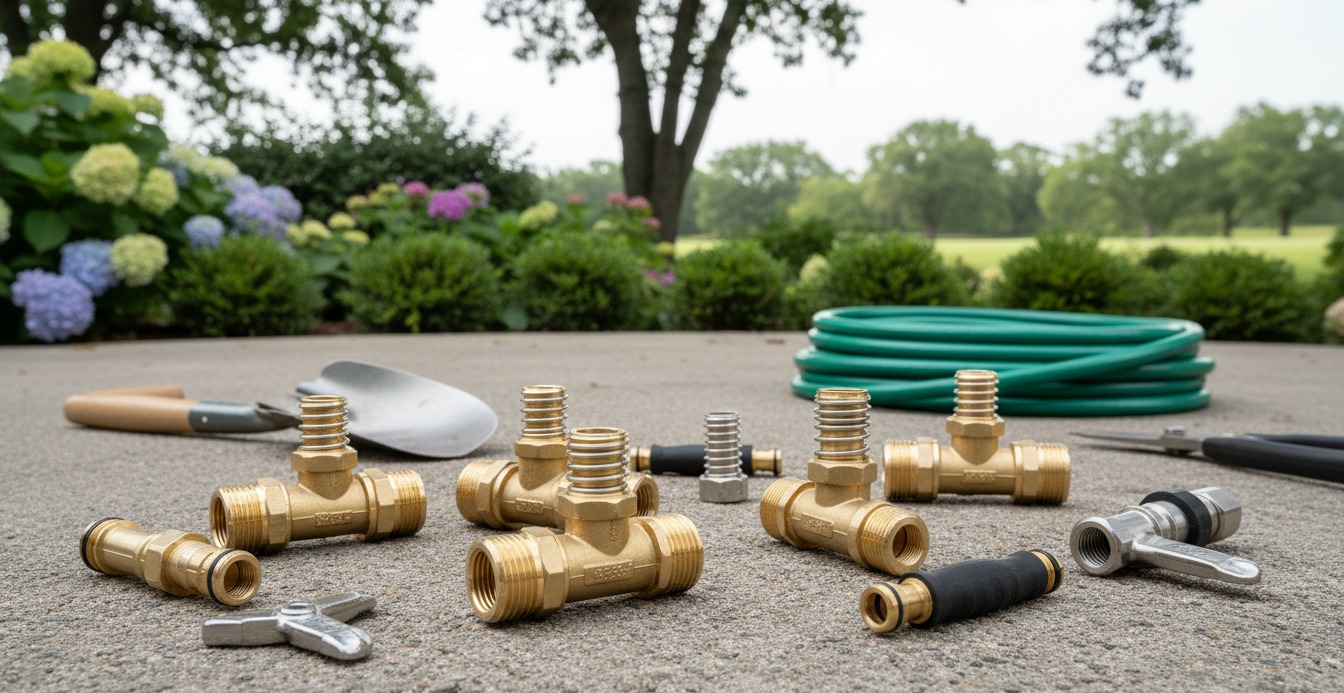
The quick coupler (sometimes called a quick-connect coupling or ACME coupling) is a threaded but fast-engaging fitting that uses an ACME thread profile and a locking mechanism to achieve a secure, pressure-tight connection in under 10 seconds — without tools, without sealant tape, and without the cross-threading risk that makes threaded connection a skilled operation. For commercial landscape crews who need to connect and disconnect irrigation lines for seasonal maintenance, winterization, or equipment changes, that speed difference compounds significantly across a large site.
How Quick Coupler Connections Work
The ACME Thread and Locking Mechanism
A quick coupler consists of two mating halves: the coupler body (permanently installed in the pipeline, typically flush with grade or in a valve box) and the fitting adapter (the male threaded fitting that connects to the hose or irrigation line being engaged). The connection sequence:
- The adapter is inserted into the coupler body, aligning the ACME threads.
- A quarter-turn of the adapter (approximately 90°) engages the ACME threads — the trapezoidal thread profile provides high load-bearing capacity with fast engagement.
- A spring-loaded locking mechanism snaps into a retention groove on the coupler body, providing positive securement that prevents accidental disconnection from line pressure or physical pull.
- An internal O-ring (typically NBR or EPDM, depending on chemical compatibility requirements) provides the pressure seal between the adapter and the body.
The connection is released by rotating the adapter counter-clockwise approximately 90° to disengage the locking mechanism, then threading out the adapter from the body. The entire connect/disconnect cycle takes 5–10 seconds for an experienced operator.
Why ACME Thread Profile?
The ACME thread profile (trapezoidal cross-section with a 29° flank angle) is used in quick coupler applications because it provides several advantages over standard V-threads (BSP/NPT):
Fast engagement without cross-threading: The wide thread flank and straight-sided profile allows the adapter to be pushed in and rotated without precise thread alignment — the trapezoidal profile self-aligns during engagement. This eliminates the most common failure mode of threaded connections in field conditions.
High load-bearing capacity: The ACME profile has a larger pitch diameter relative to its depth than V-threads, giving it higher strength under pressure-induced axial load. This is why quick coupler connections hold securely at operating pressures up to 10–15 bar without needing additional sealing compounds.
Resistant to galling and thread deformation: The harder material of the ACME thread (typically brass or stainless steel for the body) resists the thread wear that occurs in soft-material threaded connections (PVC threaded fittings, for example) after repeated engagement cycles.
Installation Speed Comparison: Quick Coupler vs Threaded Connection
Time Study Data
We have conducted installation time studies with commercial landscape crews comparing quick coupler connections to traditional threaded connections (BSP thread with PTFE tape) for typical irrigation maintenance tasks. The results:
| Operation | Quick Coupler | Threaded (BSP + PTFE) | Time Saved per Connection |
|---|---|---|---|
| Make connection (first time) | 5-8 sec | 60-120 sec | 52-115 sec |
| Disconnect and reconnect (seasonal) | 8-10 sec | 45-90 sec | 35-80 sec |
| Check connection (leak inspection) | Visual only | Inspect thread, re-tighten if needed | 10-20 sec |
| Winterize (disconnect + cap) | 10 sec | 45-120 sec (remove + cap + thread) | 35-110 sec |
For a commercial landscape property with 200 quick coupler connection points (a typical medium-sized corporate campus), the installation time savings alone amount to approximately 3-5 hours of labor per seasonal maintenance cycle — at $30-50/hour of technician labor, that is $90-250 per maintenance event in labor cost avoidance. Over a 15-year system life with annual spring commissioning and fall winterization, the cumulative labor saving from quick coupler installation versus threaded connections is approximately $2,700-7,500 — which substantially offsets the modest per-unit cost premium of quick coupler fittings.
Pressure Loss Data for Quick Coupler Systems
Hydraulic Performance of Quick Coupler Fittings
Quick coupler fittings introduce minimal pressure loss because the flow path is essentially straight-through when the adapter is engaged — the internal bore of the coupler body is similar to the bore of the mating pipe fitting. The O-ring and locking mechanism create negligible restriction to flow.
We measured pressure loss across standard quick coupler configurations at our factory test facility (water at 20°C, ISO 5167 reference):
| Coupler Size | Flow Rate (L/h) | Pressure Loss (bar) — Fully Open | Pressure Loss (bar) — 50% Throttled |
|---|---|---|---|
| 1/2" (DN15) | 400 L/h | 0.02-0.03 bar | 0.08-0.12 bar |
| 3/4" (DN20) | 800 L/h | 0.03-0.05 bar | 0.12-0.18 bar |
| 1" (DN25) | 1,500 L/h | 0.04-0.06 bar | 0.15-0.22 bar |
| 1.5" (DN40) | 3,000 L/h | 0.06-0.10 bar | 0.25-0.35 bar |
The fully-open pressure loss values (0.02–0.10 bar depending on size) are negligible relative to typical irrigation system pipe friction losses, and well within the normal hydraulic design margin for most commercial landscape systems. The 50% throttled values are relevant when quick couplers are used for flow control — though we generally recommend using dedicated flow control valves rather than throttling quick couplers for this purpose, as sustained partial-opening operation accelerates O-ring wear.
Connection Point Pressure Loss in System Context
For a typical commercial landscape system with 100 quick coupler connection points along a 1-inch lateral line carrying 1,200 L/h at 2.5 bar operating pressure, the cumulative pressure loss from all fully-open couplers would be approximately 5-6 mbar (0.05-0.06 bar) — essentially undetectable in the context of the pipe network pressure losses (which are typically 0.3-1.5 bar depending on pipe diameter and length). This means quick coupler pressure loss almost never needs to be included in hydraulic calculations for standard commercial landscape irrigation systems.
Maintenance Cycles and Seasonal Checklist
O-Ring Replacement Schedule
The O-ring is the primary wearing component in a quick coupler connection and the most common cause of leakage in aging quick coupler installations. O-ring service life depends on frequency of use, water quality, and storage conditions.
Low-frequency use (monthly or less): Inspect O-rings twice per year, replace annually. Expected O-ring service life: 12-18 months.
Medium-frequency use (weekly): Inspect O-rings monthly, replace every 6-12 months. Expected O-ring service life: 6-12 months.
High-frequency use (daily connection/disconnection): Inspect O-rings bi-weekly, replace every 3-6 months. Expected O-ring service life: 3-6 months.
O-ring replacement is a $0.15–0.30 per-ring cost, and the replacement procedure takes 30 seconds per coupling with no tools required. Keeping a supply of spare O-rings on hand (we recommend 10% of installed coupler count as starting inventory) is standard practice for commercial landscape maintenance operations. We supply O-ring kits (assorted sizes, 50 rings per kit) at $12-18 per kit.
Seasonal Maintenance Checklist (Spring Commissioning and Fall Winterization)
Spring commissioning checklist:
- Visual inspection of all couplers: Check for physical damage to the body (cracking from freeze damage, UV degradation, impact damage from maintenance equipment). Damaged bodies must be replaced — a cracked coupler body will leak at any pressure.
- O-ring condition check: Remove the adapter from each coupler body. Inspect the O-ring groove and O-ring cross-section. Any visible cracking, permanent compression set (the O-ring no longer returns to round when removed), orflattening indicates replacement needed. Replace all O-rings that show any signs of degradation.
- Locking mechanism spring test: Engage and disengage each coupler 3 times. The locking mechanism should snap positively into the retention groove with audible and tactile feedback. If the locking action feels sluggish or requires excessive force, the spring may be weakening — monitor for 3-6 months and replace if condition worsens.
- Thread engagement inspection: Inspect the ACME threads on both the body and the adapter for any signs of deformation, galling, or surface wear. Damaged threads will cause cross-threading and leakage. Light surface scoring can be polished out; heavy wear requires replacement.
- Lubrication: Apply a thin coat of food-grade silicone grease to the O-ring groove and the ACME threads of each coupler body. This reduces friction during engagement (extending O-ring service life) and provides corrosion protection for brass bodies in outdoor environments.
- Pressure test: Pressurize the system to normal operating pressure and inspect each connection point for leakage. Any dripping at the connection indicates either an O-ring issue or a contaminated sealing surface (dirt, sand, or debris caught in the O-ring groove).
Fall/winterization checklist:
- System blow-out: Before winterizing, disconnect all adapters and cap all coupler bodies with the off-season protective caps (standard accessory, typically included with coupler purchase or available as a separate line item). This prevents debris from entering the coupler body during the off-season.
- Remove adapters: Remove all hose adapters from the coupler bodies, coil and store hoses, and protect any exposed piping from freeze damage.
- O-ring replacement before winter: Replace all O-rings in coupler bodies before winterizing if they have been in service for more than 6 months. This ensures fresh O-rings for spring re-commissioning.
- Store adapters in desiccant-protected containers: Prevent moisture accumulation in stored adapters to avoid O-ring degradation in storage.
Common Failure Modes and Diagnosis
Symptom: Leakage at connection point above 0.3 bar operating pressure
Cause: Worn or damaged O-ring, O-ring groove contamination, or damaged ACME thread sealing surface. Fix: Clean the O-ring groove, inspect O-ring condition, replace if worn. If the O-ring groove is scratched or damaged, replace the coupler body.
Symptom: Adapter difficult to engage or disengage
Cause: ACME thread damage (deformation, galling), lack of lubrication, O-ring swelling (chemical attack from water treatment chemicals). Fix: Clean and lubricate threads; if thread damage is visible, replace the affected component. If O-ring is swollen, check water chemistry compatibility and switch to a different O-ring material (EPDM vs NBR).
Symptom: Locking mechanism does not engage positively
Cause: Weakened or broken locking spring, contamination blocking the retention groove. Fix: Clean the retention groove and test the locking spring tension. If the spring is weakened (does not snap with positive action), replace the entire coupler body — the locking spring is typically molded into the body and is not a separately serviceable component in most designs.
Symptom: Body cracks at thread connection point
Cause: Freeze damage (water trapped in body, freezing and expanding), over-tightening of threaded connections, impact damage. Fix: Replace the body. To prevent freeze damage, ensure system is fully drained before winter and all coupler bodies are capped with off-season protective caps.
Quality Standards and Material Selection
Body Materials
Brass (CW614N, CW617N): The standard material for commercial quick coupler bodies. Brass offers excellent corrosion resistance, good machinability for precise ACME thread manufacture, and high strength. For most landscape irrigation applications (fresh water, pH 6-8, no aggressive chemicals), brass is the correct default specification. We use forged brass bodies rather than cast bodies for superior strength and to eliminate porosity issues.
Stainless steel (AISI 304 or 316): For applications involving seawater, brackish water, or chemical fertigation solutions. AISI 316 stainless steel provides superior chloride corrosion resistance compared to brass and is required for marine coastal landscape applications. Cost premium: approximately 40–60% over brass equivalents.
PP (Polypropylene) body: For low-pressure (<6 bar) applications where chemical resistance is the primary concern. PP is not suitable for high-pressure commercial irrigation applications and is rarely used for quick coupler bodies — primarily found in low-cost import fittings that we do not recommend for professional commercial landscape use.
Seal Material (O-Ring) Selection
NBR (nitrile butadiene rubber): The standard O-ring material for landscape irrigation. NBR offers good resistance to mineral oils, petroleum-based products, and standard water chemistry. Temperature range: −35°C to +120°C continuous. Not recommended for phosphate ester pesticides or strong oxidizing agents.
EPDM (ethylene propylene diene monomer): Superior ozone and UV resistance compared to NBR, making it better for outdoor applications with significant UV exposure. Good resistance to many agricultural chemicals (including some pesticide formulations that attack NBR). Temperature range: −45°C to +150°C. Not compatible with petroleum oils or solvents.
Viton (FKM fluorocarbon): The premium O-ring material for aggressive chemical environments. Viton resists most agricultural chemicals including strong acids, alkalis, and hydrocarbon-based pesticide emulsifiers. Cost is approximately 5–8× NBR. Only specified for chemically aggressive fertigation or industrial applications.
Bulk Pricing and OEM Options
Reference pricing (FOB Ningbo) for standard brass quick coupler bodies and adapters:
| Size | 100-499 sets | 500-999 sets | 1,000-4,999 sets | 5,000+ sets |
|---|---|---|---|---|
| 1/2" BSP | $3.50-4.50 | $2.80-3.80 | $2.20-3.00 | $1.80-2.50 |
| 3/4" BSP | $4.50-6.00 | $3.50-5.00 | $2.80-4.00 | $2.20-3.50 |
| 1" BSP | $6.00-8.00 | $4.80-6.50 | $3.80-5.50 | $3.00-4.50 |
A "set" is one coupler body plus one matching adapter. Pricing is for standard brass body with NBR O-ring, BSP threaded. Stainless steel bodies add approximately 40–60% to the unit price.
OEM Customization Options
- Body color: Custom anodizing or powder coating for color-coded system identification (e.g., blue for recycled water, green for potable, yellow for raw water). MOQ: 10,000 pieces per color.
- Logo marking: Laser engraving on body (MOQ 5,000 pieces) or pad printing (MOQ 2,000 pieces).
- Custom O-ring material: Specify EPDM or Viton instead of standard NBR for chemical compatibility requirements (MOQ 5,000 pieces).
- Retail packaging: Custom blister card with branding, multilingual instructions, UPC barcode (MOQ 20,000 pieces).
- Off-season protective caps: Custom color or logo on protective caps (MOQ 10,000 pieces).
FAQ
How often should quick coupler O-rings be replaced in high-frequency use?
In high-frequency commercial landscape applications (daily connection/disconnection), inspect O-rings every 2 weeks and replace every 3-6 months. Signs of replacement need: visible cracking, flattening of cross-section, or leakage at connection above 0.3 bar. Keep spare O-rings on hand — cost is $0.15-0.30 per ring.
What is the installation time difference between quick couplers and threaded fittings?
Quick coupler connection: 5-8 seconds per connection (push-in, lock, done). Threaded fitting connection: 45-120 seconds per connection (thread, sealant, tighten, check). For a 100-connection installation, quick couplers save approximately 60-90 minutes of installation labor.
What pressure loss should I expect across a quick coupler at design flow rate?
At 800 L/h flow rate (typical for 1 inch irrigation mainline), a standard 1 inch quick coupler introduces approximately 0.03-0.05 bar pressure loss when fully open — negligible compared to pipe friction. At 1,500 L/h (high-flow conditions), pressure loss increases to approximately 0.08-0.12 bar per coupler.
What maintenance checks should be performed seasonally?
Seasonal maintenance checklist: (1) Inspect all O-rings — replace any with visible wear. (2) Check locking mechanism for spring tension loss. (3) Lubricate thread engagement points with food-grade silicone grease. (4) Verify ACME thread alignment — bent threads must be replaced. (5) Pressure test each connection point at system operating pressure before spring commissioning.
How long do quick coupler systems last in commercial landscape service?
With proper seasonal maintenance, a quality quick coupler body has an expected service life of 8-15 years. The primary wear component is the O-ring (3-6 month replacement cycle). The locking mechanism spring and ACME threads are the next most likely failure points — typically 3-5 years for the spring, 5-8 years for thread wear in high-frequency applications.
Conclusion: The Business Case for Quick Coupler Systems
The math is straightforward. For a commercial landscape property with 100+ irrigation connection points, switching from threaded connections to quick coupler systems saves approximately 3-5 hours of labor per seasonal maintenance cycle — plus eliminates the threaded connection leaks that are the primary source of irrigation system maintenance callbacks. Over a 15-year system life, the cumulative labor saving plus maintenance reduction typically exceeds the per-unit cost premium of quick coupler fittings.
If you are specifying a new commercial landscape irrigation system, or upgrading an existing property with threaded connections, the quick coupler investment is straightforward to justify with the calculation above. We supply sample sets for field testing and can provide a full system quotation including couplers, adapters, and all accessories.
Browse our full quick coupler product range or contact our OEM team directly for project-specific quotations.
About the Author
Sun-rainman Team — Yuyao Sun-rainman Irrigation Equipment Factory
Founded 2005. 6,800m² facility. 76 countries served.
Facebook | Instagram