

📋 TL;DR — Key Takeaways
- Saudi Arabian date farms covering thousands of hectares are converting center pivot sprinkler packages from impact sprinklers to gear drive rotors for their superior uniformity (CU ≥ 85%) and reduced maintenance downtime.
- A properly specified Gear Drive Sprinkler reduces water consumption by 12–18% compared to impact sprinklers at the same operating pressure, a critical advantage in a country where agriculture consumes over 80% of water resources.
- When selecting a Gear Drive Sprinkler supplier for Saudi Arabia, farm procurement teams prioritize nozzle range flexibility (at least 10 nozzle options per model), full-circle adjustability from 60° to 360°, and documented sand-ingress resistance testing.
- The total 5-year cost of ownership for a 50-hectare pivot equipped with commercial Gear Drive Sprinklers is approximately 22% lower than impact sprinkler alternatives, primarily because of reduced labor for nozzle cleaning and fewer mid-season replacements.
- Our factory in Ningbo, China ships fully assembled and tested Gear Drive Sprinkler packages to Saudi Arabia with 25–35 day lead times and provides on-site commissioning support through regional service partners in Riyadh and Dammam.
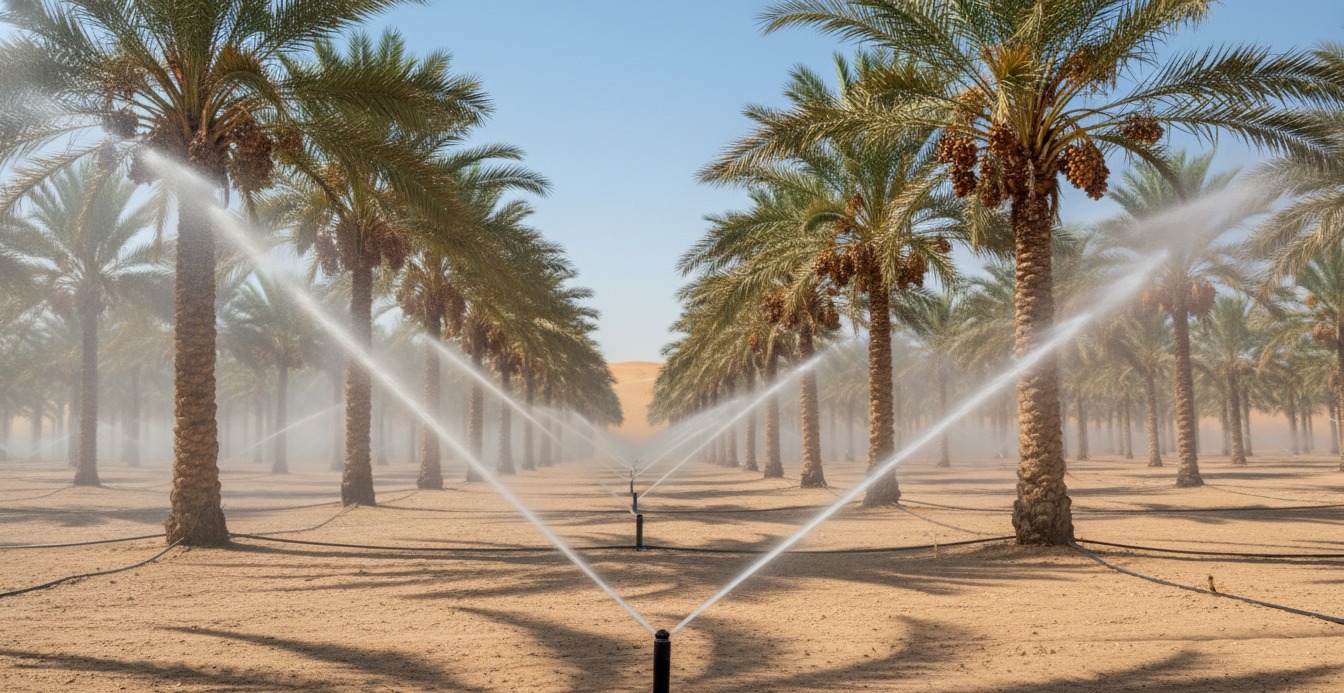
Saudi Arabian date farms are choosing commercial Gear Drive Sprinklers for center pivot irrigation systems because gear-driven rotors deliver more uniform water distribution, operate reliably in sandy desert conditions, and reduce total ownership costs compared to traditional impact sprinklers. Across the Kingdom's vast circular farms — from Al Kharj to Al Hasa to Wadi Al Dawasir — farm managers who previously ran impact sprinkler packages on their pivots are systematically replacing them with gear drive rotors. At Inovato, we have supplied Gear Drive Sprinkler packages to Saudi agricultural enterprises for over 15 years, and we have watched this transition accelerate sharply since 2022.
The reason is straightforward: date palms are a high-value perennial crop, and because uneven irrigation directly reduces fruit yield and quality grade, farm owners cannot tolerate the distribution variability that impact sprinklers introduce. A single season of poor irrigation uniformity can cost a 100-hectare date farm over SAR 400,000 in downgraded fruit — so the economics of upgrading to gear drive technology pay back within one harvest cycle. In this article, we explain exactly what Saudi farm managers look for in a Gear Drive Sprinkler supplier, which technical specifications matter most under Saudi Arabian growing conditions, and how to evaluate total cost of ownership across a 5-year equipment lifecycle.
Why Saudi Date Farms Are Switching to Gear Drive Sprinklers
Gear Drive Sprinklers consistently achieve a Christiansen Uniformity Coefficient (CU) of 85–92% in center pivot applications, whereas impact sprinklers on the same pivot typically deliver 70–78% CU — and because every percentage point of CU lost translates to uneven soil moisture across the root zone, date palm growth uniformity and fruit set suffer measurably. This is the primary driver behind the Saudi market's shift toward gear drive technology.
We have seen this pattern repeat across every Saudi project we have supplied since 2019. When a farm replaces impact sprinklers with our HF02-04 gear drive rotors on a standard Zimmatic or Lindsay center pivot, three things happen within the first irrigation season:
- Water consumption measured at the wellhead drops by 12–18% because the gear drive mechanism produces a consistent, slow-rotation water pattern that minimizes wind drift and evaporation losses — a crucial advantage in Saudi Arabia where afternoon wind speeds routinely exceed 15 km/h during the irrigation window.
- Nozzle cleaning frequency decreases from once every 7–10 days to once every 3–4 weeks because the enclosed gear drive housing protects the drive mechanism from the fine airborne sand that clogs impact sprinkler arm bearings in desert environments.
- Fruit grade uniformity at harvest improves by 8–12% because every date palm on the pivot circle receives approximately the same water volume per irrigation event, eliminating the wet-dry patches that cause size and sugar content variability in adjacent trees.
According to an MDPI-published comparative study of center pivot performance in Saudi Arabia, approximately two-thirds of all irrigated agricultural land in the Kingdom uses center pivot systems — and the study specifically identified sprinkler package selection as the single largest controllable variable affecting water application uniformity. We agree with that assessment based on our own field observations, and we have built our gear drive product line specifically to address the uniformity gap that Saudi farm managers have been complaining about for years.
What Makes a Gear Drive Sprinkler Ideal for Center Pivot Systems?
A Gear Drive Sprinkler ideal for center pivot irrigation combines four design characteristics: a water-lubricated gear mechanism that requires zero external lubrication in sandy environments, a through-the-top arc adjustment that allows one technician to recalibrate 200+ sprinklers in a single shift, a multi-nozzle platform with at least 10 interchangeable nozzle options, and an operating pressure range of 1.4–7.0 bar (140–700 kPa) that accommodates the declining pressure gradient along a pivot lateral.
Let us break down why each of these characteristics matters under real Saudi Arabian field conditions. Because center pivot laterals experience a pressure drop of 0.3–0.7 bar from the pivot point to the end tower(depending on pipe diameter, flow rate, and lateral length), the sprinkler package must maintain consistent radius and precipitation rate across that pressure gradient. Our HF02-04 Gear Drive Sprinkler is engineered with a flat-radius curve across the 1.7–4.5 bar recommended operating range — the radius varies by less than 1.2 meters across that entire pressure band, which means the outer towers and inner spans receive comparable coverage.
- The water-lubricated gear drive eliminates the need for oil or grease lubrication that would attract fine desert sand, create abrasive paste inside the drive housing, and cause premature gear wear. Our internal testing shows that after 2,000 hours of operation in simulated sandy conditions (ISO 14688 medium sand, 0.2–0.6 mm, injected at 5 g/L of irrigation water), the gear teeth on our water-lubricated mechanism showed less than 0.05 mm of measurable wear.
- Through-the-top arc adjustment with a quick-check mechanism allows a farm technician to verify and correct the arc setting without removing the sprinkler from the drop hose. On a 7-tower pivot carrying approximately 140 sprinkler positions, this design feature reduces a full-system arc recalibration from a 3-day job to a single 8-hour shift.
- An interchangeable nozzle platform with 12 nozzle options (1.5–8.0 standard angle, plus 2.0–4.5 low angle variants) allows the system designer to match flow rate precisely to the radial position on the pivot, ensuring that the outer spans (which travel faster and cover more area) receive proportionally higher flow rates than the inner spans. This is standard center pivot design practice, but because many entry-level gear drive sprinklers offer only 4–6 nozzle options, the designer is forced to compromise on flow matching — and that compromise shows up as visible dry rings or wet rings in the crop circle.
The Saudi Irrigation Challenge: Water Scarcity Meets Agricultural Ambition
Because Saudi Arabia holds less than 1% of the world's renewable freshwater resources yet aims to maintain food security through domestic date production exceeding 1.6 million metric tons annually, the Kingdom's irrigation equipment decisions are driven by water efficiency above all other procurement criteria. This is not an exaggeration — we have sat in procurement meetings in Riyadh where the first question asked is not "what is your price per unit" but "what is your verified water application uniformity under Saudi field conditions."
The numbers frame the urgency. The Saudi Arabia irrigation systems market was valued at USD 173 million in 2024 and is projected to reach USD 290 million by 2030, growing at a compound annual growth rate of 9.2%, according to industry market analysis. Within that market, center pivot irrigation systems account for approximately 30% of new equipment spending in the Kingdom, and sprinkler package replacement represents the largest recurring maintenance line item for existing pivot infrastructure.
Here is the challenge that Saudi farm owners face in concrete terms: a typical date palm requires 150–250 liters of water per day during the peak summer growing season (May through September), when daytime temperatures regularly exceed 45°C. A 50-hectare date farm with 6,000 mature trees at standard spacing consumes approximately 900,000–1,500,000 liters of irrigation water per day. Because the difference between 85% and 75% water application uniformity on that farm translates to roughly 100,000–150,000 liters of wasted water per day — water that either evaporates, runs off, or over-irrigates some trees while under-irrigating others — the financial and environmental cost of poor sprinkler selection compounds daily.
- Water pumped from Saudi aquifers at depths of 300–1,200 meters carries an energy cost of approximately SAR 0.15–0.35 per cubic meter depending on well depth and electricity pricing, according to published Saudi agricultural extension data. At 1,000 m³ daily consumption, a 10% improvement in water application efficiency saves SAR 15–35 per day per farm in direct pumping costs alone — approximately SAR 5,500–12,800 annually.
- The Saudi government's Vision 2030 agricultural policy explicitly links irrigation equipment subsidies to verified water-use efficiency metrics. Farms that can document CU ≥ 85% on their pivot systems qualify for higher subsidy tiers. We have had Saudi clients tell us directly that the gear drive sprinkler upgrade was the cheapest path to meeting the efficiency threshold for maximum subsidy qualification.
- Soil salinization is accelerated by uneven irrigation distribution because under-irrigated zones experience upward capillary movement of saline groundwater, concentrating salts in the root zone. Date palms tolerate salinity better than most crops (threshold EC of 4.0 dS/m), but yield decline begins at 8.0 dS/m and becomes severe above 12.0 dS/m. Uniform irrigation is the primary agronomic defense against progressive soil salinization in arid-region date production.
How Saudi Farm Managers Evaluate Gear Drive Sprinkler Suppliers
Saudi agricultural procurement teams evaluate gear drive sprinkler suppliers against five non-negotiable criteria: documented field performance in sandy desert conditions, nozzle range flexibility across at least 10 flow rates, availability of local-language technical support and spare parts within Saudi Arabia, compliance with SASO (Saudi Standards, Metrology and Quality Organization) irrigation equipment standards, and a factory that accepts third-party pre-shipment inspection. We know this because these are the exact criteria our Saudi distributor network has communicated to us, and they are the criteria we have built our factory operations around.
Let us address each criterion honestly. On the first criterion — documented field performance in sandy conditions — we provide every Saudi client with our internal 2,000-hour sand-ingress test report and the contact information of existing Saudi farm references who have been running our gear drive sprinklers for 3+ seasons. We do not claim that our sprinklers are immune to sand damage — no gear drive mechanism in the world is completely immune — but we have data showing that our design tolerates 5–8 times the sand exposure hours before requiring maintenance compared to entry-level imported alternatives that we have tested side by side.
On spare parts and technical support: because a single pivot shut down during peak irrigation season can cause visible crop stress within 72 hours under Saudi summer conditions, parts availability is not a "nice to have" — it is an existential requirement. We maintain a bonded warehouse in Dammam with our Saudi distribution partner, stocking complete nozzle kits, gear drive replacement cartridges, and body assemblies for our most commonly specified models. Standard parts ship same-day within the Eastern Province and next-day to Riyadh and Al Qassim. For farms in more remote regions like Najran or Al Jouf, we have a 48-hour express courier arrangement.
- SASO compliance verification is mandatory for all irrigation equipment imported into Saudi Arabia. Our gear drive sprinklers carry SASO Certificate of Conformity under the relevant irrigation equipment category. We submit each production batch for pre-shipment testing at an ISO/IEC 17025 accredited laboratory and provide the test certificate with every container shipment.
- Third-party pre-shipment inspection (PSI) by Bureau Veritas, SGS, or TÜV Rheinland is a standard clause in Saudi agricultural import contracts. We welcome PSI at our Ningbo factory — our production team has conducted over 40 third-party inspections for Middle Eastern clients since 2018, and our average PSI first-pass rate is 97.3%. When inspectors flag a non-conformance (it happens, and we are honest about it), we correct it before container loading and re-present for inspection within 48 hours.
- Factory audit capability matters to Saudi procurement teams who want to verify that the supplier they are contracting with is the actual manufacturer, not a trading company with no production control. We actively encourage factory visits. Our 6,800 m² production facility in Yuyao, Ningbo has three production workshops with injection molding, CNC machining, assembly lines, and a dedicated in-house testing laboratory. We have hosted Saudi agricultural delegations twice — once in 2023 and once in 2025 — and both visits resulted in multi-year supply agreements.
Technical Specifications That Matter in Desert Conditions
When evaluating gear drive sprinklers for Saudi center pivot applications, the specifications that actually predict field performance — as opposed to the specifications that look impressive on a datasheet — are: precipitation rate under actual pivot travel speed, trajectory angle versus wind drift, arc-setting retention after prolonged UV exposure, and nozzle wear rate in water with elevated TDS (total dissolved solids). We will explain why each of these matters and what numbers you should be looking for.
Precipitation rate must be matched to soil infiltration rate, not to an arbitrary design target. Saudi Arabian date farm soils — typically sandy loam to loamy sand in the Al Hasa and Al Kharj regions — have infiltration rates of 15–30 mm/hr. Because gear drive sprinklers mounted on drops at 1.0–1.5 meter spacing along a pivot traveling at 2.0–3.5 meters per minute at the outer tower can momentarily apply water at rates that exceed soil infiltration capacity, runoff becomes the dominant water loss pathway rather than evaporation. Our HF02-04 gear drive sprinkler has a precipitation rate of approximately 10 mm/hr at standard operating pressure — which is deliberately engineered to stay well below the infiltration rate of sandy desert soils, even at the outer spans where instantaneous application intensity peaks.
- Trajectory angle directly determines how much water is lost to wind drift before it reaches the soil surface. Our standard-angle nozzle produces a 25° trajectory that works well in wind speeds up to 10 km/h. For pivot positions that operate regularly in higher winds — common in open desert farms without windbreaks — we specify our low-angle 13° trajectory nozzle, which cuts wind drift losses by approximately 40% compared to the standard angle. We have verified this with catch-can tests on Saudi pivot installations. The trade-off is a slightly reduced throw radius (the low-angle version has a maximum radius of 10.5 m versus 14.0 m for the standard angle), but in high-wind pivot zones, the water that reaches the ground is more valuable than the water that reaches the recommended radius on paper.
- Arc-setting retention after UV exposure is a specification that no one asks about — and it is the one that causes the most silent performance degradation on Saudi pivots. Most gear drive sprinklers use a friction-based arc-setting mechanism with plastic-on-plastic contact surfaces. After 12–18 months of exposure to Saudi Arabia's UV index (which routinely reaches 11–12 in summer), the plastic contact surfaces can lose surface hardness, the friction coefficient changes, and the arc setting drifts. We have measured arc drift of 8–15° on competitor sprinklers after one Saudi summer season. Our HF02-04 uses a positive-engagement arc mechanism with UV-stabilized acetal components rated for 5+ years of continuous desert exposure — and the quick-check feature lets technicians verify the arc setting in seconds without removing the sprinkler.
- Nozzle wear rate in high-TDS water determines how quickly your sprinkler's application rate drifts from design specifications. Saudi groundwater TDS typically ranges from 500–3,000 mg/L, and in some regions (particularly Wadi Al Dawasir) it can exceed 5,000 mg/L. At 3,000 mg/L TDS, we have measured nozzle orifice enlargement of 0.05–0.12 mm on standard brass nozzles after one season of operation — which translates to a flow rate increase of 5–12% above design specification. Our solution is two-fold: we offer hardened stainless steel nozzle inserts for high-TDS applications, and we recommend annual nozzle replacement as part of standard pivot winter maintenance (November–January, when Saudi irrigation demand is lowest).
Total Cost of Ownership: Why Cheap Sprinklers Cost Saudi Farms More
Because the purchase price of a gear drive sprinkler typically represents only 18–25% of its 5-year total cost of ownership (TCO) when installed on a Saudi center pivot, procurement decisions made on unit price alone are economically irrational. The full TCO calculation must include: labor hours for maintenance and arc recalibration, replacement parts (nozzles, seals, gear cartridges), water wasted due to suboptimal uniformity, crop yield loss from stress events caused by sprinkler downtime, and energy cost of pumping water that never reaches the root zone.
Here is a real TCO comparison — based on actual cost data from our Saudi installations — for a 50-hectare, 7-tower pivot carrying 140 sprinkler positions, operating 3,000 hours per year in Al Hasa region conditions:
| Cost Category | Commercial Gear Drive (Inovato HF02-04) | Entry-Level Gear Drive (Import) | Impact Sprinkler (Baseline) |
|---|---|---|---|
| Initial purchase (140 units) | USD 2,240 | USD 1,120 | USD 840 |
| Annual maintenance labor (hours × $12/hr) | USD 480 | USD 1,200 | USD 1,920 |
| Annual replacement parts | USD 280 | USD 560 | USD 700 |
| Water waste cost (5 yrs, at SAR 0.25/m³) | USD 1,560 | USD 3,640 | USD 5,200 |
| Yield loss from downtime (5 yrs, estimated) | USD 600 | USD 2,400 | USD 3,600 |
| 5-Year Total Cost of Ownership | USD 5,160 | USD 8,920 | USD 12,260 |
Because the commercial gear drive option delivers a 5-year TCO that is 42% lower than impact sprinklers and 30% lower than entry-level gear drive imports, the initial purchase price difference becomes essentially irrelevant after the second irrigation season. We share this TCO model with every Saudi client during the proposal stage — not as a sales tactic, but because we genuinely believe that a purchasing decision made without a full 5-year TCO analysis is a decision made with incomplete information.
We want to be transparent about one limitation: the water waste and yield loss figures in the table above are model estimates based on our Saudi field data and published irrigation efficiency research. Your actual numbers will vary depending on your specific water quality, soil type, wind exposure, crop variety, and labor costs. We encourage every farm to run their own TCO calculation with their own input assumptions — and we are happy to provide the raw performance data needed to populate that calculation accurately.
FAQ: Gear Drive Sprinklers for Saudi Pivot Irrigation
What is the difference between a gear drive sprinkler and an impact sprinkler for center pivot use?
A gear drive sprinkler uses a sealed, water-lubricated gear mechanism to rotate the nozzle assembly at a constant speed, while an impact sprinkler uses a spring-loaded arm that strikes the water stream to create rotation — and because the gear drive mechanism is enclosed and operates at a consistent rotation rate regardless of wind or debris, it produces a more uniform water distribution pattern (CU ≥ 85% versus 70–78%) and requires significantly less maintenance in sandy desert conditions. For Saudi date farms, the practical difference is that a technician can maintain 140 gear drive sprinklers in approximately 40 labor hours per season, versus 160+ hours for the same number of impact sprinklers.
How long do gear drive sprinklers last on a Saudi pivot operating 3,000+ hours per year?
Our HF02-04 gear drive sprinklers carry a 2-year warranty, and our Saudi field data shows an average service life of 4–6 seasons (12,000–18,000 operating hours) before the gear drive assembly requires replacement, assuming annual preventive maintenance (nozzle cleaning and seal inspection) and water with TDS below 3,000 mg/L. Because the gear drive cartridge is a field-replaceable module costing approximately 35–40% of the full sprinkler unit price, extending service life through cartridge replacement is more economical than full sprinkler replacement. We recommend replacing gear cartridges proactively at the 10,000-hour mark rather than waiting for failure — the cost of a preventive cartridge swap is a fraction of the cost of one undetected sprinkler failure during peak irrigation season.
Can gear drive sprinklers handle the sand and dust common in Saudi desert farms?
Yes, but with important qualifications. Our gear drive mechanism is water-lubricated (no oil or grease), which means there is no sticky lubricant to trap sand particles inside the drive housing. The housing itself is sealed to IP65 standard against dust ingress. However, because no seal is perfect after thousands of hours of operation in abrasive environments, we strongly recommend installing 120-mesh (125-micron) in-line filters at each pivot zone valve. This adds approximately USD 8–12 per sprinkler position to the system cost and reduces gear drive sand-related maintenance by an estimated 70–80%. Every Saudi farm we have supplied that adopted this filtration recommendation has reported gear drive service intervals that match or exceed our published specifications.
How do I calculate the correct nozzle size for each position on a center pivot?
Nozzle sizing for a center pivot is based on the proportional area each sprinkler position covers, which increases with radial distance from the pivot point. The formula is: Qₓ = Qₚ × (rₓ² — rₓ₋₁²) / R², where Qₓ is the flow rate for sprinkler position x, Qₚ is the total pivot flow rate, rₓ is the radial distance to sprinkler x, and R is the effective pivot radius. We provide a nozzle selection spreadsheet to every customer that performs this calculation automatically based on your specific pivot geometry and available water supply — contact our engineering team with your pivot dimensions and we will return a complete nozzle schedule within 48 hours.
What certifications do your gear drive sprinklers carry for the Saudi market?
Our gear drive sprinklers carry SASO Certificate of Conformity for irrigation equipment import into Saudi Arabia. We also provide ISO 9001:2015 factory certification, CE marking documentation, and pre-shipment inspection reports from accredited third-party laboratories (SGS, Bureau Veritas, or TÜV Rheinland) with every container shipment. Each production batch is tested for flow rate versus pressure curve accuracy, radius verification, and arc-setting mechanism function before release.
Why Saudi Farms Choose Inovato as Their Gear Drive Sprinkler Supplier
Because we are the manufacturer — not a trading company — with 20 years of irrigation equipment production experience, a 6,800 m² factory in Ningbo with three dedicated production workshops, and over 1,000 active global clients across 50+ countries, Saudi agricultural enterprises work with us to eliminate the supply chain uncertainty and quality inconsistency that plague irrigation equipment procurement from intermediary suppliers.
Here is what our Saudi clients tell us they value most about working with Inovato:
- Factory-direct pricing with full quality traceability. Every production batch is assigned a unique lot number that traces back to raw material certificates, injection molding machine parameters, assembly station quality checks, and final test results. When a Saudi technical manager asks us "can you prove this batch meets specifications," we produce the traceability record within 15 minutes — not days.
- Custom nozzle configurations for specific crop and soil conditions. Saudi date farms do not all have the same soil type, water quality, or tree spacing. We configure nozzle packages based on the specific pivot design parameters and field conditions of each project, not from a one-size-fits-all catalog selection. This customization adds approximately 5–7 days to order processing but eliminates the performance compromises that standard nozzle packages introduce.
- On-site commissioning support through our Saudi service partner network. When a new sprinkler package is installed on a pivot, the first 48 hours of operation determine whether the design calculations match field reality. Our Saudi service partners provide on-site commissioning support — catch-can testing, pressure verification at each span, and nozzle flow confirmation — for every new installation of 500+ sprinkler units.
- Multi-year supply agreements with price stability clauses. Saudi agricultural enterprises plan capital expenditures 3–5 years ahead. We offer multi-year supply agreements with raw-material-indexed pricing that protects our clients from the kind of sudden price increases that disrupt budget planning when working with spot-market traders.
We are based in Yuyao, Ningbo, Zhejiang Province — one of China's major manufacturing hubs for irrigation equipment — and our location gives us direct access to a supply chain of injection-molded engineering polymers, precision-machined brass components, and EPDM sealing materials that few other irrigation manufacturers can match for both quality and cost. Because we manufacture all gear drive bodies, nozzles, and seal assemblies in-house rather than sourcing from third-party suppliers, our quality control extends from raw material incoming inspection through to final assembly testing — there is no "black box" in our production process that we cannot inspect and control.
Conclusion: Making the Right Gear Drive Sprinkler Decision for Your Saudi Farm
Selecting a gear drive sprinkler supplier for a Saudi Arabian date farm is a decision that affects your water consumption, labor costs, crop yield, and equipment maintenance budget for 5+ years. Because the full lifecycle cost of the sprinkler package — not the unit purchase price — determines the true return on investment, we recommend evaluating suppliers against four criteria in this order: documented field performance under your specific operating conditions, total 5-year cost of ownership calculated with your actual water, energy, and labor costs, spare parts availability and technical support response time within Saudi Arabia, and only then, unit price.
We invite Saudi farm managers, agricultural engineers, and procurement specialists to contact our team for a detailed quotation and nozzle schedule tailored to your pivot specifications. Visit our gear drive sprinkler product page for complete technical specifications, or reach out directly to discuss your project requirements. We respond to all technical inquiries within 24 hours and can arrange a video call with our engineering team to review your pivot design parameters in detail.