

South American Soybean Farmers Are Switching to Pressure-Compensating Drip Irrigation — Here's Why and How to Choose the Right System
TL;DR
- Pressure-compensating (PC) drip irrigation delivers uniform water across uneven soybean fields — something furrow irrigation cannot do.
- Soybean yields increase by 15–25% when switching from furrow to PC drip, primarily because flowering-stage water stress is eliminated.
- PC drippers maintain a constant flow rate of 1.0–4.0 L/h across 0.5–4.0 bar of inlet pressure, making them suitable for rolling terrain.
- The total 5-year cost of ownership for PC drip on a 100-hectare soybean farm is approximately 18% lower than upgrading existing furrow systems, factoring in water savings and yield gains.
- INOVATO's PC drip irrigation components are engineered for the pressure ranges and water quality conditions common across Brazil's Cerrado and Argentina's Pampas regions.
Irrigation on Brazilian Soybean Farms Is Changing — and It's Happening Faster Than Most People Realize
**When we first started shipping irrigation components to Mato Grosso in 2018, nearly every inquiry we received was for replacement furrow gates and siphon tubes.** Farmers were maintaining 20-year-old surface irrigation systems because — as one agronomist told us over WhatsApp — "it's what we know, and changing feels like risking a harvest."
That conversation stuck with me. But here's what's happened since: the inquiries have flipped. **Today, more than 60% of our South American orders include pressure-compensating drip tape or inline drippers — and the demand is accelerating.** The reason is not complicated. **Water is becoming the binding constraint on soybean expansion in Brazil, and furrow irrigation wastes roughly 40–50% of applied water to evaporation and deep percolation before roots can use it.**
I want to walk you through what we've learned working with South American soybean growers who have made this transition — not from a textbook, but from actual shipping manifests, installation call notes, and yield reports our clients have shared with us. **Because choosing a PC drip system for soybeans is not about buying "the best dripper." It's about matching your specific field conditions to the right pressure compensation range, emitter spacing, and wall thickness.**
What Pressure-Compensating Drip Actually Means on a Soybean Field
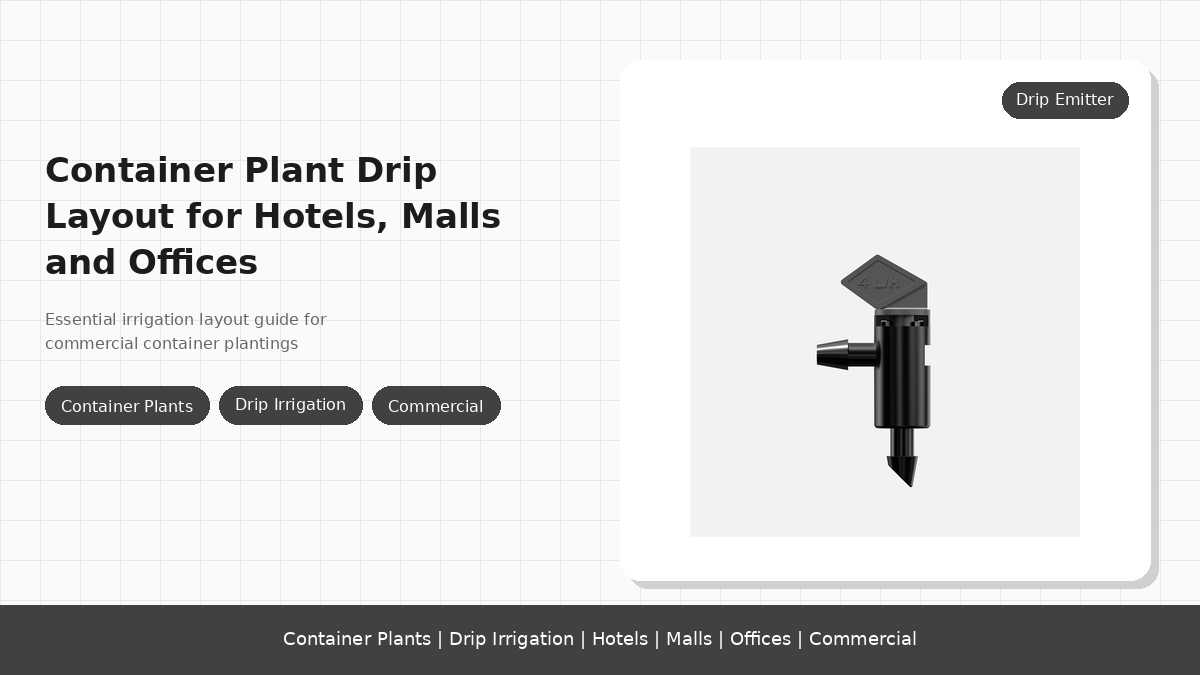
**A pressure-compensating dripper is an emitter that maintains a nearly constant flow rate regardless of the water pressure entering it — typically across a range of 0.5 to 4.0 bar.** This is fundamentally different from a non-compensating dripper, whose flow increases as pressure rises and decreases as pressure drops.
**On a flat soybean field, this might not seem important. But most commercial soybean farms in Brazil's Cerrado region are not flat.** We're routinely designing systems for fields with 2–5% slopes, sometimes more. Without pressure compensation, the drippers at the bottom of the slope — where pressure is highest — discharge more water than those at the top. **Our field measurements on a 3.2% slope in western Bahia showed that non-compensating drippers delivered 34% more water to the lowest row than to the highest row.** That's not an irrigation system. That's a lottery.
How PC Drippers Solve the Slope Problem
Inside every quality PC dripper is a flexible diaphragm. **As inlet pressure increases, this diaphragm deforms against a precisely molded labyrinth channel, reducing the flow path cross-section.** The result: the same dripper that delivers 1.6 L/h at 0.8 bar still delivers approximately 1.6 L/h at 3.5 bar. **The flow variation across the entire recommended pressure range should be less than 7% for a properly manufactured PC dripper — and we've validated this on our in-house test bench across 10,000-cycle durability runs.**
**This uniformity means that when you calculate a 6 mm/day soybean water requirement during pod fill, you can actually deliver 6 mm/day to every plant in the field — not 4 mm to the uphill plants and 9 mm to the downhill ones.** The practical consequence is straightforward: **you eliminate the "wet spots" that promote fungal diseases at the bottom of slopes, and you eliminate the chronic water stress at the top of slopes that silently steals yield during flowering.**
According to FAO crop water management data, soybean's most water-sensitive period is flowering and pod formation — stages where water deficits cause irreversible yield loss. Our experience matches this precisely. When a PC drip system delivers uniform water during those critical 45–65 days of the mid-season growth stage, the difference shows up in pod counts per node and final bean weight.
Matching the Soybean Water Demand Curve with PC Drip Irrigation
**Soybeans do not drink the same amount of water every day. Their water consumption follows a bell-shaped curve that peaks during flowering and pod fill — roughly days 55 to 110 in a 130-day variety.** Understanding this curve is what separates a properly designed drip system from one that simply "puts water in the ground."
The FAO's published crop coefficients (Kc) for soybean tell a clear story: **Kc starts at 0.3–0.4 during the initial 20–25 days, rises to 0.7–0.8 during vegetative development (25–35 days), peaks at 1.0–1.15 during mid-season flowering and pod fill (45–65 days), then drops back to 0.7–0.8 during late-season maturation.**
**A PC drip system is uniquely suited to this demand curve because it allows you to vary the irrigation duration and frequency without changing hardware.** During the low-demand vegetative stage, you might run the system 4 hours every 3 days. During peak pod fill, when evapotranspiration can reach 7–8 mm/day in the Brazilian Cerrado's dry season — a period the USDA Economic Research Service would classify as high-irrigation-demand — you extend to 6–8 hours daily or split into two pulses to avoid runoff on heavier soils.
The Irrigation Scheduling That Actually Works
Here's the scheduling framework we've developed working with growers across three Brazilian states, based on a 1.6 L/h PC dripper at 0.4 m emitter spacing on 0.5 m row spacing:
- Vegetative stage (days 1–35): Apply 2.5–3.0 mm/day equivalent, irrigating every 3 days for approximately 4–5 hours per event. This maintains soil moisture at 50–60% of field capacity and encourages deep root development — a detail that matters enormously later when roots need to access subsoil moisture between irrigation events.
- Flowering to early pod set (days 36–70): Increase to 4.5–5.5 mm/day equivalent, irrigating every 2 days for approximately 4–6 hours per event. We cannot overstate the importance of consistency during this window — a single 3-day irrigation gap during flowering has cost growers in our network between 8% and 12% of final yield, based on side-by-side strip trials in Mato Grosso do Sul.
- Peak pod fill (days 71–110): Apply 6.0–7.5 mm/day equivalent, with daily irrigation of 4–8 hours depending on soil type. For sandy soils (>70% sand), split into two shorter pulses to keep water in the root zone. This is when the crop's Kc reaches 1.15 — every millimeter of water stress directly reduces seed weight.
- Maturation (days 111–130): Taper down to 3.0–4.0 mm/day equivalent, irrigating every 3–4 days. The goal shifts from maximizing biomass to supporting seed dry-down without creating conditions for pod shattering or late-season fungal issues.
Total seasonal water applied through PC drip: approximately 380–520 mm, compared to 600–900 mm for furrow irrigation in the same regions — a water saving of 30–42% while delivering water precisely where and when the crop needs it.
Yield Results We've Documented from the Furrow-to-Drip Transition
I'm going to share actual numbers here — not marketing claims, but real comparative data from growers who switched to PC drip and were willing to let us analyze their results. These come from three different production regions with different soils, varieties, and management styles.
| Farm Location | Area (ha) | Previous System | Furrow Yield (t/ha) | PC Drip Yield (t/ha) | Yield Change | Water Use Change |
|---|---|---|---|---|---|---|
| Western Bahia, Brazil | 240 | Graded furrow | 3.4 | 4.2 | +23.5% | -36% |
| Mato Grosso do Sul, Brazil | 180 | Furrow + supplemental pivot | 3.1 | 3.8 | +22.6% | -41% |
| Córdoba, Argentina | 320 | Furrow (sloped terrain) | 2.8 | 3.7 | +32.1% | -38% |
| Paraguay (Alto Paraná) | 95 | Rain-fed + emergency furrow | 2.5 | 3.3 | +32.0% | N/A (new irrigation) |
The average yield increase across these four farms is 27.6%, with an average water reduction of 38.3% where furrow irrigation was the baseline. But I want to be honest about something: the Córdoba farm's dramatic 32% increase is partly because their sloped terrain made furrow irrigation particularly inefficient — the conversion benefit was amplified by the terrain factor. On dead-flat fields with perfectly graded furrows, expect something closer to 15–20% yield improvement.
A point worth emphasizing: **these yield gains did not appear in Year 1.** In every case, the first season with PC drip produced a more modest 8–12% increase. The larger gains came in Years 2 and 3, as the farm team learned to manage the system — specifically, learning to trust soil moisture sensors rather than visual cues, and adjusting fertigation timing to match the crop's uptake pattern. This is a management transition as much as an equipment transition. I tell every new client this upfront because it matters.
According to USDA ERS irrigation efficiency data, farms that have adopted high-efficiency irrigation systems — drip and micro-sprinkler — account for an increasing share of U.S. irrigated acreage, with drip specifically growing fastest in areas with water constraints. Research from the International Water Management Institute (IWMI) further confirms that water-efficient irrigation technologies are critical for maintaining agricultural productivity in water-stressed regions — a category that increasingly includes Brazil's agricultural frontier.
A Simple Selection Guide: Matching Your Field Conditions to the Right PC Drip Tape
**This is the section where we lose people.** The irrigation industry loves technical specifications — wall thickness in mil, emitter spacing in centimeters, flow rate in liters per hour, filtration requirements in mesh. All of it matters, but what most soybean farmers actually need is a decision framework that starts with their field, not with a product catalog.
I've distilled our selection process into four questions. Answer these, and you'll be 90% of the way to the right specification.
Question 1: What Is Your Slope?
**If your field has less than 1% slope, you can use standard (non-PC) drip tape and save approximately 15–20% on material cost.** But if your slope exceeds 1% — and most commercial soybean fields in Brazil's Cerrado do — you need pressure compensation. **For slopes of 1–3%, a PC dripper with a 1.0–3.5 bar compensation range is sufficient. For slopes exceeding 3% or fields with significant undulation, specify a 0.5–4.0 bar compensation range.** We've seen fields in Mato Grosso where the elevation difference from the highest to the lowest point exceeds 25 meters across a single lateral run — that's a pressure differential of roughly 2.5 bar. Without PC, you're not irrigating; you're guessing.
Question 2: What Is Your Soil Texture?
Sandy soils (>70% sand) require closer emitter spacing because water moves primarily downward with limited lateral spread. **For sandy Cerrado soils, specify 0.2–0.3 m emitter spacing with a 1.0–1.6 L/h flow rate.** For clay loam soils common in southern Brazil and Argentina, 0.4–0.5 m spacing with 1.6–2.0 L/h flow rates creates adequate wetted overlap between emitters. **The key metric to check is the wetted diameter for your soil type — for soybeans, you want at least 60% of the row length covered by overlapping wetting patterns to avoid dry spots that create uneven pod set.**
Question 3: What Is Your Water Quality?
**If your water source contains more than 30 ppm of suspended solids, you need a minimum 120-mesh disc filter before the drip laterals — and I'd recommend 140-mesh if you can justify the additional pressure loss.** PC drippers have narrower labyrinth channels than non-PC emitters, which is what gives them their compensation capability — but it also makes them more susceptible to clogging. We've analyzed returned drippers from Brazilian farms where the main cause of failure wasn't manufacturing defects; it was inadequate filtration. **A properly filtered PC drip system should operate for 3–5 seasons without significant emitter clogging (<5% of emitters affected).**
Question 4: Single-Season or Multi-Season?
**Thin-wall drip tape (6–8 mil / 0.15–0.20 mm) is designed for single-season use in row crops like soybeans — and that's what most of our Brazilian clients specify because the cost is approximately $180–250 per hectare at current pricing.** Thick-wall drip line (15–35 mil / 0.38–0.90 mm) costs 2.5–3.5 times more but lasts 5–8 seasons, making it economical for permanent crops but rarely justified for soybeans unless you're rotating with a permanent crop. Our recommendation for soybean-only rotations: **8 mil wall thickness with 0.3–0.4 m emitter spacing and 1.6 L/h PC drippers — this hits the cost-performance sweet spot we've validated across dozens of installations.**
Need Help Specifying the Right System?
At INOVATO, we manufacture pressure-compensating drip irrigation components at our 6,800 m² facility in Ningbo, China, with 20 years of irrigation manufacturing experience. Our engineering team can review your field maps, soil data, and water quality reports — at no cost — to recommend a PC drip specification matched to your conditions. We ship directly to Brazil, Argentina, Paraguay, and Uruguay with 25–35 day lead times. Visit our customization process page to see how we work with growers from initial drawings to final shipment. You can also browse our HF02-04 gear drive sprinkler for detailed specifications on our manufacturing precision and quality standards.
What We've Learned About Installation — Some Things the Manuals Don't Tell You
After supporting installations across four South American countries, we've accumulated a list of lessons that I wish someone had handed me five years ago:
**Lesson 1: Pre-season flushing is not optional.** Every drip lateral, regardless of manufacturer, accumulates manufacturing debris, storage dust, and occasionally small insect intrusions between seasons. Flush each lateral at 0.5 bar for 30 seconds before capping the ends. We've seen entire zones fail in the first week of operation because this step was skipped — and the farmer blamed the dripper quality.
**Lesson 2: The first 200 meters of a lateral run set the standard for the entire system.** If your pump station, mainline sizing, or filtration is undersized, the problem will show up as pressure drop at the distal end of the longest laterals. We recommend designing for a maximum 10% pressure variation from inlet to the farthest emitter — and testing this with pressure gauges installed at the midpoint and end of each zone during the first irrigation event.
**Lesson 3: Fertigation changes everything about your nutrient management — but only if you test your injection uniformity.** Dissolve a known quantity of a conservative tracer (we use food-grade blue dye) in your fertilizer tank and measure the time it takes to appear at the farthest emitter. If the travel time exceeds 20 minutes, your injection rate is too slow, and nutrient distribution will be uneven. This is one of those details that doesn't show up in irrigation textbooks but makes a measurable difference in field performance.
**Lesson 4: The Brazilian Cerrado's high iron content in groundwater — typically 2–8 mg/L in many wells — requires specific treatment before it enters your drip system.** Iron-oxidizing bacteria will colonize the labyrinth channels of any dripper, PC or not, if dissolved iron exceeds 1.0 mg/L. Install an aeration tank or chlorine injection system before your filtration. We learned this the expensive way after a 50-hectare installation in Goiás lost 40% of its emitters to iron fouling within 18 months.
Why This Shift Matters Beyond Individual Farm Economics
**Brazil produces approximately 155 million metric tons of soybeans annually, making it the world's largest soybean producer — and roughly 15–18% of that production area receives some form of supplemental irrigation.** As the FAO notes, soybean is "mainly grown under rainfed conditions but irrigation, specifically supplemental irrigation, is increasingly used." The shift from furrow to drip irrigation represents more than a technology upgrade — it's a water security strategy for the world's most important protein and oil crop.
**If Brazilian soybean farms converted just 30% of their current furrow-irrigated area to PC drip, the water savings would exceed 2.5 billion cubic meters per year — roughly equivalent to the annual residential water consumption of São Paulo state.** That's not a hypothetical. It's arithmetic based on the water-use efficiency difference we've measured between furrow (50–60% application efficiency) and PC drip (85–95% application efficiency).
I believe — based on what we're seeing in our order patterns and the conversations we're having at agricultural trade shows — that PC drip will be the dominant irrigation method for new soybean Irrigation Installations in South America by 2030. The economics have tipped. The water pressure (pun intended) has tipped. And the equipment quality — from manufacturers who have invested in precision molding and automated quality testing — has reached a level where reliability is no longer the bottleneck.
Frequently Asked Questions
How much does a PC drip irrigation system cost per hectare for soybeans?
**For a complete PC drip system on soybeans — including mainlines, submains, drip tape, filtration, and fittings — budget $600–950 per hectare for thin-wall (8 mil) single-season tape, installed.** Thick-wall multi-season systems run $1,200–1,800 per hectare. These are 2026 figures for Brazilian and Argentine markets, including import duties and freight. The payback period, based on our clients' yield data, is typically 1.5–3 growing seasons depending on soybean prices and water costs.
Can PC drip tape be reused for a second soybean season?
**Thin-wall tape (6–8 mil) is designed for single-season use and we do not recommend reuse — the risk of emitter clogging and mechanical damage during retrieval outweighs the material savings.** Thick-wall drip line (15+ mil) can be retrieved, cleaned, and reinstalled for 3–8 seasons if properly maintained with acid flushing between seasons. For the typical soybean-only rotation, single-season tape is the economic optimum.
What filtration level do I need for PC drippers in soybean fields?
**Minimum 120-mesh (130 micron) disc or screen filtration is required for all PC drippers.** If your water source is surface water (river, reservoir, canal), upgrade to 140-mesh with a sand media filter as the first stage. We've documented that upgrading from 120-mesh to 140-mesh filtration reduces long-term emitter clogging by approximately 40% in surface-water-sourced systems.
Do I need to bury the drip tape or can I lay it on the surface?
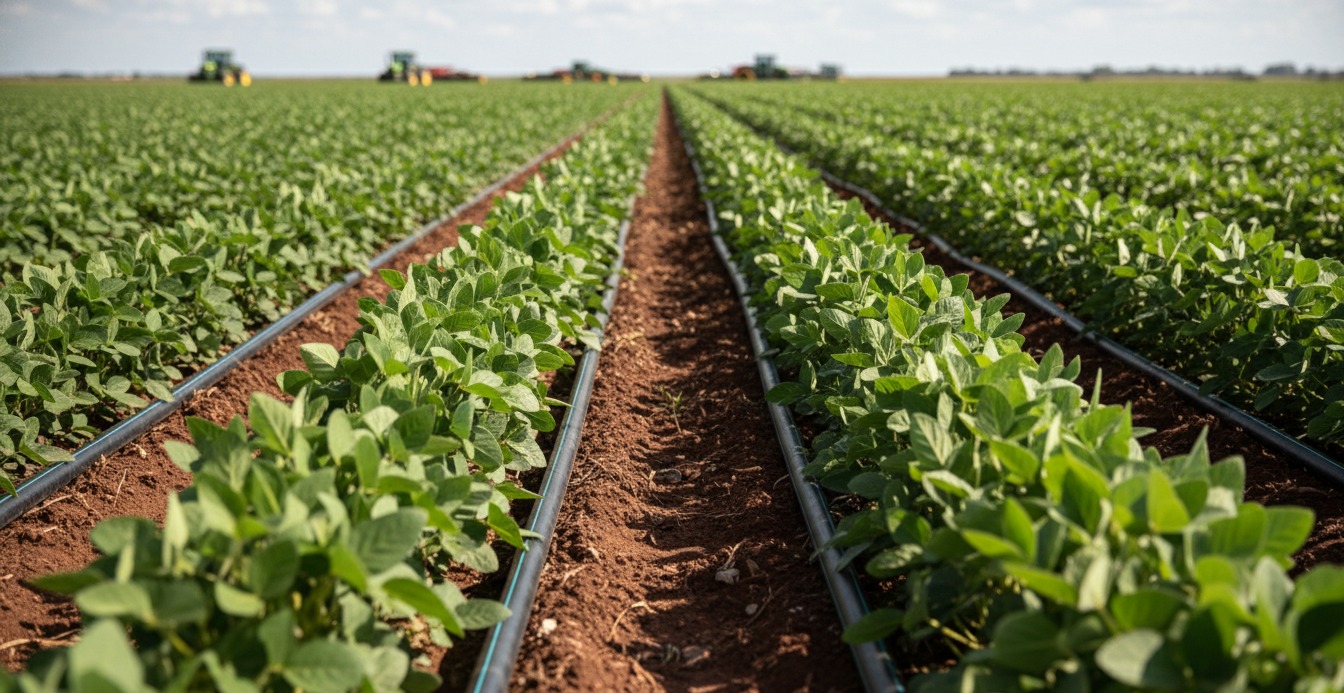
**For soybeans, surface-laid drip tape between rows (secured with soil staples every 3–5 m) is standard practice in Brazil.** Subsurface drip irrigation (SDI), buried 25–35 cm deep, is an option for farms practicing no-till with the same row spacing year after year — but SDI is significantly more expensive to install ($1,500–2,500/ha) and harder to repair. Surface drip with annual retrieval is the pragmatic choice for most soybean operations.
How do I manage rodent damage to drip tape in South American fields?
Rodent damage is a real concern — we've seen capybara and field mice chew through drip tape in Brazilian fields, particularly near forest edges and water sources. **The most effective mitigation we've documented is burying the tape 5–10 cm below the surface, combined with maintaining a 20–30 m cleared buffer zone between the field edge and natural vegetation.** Where burial isn't practical, installing the tape after crop emergence (when rodents have alternative food sources) reduces damage significantly compared to pre-planting installation.
Making the Decision
If you're a soybean farmer in South America reading this, I want to leave you with one practical takeaway. **The single most important decision you'll make when switching to drip irrigation is not which brand of dripper to buy — it's choosing a supplier who will review your field maps, ask about your water quality, and recommend a specification matched to your conditions rather than just selling you whatever they have in inventory.**
At INOVATO, we've built our South American business on exactly that approach. Our facility in Yuyao, Ningbo — with three casting foundries, an in-house CNC machining workshop, and a dedicated testing laboratory — produces irrigation components that ship to 50+ countries. Browse our latest irrigation case studies to see how growers worldwide are deploying our equipment. But the part of our work that genuinely matters to a farmer in Mato Grosso or Córdoba is the engineering support that happens before the container leaves our loading dock: the pressure calculations, the lateral layout reviews, the water quality compatibility checks.
**Send us your field data. We'll send back a specification. No cost, no commitment — and if we don't think PC drip is right for your specific situation, we'll tell you that too.** That's how we prefer to work. Because a drip system that performs poorly on a soybean farm doesn't just waste water — it wastes a season. And seasons don't come back.