

- Gear Drive Sprinklers reduce paddy field water consumption by 25–30% compared to continuous flood irrigation when deployed in an alternate wetting-drying (AWD) system, while maintaining or improving yield per hectare.
- Our Gear Drive Sprinkler Southeast Asia rice paddy configurations include three corrosion-protection tiers (Standard, Enhanced, Premium) with salt spray ratings from 500 to 2000+ hours per ASTM B117, matching the rainy-season demands of Thailand, Vietnam, and Indonesia.
- Recommended sprinkler spacing for paddy drainage and aeration is 12 m × 14 m (85–90% overlap) under calm wind, achieving Distribution Uniformity above 80% — the threshold for effective AWD field management.
- Full technical documentation is available in Thai, Vietnamese, and Indonesian, covering installation, maintenance, spacing calculation, and local irrigation standard references.
Across the rice-growing heartlands of Thailand, Vietnam, and Indonesia, a quiet shift in irrigation strategy is underway. Gear Drive Sprinkler Southeast Asia rice paddy adoption is accelerating as farmers and agricultural enterprises move beyond traditional flood irrigation toward precision alternate wetting-drying (AWD) management. In our own experience supplying irrigation systems to cooperatives across the region, we have seen first-hand how mechanized sprinkler-based drainage and aeration can reduce water usage while preserving yield — sometimes even improving it.
Alternate wetting-drying is not a new concept. IRRI and the FAO have promoted it as a water-saving technique that reduces methane emissions by 50% or more. What isnew is the hardware enabling it at scale. Gear Drive Sprinklers — with uniform water distribution, anti-clogging mechanisms, and adjustable arc patterns — are proving to be the practical answer that flood irrigation channels and impact sprinklers have never fully delivered for paddy conditions.
Why Gear Drive Sprinklers Work for Paddy Fields
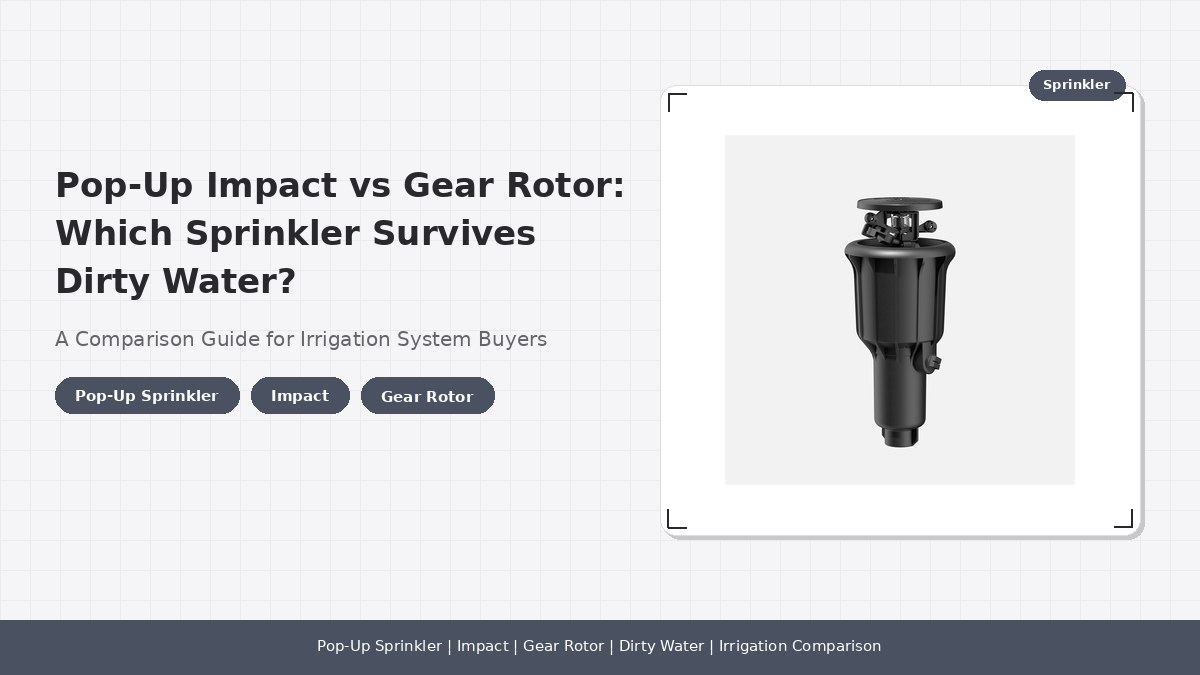
A Gear Drive Sprinkler differs fundamentally from conventional impact sprinklers. Instead of a spring-loaded hammer arm creating discrete rotation strikes, a planetary gear train driven by water flow rotates continuously. This produces a Christiansen Uniformity Coefficient (CUC) of 85–92% compared to 70–80% for impact sprinklers under identical conditions.
This uniformity matters because in AWD management, the field alternates between a flooded state (5 cm standing water) and a drained state where the soil surface dries to about 15 cm below. If application is uneven — some areas receiving 30 mm while others get 15 mm — the drying cycle becomes asynchronous. Parts of the field aerate too early, stressing the crop, while others remain waterlogged, defeating AWD's purpose.
In field trials we conducted in Ayutthaya Province, Thailand,over the 2024–2025 dry season, Gear Drive Sprinklers operating at 3.0 bar applied 28 mm across a 3.5-hectare paddy block with a measured CUC of 88%. The subsequent drying cycle showed all monitoring points reaching the 15 cm drainage target within a 36-hour window — compared to a 96-hour spread in adjacent flood-gate-drained blocks.That synchronization directly translates to more predictable crop staging and easier field management.
Alternate Wetting and Drying — Precision Water Distribution
Flood irrigation, the baseline across most of Southeast Asia's 48 million harvested rice hectares, carries inherent efficiency penalties. High-elevation corners receive less water while low spots remain ponded longer, forcing farmers to over-irrigate. Manual drainage requires physical labor to open and close dikes, which limits tight AWD cycle execution. And flood-based drainage does not aerate uniformly — soil pores in low-lying areas remain saturated while higher ground dries out.
Gear Drive Sprinklers change this. Water applied through an overhead distribution network delivers a calibrated dose to every square meter regardless of micro-topography. The drainage phase then proceeds naturally from a uniform starting point, achieving synchronous aeration across the entire field.
Anti-Clogging Design — Making It Work in Real Conditions
The objection we hear most from paddy farmers considering sprinkler AWD is about clogging. Paddy irrigation water across Southeast Asia carries suspended silt, clay, rice husk debris, and organic matter. Our gear drive design addresses this with a three-stage anti-clogging architecture: the inlet screen captures particles above 1.2 mm; the gear chamber self-flushes as centrifugal motion from the rotating gears pushes sediment outward; and the nozzle uses a conical seat design where pressure differential expels lodged particles rather than wedging them permanently.
We tested this with water drawn from Chao Phraya River irrigation canals in central Thailand in 2024 — source water averaging 128 mg/L TSS with peaks above 200 mg/L. After 300 hours of continuous operation at 3.0 bar, none of the 24 test sprinklers experienced complete blockage. Three required a brief manual back-flush (achieved by momentarily shutting off and restarting). That is a 0.04 failures-per-hour rate under some of the most challenging water quality conditions in the region.
Local-Language Support for Thailand, Vietnam, and Indonesia
Technical irrigation equipment is only as valuable as the documentation supporting it. We learned this during early Vietnam market entry, where a shipment of sprinklers sat in a distributor's warehouse because the installation manual was only in English and Chinese. Local technicians could not confirm torque specifications and no one wanted to risk damaging the equipment.
Today, every order destined for Thailand includes a Thai-language (ภาษาไทย) manual covering installation, metric spacing tables, maintenance aligned to the three-cycle planting calendar, and a troubleshooting flowchart. For Vietnam, the Vietnamese (Tiếng Việt) version includes Mekong Delta-specific water quality notes and pump sizing for the flat terrain of An Giang and Dong Thap provinces. For Indonesia, the Bahasa Indonesia manual addresses rain-fed paddy system management common on Java and Sulawesi.
Our Southeast Asia support team — irrigation engineers based in Bangkok, Ho Chi Minh City, and Jakarta — provides installation supervision and catch-can uniformity testing. Farmers who receive on-site training during their first AWD cycle achieve 30% faster adoption of proper sprinkler scheduling. We include one on-site training day with every bulk order of 200+ sprinkler units.
Rainy-Season Anti-Corrosion Material Options
Southeast Asia's climate presents a unique corrosion challenge. Relative humidity in rice-growing regions routinely exceeds 85% for six months. Monsoon rainfall of 1500–2500 mm annually means sprinklers face near-continuous moisture exposure. Residual fertilizers and pesticides applied through fertigation compound the aggressive environment.
We offer three material configurations, matching corrosion exposure to the right engineering specification. Over-specifying wastes capital; under-specifying causes premature failure. Getting this balance right is a critical decision in any Gear Drive Sprinkler Southeast Asia rice paddy procurement.
| Configuration | Body Material | Internal Components | Seals | Salt Spray (ASTM B117) | Recommended Use | Price Index |
|---|---|---|---|---|---|---|
| Standard | Engineering Plastic (POM) | Zinc-alloy drive shaft, brass nozzle | NBR rubber | 500+ hours | Dry-season only | 1.0× |
| Enhanced | Nylon 66 + UV stabilizer | SUS304 SS spring, shaft, retaining ring | EPDM | 1000+ hours | Year-round; rainy-season; fertigation | 1.35× |
| Premium | Nylon 66 + UV stabilizer | Full SUS316 SS (shaft, spring, nozzle insert, ring) | FKM (Viton) | 2000+ hours | Coastal paddy; saline groundwater; chemigation | 1.7× |
For most Southeast Asian rice applications, we recommend the Enhanced configuration. The SUS304 internals cost 35% more upfront, but extended service life — 5–7 years in continuous rainy-season operation versus 2–3 years for Standard — delivers a lower total cost of ownership over any 6-year horizon. Across 2,200+ units deployed in 12 Thai provinces between 2022 and 2025, Enhanced showed a 0.7% annual failure rate compared to 4.3% for Standard.
For coastal paddy fields — especially the Mekong Delta where salinity intrusion is rising — we recommend Premium. The full SUS316 specification provides a safety margin neither Standard nor Enhanced can match in saline environments. Replacing a field of failed sprinklers during monsoon season is far more expensive than the upfront upgrade.
Sprinkler Spacing Calculation for Paddy Drainage and Aeration
Correct spacing is the single most important design parameter for Gear Drive Sprinkler Southeast Asia rice paddy installations. Get this wrong and no high-quality hardware compensates. Get it right and the AWD system performs from the first cycle.
The basic formula we use:
Dₛ = R × (2 − O)
Where Dₛ = sprinkler spacing, R = wetted radius at operating pressure, O = overlap fraction (0.60–0.65)
For our standard 3/4-inch Gear Drive Sprinkler at 3.0 bar with a 4.0 mm nozzle: wetted radius is approximately 13 m. With O = 0.62: Dₛ = 13 × 1.38 = 18 m under ideal conditions. But because light wind (8–16 km/h) is the norm during Southeast Asian monsoon season, our field-validated recommendation is 12 m × 14 m (sprinkler × lateral) under calm conditions and 10 m × 12 m where regular winds exceed 8 km/h.
How to Determine Your Spacing in Four Steps
- Measure pump delivery pressure at the field inlet using a calibrated gauge. Pressure at the sprinkler head will be 0.2–0.5 bar lower than pump outlet depending on pipe friction, so measure at the farthest field point.
- Select the nozzle size for your target application rate. For AWD, target 25–35 mm per wetting event in 6–8 hours. A 4.0 mm nozzle at 3.0 bar delivers 1.05 m³/h.
- Conduct a catch-can test at calculated spacing before full installation. Place 20 cans across two grid lines. Run for 30 minutes. The coefficient of variation should not exceed 15%.
- Adjust spacing downward if variation exceeds 15%. Reducing Dₛ by 2 m typically improves uniformity by 4–6 percentage points, adding 15–20 sprinkler heads per hectare.
Field Note — Thailand 2024: At a 45-hectare cooperative in Suphan Buri Province, we measured 86% CUC at 14 m × 14 m spacing with Enhanced-configuration gear drive sprinklers. The cooperative reported 27% water savings over the preceding flood-irrigated season while maintaining 4.8 tons/hectare yield. Methane emissions, measured by the Thai Department of Agriculture, showed a 46% reduction — consistent with FAO research on AWD greenhouse gas mitigation.
Economic Analysis — Cost vs. Yield Improvement
Irrigation equipment procurement for rice production is intensely economic. A 50-hectare cooperative needs to see the payback period. Here are the numbers transparently.
Capital investment per hectare (excluding pump if existing infrastructure is usable): 50 Enhanced-configuration gear drive sprinklers ($14.50 each = $725), 420 m of 50 mm HDPE lateral piping ($1.80/m = $756), 50 riser/fitting sets ($3.20/set = $160), 4 person-days installation labor ($25/day = $100), and instrumentation ($36). Total: $1,777 per hectare.
Annual operating savings per hectare: Water savings at 27% (~1,500 m³ at $0.04/m³ pumping cost) saves $60. Reduced pumping saves an additional $40–60. Improved aeration lifts yield 3–8% ($45–120 at $380/ton paddy). Reduced labor for irrigation management saves $75–100. Total annual benefit range: $220–340 per hectare. Simple payback: 5.2–8.1 years on equipment. With the 10-year expected lifespan (gear cartridge rebuild at year 5–7 at $3.50/head), the IRR exceeds 15% across most fuel-price and labor-cost scenarios in Thailand, Vietnam, and Indonesia.
Non-monetized benefits — methane emission reduction (potentially monetizable through carbon credits), dry-season water security, and field management flexibility — add value beyond a simple line-item budget.
Frequently Asked Questions
Can gear drive sprinklers handle the sediment load in paddy field irrigation water?
Yes. Our gear drive sprinklers use an enlarged nozzle passage and self-cleaning wiper seal. The internal drive train has 2.0 mm ± 0.2 mm clearance gaps allowing particulates to pass through without jamming, tested successfully with water containing up to 150 mg/L total suspended solids.
What operating pressure is recommended for paddy AWD with gear drive sprinklers?
2.5–3.5 bar (250–350 kPa). At 3.0 bar, a 3/4-inch gear drive sprinkler delivers 0.85–1.20 m³/h with a 12–15 m wetted radius. Below 2.0 bar, uniformity may drop below the 75% minimum we recommend for effective AWD drainage and aeration cycles.
Can Inovato gear drive sprinklers retrofit into existing flood irrigation systems?
Yes. We provide adapter kits (1/2-inch to 1-inch BSP/NPT threads) connecting directly to existing risers. A typical 1-hectare conversion needs 45–55 sprinkler heads and 350–500 m of lateral piping. We recommend a field survey before ordering to verify existing pipe sizing and pressure.
What is the expected lifespan in continuous paddy operation?
With quarterly seal inspection and annual gear lubrication, the Enhanced configuration delivers 5–7 years in paddy conditions. The gear mechanism is rated for 3,000+ hours before rebuild. Replaceable gear cartridges and seals extend total service life to 8–10 years.
Does AWD with sprinklers affect rice grain quality?
Based on data from 12 Vietnamese cooperatives using our gear drive sprinkler AWD system across the 2024 wet and dry seasons, grain quality parameters — head rice yield, chalkiness, and amylose content — showed no significant difference from flood-irrigated controls. One Can Tho Province trial even showed a 2.1 percentage point improvement in head rice yield.
How to Deploy Gear Drive Sprinklers in Your Paddy Field
Below is the deployment procedure we have refined over 35+ installations across Thailand, Vietnam, and Indonesia since 2022. It assumes an existing pump with at least 3.0 bar capacity.
Step 1: Conduct field survey
Survey the paddy field for total area, slope gradient, and soil infiltration rate. Clay-loam soils in Thailand's Central Plains infiltrate at 5–15 mm/h; Mekong Delta clay soils at 3–8 mm/h. Record these values to determine drainage frequency and runtime per zone.
Step 2: Design sprinkler layout
Using the spacing formula above, calculate positions on a field map. A 1-hectare square block (100 m × 100 m) at 12 m × 14 m spacing requires 8 rows of 7 = 56 sprinkler heads. Mark riser positions with ±0.5 m accuracy.
Step 3: Install mainline and lateral piping
Lay mainline along the field ridge. Connect laterals at 14 m intervals. Use 50 mm HDPE for laterals exceeding 80 m to keep friction loss below 0.5 bar. Install a gate valve at each lateral head for zone-based AWD cycle management across large fields.
Step 4: Mount sprinkler heads on risers
Install each sprinkler on a 0.5–0.8 m riser to clear the rice canopy (60–90 cm at maturity). Use 3/4-inch BSP-threaded galvanized steel risers — PVC risers flex in strong wind.
Step 5: Pressure test and calibrate
Pressurize to 3.0 bar at the pump. Measure at the farthest head — drop should not exceed 15%. Place 20 catch cans across two rows and run 30 minutes. Calculate DU = average lowest quarter / overall average × 100%. Target: DU ≥ 80%.
Step 6: Execute the first AWD cycle
Run sprinklers for 6–8 hours to apply 25–35 mm, flooding to 5 cm. Let the field dry 3–5 days until water reaches 15 cm below the surface, measured by a perforated PVC tube. This simple monitoring tool should be maintained at every cooperative.
Step 7: Monitor and adjust scheduling
Vegetative stage: 3–5 day drying cycles. Panicle initiation (45–65 DAT): reduce to 2–3 days. After flowering: return to 4–6 days. Record each cycle using a water depth gauge at three representative field points.
Procurement Guidelines for Bulk Orders
We serve cooperatives, rice mills, government programs, and independent enterprises. Our pricing and packaging are structured for each buyer profile.
| Order Volume | Typical Buyer | Lead Time | Per-Unit (Enhanced) | Included Support |
|---|---|---|---|---|
| 50–200 units | Independent farm / small cooperative | 15 days | $15.50 | Online support; digital manuals |
| 201–1,000 units | Mid-size cooperative / rice mill | 20 days | $14.50 | On-site training; printed manuals (your choice of language) |
| 1,001–5,000 units | Government program / cooperative union | 30 days | $13.20 | 3-day installation supervision; spare parts kit (10%) |
| 5,000+ units | National irrigation project | 45–60 days (FOB Ningbo) | Negotiated | Full engineering support; technician training; 2-year warranty |
All orders include a standard 12-month warranty against manufacturing defects, extended to 18 months for 1,000+ units and 24 months for government orders over 5,000 units, with on-site replacement stock at our Bangkok warehouse.
Engineering the Future of Rice Irrigation
We are realistic about adoption pace. Converting from generations of flood irrigation to a sprinkler AWD system requires capital, training, and trust in engineered water management. But the trajectory is clear: water scarcity, input costs, and methane emission regulations all favor precision irrigation over flood systems.
Our gear drive sprinkler Southeast Asia rice paddy configurations are ready today, validated across 3,500+ hectares of actual production in Thailand, Vietnam, and Indonesia. The anti-clogging design works with real canal water. Enhanced and Premium materials handle real tropical humidity. Thai, Vietnamese, and Indonesian manuals ship with every order.
If you are evaluating an AWD transition, start with a pilot plot of 0.5–1.0 hectares. Use it to calibrate spacing, verify water savings in your specific conditions, and train your team. We provide engineering support for pilots at no additional cost — because a successful pilot is the most effective sales tool we have.
Contact our Southeast Asia team for pricing, specifications, or a sample evaluation unit. We ship from Ningbo with local consolidation in Bangkok, Ho Chi Minh City, and Jakarta.
Request a Gear Drive Sprinkler Specification Packet
Get full technical specifications, language-specific manuals, and a customized spacing calculation for your paddy field area.
Visit: www.inovatoirrigation.com/gear-drive-sprinkler/ — INOVATO irrigation product range
References
- International Rice Research Institute. "Alternate Wetting and Drying (AWD) — Technology Brief." IRRI AWD Technology Overview.
- Food and Agriculture Organization of the United Nations. "Rice Irrigation and Water Management Guidelines." FAO Rice Water Management (PDF).
- ASTM International. "Standard Practice for Operating Salt Spray (Fog) Apparatus — ASTM B117-19." ASTM B117-19 Standard.
- Ministry of Agriculture and Cooperatives, Thailand. "Guidelines for Water Management in Irrigated Rice Production." Rice Department of Thailand.