


TL;DR Summary
Swing joints are flexible connectors between lateral pipes and sprinkler heads in commercial irrigation systems. UK sports stadium turf managers overwhelmingly specify brass swing joints over PVC alternatives due to superior pressure ratings (up to 16 bar working pressure), resistance to UV degradation, tolerance of ground movement, and a service life exceeding 25 years under heavy-duty cycling. Brass swing joints reduce maintenance callouts, prevent costly pitch damage from fitting failures, and comply with the rigorous demands of professional sports turf irrigation. This guide covers material science, installation best practices, specification data, and real-world guidance for contractors and turf professionals working on high-value commercial sites.
What Is a Swing Joint and Why Does It Matter in Commercial Sprinkler Systems?
A swing joint is a short, flexible assembly that connects a buried lateral irrigation pipe to a sprinkler head. Its primary function is to allow the sprinkler to absorb impact, settle with surrounding soil, and be adjusted vertically or horizontally without stressing the underground pipe network. In a commercial sprinkler system serving a sports pitch, each swing joint must handle repeated hydraulic pressure surges, mechanical loading from maintenance equipment, and the thermal expansion and contraction cycles that come with outdoor installation across all UK seasons.
For residential irrigation, swing joints are often considered a convenience. For commercial and sports turf irrigation, they are an engineering necessity. A Premier League football pitch, a county cricket ground, or a Championship rugby stadium may contain anywhere from 40 to over 200 pop-up sprinkler heads. Every one of those heads relies on a swing joint to connect it safely to the lateral main. A single fitting failure beneath a playing surface does not simply reduce coverage. It saturates a localised area of turf, creates a soft spot that compromises player safety, and can require emergency excavation during a match schedule with zero tolerance for downtime.
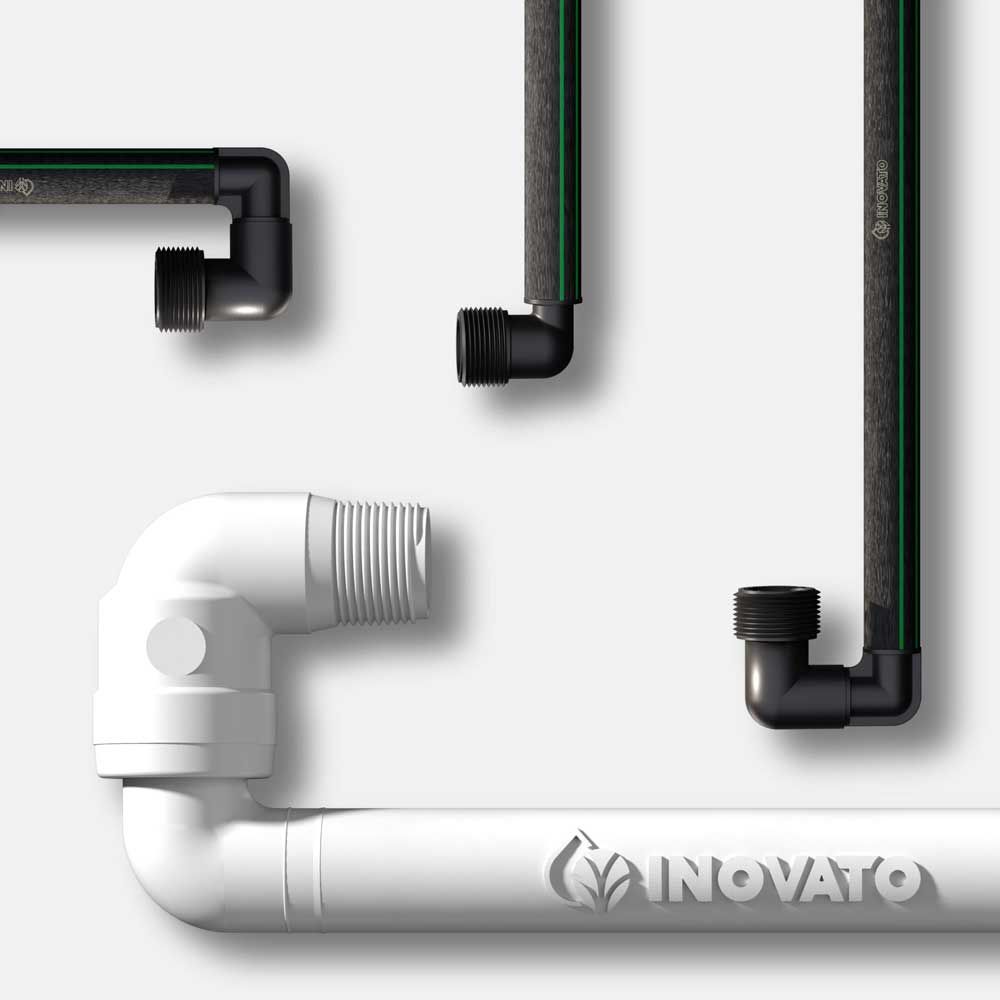
The swing joint itself typically consists of a rigid riser fitting at the pipe end, one or more flexible elbows or swivel joints, and a thread that accepts the sprinkler body or a sprinkler accessory. High-quality swing joints, such as the brass assemblies available from INOVATO Irrigation, are manufactured to precise tolerances to ensure smooth articulation, reliable sealing under rated pressure, and long-term resistance to corrosion in buried or partially buried conditions. The INOVATO SJ Swing Joint range is designed specifically for the demands of commercial and sports turf installations where reliability is non-negotiable.
Brass vs PVC Swing Joints: A Material Science Comparison
The choice between brass and PVC for swing joint fittings is one of the most consequential decisions in commercial irrigation specification. While PVC fittings have a legitimate role in low-pressure, low-risk residential systems, the material science tells a clear story for commercial applications. The table below summarises the key performance differences that matter to professional turf managers and irrigation contractors.
| Property | Brass (CW617N / CW614N) | PVC-U |
|---|---|---|
| Maximum working pressure | 16 bar (232 psi) | 10 bar (145 psi) at 20 degrees C |
| Temperature tolerance range | -20 degrees C to +120 degrees C | 0 degrees C to +60 degrees C |
| Impact resistance at low temperature | Excellent; ductile fracture behaviour | Poor; brittle failure below 5 degrees C |
| UV resistance | Immune; no photodegradation | Degrades without stabiliser coating |
| Thread durability (cycle count) | 500+ assembly cycles without stripping | 50 to 80 cycles before thread damage |
| Typical service life (buried, commercial use) | 25 to 40+ years | 8 to 15 years |
| Resistance to ground movement | High; absorbs deflection without fracture | Moderate; rigid joints transfer stress to pipe |
| Chemical resistance (fertiliser, soil acidity) | Excellent across pH 4 to pH 10 | Good in neutral soil; degrades in acidic conditions |
The critical failure mode for PVC swing joints in sports turf applications is brittle fracture. During a UK winter, soil temperatures at burial depth (typically 250 to 400 mm) can drop to between 2 and 5 degrees C. At these temperatures, PVC-U loses a significant proportion of its impact strength. A groundskeeper driving a maintenance vehicle over a sprinkler location, or even the repeated hydraulic hammer effect of valve actuation, can crack a PVC fitting that would have survived in summer. Brass, by contrast, retains its full mechanical properties well below zero and does not suffer from this seasonal vulnerability.
Why UK Sports Stadium Turf Managers Specify Brass
Walk into the maintenance facility at any major UK sports stadium and you will find a stores shelf stocked with brass swing joints, brass nozzles, and brass-bodied valves. The specification is not accidental. It is the result of decades of hard-won field experience by turf managers who cannot afford to dig up a playing surface mid-season to replace a failed fitting. The economics are straightforward: the cost of excavating and reinstating a single sprinkler position on a professional sports pitch, including turf repair, can exceed three to five times the initial cost difference between brass and PVC fittings across the entire system.
At venues hosting Premier League football, international rugby union, or ECB county cricket, the irrigation system is often integrated into a broader grounds management strategy that includes undersoil heating, drainage, and aeration. The sprinkler network operates at pressures between 7 and 12 bar, with dynamic surges during valve transitions. These pressures are well within the safe operating envelope of brass fittings but approach or exceed the derated capacity of PVC fittings when temperature and age are factored in. Stadium turf managers, many of whom hold IOG (Institute of Groundsmanship) or equivalent qualifications, understand this margin and specify accordingly.
Beyond the technical arguments, there is a practical maintenance advantage. Brass swing joints can be unscrewed and reassembled multiple times without thread damage, allowing sprinkler heads to be removed for off-season servicing, nozzle changes, or arc adjustments. PVC threads strip easily after repeated assembly, leading to leaks that demand complete fitting replacement. In a system with 100 or more heads, the cumulative maintenance burden of PVC thread degradation becomes a significant operational cost over a five-year cycle. Brass eliminates this recurring expense and the associated pitch disruption.
Swing Joint Configuration Options for Commercial Installations
Commercial swing joints are available in several configurations, each suited to specific installation conditions and sprinkler body types. Understanding the options allows contractors and specifiers to select the right assembly for each zone of a commercial irrigation system. The three principal configurations are the single-elbow swing joint, the double-elbow (S-shape) swing joint, and the triple-elbow (Z-shape) swing joint. Each provides a different range of articulation and a different stress profile on the connection.
The single-elbow configuration uses one swivel elbow at the pipe connection and a short rigid riser to the sprinkler body. It is suitable for shallow burial depths (200 to 300 mm) and provides sufficient adjustability for standard lawn and turf installations. The double-elbow configuration adds a second swivel point, creating an S-shaped path between the pipe and the sprinkler. This allows greater vertical and lateral adjustment, making it the most common choice for sports turf where sprinkler bodies must sit at precise grade levels relative to the surrounding playing surface. The triple-elbow configuration provides maximum articulation and is specified for deep burial situations, installations on slopes, or locations where significant ground movement is expected.
INOVATO's SJ Swing Joint range covers all three configurations in brass, with BSP thread options to suit the full range of commercial sprinkler bodies. All assemblies are pressure-rated to 16 bar working pressure with a 25 bar burst rating, providing a safety factor well above the minimum 2.5:1 ratio specified by ASABE EP413.1. Contractors can order pre-assembled units or individual components for on-site assembly, depending on project requirements and site logistics.
Selecting the Right Length and Thread
Swing joint length is determined by the burial depth of the lateral pipe and the height of the sprinkler body riser. In UK sports turf installations, lateral pipes are typically buried at 300 to 450 mm depth to clear drainage layers and aeration equipment. The swing joint must bridge this distance while allowing 50 to 80 mm of vertical adjustment for final grade levelling. Thread selection (typically 3/4 inch or 1 inch BSP in the UK) must match both the sprinkler inlet and the lateral pipe saddle or tee outlet. Mismatched threads are a common source of leaks and should be avoided by specifying all components from a single system manufacturer where possible.
Installation Best Practices for Swing Joints in Sports Turf
Correct installation is as important as correct specification. Even the highest-quality brass swing joint will underperform if installed without attention to alignment, support, and backfill technique. The following guidance reflects current best practice as recommended by irrigation consultants working on professional sports turf projects in the UK and Europe.
Step 1: Excavation and Pipe Preparation
Excavate the sprinkler pit to the required depth, ensuring the base is level and free of sharp stones or debris that could point-load the swing joint. Cut the lateral pipe cleanly using a pipe cutter rather than a saw, as burrs and uneven cuts compromise the seal at the saddle or tee connection. Deburr the pipe interior and exterior before fitting the saddle.
Step 2: Assembly and Connection
Assemble the swing joint components finger-tight first, checking articulation range. Apply PTFE tape (minimum six wraps, wound in the direction of thread engagement) to all male BSP threads. Tighten to manufacturer-specified torque using two wrenches to avoid overstressing the first swivel elbow. Connect the pipe-end fitting to the saddle or tee, and thread the sprinkler body onto the top fitting. Do not fully tighten the sprinkler body at this stage, as final height adjustment comes after backfill.
Step 3: Backfill and Compaction
Backfill around the swing joint with clean sand or fine gravel, not excavated clay or topsoil. Compact in layers of 50 to 75 mm using hand tools. Do not use mechanical compactors directly over the swing joint, as shock loading can damage swivel seals. Bring backfill to 100 mm above the sprinkler body shoulder before allowing any vehicle traffic over the location.
Step 4: System Testing
Before reinstating turf, pressure-test the zone to 1.5 times working pressure (minimum 10 bar) for 30 minutes with zero pressure drop tolerance. Inspect every swing joint connection for weeping or seepage. Adjust sprinkler body height to final grade level and tighten the body connection to final torque. Record all test results for handover documentation.
Specification Guidance for Contractors and Landscape Professionals
Writing a robust swing joint specification for a commercial irrigation tender requires clarity on materials, dimensions, pressure ratings, and compliance standards. A vague specification leads to value-engineering substitutions that may compromise system longevity. The following specification framework can be adapted for inclusion in contract documents, design drawings, or procurement specifications for sports turf and high-value commercial irrigation projects.
Recommended Specification Wording
All sprinkler-to-pipe connections shall be made using brass swing joint assemblies rated to a minimum of 16 bar working pressure. Swing joints shall be CW617N or equivalent dezincification-resistant brass alloy. Thread forms shall be BSP parallel to BS EN 10226-1. Swivel elbows shall incorporate EPDM O-ring seals rated for potable water contact. Swing joints shall be supplied in single, double, or triple configuration as shown on drawings. Minimum articulation range shall be 30 degrees in any plane from the installed position. All components shall be sourced from a single manufacturer to ensure dimensional and material compatibility.
For projects requiring compliance with the UK Water Supply (Water Fittings) Regulations 1999 (or Scottish equivalent), confirm that all brass fittings carry appropriate WRAS approval or can demonstrate material compliance with BS 6920 for potable water contact. While irrigation water may not always be potable-sourced, WRAS-approved materials provide assurance of material quality and absence of lead leaching, which is increasingly specified by public sector clients and sports governing bodies.
Budget Considerations
Brass swing joints typically cost between 2.5 and 4 times more per unit than PVC equivalents. However, when the total cost of ownership is calculated over a 15-year horizon including maintenance labour, replacement parts, and turf repair, brass delivers a lower lifecycle cost in every commercial scenario modelled. For a 120-head sports pitch system, the incremental material cost of specifying brass across the entire installation is typically recovered within three to five years through reduced maintenance callouts alone. Procurement managers and quantity surveyors should be presented with lifecycle cost comparisons rather than unit price comparisons when evaluating swing joint options.
INOVATO Irrigation supplies swing joints and complementary sprinklers and accessories direct to irrigation contractors and distributors worldwide, with stock held for fast delivery on standard configurations. Custom assemblies with non-standard lengths, thread combinations, or material grades can be manufactured to order with short lead times, supporting both new-build and retrofit projects on tight programme schedules.
Maintenance and Lifecycle Management for Swing Joints
A well-installed brass swing joint in a sports turf system should deliver 25 or more years of trouble-free service. However, proactive maintenance extends that life further and catches minor issues before they become major failures. The following maintenance protocol is recommended for commercial irrigation systems with brass swing joints.
Perform a visual inspection of all accessible sprinkler heads at the start of each growing season (typically March in the UK). Check for signs of leakage at the sprinkler body connection, including water staining, localised turf greening, or soft ground around the head. Where leakage is detected, isolate the zone, excavate to the swing joint, and replace the O-ring seals. On brass fittings, the threads themselves rarely require replacement if they have been properly maintained with PTFE tape at each disassembly.
At five-year intervals, or following any major ground disturbance such as drainage works or pitch reconstruction, conduct a full pressure test of each zone. Dynamic pressure testing, where the system is cycled through operating sequences, is more revealing than static pressure holding, as it subjects swing joints to the hydraulic transients that cause fatigue over time. Record all test pressures and compare with commissioning data to identify any trends toward pressure loss that might indicate developing seal wear.
For systems installed with PVC swing joints that are now showing signs of age or failure, a phased replacement programme with brass is recommended. Priority should be given to high-traffic areas, zones operating at the highest pressures, and any locations where historical failures have occurred. Replacing PVC swing joints with brass during scheduled sprinkler head upgrades is a cost-effective approach that avoids emergency replacements and associated pitch disruption. The INOVATO SJ Swing Joint range is dimensionally compatible with most major sprinkler body brands, simplifying retrofit projects.
Industry Standards and Compliance for Commercial Irrigation Fittings
Professional irrigation specification does not happen in a regulatory vacuum. Several standards and guidelines apply to swing joints and fittings in commercial sprinkler systems, and understanding these is essential for contractors, consultants, and turf managers who need to demonstrate due diligence in their specification choices.
ASABE EP413.1 (Installation of Sprinkler and Trickle Irrigation Systems) provides comprehensive guidance on swing joint installation, including recommended materials, minimum pressure ratings, and installation depth. While this is an American standard, it is widely referenced in international irrigation practice and forms the technical basis for many UK consultants' specifications. The standard specifically recommends metal fittings at sprinkler connections for systems operating above 6 bar and for all commercial and sports turf applications.
In the UK context, BS EN 10226-1 specifies the requirements for pipe threads where pressure-tight joints are made on the threads, directly applicable to BSP-threaded swing joints. The Water Supply (Water Fittings) Regulations 1999 apply where irrigation systems connect to the public water supply, requiring materials that do not contaminate water or support microbiological growth. Brass alloys meeting CW617N specification inherently satisfy these requirements, while PVC fittings may require additional certification depending on formulation and stabiliser chemistry.
The Sports and Play Construction Association (SAPCA) publishes codes of practice for sports pitch construction that reference irrigation system standards. While SAPCA does not specify swing joint materials directly, its guidance on sprinkler installation aligns with the general principle that components in high-value, high-traffic sports surfaces should be selected for maximum reliability and minimum maintenance intervention. This philosophy is consistent with the brass specification adopted by the majority of UK stadium turf managers.
Frequently Asked Questions
What is the standard working pressure for a commercial sprinkler swing joint?
Commercial brass swing joints are typically rated at 10 to 16 bar working pressure, with burst ratings of 25 to 40 bar depending on the manufacturer and configuration. INOVATO SJ Swing Joints are rated at 16 bar working pressure with a 25 bar burst rating, providing a safety factor of 1.56:1 above the nominal working pressure and well above the minimum 2.5:1 burst-to-working ratio specified in ASABE EP413.1. For most sports turf systems operating between 7 and 12 bar dynamic pressure, this provides substantial operational headroom even during pressure surges caused by valve actuation or pump start-up transients.
Can PVC swing joints be used in commercial sports turf systems?
PVC swing joints can technically be installed in commercial systems, and some contractors use them on lower-budget projects. However, most professional turf managers and irrigation consultants specify brass for sports turf applications due to PVC's limitations in impact resistance at low temperatures, thread durability over repeated assembly cycles, and shorter overall service life. The lifecycle cost analysis almost always favours brass in commercial settings where maintenance access requires turf disruption. PVC remains a viable option for ornamental landscape irrigation with lower operating pressures and infrequent maintenance requirements.
How deep should swing joints be buried in a UK sports pitch?
In UK sports turf installations, lateral irrigation pipes are typically buried at 300 to 450 mm depth. The swing joint bridges the distance from the pipe to the sprinkler body, which sits at the finished turf level. The swing joint length must therefore match the burial depth minus the sprinkler body height, with 50 to 80 mm of adjustment range to allow for final grade levelling. On pitches with integrated drainage or undersoil heating, burial depths may be increased to 500 mm to clear the drainage aggregate layer, requiring correspondingly longer swing joint assemblies.
What thread standard is used for swing joints in the UK?
British Standard Pipe Parallel (BSPP) threads to BS EN 10226-1 are the standard thread form for irrigation fittings in the UK and most of Europe. The most common sizes for commercial Sprinkler Swing Joints are 3/4 inch BSP and 1 inch BSP, matching the inlet threads of the sprinkler bodies from major manufacturers. It is essential to use BSP-compatible fittings throughout the swing joint assembly to ensure reliable sealing. Mixing thread standards (for example, inadvertently combining BSP and NPT components) will result in leaks and potential fitting damage.
How often should commercial swing joints be inspected or replaced?
Visual inspection of accessible sprinkler heads should be performed annually at the start of the growing season. A full dynamic pressure test of each irrigation zone is recommended every five years or following any major ground works. Brass swing joints in well-designed systems typically last 25 to 40 years with minimal intervention beyond periodic O-ring replacement. Replacement is generally triggered by external factors such as pitch reconstruction, system upgrades to different sprinkler models, or damage from construction activity rather than age-related failure of the brass fittings themselves.
What is dezincification-resistant brass and why does it matter for swing joints?
Dezincification is a corrosion process that affects standard brass alloys (particularly those with high zinc content) when exposed to water with certain chemical characteristics. The zinc is selectively leached from the alloy, leaving a porous, weakened copper structure. Dezincification-resistant brass alloys, such as CW617N with arsenic or phosphorus additions, resist this process and maintain their full mechanical properties over decades of service in buried conditions. For Irrigation Swing Joints that are in constant contact with soil moisture and irrigation water, dezincification-resistant brass is the recommended material to ensure long-term structural integrity and leak-free performance.
Source Reliable Swing Joints for Your Next Project
INOVATO Irrigation manufactures brass swing joints, Gear Drive Sprinklers, nozzles, valves, and complete sprinkler and accessory systems for commercial and sports turf irrigation. Contact us to discuss your project requirements or request a quotation.
View Swing Joint RangeIndustry Standards and Authoritative Resources
- Irrigation Association - Global industry association for irrigation professionals and best practices
- ASABE Standards - American Society of Biological and Agricultural Engineers technical library
- WRAS - Water Regulations Advisory Scheme - UK compliance scheme for water fittings and plumbing materials
- Sports Turf Research Institute (STRI) - Independent authority on sports surface management and turf science