


Quick read:
- A 1/2" plastic-body impact sprinkler (8427-class) FOB Ningbo typically splits raw polymer ≈ 32-38 %, injection molding ≈ 14-18 %, assembly & sub-components ≈ 12-16 %, inspection ≈ 3-5 %, packaging ≈ 5-8 %, inland + port fees ≈ 8-12 %, leaving roughly 6-10 % gross margin before sales overhead.
- A brass-body counterpart inverts the weights: raw brass bar ≈ 48-55 %, hot forging / CNC ≈ 18-24 %, surface finishing ≈ 4-6 %, inspection ≈ 4-6 %, with packaging/logistics proportionally lower (heavier, fewer units per box).
- The line item most often under-quoted is inspection (sampling + pressure-test + rotation uniformity), not raw material. A 1.5 % swing in inspection rate on a large order is a full quarter-point of FOB.
- A buyer comparing FOB quotes without first normalizing the cost-structure assumption (material family, order volume, packaging spec, inspection scope, Incoterm version) is comparing two different products.
Why a 7-line cost stack beats a single price-per-kg estimate
The textbook answer to "what drives FOB" is "raw material." For irrigation parts that is wrong in a measurable way. Take brass bar: at LME-style reference prices, brass rod of the C36000 free-cutting grade trades in a band that makes the bar input the dominant cost — typically 48-55 % of the FOB number for a forged brass-body sprinkler (copper pricing reference). But the same FOB number also contains a forged-and-machined body, a finished spray plate, a brass pin, a spring, a spray-nozzle insert, a spray-pattern adjuster, packaging, and a truck ride to the port. Aggregating "raw material" hides whether the supplier spent more on bar stock or on the forging step.
The reverse is true for plastic parts. Engineering polymers such as POM (polyoxymethylene) and glass-filled PP for impact-sprinkler bodies do not trade on an exchange the way copper does, but their per-kg cost is significant for a part that is mostly plastic by weight. (polymer overview, POM material reference) What makes the FOB number move for plastic-body parts is rarely the polymer price — it is the mold amortization, cycle time, and scrap rate that sit downstream of the molding machine. (injection molding process reference)
This is why a single cost-per-kg benchmark is misleading. The seven-line cost stack used in the rest of this article is:
1. Raw material (polymer pellet, brass bar, aluminum billet)
2. Primary forming (injection molding, hot forging, die casting)
3. Secondary machining (CNC drilling, tapping, spray-nozzle orifice sizing)
4. Surface finishing (deburring, polishing, plating, anodizing)
5. Inspection (incoming, in-process, pre-shipment — dimensional + functional)
6. Packaging (inner box, master carton, pallet, wrap, label)
7. Inland logistics + port fees (factory-to-port truck, terminal handling, export documentation)
Each line is a different percentage of the FOB number depending on the material family. Walking three material families through these seven points is the rest of the article.
The plastic-body impact sprinkler: 8427-class reference
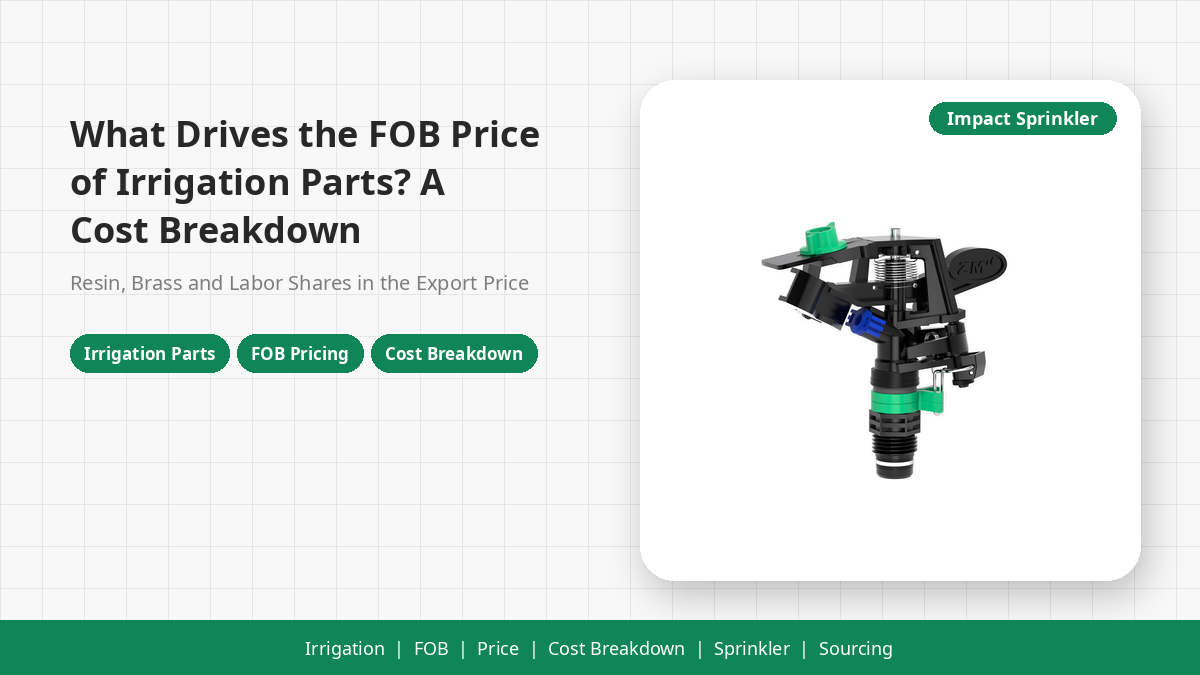
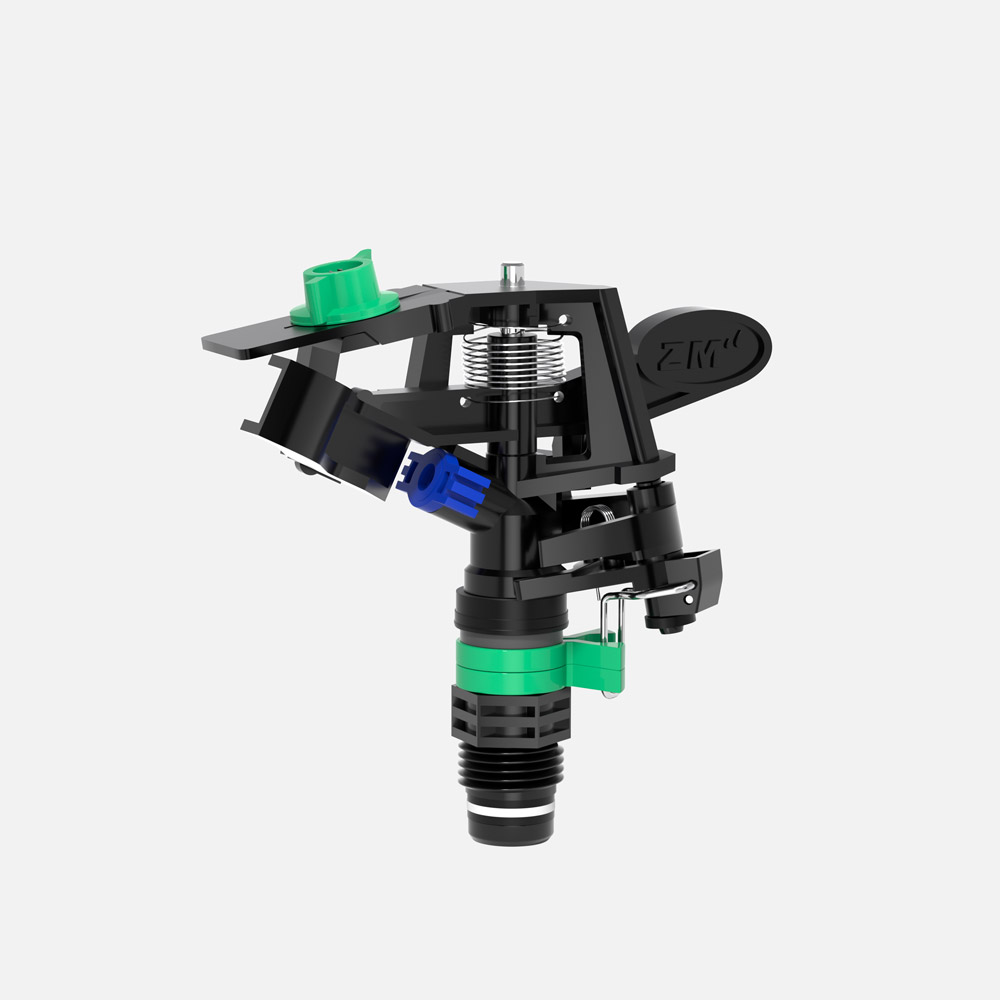
The Inovato 8427 plastic-body impact sprinkler is a useful reference for the plastic family because the part is dominated by its body — typically POM or glass-filled PP — with a small metal content in the spring, pivot pin, and spray-plate insert. For a typical 1/2" male-thread body in a mid-volume order (say, 5,000-20,000 pieces), the cost stack looks approximately like this:
1. Raw material (polymer + small-metal inserts): 32-38 %. The polymer pellet cost varies with grade (virgin POM for tight-tolerance internal bodies, recycled-content PP for arm covers and end caps), and the metal content is small but non-zero. A factory running both grades needs two resin streams, which raises the practical raw-material percentage by 1-2 points versus a single-resin operation.
2. Primary forming (injection molding): 14-18 %. The mold amortization — typically USD four-figure to low-five-figure per cavity set, amortized over the order — is the single most-negotiated line item in plastic-part RFQs. A short run (under ~3,000 pieces) inflates this to 25 %+ because the mold cost is spread over too few units; a long run (50,000+) compresses it toward 8-10 %.
3. Assembly & sub-components (springs, pins, spray plates, washer): 12-16 %. The 8427 has roughly 8-12 piece parts, several of which are bought-in (the spray-nozzle insert is often sourced as a sub-component). The assembly cost is mostly labor plus a small allocation for the bought-in parts.
4. Surface finishing: 1-2 %. Plastic parts usually need only deburring and a visual polish; no plating, no anodizing. This is the line where plastic wins decisively over brass.
5. Inspection: 3-5 %. Critical for plastic impact sprinklers because the rotation uniformity and spray-pattern diameter depend on the body geometry being within tolerance. Visual + dimensional + a sample-based rotation test (water-on, run for a fixed time, measure wetted radius at four cardinal points) is the standard scope. A factory quoting below this band is almost certainly skipping the rotation test.
6. Packaging: 5-8 %. Inner box (printed or plain), master carton, often a polyfoam insert, an outer shipping carton, and a pallet if the order is full-container. Plastic parts are light, so a 20' FCL holds more units than a brass run; the per-unit packaging is therefore lower than brass despite the same packaging materials.
7. Inland logistics + port fees: 8-12 %. Truck from Yuyao or Ningbo factory to Ningbo-Zhoushan port, terminal handling, export documentation, and the China-side port fees that build up before the container is loaded. (Ningbo port overview) On a typical 20' FCL, the inland share is 8-12 %; on an LCL shipment it can climb to 15-18 % because the consolidation fee is added to the per-cubic-meter base.
Margin band: 6-10 % gross before sales overhead. Below this and the factory is either losing money or quietly substituting material. Above this and the buyer should ask what justifies it.
The brass-body impact sprinkler: same SKU, inverted weights
A brass-body impact sprinkler of the same 1/2" male-thread specification is not a substitute for a plastic-body unit — the failure modes differ, the spray pattern differs, the price differs by 3-5x. But cost-structure comparison is instructive because the weights invert.
1. Raw material (brass bar C36000 / C37700): 48-55 %. The dominant cost. Brass rod trades at a multiple of LME copper plus a fabrication premium that varies with the nickel and zinc content and the diameter tolerance. A buyer watching only the LME copper ticker will miss the fabrication premium, which can swing the input cost by 10-15 % over a 12-month window even when LME copper is flat. (copper reference, brass alloy reference)
2. Primary forming (hot forging): 18-24 %. Brass bodies are forged, not injection-molded. The forging dies are expensive and long-lived, so mold amortization is less of a swing factor than for plastic, but the per-shot forging cycle and the flash-trim operation add cost that is not present in plastic.
3. Secondary machining (CNC drill + tap + spray orifice): 6-10 %. The thread, the spray-orifice, and the spray-pattern adjuster slot are machined after forging. Brass is free-cutting, so cycle time is moderate, but every additional machined feature adds to the per-piece cost.
4. Surface finishing (polishing, optional nickel-plating): 4-6 %. A polished brass body needs barrel finishing or hand polishing; a nickel-plated body adds plating cost. The plating step is a frequent source of RFQ ambiguity — buyers often do not specify whether they want polished-only or polished-and-plated, and the two can differ in cost by 2-3 %.
5. Inspection: 4-6 %. The dimensional and rotation tests are similar to plastic, but brass parts also need a pressure-test step (typically 1.0-1.5 MPa hydrostatic for 30 seconds) to verify the forged body has no porosity. This step is sometimes bundled into the forging line, sometimes run as a separate post-machining test; either way it is non-zero.
6. Packaging: 3-5 %. Heavier parts mean fewer units per master carton, but the per-unit packaging materials are essentially the same. The percentage drops because the denominator is bigger.
7. Inland logistics + port fees: 5-8 %. The truck rate is per-cubic-meter or per-container, not per-piece, so heavier parts dilute this line item even though the absolute logistics spend is similar. (container freight reference, Incoterms 2020 reference, FOB Incoterm reference)
Margin band: 5-8 % gross. Brass is a commodity-input business with thin margins; a brass-body quote with a 12 %+ gross margin is either optimistic or has a value-add the buyer has not asked about.
The aluminum-body irrigation part: between plastic and brass
Aluminum sits in the middle: lighter than brass, more expensive than plastic, and useful for spray plates, valve bodies, and quick-connect fittings where the strength-to-weight ratio matters.
1. Raw material (aluminum billet / bar — typically 6061 or A380): 30-40 %. LME aluminum pricing applies, but again the fabrication premium and the alloy grade are the real swing factors. (aluminum reference)
2. Primary forming (die casting for complex shapes, extrusion + machining for bars): 20-26 %. Die casting is the high-volume path for complex aluminum bodies; the die cost is comparable to an injection mold but the cycle time is longer because the cooling phase dominates.
3. Secondary machining: 8-12 %. Aluminum machines faster than brass but slower than plastic; the share of FOB is intermediate.
4. Surface finishing (anodizing, powder-coat, or as-machined): 3-5 %. Anodizing adds a step that brass and plastic typically skip; powder-coating is common for outdoor-rated valve bodies.
5. Inspection: 3-5 %. Similar scope to plastic, plus a thread-engagement test that is more critical for aluminum because the thread is softer.
6. Packaging: 5-7 %. Similar to plastic.
7. Inland logistics: 6-10 %. Lighter than brass, similar to plastic.
Margin band: 6-9 % gross. Aluminum is competitive when the part geometry rewards die casting, less so when the part is mostly machined.
The cross-family comparison table
| Cost line | Plastic (8427-class) | Brass (1/2" body) | Aluminum (valve/spray plate) |
|---|---|---|---|
| Raw material | 32-38 % | 48-55 % | 30-40 % |
| Primary forming | 14-18 % | 18-24 % (forging) | 20-26 % (die casting) |
| Secondary machining | 2-4 % | 6-10 % | 8-12 % |
| Surface finishing | 1-2 % | 4-6 % | 3-5 % |
| Inspection | 3-5 % | 4-6 % | 3-5 % |
| Packaging | 5-8 % | 3-5 % | 5-7 % |
| Inland + port | 8-12 % | 5-8 % | 6-10 % |
| Gross margin | 6-10 % | 5-8 % | 6-9 % |
The headline takeaway: raw-material share inversely predicts margin band. A material-dominant part (brass) cannot absorb a price war; a process-dominant part (plastic, aluminum) has more room to compete on cycle time, mold amortization, and scrap rate.
What "low FOB" actually buys — and what it does not
A buyer comparing two FOB quotes for the same SKU usually finds a 15-30 % spread. Where the spread lives:
1. Material substitution. The cheapest quotes use a lower polymer grade (recycled-content PP instead of virgin POM) or a thinner brass bar that does not meet the original spec. A buyer who specifies "POM, virgin grade" and gets a quote 25 % under the median has good reason to ask for a material certificate before issuing the PO. (inspection norms reference)
2. Inspection cuts. The cheapest quotes often reduce inspection from AQL 1.5 / 2.5 (general inspection level II) to a 10 % sample pull. The saving is real — 1-2 % of FOB — but the consequence is that defects ship. (ISO 2859 sampling reference)
3. Packaging substitution. A printed inner box becomes a plain white box. A polyfoam insert becomes a bubble-wrap ball. The saving is small (under 1 % of FOB) but it is one of the easiest cuts a factory makes to win a price war.
4. Inland logistics. A factory 250 km from the port (rather than 50 km) has a structural cost disadvantage that shows up as a 1-2 % higher inland line. (logistics overview)
5. Hidden overhead in the margin line. A 4 % gross-margin quote is a factory that has not priced in engineering-change costs, after-sales warranty, or sales overhead. The first 2 % of any post-RFQ change order goes to absorbing those costs.
The cheapest FOB is rarely the cheapest landed cost, and almost never the cheapest total cost. (Incoterms reference, WTO trade-costs framework)
How a 2026 buyer writes an RFQ that returns a comparable FOB
Five rules that produce quotes a buyer can actually compare:
Rule 1 — Pin the material grade in the RFQ, not in the PO. A spec that says "brass body, C36000 or equivalent" forces the supplier to interpret "equivalent" in the cheapest way. A spec that says "brass body, C36000, Cu 60-63 %, Pb 2.5-3.7 %, Zn remainder, hot-forged" cannot be silently substituted.
Rule 2 — Quote the order volume in a band, not a point. A quote for 5,000 pieces is structurally different from a quote for 50,000. Ask for both, or for a step-pricing table (5K / 10K / 20K / 50K). The factory's mold-amortization math depends on volume; the buyer should see that math.
Rule 3 — Specify the inspection scope. "Pre-shipment inspection, AQL 1.5 / 2.5, level II, including rotation-uniformity test on 5 samples per lot" is a complete scope. "QC before shipping" is not.
Rule 4 — Specify the packaging. "Inner box 25 × 18 × 12 cm, 50 pcs/inner, 4 inner/master carton, pallet 80 × 60 cm, 8 master/pallet, plastic wrap, shipping mark per buyer artwork" is a complete spec. "Standard export carton" is not.
Rule 5 — Pin the Incoterm version and the port. "FOB Ningbo, Incoterms 2020" is unambiguous. "FOB China" is not. (HS code reference for customs classification)
A factory that cannot or will not respond to this level of spec is a factory whose FOB quote is a guess. Standard pre-shipment inspection norms are published by SGS, Bureau Veritas, and Intertek, and polymer-grade selection for plastic-body parts draws on supplier datasheets such as the BASF engineering-plastics product family.
FAQ
Q1: Why does my brass-body FOB quote have a different USD price every quarter even when I have not changed the spec?
A1: Two reasons dominate. The first is the brass bar input cost, which follows LME copper plus a fabrication premium; both move independently. The second is the USD-CNY exchange rate, which moves the entire cost stack in CNY terms but the FOB number in USD terms. A buyer who wants price stability can negotiate a raw-material pass-through clause that adjusts the FOB by the change in LME copper over a defined index window, capped at +/- 5 % per quarter. (copper pricing reference)
Q2: Is FOB really the right comparison, or should I be asking for CIF or DDP?
A2: FOB is the right comparison for supplier-to-supplier cost benchmarking because it removes freight and insurance from the equation and forces the comparison onto the factory gate. For landed-cost planning, CIF or DDP is more useful because it includes ocean freight, insurance, and duty. The two are complementary: FOB for comparing suppliers, CIF/DDP for budgeting total landed cost. (Incoterms 2020 reference)
Q3: My quote includes "free spare parts 2 %" — should that affect my FOB comparison?
A3: Treat it as a separate line. Spare-parts allocation is a contractual term, not a cost item, and it should be netted out before comparing FOB numbers. A 2 % spare-parts allocation is a real cost the supplier has priced in; if you do not need the spares, negotiate them out for a 1-1.5 % FOB reduction.
Q4: The cheapest quote is 22 % below the median. What should I check first?
A4: Three things, in this order. First, ask for a material certificate on the body and the spray plate; a 22 % spread almost always involves material substitution. Second, ask for the inspection report on a recent lot; if the report covers "visual only," the factory is running below AQL 1.5 / 2.5. Third, ask for a packaging sample; a plain white inner box is the cheapest tell. If all three check out and the quote is still 22 % under, you are looking at a factory losing money to win a reference customer, which is a different conversation.
Q5: How do I know if a factory's "factory price" is already FOB or ex-works?
A5: Ask, in writing, for the price to be quoted as "FOB [port name], Incoterms 2020." If the supplier responds with a number that does not include port fees or inland trucking, they have quoted ex-works (EXW) and the inland + port share of 5-12 % needs to be added back. A buyer comparing an FOB quote to an EXW quote is comparing two different cost stacks. (Incoterms reference)
Q6: Does order volume really change the FOB that much?
A6: Yes, and the change is non-linear. For a plastic-body impact sprinkler, doubling the order from 5,000 to 10,000 pieces typically drops FOB by 8-12 %; doubling again from 10,000 to 20,000 drops it by another 4-6 %; from 20,000 to 50,000 another 2-3 %. The curve flattens because the dominant cost (raw material) is volume-linear; only the mold-amortization and setup lines compress with volume.
Q7: What is the single biggest mistake buyers make when comparing FOB quotes?
A7: Comparing quotes from different material families as if they were the same product. A plastic-body 8427 and a brass-body 8427 share a thread specification and a spray-pattern spec; they do not share a cost stack, a tooling lead time, or a failure mode. Comparing their FOB numbers without normalizing the family is the single most common analytical error in irrigation-parts sourcing.