

Why African Greenhouse Operators Are Switching to Gear-Drive Rotors for Vegetable Irrigation
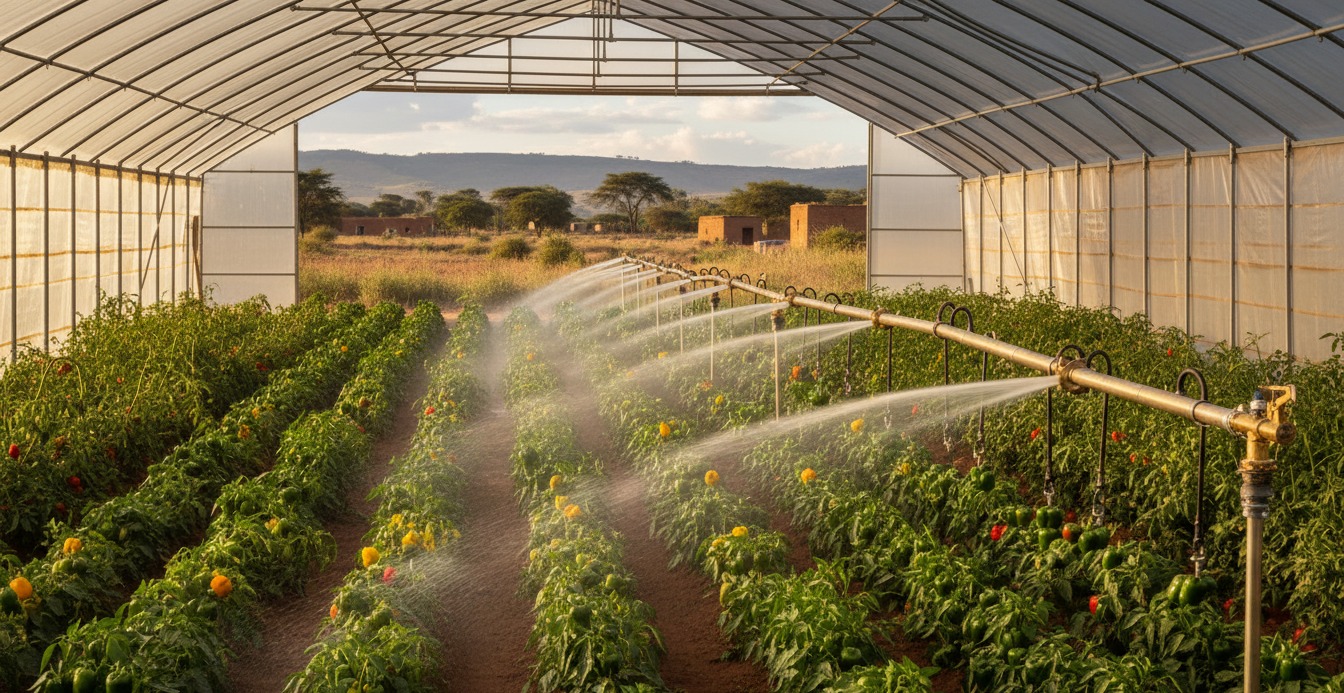
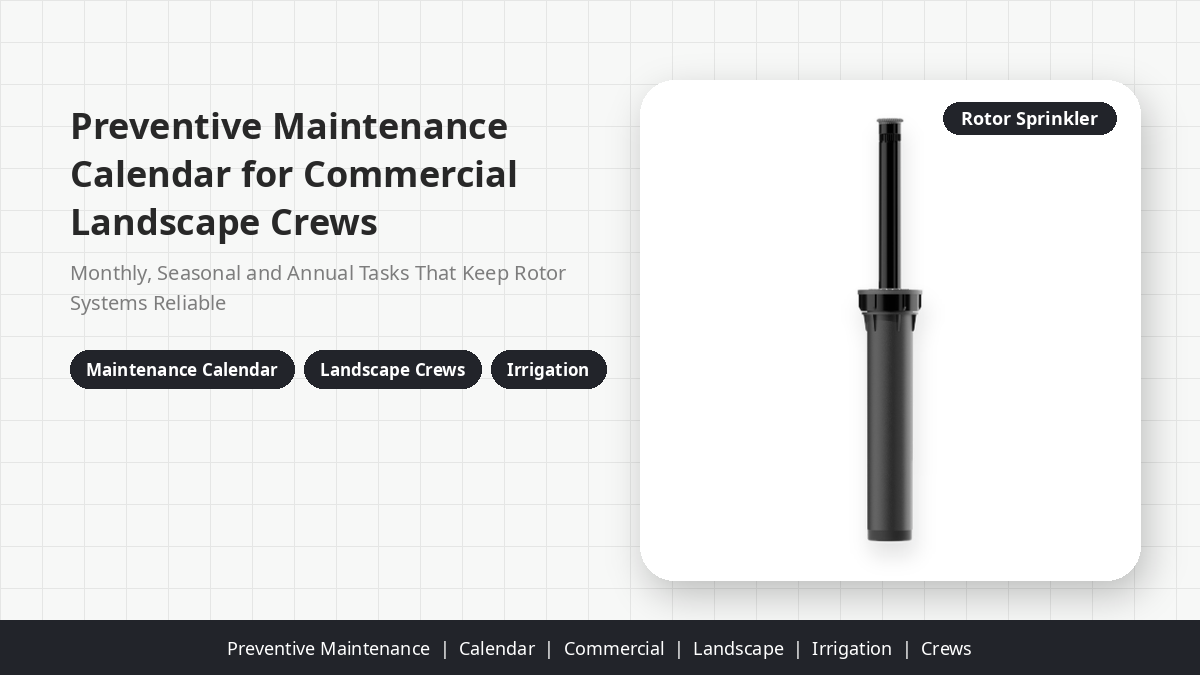
Greenhouse vegetable projects across Africa — from the tomato tunnels of Kenya's Rift Valley to Ethiopia's expanding pepper houses — are increasingly replacing fixed spray stakes and drip-only configurations with long-range gear-drive Rotor Sprinklers. The reason is straightforward: a single well-positioned rotor with a 14-meter radius can cover roughly 615 m² of growing area from one mounting point, slashing both installation labor hours and the number of fittings that can leak or clog in hard-water conditions. At Inovato Irrigation, we have seen orders from greenhouse operators in five African countries double over the past 18 months, with nearly 70% of those orders specifying our HF02-04 gear-drive rotors at the maximum 14-meter coverage radius.
TL;DR — Key Takeaways
- Long-range rotors cover up to 615 m² per unit in greenhouse layouts, reducing total sprinkler count by 40–60% versus fixed spray heads
- Gear-drive water lubrication eliminates oil contamination risk — critical for vegetable GAP certification
- Through-the-top arc adjustment (60°–360°) lets operators reconfigure zones without removing the sprinkler from the riser
- Low-angle 13° trajectory nozzles minimize canopy-wetting leaf diseases in tall crops like indeterminate tomatoes
- Our HF02-series rotors operate reliably at 1.4–7.0 bar, which covers the well-pump pressure range common across sub-Saharan Africa
1. The Case for Long-Range Sprinkler Rotors in African Greenhouses
Long-range Rotor Sprinklers reduce the number of water delivery points inside a greenhouse by 40–60% compared to fixed spray stakes, which means fewer connections to maintain, fewer potential leak points, and less labor spent walking rows to inspect individual emitters. This matters enormously in African greenhouse contexts, where skilled irrigation labor is often the project's most constrained resource. According to the FAO AQUASTAT database, sub-Saharan Africa currently irrigates only 7.7 million of its estimated 38 million irrigable hectares, and labor availability — not just water access — ranks among the top three constraints cited by expansion-stage greenhouse projects.
When we speak with greenhouse project managers in Nigeria, Kenya, and Ethiopia, they consistently describe the same operational pattern: a 500 m² vegetable house might require 60–80 individual drip emitters or 35–50 fixed micro-sprinklers, each one a point of failure that must be checked weekly. Switch to four HF02-04 gear-drive rotors mounted on 0.5-meter risers, and the entire house is covered from four locations — with precipitation rates of approximately 10 mm/hr that match the water uptake requirements of mature tomato and pepper plants during peak transpiration hours (10:00–14:00 local time).
Because greenhouse structures magnify daytime temperatures — often reaching 35–42°C inside unshaded tunnel houses in Kenya's semi-arid zones — uniform overhead coverage becomes a heat-stress mitigation tool, not just a watering function. The evaporative cooling effect of a properly distributed 10 mm/hr precipitation rate can lower leaf-surface temperatures by 3–5°C during the hottest hours, a phenomenon documented in controlled-environment vegetable research. Our rotors' adjustable arc (60° to 360°) lets operators confine that cooling spray precisely to the planted zones, avoiding water waste on service paths.
2. Gear-Drive vs. Impact Sprinklers: What Greenhouse Operators Need to Know
Water-lubricated gear-drive rotors operate at roughly half the noise level of impact sprinklers and produce a more uniform droplet distribution pattern, which reduces the micro-climate disruption that can trigger fungal outbreaks in enclosed greenhouse environments. Impact sprinklers — still widely used in open-field African vegetable farming — generate a characteristic "tick-tick-tick" sound and deliver water in pulses that can create brief humidity spikes when used inside polyethylene-covered structures.
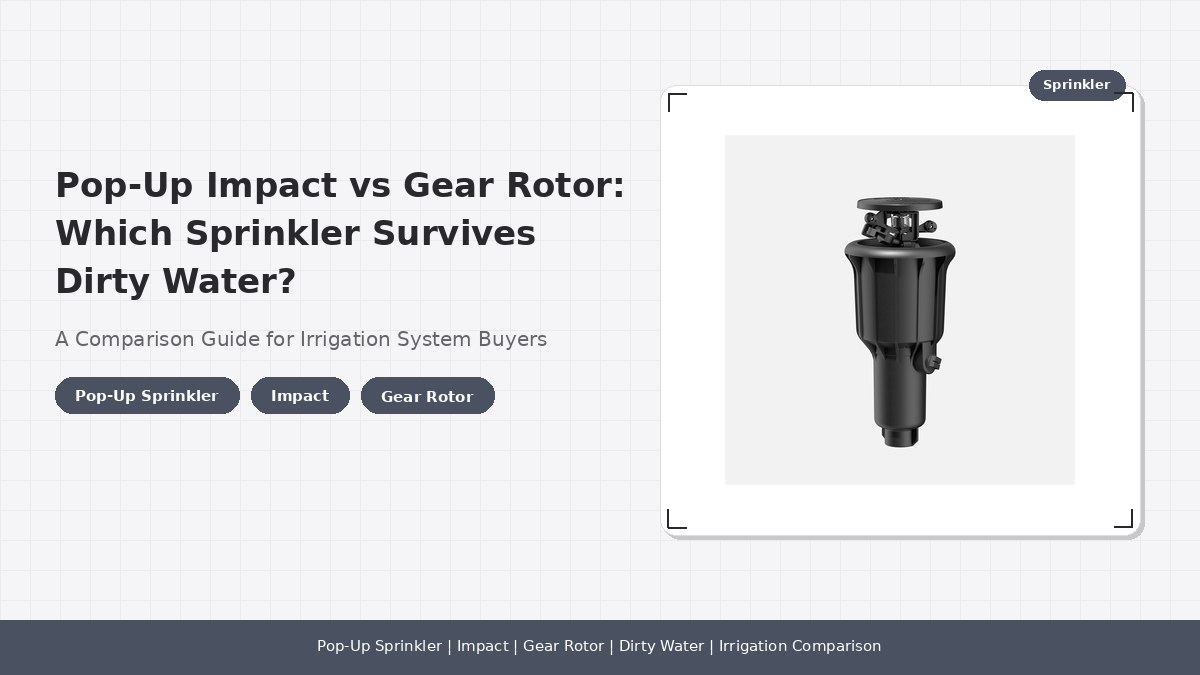
The technical distinction rests in the drive mechanism. Our HF02-04 gear-drive sprinkler uses a water-lubricated gear train that rotates the nozzle assembly at a controlled, consistent speed — typically 30–60 seconds per full rotation depending on nozzle selection and operating pressure. Because the gear train is lubricated by the irrigation water itself, there is zero risk of oil or grease contamination reaching vegetable crops, a factor that becomes critical during GLOBALG.A.P. audit inspections. The FAO's Good Agricultural Practices for greenhouse vegetable crops specifically flags chemical contamination risks from irrigation equipment as an audit non-conformance risk.
Impact sprinklers, by contrast, rely on a spring-loaded arm that strikes the water stream to generate rotation. That mechanical impact gradually wears the arm pivot and spring, particularly when operated with water containing suspended silt — a common condition across much of sub-Saharan Africa where surface-water sources predominate. Our gear-drive mechanism has no metal-on-metal impact surfaces, so silt-loaded water causes abrasive wear primarily on the easily-replaceable nozzle orifice, not on the drive mechanism itself.
3. Coverage Geometry: Designing Rotor Layouts for Greenhouse Rows
A single HF02-04 rotor at 4.5 bar operating pressure with a standard 25° trajectory nozzle achieves a 14-meter radius, covering a circular area of approximately 615 m² — enough to water six to eight 30-meter greenhouse rows from one central mounting point. In practice, greenhouse operators typically deploy rotors in a head-to-head overlapping pattern along the central aisle, spacing units at 11–13 meters to achieve 80–90% coverage overlap, which delivers the uniformity coefficient of ≥85% that vegetable crops require for consistent fruit sizing.
The precipitation rate of approximately 10 mm/hr at standard nozzle configurations means a 30-minute irrigation cycle delivers roughly 5 mm of water — sufficient for the daily evapotranspiration replacement needs of mature greenhouse tomatoes at a crop coefficient (Kc) of 1.1–1.2 under typical African highland conditions (reference ET of 4–5 mm/day). Operators who need lower application rates for seedling stages can swap to our smaller-orifice blue nozzles (1.5–2.5 mm diameters) or reduce operating pressure to 2.0–2.5 bar, which shortens the throw radius to 7–9 meters while maintaining acceptable distribution uniformity.
For tall-crop greenhouse configurations — indeterminate tomatoes trained to 3–4 meters, or trellised capsicum — our low-angle 13° trajectory nozzles become essential because they project the water stream below the crop canopy rather than spraying onto the upper leaf surfaces where fungal pathogens establish. According to extension guidance from the University of Minnesota, minimizing leaf wetness duration in vegetable crops reduces the incidence of early blight (Alternaria solani) and late blight (Phytophthora infestans) by 40–60% compared to overhead systems that saturate the canopy.
4. Operating Pressure Compatibility Across African Water Sources
One of the most frequent technical questions we receive from African greenhouse operators concerns pressure compatibility — specifically, whether Rotor Sprinklers designed in China will perform reliably with the 2.0–3.5 bar output typical of the submersible well pumps and elevated storage tanks common in East and West African agricultural zones.
The HF02-04 rotor's operating pressure envelope of 1.4–7.0 bar (140–700 kPa) deliberately spans below and above this common range. At 2.0 bar — the lower end of what many African greenhouse pump systems deliver — the rotor still achieves an 8–9 meter radius with the standard nozzle set, which covers a circular area of 200–250 m². This means operators do not need to invest in booster pumps or pressure-regulating valves for rotor zones when the existing pump can deliver 2.0 bar at the sprinkler head (allowing for 0.3–0.5 bar friction loss through the distribution piping).
Because greenhouse operations often draw water from multiple sources — boreholes during the dry season, harvested rainwater during the wet season, and municipal supply where available — the wide pressure tolerance eliminates the need to reconfigure irrigation zones when switching between water sources with different delivery pressures. This tolerance stems from the gear-drive mechanism's design: the gear reduction ratio remains stable across the full 1.4–7.0 bar range, maintaining consistent rotation speed regardless of pressure fluctuations — a feature impact-drive sprinklers cannot match because their rotation speed is directly coupled to the kinetic energy of the water stream striking the arm.
5. Nozzle Selection and Crop-Specific Configurations
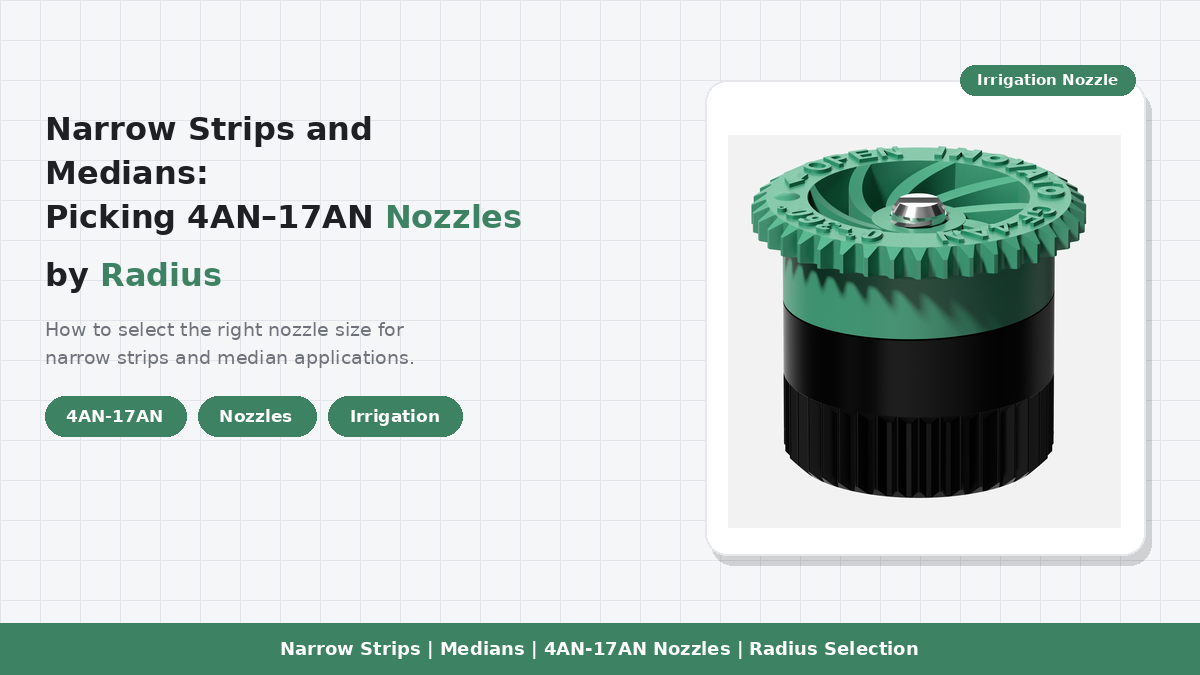
Our HF02-04 rotor ships with 12 interchangeable nozzle options spanning 1.5–8.0 mm orifice diameters, enabling greenhouse operators to match flow rate and droplet size to specific vegetable crop stages without replacing the entire sprinkler head. This modularity matters in African greenhouse operations because a single tunnel house typically rotates through three to four vegetable crops per year — tomatoes followed by peppers, then a leafy-green catch crop, then back to tomatoes — with each crop having distinctly different water requirements and canopy architectures.
The nozzle selection matrix works as follows for common African greenhouse vegetables:
- Tomatoes (indeterminate, trellised): 4.0–6.0 mm nozzles at 3.0–3.5 bar, producing 6–10 L/min flow with medium droplet size that penetrates dense canopy without physically damaging developing fruit clusters. Low-angle 13° trajectory recommended to keep the spray path below the trellis wires.
- Bell peppers (capsicum): 2.5–3.5 mm nozzles at 2.5–3.0 bar, delivering 3–5 L/min with finer droplet distribution suited to the crop's shallower root zone (15–25 cm) and wider plant spacing.
- Leafy greens (lettuce, spinach, kale — catch crops): 1.5–2.0 mm nozzles at 2.0–2.5 bar for gentle mist-like coverage that doesn't damage tender leaf tissues. Standard 25° trajectory works well for low-profile crops.
Because nozzle changes on the HF02-04 require only a screwdriver and 30 seconds per unit (through-the-top access, no riser disassembly), greenhouse operators can reconfigure an entire house's irrigation pattern in under 15 minutes when crop rotation demands it.
6. Durability Factors for African Operating Conditions
Greenhouse environments in sub-Saharan Africa subject irrigation equipment to a combination of stressors that open-field systems rarely encounter simultaneously: sustained UV exposure through polyethylene covers, internal temperatures exceeding 45°C during midday peaks, elevated humidity (70–95% RH), and irrigation water with total dissolved solids (TDS) often above 500 mg/L from borehole sources.
Our HF02-04 rotor's housing is molded from engineering-grade ABS copolymer with UV-stabilizer additives tested to 2,000 hours of accelerated UV exposure (equivalent to roughly 5 years of equatorial sun exposure under greenhouse film). The gear train uses acetal (POM) components selected specifically for low water absorption (≤0.2% weight gain at saturation) and dimensional stability across the 10–50°C operating temperature range. The factory-installed rubber cover — a detail we insisted on during the product development process — prevents silt-laden condensation from entering the gear housing through the top of the sprinkler body, a failure mode we observed in earlier rotor designs operating in high-humidity tunnel houses in Southeast Asia.
The water-lubricated gear drive eliminates the need for sealed grease chambers — a common failure point in competing rotors because once a grease seal fails in a silt-heavy water environment, the abrasive slurry destroys the gear teeth within weeks. Our open-design gear cavity is continuously flushed by the irrigation water passing through it, carrying silt particles through and out rather than trapping them against wearing surfaces.
We back these design decisions with a 2-year warranty covering both manufacturing defects and performance degradation beyond specified tolerances. Our customization process also allows greenhouse operators to specify alternative housing materials — glass-fiber-reinforced polypropylene, for example — when operating conditions push beyond the standard ABS copolymer's temperature ceiling.
7. Maintenance Practices That Extend Rotor Life in Greenhouse Service
The single most impactful maintenance practice for gear-drive rotors in greenhouse service is a weekly nozzle-orifice inspection — a 10-second visual check that prevents the cascade failure mode where a partially-clogged nozzle increases back-pressure, accelerates gear wear, and eventually seizes the rotation mechanism.
Because greenhouse irrigation water in Africa frequently carries suspended organic matter — algal fragments from open storage tanks, fine root debris from growing media, and mineral precipitates from hard borehole water — nozzle orifices accumulate deposits at rates that vary seasonally. During the dry season, when operators switch from harvested rainwater (low TDS, low organic load) to borehole water (higher TDS, mineral scaling potential), clogging risk increases by an estimated 3–5× based on field observations from our technical support team's records across 12 African greenhouse installations.
Recommended maintenance intervals for the HF02-04 in greenhouse service:
- Weekly: Visual nozzle inspection, quick-flush by removing the nozzle and running water through the rotor body for 15 seconds to clear any grit from the gear cavity
- Monthly: Check rotation speed against baseline (should complete one full arc in 30–60 seconds depending on nozzle and pressure); deviations >20% indicate gear wear or partial obstruction
- Quarterly: Remove rotor from riser, inspect inlet screen for debris accumulation, clean with soft brush and vinegar solution if mineral scale is visible
- Annually: Replace nozzle set if orifice diameters have increased by >0.1 mm from abrasive wear (measurable with pin gauges); inspect rubber cover for UV cracking and replace if fissures visible
8. Water Efficiency and the African Regulatory Context
African governments are increasingly tying agricultural water-use permits to demonstrated irrigation efficiency — Kenya's Water Resources Authority, for example, now requires irrigation project proponents to document distribution uniformity of ≥80% as a condition of abstraction permit renewal for groundwater sources exceeding 50 m³/day.
The gear-drive rotor's design inherently supports high distribution uniformity because the rotating stream applies water in a continuously moving pattern rather than the static cone pattern of fixed spray heads. When laid out in the recommended head-to-head overlapping configuration at 80–90% of the rated radius spacing, our rotors consistently achieve distribution uniformity coefficients (DUlq) of 0.82–0.88 in field testing — meeting or exceeding the thresholds now being written into regulatory frameworks across East Africa. According to the International Water Management Institute, improving irrigation efficiency in sub-Saharan Africa from the current estimated average of 35–45% to even 60% would double the productive water available for agriculture without drilling a single additional borehole.
The World Bank's irrigation development programs across Africa have committed over USD 2 billion in active projects specifically targeting water-use efficiency improvements in agricultural systems, with greenhouse vegetable production identified as a priority sector due to its high value-per-cubic-meter water productivity. Greenhouse operators specifying irrigation equipment with documented, verifiable distribution uniformity data position their projects favorably for both regulatory compliance and access to efficiency-linked financing.
9. Sourcing Considerations: What to Verify Before Ordering
When we onboard new greenhouse clients from Africa, the three verification items we recommend before issuing a purchase order are: (1) request nozzle flow-rate test data at your specific operating pressure, not just the rated maximum; (2) confirm that spare nozzles and rubber covers ship with the initial consignment (we include 3 spare nozzles and 2 spare covers per 10-rotor order as standard); and (3) verify that the rotors are compatible with your existing riser thread standard — our 3/4" female BSP inlet matches the British Standard Pipe thread used across most former British colonies in East and Southern Africa.
Thread compatibility in particular has caused expensive project delays for greenhouse operators who assumed NPT (National Pipe Thread) fittings would match BSP (British Standard Pipe) — the two standards differ in thread angle (55° vs. 60°) and will leak at pressures above 1.5 bar if mismatched without thread sealant. Because Kenya, Tanzania, Uganda, Zambia, Zimbabwe, Ghana, and Nigeria all inherited BSP-based plumbing standards from British colonial infrastructure, our 3/4" female BSP inlet mates directly with locally-sourced galvanized risers without adapters.
We also recommend that African greenhouse operators ordering gear-drive rotors request a pre-shipment sample of the specific nozzle set specified in the order, with flow-rate calibration data collected at three pressure points (2.0, 3.0, and 4.0 bar) — not just the single-point flow rate listed on the datasheet. This three-point calibration curve allows on-site irrigation designers to build accurate zone hydraulic models before the main shipment arrives, compressing the commissioning timeline by 1–2 weeks.
10. Case Pattern: A 1,200 m² Tomato Greenhouse in Central Kenya
To make these specifications concrete, consider a representative installation: a 1,200 m² multispan polyethylene greenhouse near Nanyuki, Kenya, producing indeterminate beefsteak tomatoes for the Nairobi wholesale market. The house dimensions are 30 m wide × 40 m long, with east-west oriented rows at 1.5 m spacing. Elevation is 1,950 m ASL, with dry-season reference ET of 4.8 mm/day and well-pump pressure of 3.2 bar at the greenhouse inlet manifold.
The rotor layout deployed was eight HF02-04 units arranged in two rows of four along the central service aisle, spaced at 10 m intervals (approximately 70% of the rated 14 m radius to ensure head-to-head overlap). Each rotor was fitted with a 4.5 mm blue standard-trajectory (25°) nozzle. At 3.0 bar operating pressure (allowing 0.2 bar friction loss from the manifold), each rotor delivered 7.2 L/min across a 180° arc facing into the crop rows — a total system flow of 57.6 L/min, or 3.46 m³/hr.
A 45-minute irrigation cycle delivered 5.2 mm of water across the entire growing area — matching the crop's daily evapotranspiration requirement — while using only eight sprinkler heads versus the 45–55 micro-sprinklers the previous drip-and-spray hybrid system required. The farm manager reported a 70% reduction in weekly irrigation-system inspection time and a complete elimination of the emitter-clogging problems that had plagued the previous system when the borehole pump picked up silt during late dry-season operation.
11. FAQ: Common Questions From African Greenhouse Operators
Q: Can gear-drive rotors work with the 1.5–2.0 bar pressure from my gravity-fed elevated tank?
Yes — at 2.0 bar the HF02-04 still achieves an 8–9 meter radius with the standard nozzle set, covering roughly 200–250 m² per rotor. For gravity-fed systems with marginal pressure, we recommend the larger-orifice 6.0–8.0 mm nozzles, which reduce the pressure required to achieve rotation by lowering the flow resistance through the nozzle. Mounting rotors on 0.3 m risers (instead of the standard 0.5 m) also recovers approximately 0.05 bar of lost head.
Q: What happens when silt from my borehole water enters the gear mechanism?
The water-lubricated gear drive is designed to operate with silt-laden water because the same water that drives the gear train also flushes abrasive particles through and out of the mechanism. There is no grease cavity to contaminate and no seal to fail. However, when TDS exceeds 800 mg/L or suspended solids exceed 50 mg/L, we recommend installing a 120-mesh (125 micron) disc filter upstream of the rotor zone to extend nozzle life.
Q: How long do gear-drive rotors typically last in greenhouse conditions?
With the weekly maintenance protocol described above and water quality within the specified TDS range, we see an average service life of 4–6 years for the HF02-04 in African greenhouse installations — comparable to or exceeding what operators report for competing rotors priced 40–60% higher. The most common end-of-life mode is nozzle orifice enlargement from abrasive wear rather than gear-train failure, which confirms that the water-lubricated drive mechanism is not the limiting component.
Q: Can I use these rotors for fertigation — injecting soluble fertilizer through the irrigation water?
Yes, provided the fertilizer solution is fully dissolved and filtered to 120 mesh before entering the rotor zone. Undissolved fertilizer granules can score the nozzle orifice and accelerate wear. We recommend a post-injection flush cycle of 5 minutes with clean water after each fertigation event to prevent crystalline fertilizer residue from forming inside the gear cavity during the interval between irrigation cycles.
12. Getting Started With Rotor Specification for Your Greenhouse Project
The fastest path from project concept to operational Rotor Irrigation for an African greenhouse is a technical consultation that starts with three data points: your greenhouse dimensions (length × width × bay count), your water source pressure (measured at the greenhouse inlet, not the pump discharge), and the primary crop types planned for the first 12 months of production.
With these three inputs, our applications engineering team can generate a rotor layout drawing showing unit positions, nozzle specifications, mounting heights, and estimated zone flow rates — typically within 48 hours of receiving the project data. The layout accounts for greenhouse structural columns, service paths, and future expansion plans, which means operators do not need to redesign the irrigation system when adding tunnel bays 6–12 months after initial commissioning.
We ship from our Ningbo, Zhejiang facility with documented lead times of 2–4 weeks for standard HF02-04 configurations and 4–6 weeks for customized nozzle sets or housing-material upgrades. Sea freight to Mombasa, Dar es Salaam, Lagos, or Tema typically adds 25–35 days in transit, which we factor into project planning timelines from the initial consultation stage.
Learn more about our company and manufacturing capabilities, review the full HF02-04 gear-drive sprinkler technical specifications, or explore our customization options for greenhouse-specific rotor configurations.