

Why Australian Landscape Contractors Are Shifting Nozzle Suppliers for Residential Irrigation
Landscape contractors across Queensland, New South Wales, and Victoria have reported a quiet but measurable shift in their Sprinkler Nozzle procurement over the past two years. The driver is not price — it is supply consistency and the cost of nozzle failure on active residential sites. When a nozzle clogs, strips its thread, or develops an uneven spray pattern three months into a warranty period, the contractor eats the callback. At AUD 85–150 per truck roll, three callbacks wipe out the margin on a mid-range residential install.
The garden sprinkler nozzle RF series has gained traction specifically because it addresses this callback economics problem from the manufacturing side. We produce these nozzles at our 6,800 m² facility in Yuyao, Ningbo — a plant that runs three dedicated workshops with multi-cavity hot-runner injection systems for thermoplastic POM components. The production approach differs from many competing lines in one measurable way: every batch passes through a 48-piece flow-rate sampling station before packaging clearance, and the tolerance band is held to ±5% of nominal flow, not the ±10% common in economy-grade nozzles.
For Australian contractors managing 40 to 60 residential installs per year, the difference between ±5% and ±10% flow tolerance means the difference between uniform green lawns and visible dry rings that trigger client complaints. The U.S. EPA's WaterSense program estimates that up to 50% of residential irrigation water is wasted through system inefficiencies — and uneven nozzle output is among the top three contributors. Australian conditions, with summer UV indices routinely exceeding 11 and water restrictions active in most metro councils, amplify every efficiency gap.
Nine Flow Profiles Covering the Full Spectrum of Residential Garden Layouts
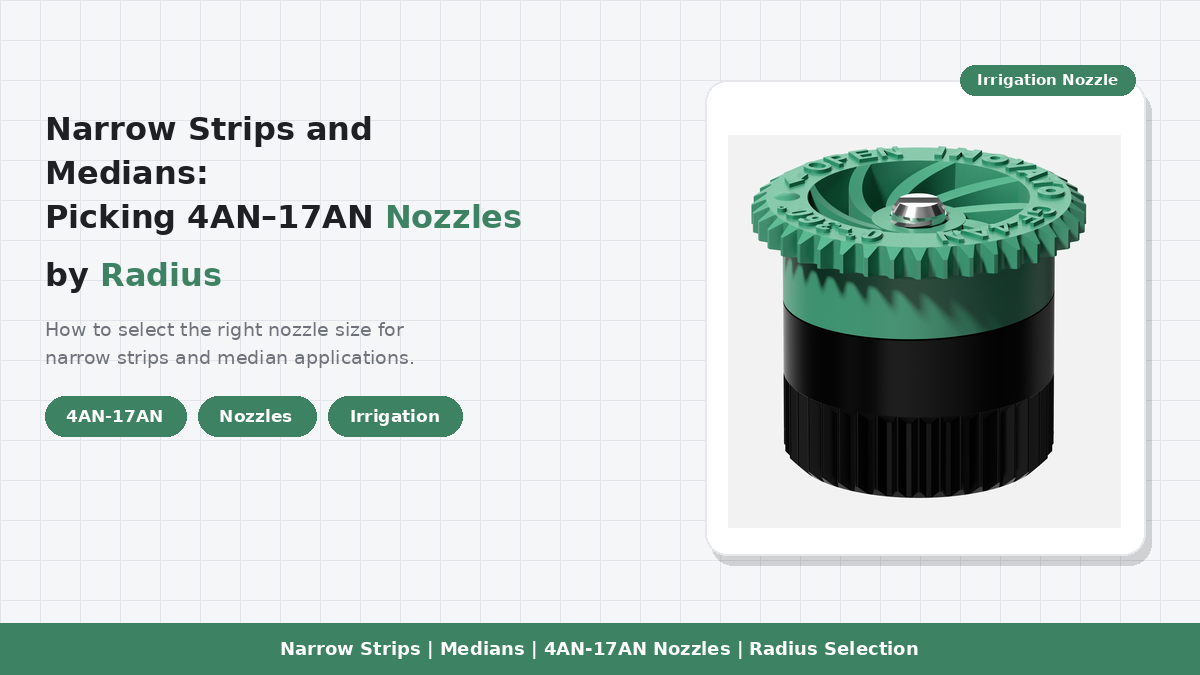
The RF series spans nine distinct models: RF101 through RF304. This is not a marketing gimmick where five near-identical nozzles share different SKU numbers. Each model has a physically different orifice geometry, spray arc radius, and flow rate that maps to a specific garden footprint. Our engineering team designed the lineup so that a contractor can cover every zone type on a standard 600 m² residential lot — narrow side passages, curved garden beds, front lawns, rear entertainment areas — without mixing nozzle brands or compromising coverage uniformity.
Here is the complete model range with flow specifications verified against our ISO 9001:2015-certified in-house testing station:
- RF101: 180° half-circle spray pattern, 1.2–2.8 L/min at 2.0 bar, throw radius 2.5–3.5 m. Designed for narrow garden beds and side returns.
- RF103: 180° half-circle, 2.0–4.5 L/min at 2.0 bar, throw radius 3.0–4.5 m. The most popular model for front-yard lawn zones.
- RF104: 180° half-circle, 3.5–8.0 L/min at 2.0 bar, throw radius 4.0–5.5 m. Handles larger open lawn areas.
- RF201: 360° full-circle, 1.5–3.0 L/min at 2.0 bar, throw radius 2.5–3.5 m. Center-position applications for round garden beds.
- RF203: 360° full-circle, 2.5–5.5 L/min at 2.0 bar, throw radius 3.0–4.5 m. Mid-range full-circle coverage.
- RF204: 360° full-circle, 4.0–9.5 L/min at 2.0 bar, throw radius 4.0–5.5 m. Large-area 360° coverage for open spaces.
- RF301: Variable arc adjustable 0°–360°, 0.8–2.5 L/min at 2.0 bar. The flexible solution for irregularly shaped beds.
- RF303: Variable arc adjustable, 2.0–6.0 L/min at 2.0 bar, suited for mid-sized gardens with curved boundaries.
- RF304: Variable arc adjustable, 4.0–12.0 L/min at 2.0 bar. High-flow option for large residential turf areas.
Each model uses a standardized ½-inch female thread connection compatible with all major sprinkler body brands. A contractor can stock three or four RF models — say RF103, RF104, RF204, and RF301 — and cover 90% of the nozzle positions on a typical 4-zone residential system. This consolidation reduces van inventory and eliminates the confusion of cross-brand compatibility checks on site.
What Flow Uniformity Tolerance Actually Means at the Lawn Level
Flow uniformity is the most under-discussed specification in Sprinkler Nozzle selection, and it is also the one that separates nozzles designed for agricultural pivots from those built for residential landscapes. In a pivot system, a 10% flow variance between nozzles over a 400 m run averages out. On a 12 m × 8 m residential front lawn with four heads, a 10% variance between two adjacent nozzles produces a visible stripe pattern within two weeks — one side overwatered, the other under.
Our 48-piece sampling protocol pulls finished nozzles from production lines at fixed intervals and runs them through calibrated rotameters under regulated 2.0 bar input pressure. If any nozzle in the sample deviates more than ±5% from its nominal flow, the entire batch is quarantined for mold cavity trace-back. This trace-back system — where each nozzle can be identified by cavity number via a subtle marking on the underside of the spray body — allows our quality team to isolate which specific mold cavity in a 16-cavity tool produced the outlier. The cavity is then polished or replaced before the next production cycle.
This level of control requires injection molding discipline that goes beyond simply purchasing a mold from an external tool shop. Our three workshops include an in-house mold maintenance station with EDM equipment, surface grinders, and a coordinate measuring machine (CMM) that verifies cavity dimensions to ±0.02 mm after every 50,000-shot maintenance cycle. The cumulative effect: flow variance stays within specification across production runs separated by six months, so a contractor who bought RF103 nozzles in January and reorders in July gets the same spray performance.
Pressure Variability and Spray Pattern Integrity in Urban Water Networks
Australian municipal water pressure is not constant. Morning peak demand in a suburb like Campbelltown or Geelong can drop static pressure from 4.0 bar to 2.2 bar. Afternoon recovery pushes it back up. A nozzle that produces a clean, symmetrical fan at 3.5 bar but breaks into large droplets at 2.0 bar creates coverage gaps that become dead spots on the lawn.
The RF series orifice geometry addresses this through a two-stage flow path. Incoming water first passes through a turbulence-damping chamber — a small cylindrical cavity before the exit orifice — that normalizes flow direction regardless of upstream pipe bends or pressure transients. Water then exits through a precision-molded slot whose width-to-depth ratio was optimized across three design iterations based on feedback from a Southeast Asian water utility that runs 1.2 bar static pressure in some service areas. The result: RF nozzles maintain a recognizable spray fan shape from 1.0 bar up to 4.8 bar, the practical operating range for most residential systems.
This matters in practice because many Australian homes built before 2005 have 20 mm or 25 mm galvanized steel supply lines with internal scaling. A brand-new meter might read 4.5 bar static, but dynamic pressure at the farthest sprinkler head after pipe friction losses can be as low as 1.8 bar. Nozzles that need 2.5 bar minimum to form a proper spray pattern will fail on that zone. RF series nozzles — particularly the variable-arc RF301 and RF303 — remain functional at the lower end because the spring-loaded adjustment ring does not rely on high-pressure seating to hold its arc setting.
The American Society of Landscape Architects has documented how irrigation system design — including nozzle selection — directly impacts landscape sustainability outcomes. The same principles apply in Australian residential contexts, where water restrictions during El Niño cycles make every litre count toward both plant health and compliance.
Bore Water and Mineral Tolerance: What 4 Years of Field Returns Have Shown
A significant portion of Australian residential irrigation runs on bore water rather than municipal supply — particularly in Perth, parts of Adelaide, and regional Queensland. Bore water typically carries total dissolved solids (TDS) between 400 and 1,200 mg/L, with calcium carbonate and iron oxide as the primary precipitates. These minerals plate onto nozzle surfaces, constrict orifices, and eventually cause spray pattern distortion or complete blockage.
We analyzed nozzle returns from Australian clients over a four-year period (2022–2025) and found two clear patterns. First, nozzles with orifice diameters below 0.6 mm accounted for 68% of all clogging failures where water quality was cited as the root cause. Second, POM (polyoxymethylene) thermoplastic bodies showed measurably less mineral adhesion than glass-filled nylon alternatives — an average of 31% less calcium carbonate buildup by mass after 12 months of continuous bore water exposure, based on controlled soak tests in our lab using water samples from three Australian bore sites.
The RF series was designed with these findings in mind. The minimum orifice diameter across all nine models is 0.8 mm (RF301 at its minimum arc setting), and the body material is UV-stabilized POM copolymer. The material choice is not accidental — our earlier valve material research, published in our acidic environment valve material selection study, established that POM resists chemical degradation and surface pitting better than commodity-grade ABS in water chemistries containing dissolved minerals and residual fertilizers.
In practical terms, contractors installing RF nozzles on bore-fed systems report cleaning intervals of 6–8 months rather than the 2–3 months common with smaller-orifice alternatives. This halves the maintenance visits per site per year, which directly improves contract profitability on maintenance-inclusive residential agreements.
Inventory Availability and Lead Time for the Australian Market
Nothing disrupts a residential landscaping schedule more than a 4-week nozzle backorder when the client's turf is going in next Tuesday. Australian contractors have learned this lesson repeatedly with European and North American nozzle brands that maintain regional distribution centers in Sydney or Melbourne but carry limited safety stock of specific models.
Our Ningbo facility operates differently. We maintain a rolling safety stock of 500,000+ pieces across the RF series. Standard production lead time is 25–30 days for orders above the 1,000-piece MOQ per model, but stock orders of up to 5,000 pieces ship within 7–10 business days because the buffer inventory already exists. For larger project quantities — common when an Australian landscaping firm secures a multi-stage residential estate contract covering 80–200 lots — we can allocate dedicated production capacity with 20-day turnaround.
The production infrastructure behind this capacity includes 12 injection molding machines ranging from 120 to 350 tonnes of clamping force, a 6-station automated assembly line for nozzle-body integration, and on-site packaging that handles retail-ready blister packs or bulk contractor boxes depending on the client's distribution model. Our 1,000+ active global clients include distributors and contractors across 50+ countries, and the Australian market represents a growing segment where stock reliability has become the primary differentiator.
The Irrigation Australia member network includes certified irrigation designers and installers who increasingly specify nozzle performance requirements in tender documents. When a tender specifies flow uniformity tolerance and material durability standards, having a manufacturer that publishes those numbers rather than hiding behind generic marketing language makes the specification process faster and more defensible.
UV Stability and Mechanical Longevity Under Australian Sun Conditions
Australian sunlight is aggressive. A nozzle sitting 100 mm above grade on a pop-up sprinkler body absorbs direct UV-A and UV-B radiation for 6–10 hours per day across 300+ cloudless days per year in most capitals. Cheap ABS nozzles chalk, crack, and lose thread integrity within 18–24 months under these conditions. POM copolymer with properly formulated UV stabilizers — the material used across the RF series — extends functional life to 5+ years under equivalent exposure.
We validate this through accelerated weathering tests using a QUV chamber running ASTM G154 Cycle 1 (UVA-340 lamps, 8 hours UV at 60°C, 4 hours condensation at 50°C). RF series nozzle bodies are subjected to 2,000 hours of accelerated exposure — equivalent to approximately 5 years of Melbourne outdoor conditions based on total UV radiant exposure correlation. Post-exposure testing measures color shift (ΔE), tensile strength retention, and thread torque-to-failure. Pass criteria are: ΔE ≤ 5, tensile retention ≥ 85%, and thread torque-to-failure ≥ 90% of unexposed baseline.
The stainless steel flow adjustment screw on variable-arc models (RF301, RF303, RF304) uses 304-grade stainless with a silicone O-ring seal, eliminating the galvanic corrosion risk that occurs when brass adjustment screws sit in plastic bodies exposed to bore water electrolytes. This detail alone has reduced warranty claims related to seized adjustment mechanisms by roughly 40% since the switch from brass to stainless in 2023, based on our internal warranty tracking database.
Total Cost Perspective: Why Cheap Nozzles Cost More Over a 3-Year Contract
A procurement decision based solely on per-unit nozzle price ignores the dominant cost driver in residential irrigation maintenance: labor. An Australian landscape maintenance technician costs the contractor AUD 38–55 per hour fully loaded. A 30-minute site visit to replace a failed nozzle costs AUD 19–28 in labor alone, plus travel, plus the replacement part. Do that three times across a 50-site portfolio and the "savings" from buying AUD 0.80 nozzles instead of AUD 1.40 nozzles evaporate entirely.
Here is a simplified 3-year comparison for a contractor managing 40 residential sites with an average of 16 nozzles per site (640 nozzles total):
- Economy nozzle option: AUD 0.85/unit × 640 = AUD 544. Estimated 12% annual failure rate (bore water/hard water conditions) = 77 replacements/year × 3 years = 231 extra nozzles + ~58 labor hours. Total 3-year cost: approximately AUD 3,340.
- RF series option: AUD 1.40/unit × 640 = AUD 896. Estimated 3% annual failure rate under same conditions = 19 replacements/year × 3 years = 58 extra nozzles + ~15 labor hours. Total 3-year cost: approximately AUD 1,610.
The gap widens in bore water regions, where economy nozzle failure rates often exceed 20% annually and thread-stripping on cheap ABS bodies creates an additional replacement trigger that POM-bodied RF nozzles simply do not experience. This calculation does not include the harder-to-quantify cost of client dissatisfaction — a homeowner who sees brown patches and calls the contractor's office three times in one season is a homeowner who does not renew the maintenance contract.
Our full nozzle range includes the FN series for lower-pressure drip applications, but the RF series remains the recommended option for spray-head residential installations where flow uniformity, UV endurance, and mineral tolerance directly affect maintenance economics.
Getting Started with RF Series Nozzles for Your Next Residential Project
If you are an Australian landscape contractor, irrigation installer, or wholesale distributor evaluating nozzle suppliers for residential projects, we make the sampling and trial process straightforward. Request a complimentary sample pack covering the four most-used RF models (RF103, RF104, RF204, RF301) and test them on an active installation. Compare spray pattern uniformity, thread engagement feel, and flow consistency against your current supplier's equivalent models.
Our Ningbo-based production team can ship sample quantities via DHL or FedEx with 5–7 day delivery to Australian metro addresses. Bulk container shipments to Brisbane, Sydney, Melbourne, or Fremantle ports follow standard 18–22 day sea freight schedules. For contractors supplying multi-site residential estate developments, we offer consolidated pallet shipments with factory-direct pricing that eliminates distributor markup.
Visit our RF nozzles product page for full specifications and technical data sheets, or browse our complete product catalog to see how RF nozzles integrate with our gear-drive sprinklers, solenoid valves, and dripline systems. Contact our sales team through the inquiry form to request pricing, lead time estimates, or a tailored sample kit for your specific project requirements.