

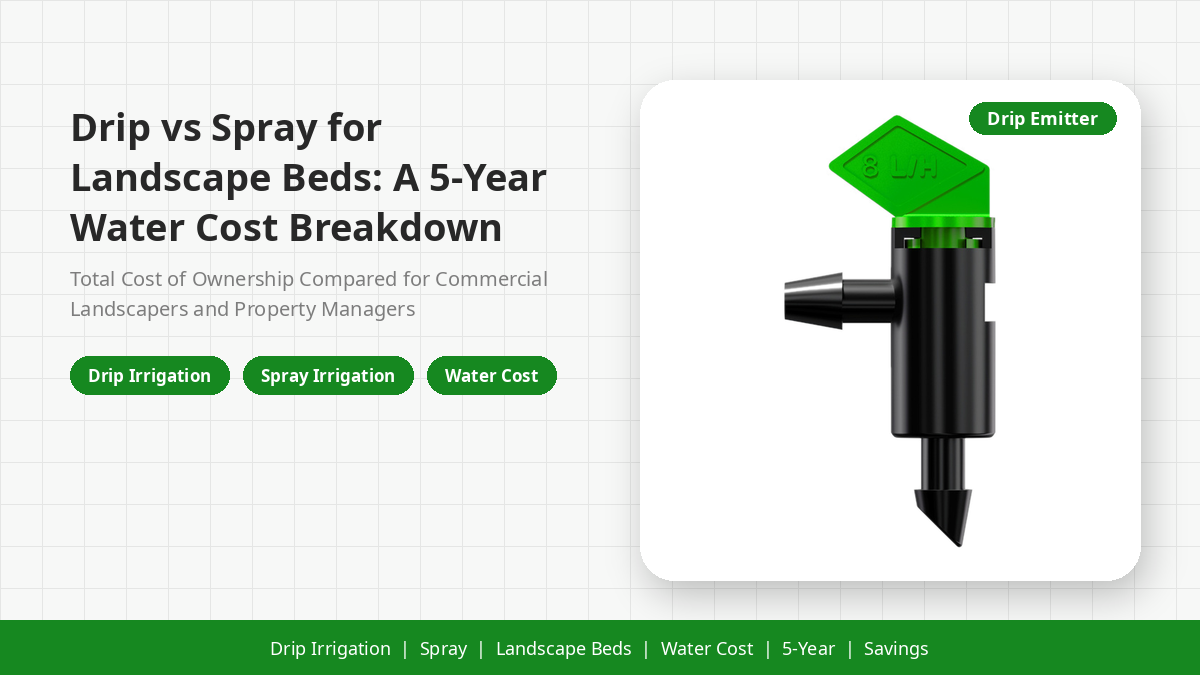
A 24-story business hotel replaces dying parlor palms in the lobby every six weeks. The cause is almost never the plants or the light. It is the irrigation. Most commercial container installations inherit a residential drip system designed for row crops, and that mismatch is what kills the plants, overflows the saucers, and stains the marble.
A container plant drip layout is a different engineering problem. Each pot is its own watershed: the emitter sits at its plant, the root ball occupies a defined volume, and runoff either disappears into a saucer or seeps onto flooring. Because containers are isolated and their soil volumes are small, the irrigation architecture must be one-to-one — one emitter per pot, with each dripper sized to the pot's water-holding capacity and the ambient humidity of the space.
This guide walks through how hotels, malls, and offices lay out drip systems for container plants using flag drippers like the OFD-04, and how to plan zone count.
TL;DR — Key Takeaways
- One emitter per pot, sized to pot diameter — 1 GPH for 6 to 8 inch pots, two emitters for 10 to 14 inch pots, three to four emitters for 18 to 24 inch pots.
- Pressure-regulated at 25 PSI with a 150 mesh filter — the OFD-04's published operating range is 10 to 24 PSI; because every emitter is non-pressure-compensating, regulating manifold pressure to 25 PSI and adding a 150 mesh filter is what gives uniform output across an entire zone.
- One 1/2 inch poly mainline can carry up to 124 OFD-04 emitters at 1 foot spacing (or 96 at 2 foot, 83 at 3 foot, 76 at 4 foot) at 25 PSI on level ground with about 90 percent flow uniformity.
- Plan 3 to 4 zones per property to separate lobby pots, atrium trees, food-court greenery, and back-of-house plantings so maintenance can isolate irrigation without shutting down guest-facing areas.
Why Container Irrigation Differs From Row-Crop Drip
Container plants are small, isolated reservoirs of soil with a defined water-holding capacity, surrounded by an air gap and a saucer or floor drain. A row-crop drip system waters a continuous bed of soil whose lateral capillary spread evens out small differences in emitter discharge. In a container, every drop has to land exactly where the root zone is.
Three things change in practice. Emitter spacing is dictated by pot diameter, not row spacing. Drainage matters more than infiltration — over-watering shows up as a saucer overflow, not a wet patch in a field. Filtration is non-negotiable, because the small orifices of point-source emitters clog faster than the larger outlets of pressure-compensating dripline. Per EPA WaterSense, emitter clogging is the most common failure mode for landscape drip systems.
For properties that also maintain outdoor row-crop beds or ornamental greenhouses, the layout for those zones follows different rules. The dripline layout guide for row crops and greenhouses covers those zones in depth.
It also changes the architecture. Agricultural systems tend toward long, parallel laterals with hundreds of emitters per run. Container layouts are short, branched, and densely cross-connected: a lobby may have 80 containers fed by four or five manifolds because the architecture is constrained by the room. That is why we reach for a point-source emitter like the OFD-04 rather than a continuous dripline.
What Makes the Flag Dripper the Right Emitter for Container Plants?
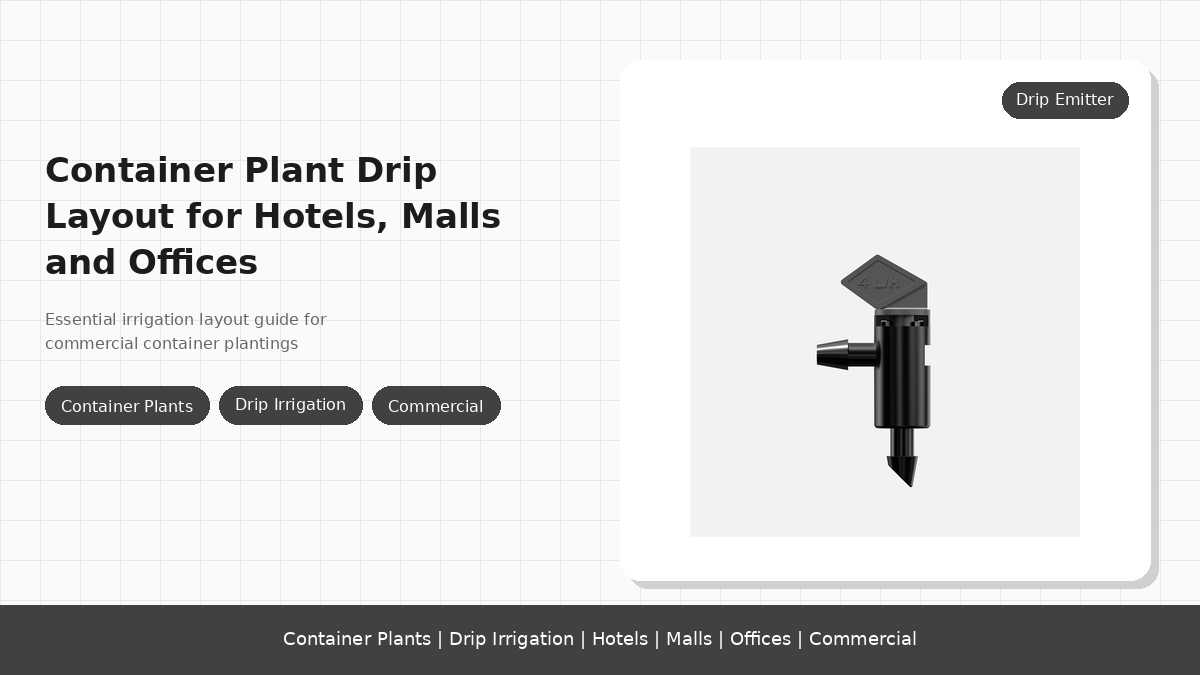
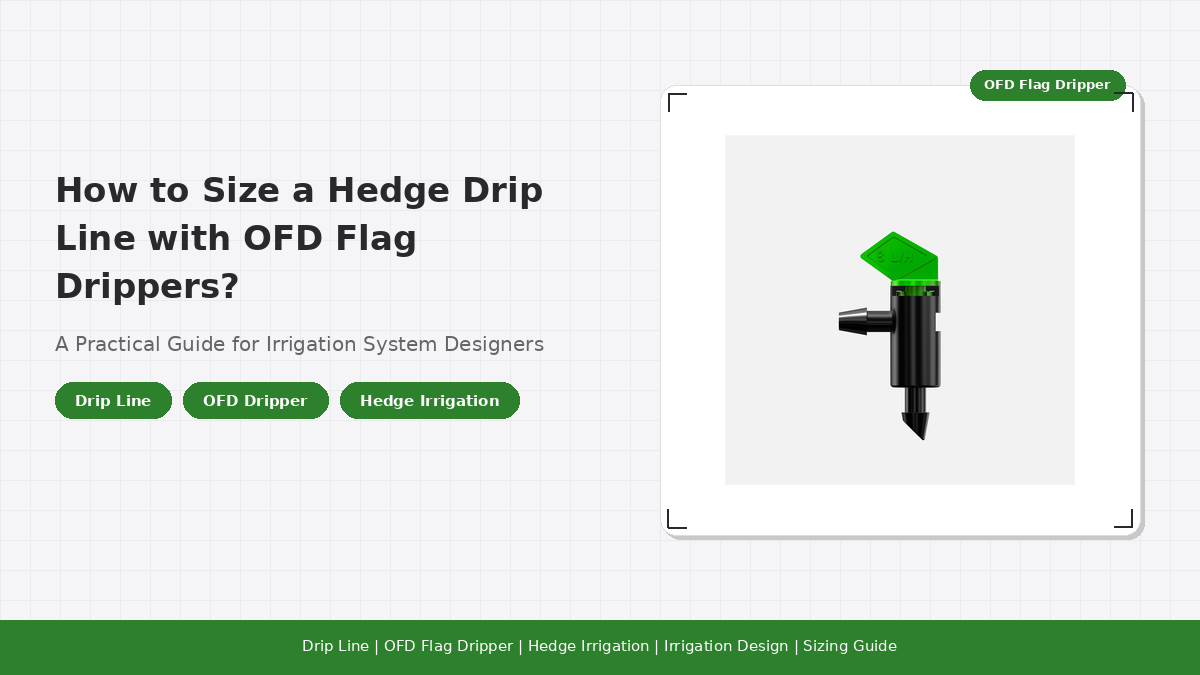
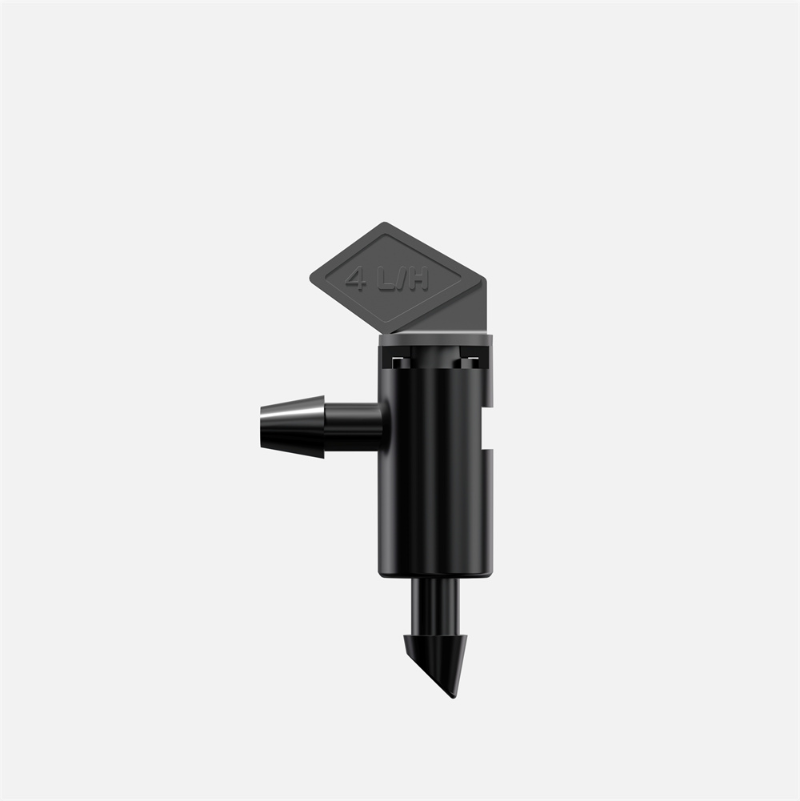
A flag dripper is a point-source emitter whose inlet barb inserts directly into a 1/2 inch polyethylene tubing without tools. The "flag" name comes from the small fin-shaped deflector that breaks the incoming stream into a low-velocity, low-splash pattern at the plant — so the water lands inside the root ball rather than ricocheting off the soil surface.
Three mechanical features decide whether a flag dripper survives in a commercial interior.
- Self-tapping barb inlet. The OFD-04's 1/4 inch barb punches straight into 1/2 inch poly tubing with hand pressure. Because pot count in a hotel or office is high and labor is the dominant cost, the time saved per emitter adds up to a meaningful share of the project budget.
- Twist-open top with locking cap. The OFD-04 cover unclips for in-line cleaning without removing the emitter body from the tubing. That serviceability is the difference between a 30 minute flush and a full emitter replacement.
- UV-resistant polypropylene body and cover. Polypropylene keeps its dimensional stability under the high-irradiance LED arrays that increasingly light interior atriums. A dripper that softens or warps under atrium light will leak at the barb interface within a season.
For container plants specifically, what matters is the point-source nature of the discharge. A dripper that throws water in a 360 degree pattern is wasted on a single plant. A point-source emitter delivers water where the roots actually are.
How OFD-04 Performs in a Single-Container Drip Loop
The OFD-04 is specified for 10 to 24 PSI operation with a recommended manifold pressure of 25 PSI, a 1 GPH nominal flow rate, and a minimum filtration of 150 mesh. Those four numbers are the only ones a procurement specification actually needs.
| Color | 5 PSI | 10 PSI | 15 PSI | 20 PSI | 25 PSI | 30 PSI |
|---|---|---|---|---|---|---|
| Black (1 GPH nominal) | 0.50 | 0.79 | 1.00 | 1.22 | 1.39 | 1.55 |
The flow rate climbs with manifold pressure because the OFD-04 is a non-pressure-compensating emitter — at 5 PSI it delivers 0.5 GPH, at 25 PSI it delivers 1.39 GPH, and at 30 PSI it has reached 1.55 GPH. Because the discharge changes with pressure, a regulator on the zone manifold is what keeps all emitters in a long run within about 5 percent of each other.
Filter and Material Compatibility
The OFD-04 manufacturer specification calls for filtration no coarser than 150 mesh. Because the OFD-04's labyrinth has a flow path on the order of a millimeter, anything larger than 150 mesh lets debris through and the emitter starts clogging within a few weeks. A 200 mesh disc filter is safer for municipal water with seasonal sediment events, per the ASABE micro-irrigation practice.
The body and cover are polypropylene, chemically compatible with municipal chlorine and the dilute fertilizer solutions used in fertigation, and UV-stabilized for atrium installations under high-output LED arrays.
The Container Layout Formula: How Many Pots per Zone?
A zone is a group of containers fed by a single solenoid valve, and its maximum size is set by the flow budget, not by the number of pots. The formula: emitter count per pot × GPH per emitter × number of pots = zone flow in GPH; divide by 60 for GPM; multiply by 1.2 for the design margin.
For 60 pots, each with one OFD-04 at 1 GPH nominal, the math is 60 × 1.0 = 60 GPH = 1.0 GPM, with a 1.2 GPM design capacity — a small zone. Because a 1 inch solenoid valve and 3/4 inch class PVC supply line carries more than 15 GPM, the bottleneck is not the hardware but the ability to walk the zone and isolate a clogged emitter without shutting down the lobby.
Per-Pot Emitter Counts by Pot Diameter
| Pot diameter | Typical species | Emitter count | Spacing pattern | Nominal GPH per pot |
|---|---|---|---|---|
| 6 to 8 in (15 to 20 cm) | Aglaonema, Pothos, small foliage | 1 | Single emitter at root crown | 1.0 |
| 10 to 14 in (25 to 36 cm) | Dracaena, Spathiphyllum, parlor palms | 2 | 180° apart, 2 in from stem | 2.0 |
| 18 to 24 in (46 to 61 cm) | Ficus, large palms, multi-stem shrubs | 3 to 4 | Triangular or square pattern | 3.0 to 4.0 |
| Over 24 in (over 61 cm), planters | Atrium trees, large planters | 6 to 12 or 1/4 in dripline ring | Ring around root ball at 8 in spacing | 6.0 to 12.0 |
These emitter counts are floor values, not ceilings. In high light or atrium heat, you may need to double them; in shaded interior corridors with stable HVAC, you can sometimes drop a count. The job of the layout engineer is to match emitter count to species, light, and airflow. The UF/IFAS Extension container plant guide is the most thorough public reference for species-specific water demand.
Maximum Run Length per 1/2 Inch Tubing at 25 PSI
Because every additional emitter on a 1/2 inch poly tubing run adds friction loss, the maximum run length on level ground is set by the emitter spacing. The OFD-04 manufacturer publishes the following envelope at 25 PSI on 1/2 inch tubing with 0.600 inch ID, 90 percent flow uniformity, and 0 percent slope:
| Emitter spacing | Max emitters | Max run length | GPM | GPH | Velocity | Head loss |
|---|---|---|---|---|---|---|
| 1 ft (30 cm) | 124 | 124 ft | 2.87 | 172.4 | 3.26 ft/s | 5.50 PSI |
| 2 ft (60 cm) | 96 | 192 ft | 2.22 | 133.4 | 2.52 ft/s | 5.19 PSI |
| 3 ft (90 cm) | 83 | 249 ft | 1.92 | 115.4 | 2.18 ft/s | 5.05 PSI |
| 4 ft (122 cm) | 76 | 304 ft | 1.76 | 105.6 | 2.00 ft/s | 5.23 PSI |
For a container plant layout, you almost never run a single 1/2 inch line for 300 feet, because that would mean dragging a single tube through a hotel lobby. This table is the upper bound on a sub-run from a zone manifold to a row of pots — typically 12 to 40 feet in a container installation. At 2 foot emitter spacing, 20 to 40 emitters fit on a sub-run, enough for most planters along a wall or a window line.
Hotels: Lobby Pots, Atrium Planters, and Rooftop Greenery
Hotel interior irrigation typically divides into three zones.
Lobby pots are the highest-visibility containers, usually 10 to 14 inch ceramic or fiberglass pots on marble or terrazzo floors. Run a 1/2 inch poly mainline along the back of the planter line and branch 1/4 inch tubing to each pot, with the dripper at the back rim. Because lobby floors cannot tolerate standing water, every pot must have a saucer of adequate volume. Two OFD-04 emitters at 1 GPH, run for 8 to 12 minutes per cycle, will saturate the root ball without overflowing.
Atrium planters (24 to 48 inch diameter) hold the trees and large shrubs that anchor the lobby. Use a 1/4 inch dripline ring with 6 to 12 OFD-04 drippers. Because atrium trees are top-heavy and expensive to replace, dripper locations should sit over the supporting root flare.
Rooftop and terrace plantings use the same emitters but a different hydraulic regime: every foot of elevation above the zone valve costs about 0.43 PSI, so a 25 story hotel can lose more than 10 PSI between the booster pump and the rooftop manifold. The regulator ahead of the rooftop zone must be sized for the worst-case elevation, not the average. For outdoor terraces on potable supply, add a backflow preventer per the ASSE plumbing series.
Malls: Atrium Trees, Food Court Planters, and Center Court Beds
Malls add two complications hotels usually do not have: large skylit atriums and food court planters exposed to cooking vapors.
Skylit atriums usually hold one or two statement trees in planters up to 10 feet in diameter. The drip layout is a 1/4 inch dripline ring with 8 to 16 OFD-04 emitters at 8 to 12 inch spacing, fed from a 1/2 inch mainline in the ceiling soffit. The ceiling mainline must be accessible — through a removable ceiling panel or an access door at each branch — because leaks are catastrophic in a finished mall interior. Because the polished floors below cannot tolerate runoff, set the dripper count so the zone can run 20 to 30 minutes during off-peak hours without producing visible overflow.
Food court planters are exposed to grease aerosols, sugar vapors, and higher temperatures during lunch rush. The layout follows the hotel lobby pattern, but the filter service interval must be shortened. Because the food court air loads the system with organic film, monthly filter service is a more realistic cadence than quarterly.
Center court display beds usually combine container specimens with a permanent landscape bed, and the transition is where most installations fail. The drip layout handles both — flag drippers for the containers and inline dripline for the bed — fed from the same zone.
Offices: Reception Plants, Floor Planters, and Partition Greenery
Office irrigation has lower per-container water demand than hotel or mall installations, because HVAC humidity is more stable. The layout is simpler, but over-watering is the more common failure mode.
Reception plants are typically 12 to 18 inch containers with a single specimen. One OFD-04 at 1 GPH, run for 6 to 10 minutes per cycle, is enough for a 12 inch pot. The dripper must land at the root crown, not on decorative mulch or stone top dressing.
Floor planters along corridors and windows are the bulk of the office installation. The pattern is a 1/2 inch mainline in the ceiling tile grid that drops at each planter column and feeds a 1/4 inch supply line with a single OFD-04 per pot. Because ceiling tile routes are out of reach, the system should be designed so no leak can drip onto a workstation below. Use barbed fittings with crimp rings rather than compression fittings.
Partition greenery — moveable planters that double as visual dividers in open offices — is the most layout-challenging application. The practical approach is a quick-connect coupler at each partition planter, fed by a stub-out from the nearest 1/2 inch mainline.
Hiding the Tubing: Aesthetic Routing for Finished Interiors
The tubing has to be invisible from guest and tenant sight lines. The standard patterns.
- Behind the planter line. Run the 1/2 inch mainline along the back of the planter row, 4 to 6 inches behind the rim, and cover it with a 2 inch strip of decorative mulch or stone.
- Inside ceiling soffits and tile grids. Drop the 1/2 inch mainline from a ceiling-mounted manifold; stub-outs come down through conduit in column corners or behind furniture panels.
- Inside planter walls. For built-in planters, run the mainline through the planter wall cavity and exit into the soil through a grommet at the soil line.
- Under raised access flooring. In office applications, run the mainline under the access floor and bring up the 1/4 inch feeders through floor grommets in the planter base.
The goal is that a guest walking through the lobby sees plants, not irrigation hardware. Because most guests do not notice well-hidden irrigation, the failure mode we worry about is the opposite — guests who notice poorly hidden irrigation will notice every flaw in the system.
Maintenance Cadence, Filter Service, and Winterization
The realistic cadence for a container drip system:
| Interval | Task | Notes |
|---|---|---|
| Weekly | Visual walk-through of each zone | Confirm drippers discharge into the root ball; no dry pots, no overflowing saucers |
| Monthly | Filter service and pressure check | Clean or replace the 150 mesh filter; confirm manifold pressure at 25 PSI |
| Quarterly | Flush the 1/2 inch mainline | Open the end cap and run each zone for 60 seconds |
| Annually | Inspect barb fittings and replace UV-damaged drippers | Replace any cracked or warped drippers; re-crimp any loose barbed fittings |
For rooftop and cold-climate installations, winterization is the additional concern. Because frozen water in a 1/2 inch poly line will split the tubing at every barb, the system must be blown out with compressed air at no more than 40 PSI before the first hard freeze. For tropical and indoor installations, no winterization is needed, but the filter service interval should be shortened when HVAC humidity is high.
One operational pattern that matters across all climate zones: label every valve with the zone number and pot count. A laminated as-built drawing filed in the engineering office is the cheapest insurance a property can buy.
Need help sizing a container drip layout for your property?
We work with hotel, mall and office landscaping teams on emitter selection, zone sizing, and mainline routing for container installations. Tell us the number of pots, the property type, and your water source — we will send back a layout sketch and emitter spec within 48 hours.
Frequently Asked Questions
1. How many flag drippers do I need per container plant?
One OFD-04 per 6 to 8 inch pot, two per 10 to 14 inch pot, three to four per 18 to 24 inch pot, and six to twelve (or a 1/4 inch dripline ring) for larger planters and trees. Match the count to the species, the light, and the airflow.
2. What pressure should I set for OFD-04 flag drippers?
25 PSI at the zone manifold is the published recommended operating pressure for the OFD-04.
3. How do I hide drip lines in a finished hotel lobby or mall?
Route the 1/2 inch mainline behind the planter row, in a ceiling soffit, or inside the planter wall cavity, and branch to each pot with 1/4 inch distribution tubing that lands at the root crown. Because most guests do not see well-routed drip lines, the visible target for a poorly designed installation is the opposite — they see every flaw.
4. How often should I service the filter on a container drip system?
Monthly is a reasonable baseline for municipal water; food court installations and any property on well water should shorten the interval to every two to three weeks.
5. Do flag drippers need a pressure regulator?
Yes, because OFD-04 is a non-pressure-compensating emitter, the zone manifold pressure must be regulated to 25 PSI to keep flow uniform across the entire zone.
6. What is the maximum number of OFD-04 emitters on a single 1/2 inch line?
On level ground at 25 PSI with 90 percent flow uniformity, the manufacturer publishes 124 emitters at 1 foot spacing, 96 at 2 foot, 83 at 3 foot, and 76 at 4 foot. In a container installation, 2 foot spacing on a 40 foot sub-run supports 20 emitters.
Article topic cluster: Drip irrigation design · Container plants · Commercial interiors. References include EPA WaterSense program guidance, ASABE micro-irrigation standards, ASSE plumbing backflow standards, ASTM material standards, UF/IFAS extension publications, and USDA plant database. Last verified: 2026-09-22.