


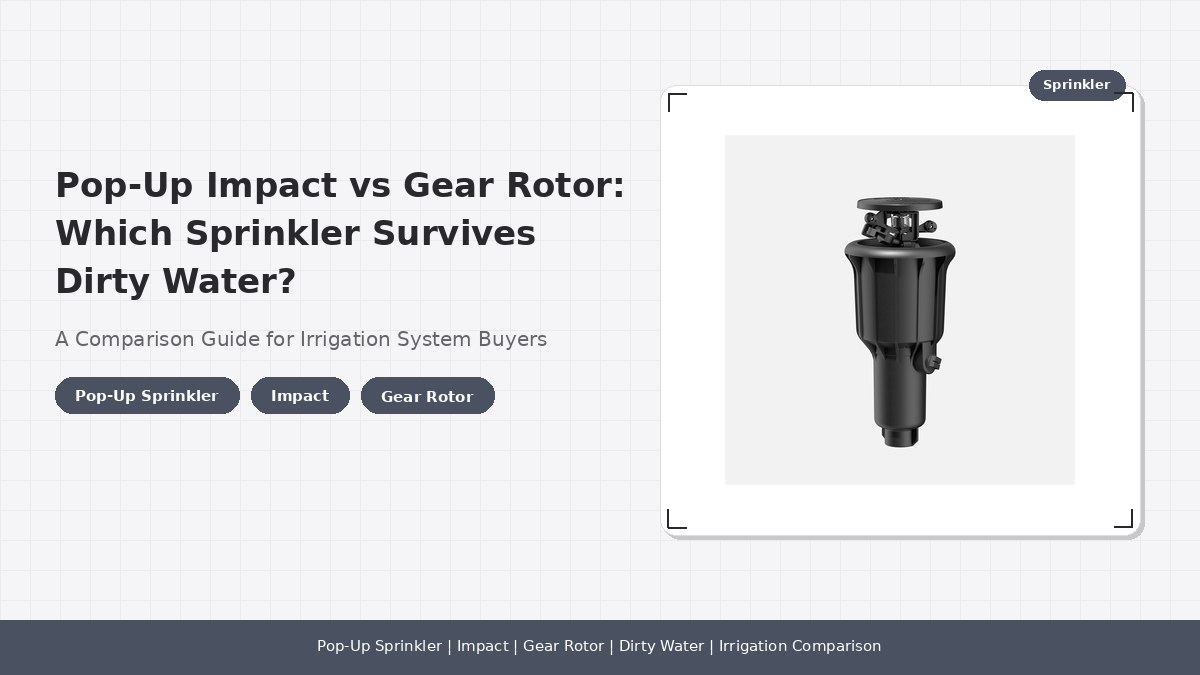
For commercial landscape crews running campus, sports complex, municipal park, or hotel grounds, the difference between a 5-year and a 15-year irrigation system is not the original equipment — it is the irrigation preventive maintenance plan. The data behind that statement comes from INOVATO's internal quick-coupler installation and maintenance-cycle study: quick couplers install in 5–8 seconds per connection versus 45–120 seconds for threaded connections, with negligible pressure loss (~0.03–0.05 bar per coupler at 800 L/h), and a multi-decade cumulative labor advantage on the per-event maintenance cycle. Below is the annual maintenance calendar built from that data — the O-ring replacement cycles, sprinkler head inspection schedules, and seasonal tasks that commercial landscape crews run on the INOVATO equipment range, including the sprinklers & accessories line and the SF06 pop-up spray body.
Annual Maintenance Calendar: 12-Month Cycle for Commercial Landscape Crews
The annual maintenance calendar below is calibrated to the equipment platform documented in INOVATO's quick-coupler maintenance-cycle study and applies to any commercial property with 100+ irrigation connection points. Each month has a primary task and a secondary task; the secondary task can be deferred one month without breaking the calendar, the primary task cannot.
| Month | Primary task | Secondary task |
|---|---|---|
| January | Winter review — system pressure test and leak audit | Order spring-start replacement parts |
| February | Pre-spring prep — order O-ring kits, nozzles, valve diaphragms | Calibrate controllers |
| March | Spring commissioning — pressurize main, inspect zone by zone | Replace any cracked sprinkler risers |
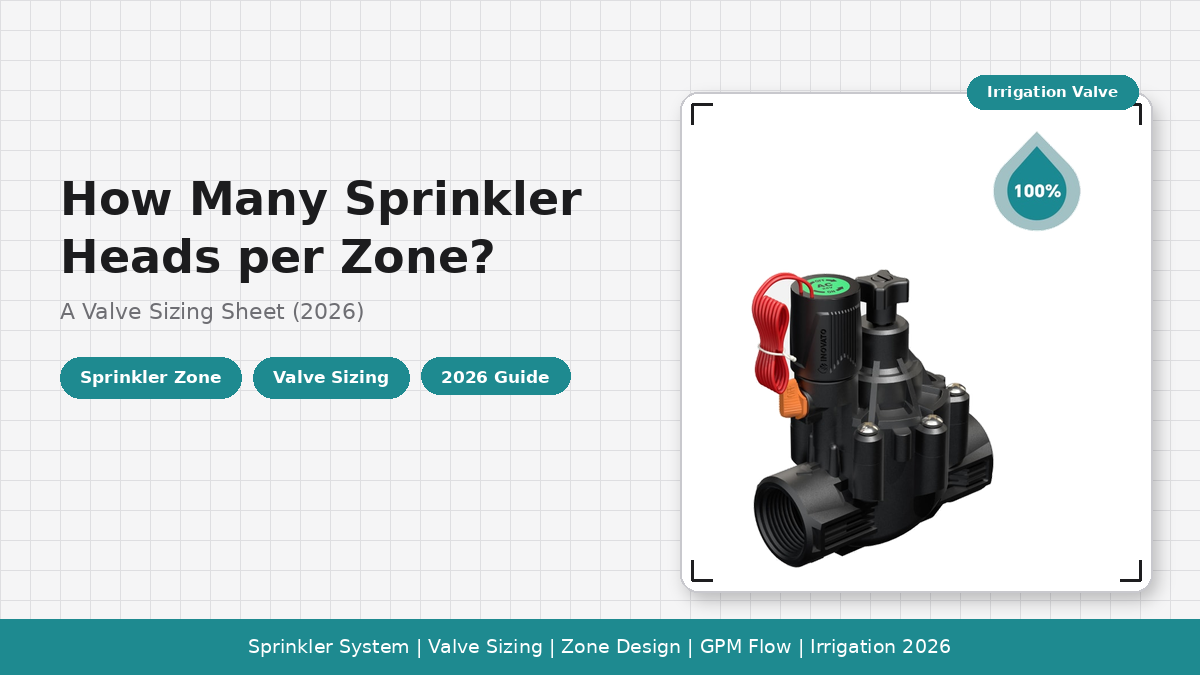
| April | Sprinkler head adjustment — coverage check, arc alignment | Check valve box drainage |
| May | Mid-season visual inspection — pop-up retraction, nozzle clogging | Test quick-coupler O-rings on first-month connections |
| June | High-demand seasonal — first round of O-ring inspection on hot-use circuits | Check valve solenoid operation |
| July | Peak-season weekly inspection — high-frequency connection cycles | Verify pressure at zone valves |
| August | Mid-peak inspection — replace any failed quick-coupler O-rings | Flush drip manifolds |
| September | Pre-fall — rotate quarter-turn ball valves to exercise seals | Begin spring commissioning inventory for next year |
| October | Fall wind-down — reduce irrigation duration, increase interval | Inspect pressure regulators |
| November | Winterization prep — drain or blow out lateral lines | Replace any final O-rings before winter dormancy |
| December | Winter shutdown — depressurize system, disconnect quick couplers where stored indoors | Review the year's maintenance log |
The calendar assumes a temperate climate with a spring startup in March and a winter shutdown in November. For warmer climates (subtropical, Mediterranean, tropical) the winterization block is replaced by a reduced-frequency inspection block; for colder climates (continental, subarctic) the November winterization block becomes a critical-path blowout-and-drain task that cannot be deferred.
Quick Coupler O-Ring Inspection Cycle: 2-Week Check, 3-6 Month Replace
The O-ring is the wear component in the INOVATO quick coupler system. The internal data behind the inspection cycle comes from the maintenance-cycle study referenced above: in standard commercial landscape service, an NBR O-ring reaches end-of-service life at roughly 3–6 months of operation depending on connection frequency, water chemistry, and exposure to petroleum-based products.
Inspection schedule by usage profile
For commercial landscape crews, the O-ring inspection cycle varies by usage profile. The three profiles INOVATO has measured in the maintenance-cycle study are:
- Low-frequency use (residential-style campus, commercial property with seasonal irrigation): inspect every 3 months, replace every 6 months.
- Medium-frequency use (municipal park, hotel grounds, weekly-scheduled maintenance): inspect every 4–6 weeks, replace every 4–6 months.
- High-frequency commercial use (sports complex, daily-scheduled landscape irrigation, golf course): inspect every 2 weeks, replace every 3–6 months.
Replacement trigger signs
The inspection step itself is straightforward: disconnect the coupler, visually inspect the O-ring, look for the three replacement triggers documented in the maintenance-cycle study:
- Visible cracking on the O-ring surface (typically radial cracks perpendicular to the ring circumference).
- Flattening of the cross-section from compression set — the O-ring no longer returns to its round profile when unloaded.
- Leakage above 0.3 bar at the connection under operating pressure — indicates the O-ring has lost its seal even if the visual inspection is inconclusive.
Replacement procedure takes 30 seconds per coupling and requires no tools. The O-ring itself is a low-cost consumable; INOVATO's recommended spare inventory is 10% of the installed coupler count — for a property with 200 quick coupler connection points, keep 20 spare O-rings on hand (one O-ring kit covers most sizes). O-ring kits (assorted sizes, 50 rings per kit) are available from INOVATO.
NBR material compatibility
The standard INOVATO quick coupler O-ring material is NBR (nitrile butadiene rubber). NBR offers good resistance to mineral oils, petroleum-based products, and standard water chemistry, with a temperature range of -5 °C to +120 °C continuous. NBR is not recommended for phosphate-ester pesticides or strong oxidizing agents — for those water chemistries, the maintenance-cycle study documents EPDM and FKM as alternative materials with their own replacement cycles (typically 50–70% longer than NBR but at higher unit cost).
Sprinkler Head Maintenance: Annual and Quarterly Tasks by Component
The sprinklers & accessories line in commercial landscape irrigation has three maintenance tiers per component, with the cycle interval set by the maintenance-cycle study at INOVATO. The component tiers are:
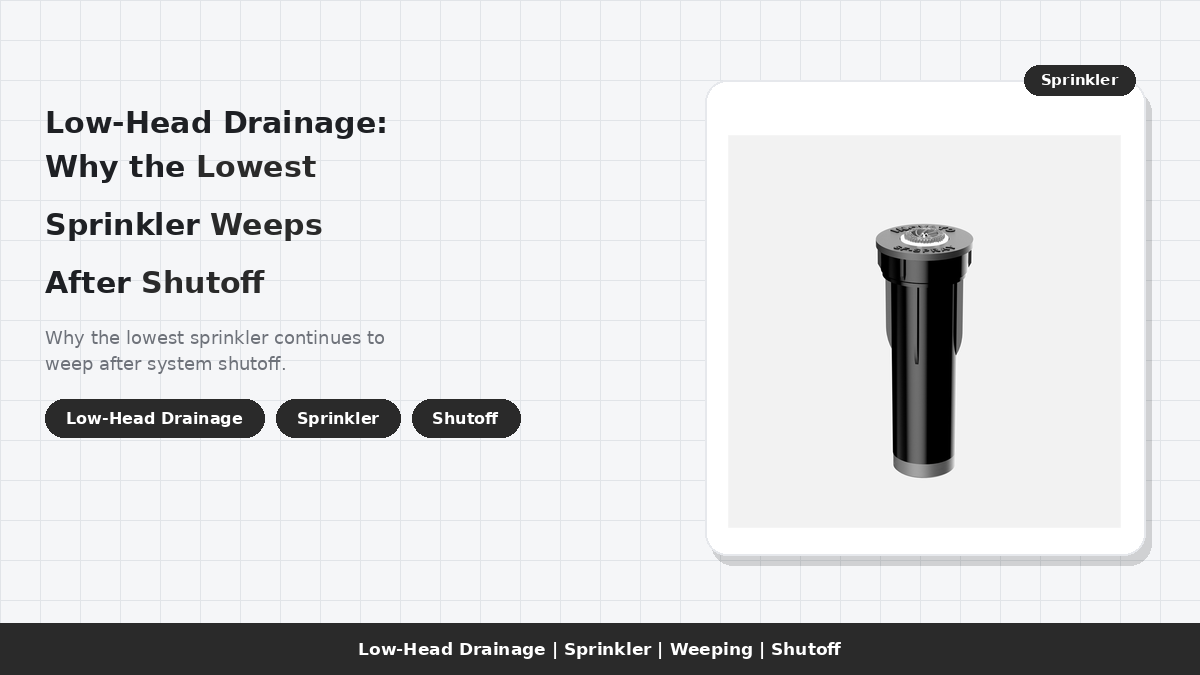
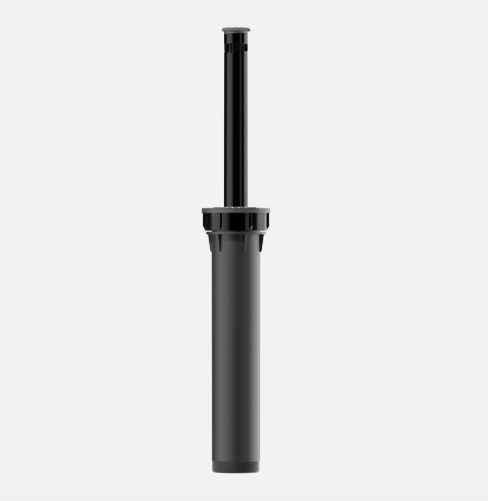
- Pop-up spray bodies (including the SF06 pop-up spray body): monthly visual inspection for retraction and alignment; quarterly internal screen cleaning; annual riser seal replacement.
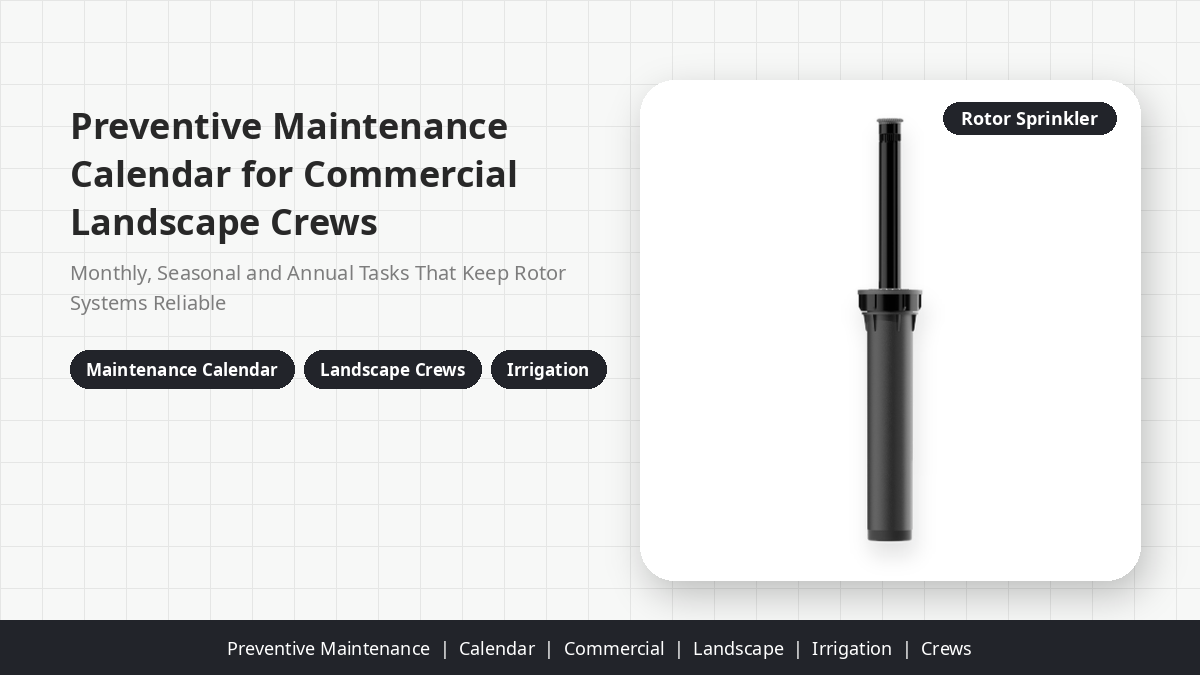
- Gear-drive rotors and rotary nozzles: monthly visual inspection for rotation smoothness and arc alignment; semi-annual internal screen and bearing check; annual nozzle replacement on high-cycle circuits.
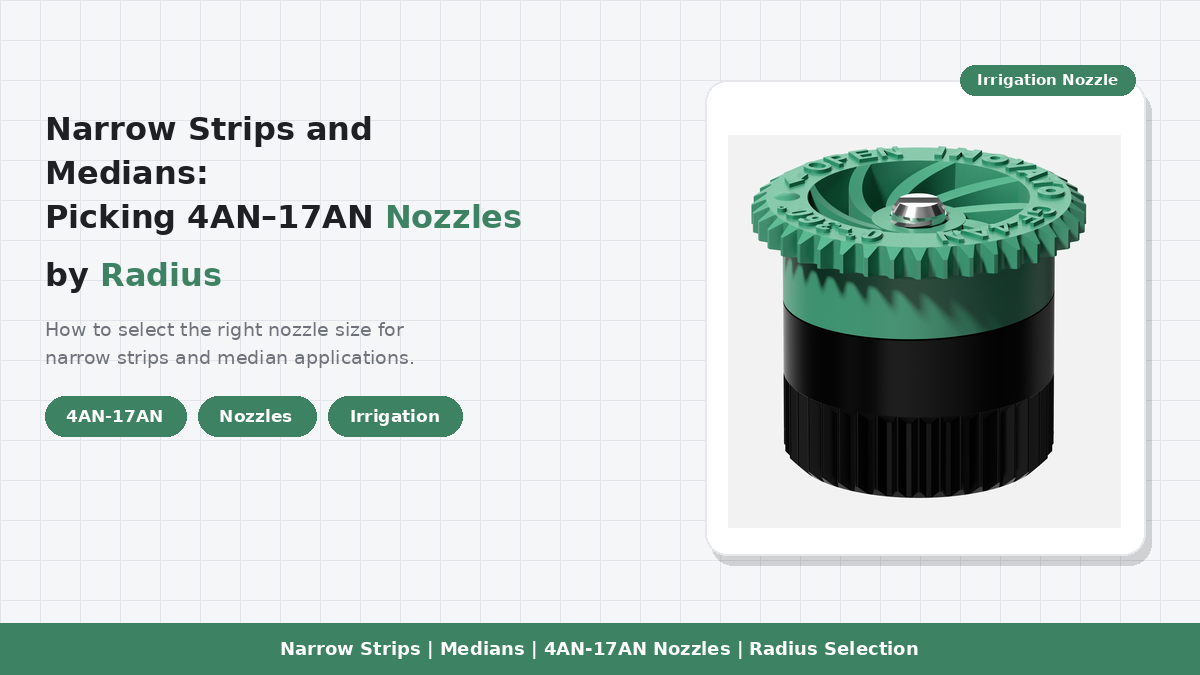
- Spray nozzles (FN, RF, and fixed-pattern): monthly visual inspection for clogging; quarterly internal screen cleaning; annual replacement on high-clog-risk circuits (mineral-heavy water, leaf debris, infrequent use).
The component-specific intervals are calibrated to the operating data behind the INOVATO quick-coupler maintenance study. Commercial properties with weekly-scheduled maintenance typically use the quarterly internal-cleaning cycle; properties with monthly-only maintenance typically need to extend to monthly visual inspection and quarterly internal cleaning as well, because the visual-only inspection misses internal screen clogging that compounds over 90 days.
SF06 pop-up spray body: a typical maintenance sequence
The SF06 pop-up spray body is the most common INOVATO pop-up for commercial landscape irrigation. The annual maintenance sequence documented for the SF06 in the maintenance-cycle study is:
- Monthly visual — verify the spray body retracts fully under pressure-off conditions and that the riser is not leaking at the cap.
- Quarterly internal screen clean — unscrew the nozzle, remove the screen filter, flush with clean water, replace. This is the highest-frequency task that prevents nozzle clogging.
- Semi-annual arc adjustment — verify the arc matches the irrigation design plan. For gear-drive rotors with adjustable arcs, the adjustment screw typically holds setting for 6 months before drift.
- Annual riser seal check — depressurize the zone, unscrew the riser from the body, inspect the riser seal for cracking or compression set. Replace if the seal no longer returns to its round profile or shows visible cracking.
The annual SF06 maintenance task takes roughly 5–8 minutes per head for a commercial crew that has done the task before. For a property with 100 SF06 spray bodies, the annual SF06 maintenance is roughly 8–13 hours of crew labor — a workload that fits within a single weekend for a 2-person crew.
Pressure Loss and System Performance: 100-Coupler Accumulation
The pressure-loss data in the INOVATO quick-coupler maintenance-cycle study is the operational floor for hydraulic-design conversations with commercial landscape crews. The relevant numbers, taken directly from the study:
| Coupler size | Flow rate (L/h) | Pressure loss fully open (bar) | Pressure loss 50% throttled (bar) |
|---|---|---|---|
| 1 inch | 800 | 0.03–0.05 | (throttled use not recommended) |
| 1 inch | 1,500 | 0.08–0.12 | (throttled use not recommended) |
| Larger sizes | (up to design flow) | 0.02–0.10 | (throttled use accelerates O-ring wear) |
For a typical commercial landscape system with 100 quick-coupler connection points along a 1-inch lateral line carrying 1,200 L/h at 2.5 bar operating pressure, the cumulative pressure loss from all fully-open couplers is approximately 5–6 mbar (0.05–0.06 bar) — essentially undetectable in the context of the pipe network pressure losses (which are typically 0.3–1.5 bar depending on pipe diameter and length). Quick coupler pressure loss almost never needs to be included in hydraulic calculations for standard commercial landscape irrigation systems. The 50% throttled values are relevant only when quick couplers are used for flow control, which INOVATO does not recommend — sustained partial-opening operation accelerates O-ring wear and produces a leaky-then-failing connection within a season.
Labor Cost Impact: 3–5 Hours Saved per Maintenance Cycle
The maintenance-cycle study published by INOVATO produces a quantified labor comparison between quick-coupler and threaded-connection irrigation systems. For a commercial property with 200 quick-coupler connection points — a typical medium-sized corporate campus — the installation time saving per seasonal maintenance cycle is approximately 3–5 hours of crew labor compared to the same number of threaded connections. The labor saving compounds across the multi-decade system life.
The labor comparison is built on three measurement cycles from the maintenance-cycle study:
- Spring commissioning cycle (March): pressurize main, inspect zone by zone, reconnect any disconnected quick-coupler points. For a 200-connection-point property, the quick-coupler cycle completes in roughly 15–25 minutes versus the threaded-cycle equivalent of 2.5–6.5 hours.
- Fall winterization cycle (November): drain or blow out lateral lines, disconnect for indoor storage if used. Same time-difference ratio as the spring cycle.
- Mid-season repair cycle (any month): connection-disconnection cycles for repairs, which on a typical commercial property run 5–15 cycles per year depending on leak history. Quick-coupler cycles complete in 1–2 minutes versus threaded cycles of 5–15 minutes.
The cumulative labor saving compounds across the system lifetime. INOVATO's reference figure for the per-cycle labor saving is roughly 3–5 hours of crew time per spring or fall maintenance event, with the annual mid-season repair-cycle savings adding a smaller additional contribution. The cumulative multi-decade saving is the operational justification for the modest per-unit cost premium of quick-coupler fittings versus threaded connections — a premium that the maintenance-cycle study documents pays back in reduced labor cost over a typical 10–15 year system lifetime.
The labor comparison also surfaces a hidden cost of threaded connections that is harder to measure but visible in the field: the threaded connection leak rate. A small fraction of threaded connections will leak at the sealant-tape interface or at the cross-thread, producing a callback to the maintenance crew that is invisible on the per-cycle labor ledger but accumulates over the system lifetime. Quick-coupler connections do not produce this failure mode because the O-ring seal is mechanical rather than sealant-based.
A 5-Step Buyer Action Plan for First-Year Implementation
For a commercial landscape crew that is adopting the INOVATO maintenance calendar for the first time, the five-step action plan below is calibrated to the equipment platform documented in the quick-coupler maintenance-cycle study. Following this plan typically takes 8–14 weeks for the first-year rollout, after which the calendar runs on its own.
- Step 1 — Inventory the existing system. Walk the property and list every connection point, sprinkler body, valve, and controller. Note the manufacturer, model, and age of each component. The output is a maintenance baseline that the calendar operates against.
- Step 2 — Identify quick-coupler retrofit opportunities. For the connection points that are accessed more than twice per year (winterization, repair, seasonal changeover), retrofit to quick-coupler fittings. The maintenance-cycle study identifies this threshold as the operational crossover point where the per-unit cost premium of quick couplers pays back through reduced labor.
- Step 3 — Stock spare O-rings and component parts. Order spare O-rings at 10% of installed coupler count, plus 2–3 spare nozzles and valve diaphragms per zone. INOVATO's reference stock for a 200-connection-point property is one O-ring kit (50 rings, assorted sizes) and 4–6 spare nozzles.
- Step 4 — Build the maintenance log. Create a shared log — spreadsheet, paper notebook, or maintenance-software — that records date, task, location, and notes for each maintenance event. The log becomes the input to the next-year calendar review.
- Step 5 — Run the calendar for a full year. Use the 12-month calendar above as the starting point and adjust the cycle intervals in July and January based on the actual wear pattern observed. After one full year, the calendar reflects the property's specific operating conditions rather than the generic temperate-climate defaults.
Following this five-step plan, the calendar typically becomes operational by month 3 and produces a complete maintenance log by month 12. The cumulative effect is a system that delivers predictable performance across the multi-decade lifetime rather than degrading through deferred maintenance.
For broader regulatory and standards context, the irrigation industry references ISO 5167 for flow measurement, the Irrigation Association (IA) for landscape irrigation best-practice guidance, and EPA WaterSense for water-efficiency labeling. The American Society of Agricultural and Biological Engineers (ASABE) publishes the standards for irrigation component performance, and FAO (Food and Agriculture Organization) provides global irrigation-scheduling guidance for high-water-stress regions. These public references complement the INOVATO internal data and give commercial landscape crews a complete technical framework for maintenance planning.
Frequently Asked Questions: Commercial Landscape Irrigation Maintenance
1. How often should commercial landscape crews inspect quick coupler O-rings?
For high-frequency commercial use (sports complex, daily-scheduled irrigation), inspect every 2 weeks and replace every 3–6 months. For medium-frequency use (municipal park, hotel grounds, weekly maintenance), inspect every 4–6 weeks and replace every 4–6 months. For low-frequency use (residential-style campus, seasonal irrigation), inspect every 3 months and replace every 6 months. Replacement triggers are visible cracking, compression-set flattening, or leakage above 0.3 bar.
2. What is the typical annual maintenance task for an SF06 pop-up spray body?
The SF06 pop-up spray body annual maintenance sequence is: monthly visual inspection for retraction and cap-seal integrity; quarterly internal screen clean; semi-annual arc adjustment; annual riser seal replacement. The annual task takes roughly 5–8 minutes per head for a crew that has done the task before. For a property with 100 SF06 bodies, the annual SF06 maintenance is roughly 8–13 hours of crew labor.
3. How much pressure loss does a quick coupler introduce at typical flow rates?
For a 1-inch quick coupler at 800 L/h, fully open, the pressure loss is 0.03–0.05 bar. At 1,500 L/h, the pressure loss is 0.08–0.12 bar. For a typical commercial landscape system with 100 quick-coupler connection points along a 1-inch lateral carrying 1,200 L/h at 2.5 bar operating pressure, the cumulative pressure loss is approximately 5–6 mbar — essentially undetectable against pipe-network pressure losses of 0.3–1.5 bar.
4. How much faster is quick coupler installation compared to threaded connection?
Quick couplers install in 5–8 seconds per connection versus 45–120 seconds for threaded connections, per INOVATO's installation time study. For a commercial property with 200 quick-coupler connection points, the spring or fall maintenance cycle savings is roughly 3–5 hours of crew labor versus the threaded equivalent.
5. What NBR O-ring temperature range is suitable for commercial landscape irrigation?
NBR (nitrile butadiene rubber) is rated for -5 °C to +120 °C continuous in standard commercial landscape service. NBR offers good resistance to mineral oils, petroleum-based products, and standard water chemistry. NBR is not recommended for phosphate-ester pesticides or strong oxidizing agents — for those water chemistries, EPDM or FKM are alternatives with longer replacement cycles (50–70% longer than NBR but at higher unit cost).
6. What is the right O-ring spare inventory level for a commercial property?
INOVATO's reference spare-inventory level is 10% of installed quick-coupler count. For a property with 200 connection points, keep 20 spare O-rings on hand. One O-ring kit (50 rings, assorted sizes) typically covers most sizes for a property at this scale. O-ring kits (assorted sizes, 50 rings per kit) are available from INOVATO at modest unit cost.
7. What happens when the O-ring cycle is skipped on a commercial site?
A single missed O-ring replacement on a high-cycle commercial site typically surfaces as a leak in the next 30–60 days. The leak rate at operating pressure is small (less than 0.5 L/h) but cumulatively over the leak-detection interval can add up to substantial water loss. For a 200-connection-point property, a 5% O-ring-failure rate translates to roughly 10 active micro-leaks at any given inspection cycle — each losing 0.3–0.5 L/h. The cumulative water loss over a 60-day detection interval is measurable in cubic meters.
8. Can quick couplers be used for flow control by throttling?
INOVATO does not recommend using quick couplers as flow-control valves. Sustained partial-opening operation accelerates O-ring wear and produces a leaky-then-failing connection within a season. The 50% throttled pressure-loss values in the INOVATO data table are listed only for diagnostic reference (e.g., identifying a partially-closed coupler as a leak source), not as an operating mode. For flow control, use dedicated flow-control valves rather than throttling quick couplers.
Ready to standardize the maintenance calendar across your commercial landscape portfolio?
Send us your property type, number of irrigation connection points, and seasonal climate. We will return a property-specific maintenance calendar, an O-ring and spare-part inventory recommendation, and a quick-coupler retrofit cost estimate. Contact the INOVATO engineering team for a maintenance calendar customized to your property.