


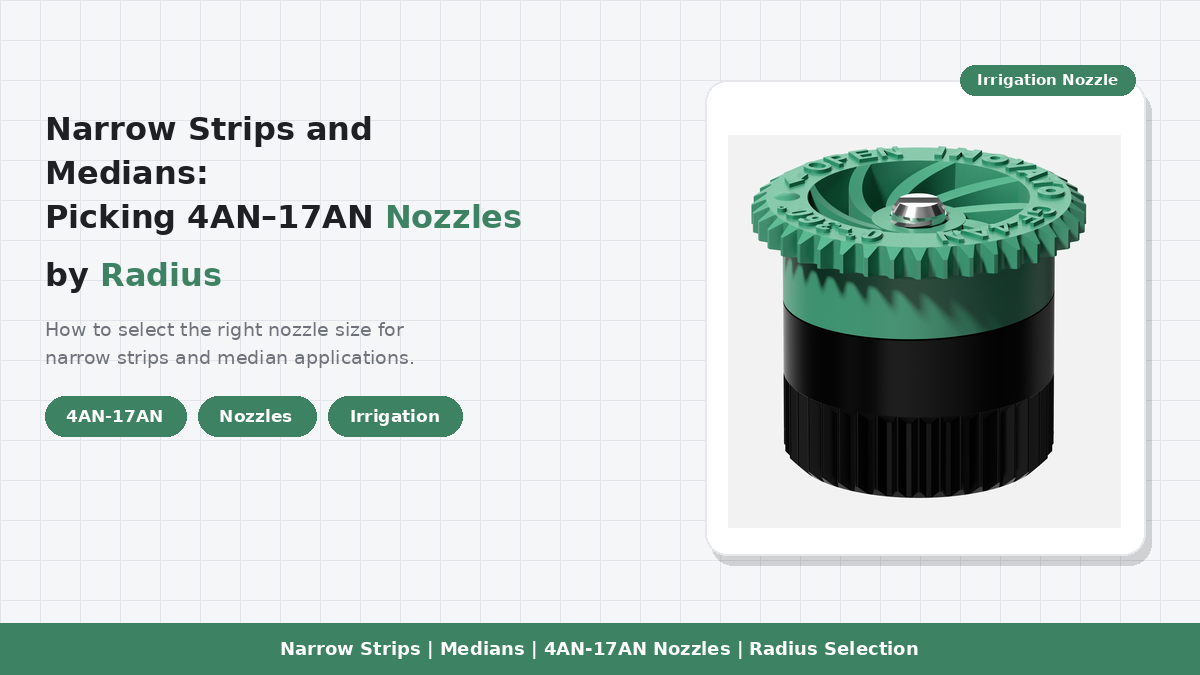
Quick answer: For a narrow strip, median, or rectangular bed, the right nozzle is the INOVATO FN fixed-orifice model whose rated radius matches the half-width of your irrigated zone. Choose from 4AN (1.2 m, light green), 6AN (1.8 m, sky blue), 8AN (2.4 m, green), 10AN (3.0 m, dark blue), 12AN (3.7 m, brown), 15AN (4.6 m, black), or 17AN (5.2 m, gray). All seven share the same 24.8 mm diameter, 22.1 mm height, 0°–360° adjustable arc, and 2.1 bar (30 PSI) recommended working pressure, so the only variable that changes between them is throw radius, trajectory, and matched-precipitation range.
This guide walks through how to read the FN radius chart, how to match it to the geometry of a real narrow strip, how trajectory affects wind performance, and how to avoid the three most common retrofit mistakes when swapping nozzles on existing pop-up bodies. The article is built around the seven INOVATO FN fixed-orifice nozzles (4AN through 17AN), because that is the only fixed-spray family on the market today that covers 1.2 m to 5.2 m in a single color-coded footprint with matched precipitation across the entire range.

TL;DR — The 4AN to 17AN Selection Cheat Sheet
- Strip or median ≤ 2.4 m wide → FN-4AN (1.2 m radius, light green, 0° trajectory, matched precip. 1.2–2.7 m).
- 2.4–3.6 m wide → FN-6AN (1.8 m radius, sky blue, 0° trajectory, matched precip. 1.4–4 m).
- 3.6–4.8 m wide → FN-8AN (2.4 m radius, green, 15° trajectory, matched precip. 1.8–4.9 m).
- 4.8–6.0 m wide → FN-10AN (3.0 m radius, dark blue, 15° trajectory, matched precip. 2–5.2 m).
- 6.0–7.4 m wide → FN-12AN (3.7 m radius, brown, 28° trajectory, matched precip. 2.5–5 m).
- 7.4–9.2 m wide → FN-15AN (4.6 m radius, black, 28° trajectory, matched precip. 2.8–5.4 m).
- 9.2–10.4 m wide → FN-17AN (5.2 m radius, gray, 28° trajectory, matched precip. 3.1–5.6 m).
All seven units share a 24.8 mm diameter, 22.1 mm installed height, a 0°–360° adjustable arc, large-droplet design for wind tolerance, and a 2.1 bar (30 PSI) recommended working pressure. If the strip is wider than 10.4 m, the FN family is the wrong product — step up to the RF rotary series or a gear-driven sprinkler instead.
What Makes a Strip Irrigation Nozzle Different?
A narrow strip irrigation nozzle is a fixed-spray pop-up nozzle engineered for one specific job: deliver an even rectangular or trapezoidal water footprint with sharp edges, rather than a circular or arc-shaped pattern. The defining geometry is a fan-style spray with a flat trajectory that lays water down close to the head instead of throwing it high into the air. The fan is what creates the well-defined strip pattern, and the low trajectory is what prevents wind from dragging the pattern off-target.
Three engineering choices separate a true strip nozzle from a regular fixed-spray nozzle:
- Multi-orifice fixed plate instead of a single adjustable nozzle. The plate is precision-cut so every droplet leaves at the same angle and velocity, which is why the spray pattern has straight, predictable edges.
- Large-droplet output for wind tolerance. The water leaves the nozzle as heavier drops that resist lateral drift, so a 5–10 kph breeze doesn't deform the strip into a crescent.
- Matched precipitation rate across the radius range. A 1.2 m nozzle and a 5.2 m nozzle from the same family both apply the same mm/h per unit area — that's what makes them mixable on the same zone without creating dry or flooded patches.
INOVATO's FN family is built on exactly these three principles, and the published spec sheet confirms them: each model uses a fixed multi-orifice plate, is engineered for large droplets to withstand winds, and is color-coded for easy field identification — a small detail that saves hours when a maintenance tech is troubleshooting a zone a year after installation. The single biggest lever for getting the strip geometry right is matching the nozzle's rated radius to the half-width of the irrigated strip.
Get that wrong, and the rest of the system can't compensate. Push a 5.2 m nozzle into a 2 m strip and half the water lands on the pavement; drop a 1.2 m nozzle into a 9 m median and you'll see wheel-line dry spots every 1.5 m.
The 4AN to 17AN Radius Chart: What's Actually Published
The seven published radii on the INOVATO FN product page are not arbitrary numbers — they form a stepped ladder that covers the practical width range for strips, medians, parking-lot islands, building perimeters, and narrow turf panels. Reading the chart top to bottom:
| Model | Color | Rated radius | Trajectory | Matched precip. range | Typical strip width |
|---|---|---|---|---|---|
| FN-4AN | Light green | 1.2 m | 0° | 1.2 m – 2.7 m | ≤ 2.4 m |
| FN-6AN | Sky blue | 1.8 m | 0° | 1.4 m – 4.0 m | 2.4 – 3.6 m |
| FN-8AN | Green | 2.4 m | 15° | 1.8 m – 4.9 m | 3.6 – 4.8 m |
| FN-10AN | Dark blue | 3.0 m | 15° | 2.0 m – 5.2 m | 4.8 – 6.0 m |
| FN-12AN | Brown | 3.7 m | 28° | 2.5 m – 5.0 m | 6.0 – 7.4 m |
| FN-15AN | Black | 4.6 m | 28° | 2.8 m – 5.4 m | 7.4 – 9.2 m |
| FN-17AN | Gray | 5.2 m | 28° | 3.1 m – 5.6 m | 9.2 – 10.4 m |
Three things on the chart deserve a closer look, because they drive real-world selection.
First, the trajectory climbs in three steps, not seven. The 4AN and 6AN both fire at 0° — flat to the ground, perfect for the tightest strips where any upward throw guarantees overspray onto adjacent hardscape. The 8AN and 10AN climb to 15°, and the 12AN, 15AN, and 17AN all sit at 28°. The trajectory jump happens at exactly the point where the radius is large enough that a higher arc actually improves wind performance without sacrificing pattern control. Because the trajectory step occurs at fixed model boundaries, you don't have to choose between radius and trajectory — they were co-engineered.
Second, the matched-precipitation ranges overlap deliberately. The 4AN's matched range goes up to 2.7 m, and the 6AN starts at 1.4 m. That 1.3 m of overlap exists so an installer can upsize the nozzle slightly for head-to-head spacing without breaking precipitation uniformity. If your spacing forces you into the upper half of one model's range, drop down to the next model — not up.
Third, the body is identical across all seven models. Diameter 24.8 mm, overall height 22.1 mm, recommended working pressure 2.1 bar (30 PSI). Every FN nozzle threads into the same female-threaded riser used by the RF series, which is what makes retrofit swaps possible without digging up the body. We'll come back to that point in the retrofit section.
How to Choose the Right FN Nozzle for a Real Strip
Walk any street, parking lot, or commercial landscape and the narrow-strip problem appears in three recognizable geometries. Each one has a different selection logic.
Case 1: The Narrow Median (1.5 m to 3.5 m wide)
Roadway medians are the most common narrow-strip application. The width is fixed by curb geometry, the length can run hundreds of meters, and the planting is usually low shrubs or ground cover with no tall canopy to block the spray. The selection logic is straightforward.
- Measure the median width perpendicular to the pipe. Not the diagonal — the perpendicular distance from the curb face on one side to the curb face on the other. A 2.4 m median is exactly the use case for the FN-8AN, because the nozzle's 2.4 m radius covers half the strip and head-to-head spacing along the pipe covers the other half.
- Verify head spacing is achievable along the pipe. For a 0° trajectory nozzle like the FN-4AN or FN-6AN, head-to-head spacing along the pipe should be roughly 0.8 × the throw radius — about 1.0 m for the 4AN and 1.4 m for the 6AN. For the 15° and 28° trajectory models, spacing can stretch to 1.0 × the radius.
- Confirm pressure at the most distant head. Every FN nozzle is rated at 2.1 bar (30 PSI). If the last head on the median run drops below 2.0 bar because of friction loss in a long lateral, the radius will fall short of the published value by roughly 10%, which can leave a dry strip down the centerline.
For medians under 2 m wide, the FN-4AN is almost always the right answer. The 0° trajectory keeps water in the bed, the light-green top is easy to identify in the field, and the 1.2 m radius is forgiving on tight head spacing. For medians between 2 m and 3.5 m, step up to the FN-6AN (1.8 m) so you can run wider head spacing along the pipe without overwatering the curb side.
Case 2: Parking-Lot Islands and Building Perimeters (2 m to 6 m)
Parking-lot islands are wider than medians, often have trees or palms in the center, and are surrounded by asphalt that heats up in summer. Two selection rules apply here that don't matter for medians.
First, match the radius to the drip line, not the curb. If the island is 4.5 m wide but the trees are planted 1.5 m in from the curb, water the trees — not the asphalt. The FN-8AN (2.4 m radius) or FN-10AN (3.0 m radius) lets you arc the nozzle away from the asphalt side and toward the root zone. The adjustable 0°–360° arc on every FN model is what makes this directional aiming possible.
Second, prefer 15° trajectory for islands with reflective heat. Hot asphalt creates a low-level thermal updraft that drags flat-trajectory spray sideways. The FN-8AN and FN-10AN both use a 15° trajectory, which puts the initial droplet stream above the thermal layer before it falls. You'll see noticeably more uniform coverage in afternoon watering cycles.
For building perimeters, the same logic applies in mirror image: the FN-8AN or FN-10AN arcs away from the wall, with the radius sized to the planting bed rather than the walkway. The FN family's sharp pattern edge is what makes this safe — you can run a strip right up to a building foundation without overspray staining the façade.
Case 3: Wide Turf Strips and Bioswale Edges (6 m to 10 m)
Above 6 m, you're past the comfortable limit of a single row of pop-up nozzles with heads on one side of the strip. Two strategies work, and the choice depends on whether you can run a pipe down the centerline.
If a centerline pipe is feasible (typical for bioswales and new commercial construction), use opposing FN-12AN nozzles set to 180° arc, with each head throwing 3.7 m toward the other. The 28° trajectory gives the stream enough height to resist the crosswind typical of an open field, and the 3.7 m radius covers a 7.4 m total strip with overlap down the centerline. This is also the cleanest way to irrigate a bioswale — the 28° trajectory throws above the lowest soil level, so the pattern doesn't get absorbed by the swale bottom.
If only a single-side pipe is possible (retrofit on an existing parkway or where the centerline is paved), the FN-15AN (4.6 m radius) or FN-17AN (5.2 m radius) lets you water a 9–10 m strip from one side, but you pay for it in uniformity. The far edge of the strip will receive less water than the near edge because the droplets lose velocity over distance — typically a 15–20% reduction at the far edge compared to the near edge. The fix is matched-precipitation overlap: place heads close enough that the far-edge deficit from one head is filled by the near-edge surplus of the next.
Three Retrofit Mistakes That Kill Strip Coverage
Most FN installations are retrofits onto existing sprinkler bodies in working landscapes. The bodies are already in the ground, the pipe is already pressurized, and the temptation is to just unscrew the old nozzle and screw in the new one. That works — but only if you avoid the three mistakes we see on roughly one in four retrofit jobs.
Mistake 1: Skipping the Pressure Check
Every FN nozzle is rated at 2.1 bar (30 PSI). Most pop-up bodies in older systems were designed for higher flows at higher pressures (the RF rotary series runs from 1.5 bar to 4.0 bar). Drop a low-pressure FN nozzle onto a high-pressure line and two things happen. First, the radius grows beyond the published value because throw distance scales with the square root of pressure. Second, the fine droplet pattern breaks up into mist, which wind carries off-target.
The fix is a pressure-regulating valve at the zone inlet, or — if the body is older — a pressure-regulating replacement screen. Don't trust the upstream valve alone; check the actual pressure at the last head on the run with a pitot-tube gauge.
Mistake 2: Mixing FN and RF Nozzles in the Same Zone
This is the single most common retrofit error, and it has a real technical explanation. The RF vs FN spray-pattern comparison shows that the two series have different precipitation rates at the same flow: the RF rotary stream distributes water more slowly per unit area than the FN fixed-spray plate. Mixing them in the same zone means the lawn under an RF nozzle gets less water per minute than the strip under an FN nozzle at the same head spacing — the lawn dries out, the strip floods.
If you're upgrading an existing zone from RF to FN (or vice versa), split it into two zones with separate valves. Yes, it's more work. No, there's no shortcut that preserves uniformity.
Mistake 3: Ignoring the Rise in Trajectory
Installers who learned the FN family on the 4AN and 6AN sometimes assume the 8AN through 17AN throw the same low pattern — they don't. The trajectory climbs from 0° to 15° to 28° across the model range, and that means the 17AN throws water 2.5 m into the air before it lands at 5.2 m. In a tight planting bed under a tree canopy, that high arc gets blocked by the lower branches. In an open median, the high arc is exactly what you want.
The rule is simple: low-growing ground cover or strips adjacent to a wall → stay at 0° trajectory (4AN, 6AN). Open field or above-canopy irrigation → use 15° or 28° (8AN through 17AN).
FN vs RF: When to Stay With FN
The FN family is not the right nozzle for every job. Against the RF rotary series, the trade-offs come down to three site questions.
Is the area geometrically constrained? If yes — median, parking-lot island, building perimeter, narrow parkway — FN wins. The sharp pattern edges let you put water exactly where the planting is, with minimal waste onto adjacent hardscape. RF rotary streams are excellent for open turf but lack the pattern-edge control needed for tight geometry.
Is the soil heavy clay or compacted? If yes, FN is the safer choice because the matched precipitation rate can be calibrated to the soil's actual infiltration capacity. The trade-off is that FN applies water faster than RF at the same flow, so on clay you may need cycle-and-soak scheduling to avoid runoff.
Is wind a persistent factor at the site? If yes — coastal sites, open plains, or any location where afternoon winds exceed 8 kph regularly — FN's large-droplet design holds the pattern together better than a fine-spray fixed nozzle. RF rotary streams also tolerate wind well, but for a different reason (slow rotation), so the choice between them on wind is closer than on geometry.
For the specific case of narrow strip irrigation, FN is almost always the correct answer, because the geometry of a strip is what defines the problem. The 4AN through 17AN ladder covers every practical strip width from 1 m to 10 m in seven steps, with matched precipitation across the entire range.
How Wind and Pressure Change the Radius in the Field
The rated radius on every FN spec sheet is measured under laboratory conditions: no wind, 2.1 bar pressure, mounted at the recommended riser height. None of those conditions hold in the field, so the real radius is always a function of three corrections.
Pressure correction. Throw radius scales with the square root of operating pressure. At 2.5 bar (5% above rated), the radius grows by about 2.5%. At 3.0 bar (40% above rated), the radius grows by about 19%. For the FN-4AN rated at 1.2 m, that means the actual throw at 3.0 bar is closer to 1.4 m — enough to push water onto an adjacent walkway. A pressure-regulating valve at the zone inlet is the most reliable fix.
Wind correction. Wind drift degrades both the effective radius and the distribution uniformity. For the FN family's large-droplet design, the effective radius reduction at 8 kph crosswind is approximately 5–8% for the 0° trajectory models (4AN, 6AN) and 3–5% for the higher-trajectory models (12AN through 17AN). The reason is straightforward: a higher trajectory puts the droplet stream above the surface wind layer for the first 30–50% of its flight, so it loses less energy to lateral drift.
Riser height correction. Every FN spec assumes the nozzle is mounted on the standard pop-up riser at the manufacturer's recommended installation height. Mounting the nozzle lower (in a tall turf stand, for example) catches the lower portion of the trajectory and produces a donut-shaped dry spot in the middle of the wetted area. Mounting it higher than recommended produces the opposite problem — water overshoots the near edge and starves the center.
Field Notes From Real Strips
Three observations from recent FN installations that are worth flagging because they don't show up in the spec sheet.
The color-coding matters more than the spec sheet suggests. When a maintenance tech walks onto a site two years after installation, the color of the nozzle top is how they figure out what's in the ground. A 1.2 m light-green 4AN and a 2.4 m green 8AN are easy to confuse in the grass if the cap is dirty. INOVATO uses distinct hues — light green vs mid-green vs dark blue — specifically to avoid that confusion. Keep the caps clean and the colors are diagnostic; let them fade and they become a guess.
The 0° trajectory nozzles collect debris. Because the 4AN and 6AN fire flat to the ground, the intake screen sits closer to the soil surface and tends to pick up fine sediment in poorly filtered water sources. The fix is a 200-mesh filter at the valve, not a finer nozzle screen — the nozzle screen reduces radius when partially clogged, which causes the dry-strip problem in the first place.
17AN on a 10 m strip is a real edge case. The 17AN is the largest-radius FN model at 5.2 m, and the only one in the family that pushes against the practical limit for fixed-spray strip irrigation. Above 10.4 m of strip width, the 28° trajectory starts to drift in any meaningful crosswind, and the matched-precipitation overlap needed at the far edge becomes impractical. If you're consistently designing strips above 10 m wide, you're in gear-driven rotor territory, not FN territory.
Quick Sizing Workflow
For a procurement or design team that needs a repeatable decision rule, the FN selection collapses to four steps.
- Measure the strip half-width perpendicular to the pipe. This is the radius the nozzle must cover.
- Round up to the nearest FN model from the radius ladder (1.2, 1.8, 2.4, 3.0, 3.7, 4.6, 5.2 m). Always round up, never down — the matched-precipitation overlap is more forgiving than a dry edge.
- Check head spacing along the pipe. For 0° trajectory models, spacing ≤ 0.8 × radius. For 15° and 28° models, spacing ≤ 1.0 × radius.
- Confirm pressure at the most distant head. 2.0 bar minimum, 2.5 bar maximum. Outside that band, install a pressure regulator at the zone valve.
That four-step workflow works for roughly 90% of the strip installations an irrigation designer encounters. The remaining 10% — geometrically irregular shapes, multi-level planting, sites with severe wind exposure — need a site-specific calculation, and at that point it's worth pulling the RF vs FN precipitation-rate methodology from the INOVATO knowledge base and working through the math for that specific zone.
FAQ
What is the difference between 4AN and 6AN nozzles?
The 4AN has a rated radius of 1.2 m and the 6AN has a rated radius of 1.8 m. Both use a 0° trajectory and the same 24.8 mm body, so they are physically interchangeable on the same pop-up riser. The choice between them depends on the strip half-width: use 4AN for strips up to about 2.4 m wide, and 6AN for strips between 2.4 m and 3.6 m wide. Both have the same recommended working pressure (2.1 bar / 30 PSI) and the same adjustable arc range (0°–360°).
Can I mix FN and RF nozzles on the same zone?
No. The two series have different precipitation rates at the same flow because the FN uses a fixed multi-orifice plate while the RF uses a rotating stream mechanism. Mixing them on the same zone produces non-uniform coverage — the area under the FN nozzle receives more water per minute than the area under the RF nozzle, leading to overwatered strips and underwatered turf. If you need both families on the same site, split them into separate zones with separate valves.
What pressure do I run FN nozzles at?
The published recommended working pressure for every FN model (4AN through 17AN) is 2.1 bar (30 PSI). The nozzles will physically operate across a broader pressure range, but the rated radius, droplet size, and distribution uniformity are all specified at 2.1 bar. For consistent field performance, install a pressure-regulating valve at the zone inlet to hold pressure at or near 2.1 bar regardless of upstream fluctuations.
What strip width is too wide for FN nozzles?
Above about 10.4 m of strip width, the FN family is no longer the right product. The 17AN's 5.2 m radius is the practical maximum for a fixed-spray strip nozzle, and beyond that you step up to the RF rotary series (which covers 3.0–4.9 m at typical flows but uses a different spray geometry) or to a gear-driven Rotor Sprinkler. Using a 17AN on a strip wider than 10 m produces dry far-edge coverage that no amount of matched-precipitation overlap can fix.
Are FN nozzles color-coded for field identification?
Yes. Every FN model uses a distinct cap color: 4AN light green, 6AN sky blue, 8AN green, 10AN dark blue, 12AN brown, 15AN black, 17AN gray. This is a maintenance feature as much as an installation feature — a service tech walking onto a site can identify which nozzle is in the ground by the cap color without unscrewing it.
Do FN nozzles work with reclaimed or non-potable water?
Yes, with the caveat that the small internal orifice on the smaller-radius models (4AN and 6AN in particular) is sensitive to fine sediment. For reclaimed water sources, install a 200-mesh filter at the zone valve to keep sediment out of the nozzle screen, and plan to clean the screens on a quarterly basis for the first year of operation. After the system stabilizes, semi-annual cleaning is usually sufficient.
Where to Spec INOVATO FN Nozzles for a Project
The full FN fixed-orifice family is documented on the INOVATO FN nozzles product page, with individual spec sheets for each model — 4AN, 6AN, 8AN, 10AN, 12AN, 15AN, and 17AN. For comparison data against the rotary series (which is the other major INOVATO nozzle family and the one to consider when you step outside the FN strip envelope), the RF vs FN spray-pattern comparison article covers the precipitation rate, retrofit compatibility, and pressure-response behavior of both families on the same pop-up body. Together, those three pages are the technical reference set for any designer working through a strip or median irrigation problem.