

Pop-Up Impact vs Gear Rotor: Which Sprinkler Survives Dirty Water?
On dirty water, the choice between a pop-up impact sprinkler and an enclosed gear drive rotor is decided long before distribution uniformity enters the picture. It is decided by the failure mode of the internal mechanism: the impact sprinkler's exposed spring-and-hammer trip will jam visibly and tell you exactly which head needs service, while the gear rotor's enclosed epicyclic gear train wears down silently until one day your catch-cans show a 25% dry stripe across the throw pattern.
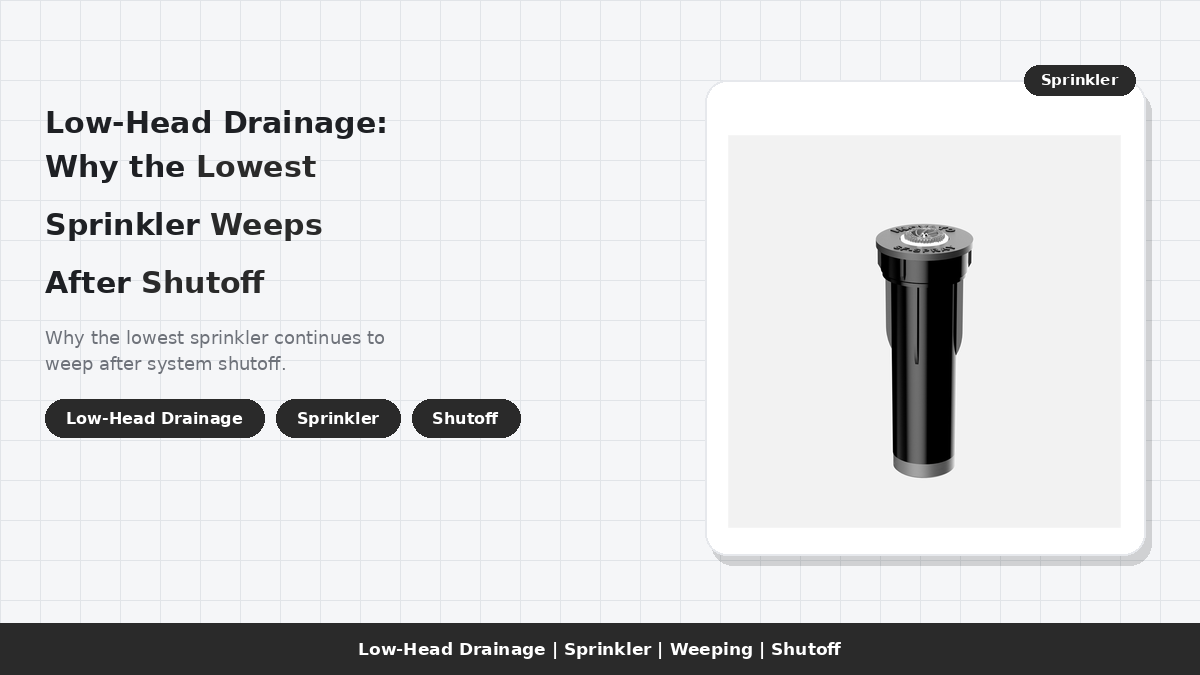
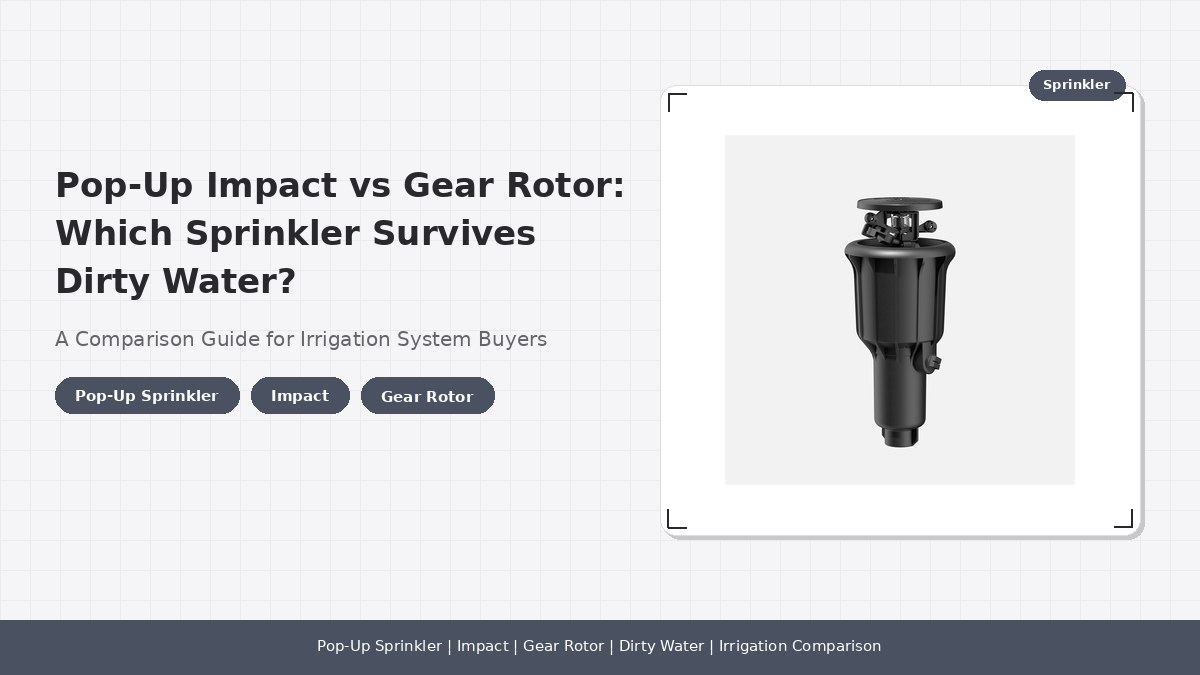
We have been running this comparison across lake, canal, and reclaimed water sources on our SRPIR01 pop-up impact sprinkler line and on the matched pop-up impact sprinkler product line, and the headline is consistent. Impact sprinklers lose roughly 10–15% of their rated service life on dirty water, because the trip spring and pivot are field-serviceable. Gear rotors running on the same water lose 40–60% of their rated gear life, because the gear train is enclosed and not serviceable. Over a 10-year window, that gap is the difference between a sprinkler you can keep running and a sprinkler you have to replace. The broader context for the comparison is in our existing piece on how gear drive and impact sprinklers differ on water savings for large-scale farms, which focused on distribution uniformity; this guide focuses specifically on dirty-water survival.
The remainder of this article gives you the framework: how to define "dirty water" in terms that actually drive sprinkler selection, why the two failure modes are different, what mesh filter each type needs, a one-season field test that picks a winner, and a specifying sheet by water source. We close with a six-question FAQ covering reclaimed wastewater, mixed sources, and service interval.
Define "Dirty Water" by Particle Size, Not by Sight
The first mistake on a dirty-water project is to grade the supply by how it looks, because suspended solids drive sprinkler wear, and suspended solids are invisible until concentrations exceed about 200 ppm. A lake that looks crystal clear at the pump intake can still carry 30 to 80 ppm of fine silt that does the same damage as visibly muddy canal water over a full season. The Irrigation Association's landscape irrigation standards treat any water source carrying more than 50 ppm of suspended solids as a special case, and the gear rotor's enclosed gear train starts losing life in that range. The impact sprinkler's exposed trip assembly does not.
Particle size matters more than total concentration. Sand particles above 200 microns (about 70 mesh) lodge in the gear rotor's worm gear and stall the rotation within a season. Silt particles between 50 and 200 microns (about 70 to 270 mesh) abrade the gear teeth slowly and shorten the rated 10,000-hour gear life by half. Organic particles, including algae fragments and leaf bits, lodge in the impact sprinkler's trip spring and either self-clear on the next cycle or stay stuck until the next service visit. The size distribution is what matters: the gear rotor is more sensitive to the coarse fraction, while the impact sprinkler is more sensitive to long fibrous organic matter. The FAO Irrigation and Drainage Paper on modernizing irrigation management uses the same particle-size framing for water-quality classification.
The way we classify dirty water for sprinkler selection is in three bands: clean (less than 20 ppm suspended solids, well or municipal supply), moderate (20 to 100 ppm, lake or river with stable bottom sediment), and heavy (above 100 ppm, canal during spring runoff, reclaimed wastewater, or any surface source after a storm event). On clean water, both sprinkler types are equally viable and the choice should be made on distribution uniformity and rotation speed. On moderate water, the impact sprinkler is the safer choice unless the gear rotor is paired with a 200-mesh pre-filter. On heavy water, the impact sprinkler is the only realistic choice.
Why Enclosed Gear Rotors Fail on Suspended Solids
The gear rotor's enclosed epicyclic gear train is the most precisely machined moving assembly in any sprinkler, and that precision is also its failure mode on dirty water. Gear rotor gear teeth are cut to tolerances of a few microns and run lubricated by the water itself. A 200-micron sand particle is larger than the oil-film thickness between gear teeth, so it scores the gear surface, embeds in the lubricant film, and begins cutting every revolution. Within a season the gear train either stalls (visible) or wears enough to slow rotation by 30 to 50% (silent), and either way the rotor is no longer distributing water uniformly.
The gear rotor's silent failure mode is the dangerous one. Our earlier comparison on gear vs impact sprinkler water savings measured distribution uniformity at 88% for a healthy gear rotor and 62% for a worn gear rotor running on unfiltered lake water for two seasons. That 26-point drop happens without any visible symptom at the sprinkler head: the rotor still rotates, the nozzle still discharges, the only sign is the dry stripes that show up in the catch-can test or, eventually, in the turf colour. By the time the operator notices, the gear train has typically lost 30% or more of its rated life. USDA NRCS irrigation practice standards treat silent wear as a primary failure mode for enclosed drive mechanisms and recommend pre-filtration for any surface water source.
The gear rotor's failure mode is also expensive to repair. The gear train is enclosed in a sealed body, so a worn gear rotor cannot be field-serviced — the entire body has to be pulled, opened on a bench, the gear assembly replaced, and the body re-sealed. On a commercial site with 80 to 200 rotors in a zone, that repair bill over a 10-year window is meaningful, and the labour is unavailable during the irrigation season when the system is running. This is the economic case for the impact sprinkler on dirty water even before the mechanical case.
Why Pop-Up Impact Sprinklers Handle the Same Solids Better
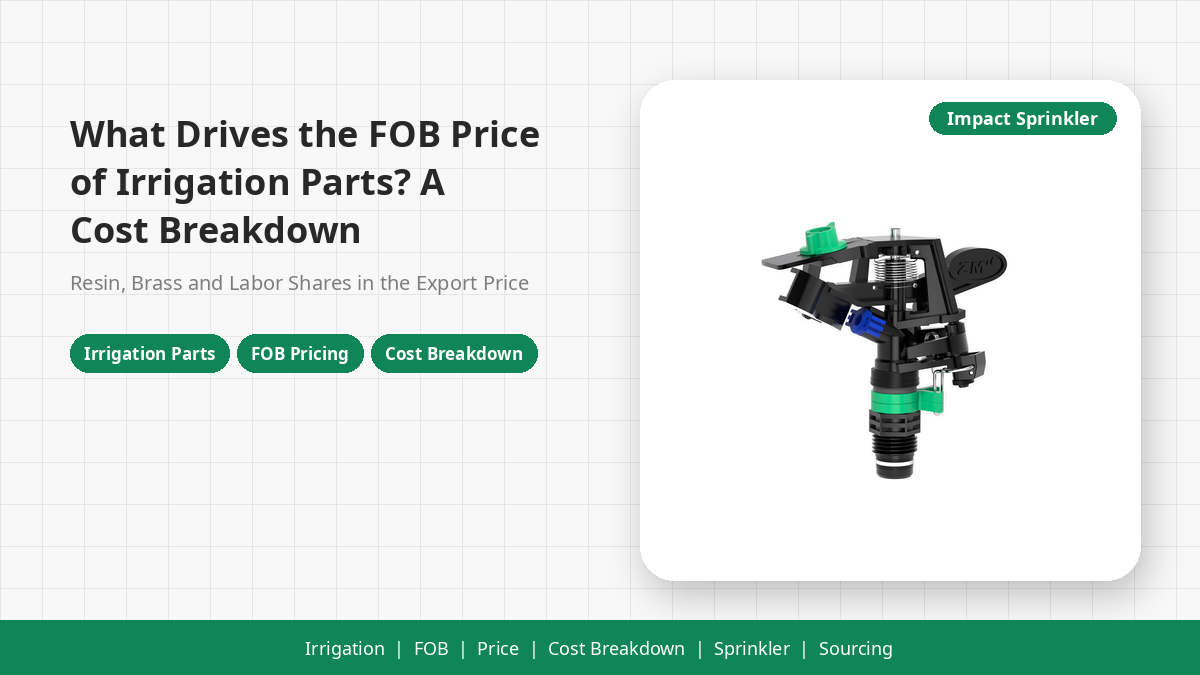
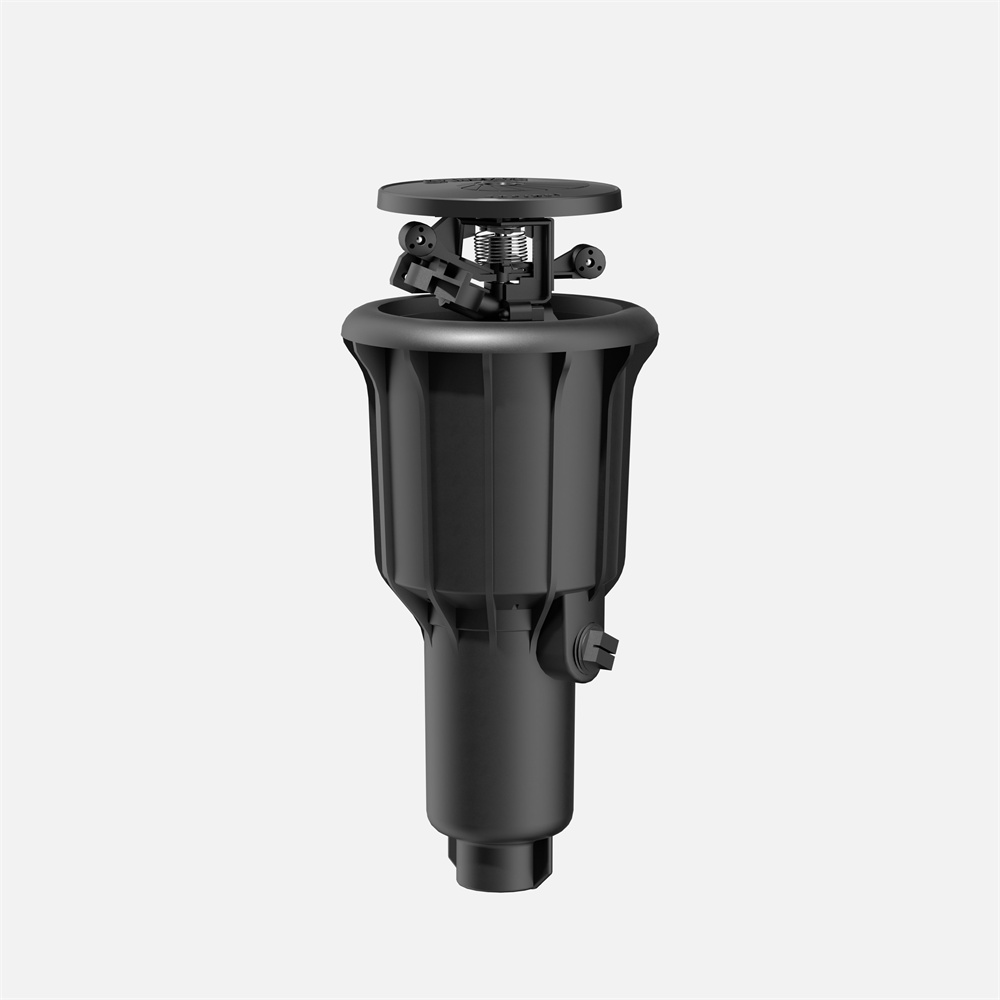
The pop-up impact sprinkler's spring-and-hammer trip assembly is the inverse of the gear rotor's gear train: it is exposed, deliberately loose in tolerance, and self-clearing on each cycle. The hammer arm hits the body, the body rotates a few degrees, the spring returns the hammer, and any sand particle that lodged between the hammer and the body is dislodged by the next impact. This is why the same lake water that ruins a gear rotor in two seasons leaves an impact sprinkler running through five or six seasons with only minor service visits.
The exposed trip mechanism is also field-serviceable in about 90 seconds per head. The cap lifts, the trip assembly pulls out, the spring and pivot get a quick rinse, the assembly goes back in, and the cap closes. No tools are required for the SRPIR01 pop-up impact sprinkler family. On a commercial site that means a single crew member can service 50 to 80 heads in a morning, which is the difference between a working system and a deferred-maintenance backlog. The matched pop-up impact sprinkler product page lists the replacement trip kits for the SRPIR01 family.
The impact sprinkler does have one dirty-water limitation worth noting: long fibrous organic matter (algae strings, leaf bits, seed hulls) can wrap around the trip spring and stall the arm. This is rare in well-filtered water, common in unfiltered pond water. The fix is a coarse pre-filter (80 mesh, about 180 microns) on the zone supply, which catches the fibres without restricting flow the way a 200-mesh pre-filter would on a gear rotor. ASABE microirrigation standards treat 80-mesh pre-filtration as the practical minimum for any sprinkler system drawing on a surface water source.
Filtration Requirements Side by Side
The filtration gap between the two sprinkler types is large enough that the pre-filter often costs more than the sprinkler. A 200-mesh (74 micron) pre-filter for a gear rotor zone on lake water costs roughly four times the price of an 80-mesh (177 micron) pre-filter for an impact sprinkler zone on the same water, and the 200-mesh filter needs cleaning two to three times as often. That operating-cost delta compounds across a 10-year window.
| Water source band | Impact sprinkler pre-filter | Gear rotor pre-filter | Filter cleaning interval (impact / gear) |
|---|---|---|---|
| Clean (less than 20 ppm) | None required | None required | n/a |
| Moderate (20 to 100 ppm) | 80 mesh (about 180 microns) | 120 mesh (about 130 microns) | Monthly / Bi-weekly |
| Heavy (above 100 ppm) | 80 mesh (about 180 microns) | 200 mesh (about 75 microns) | Weekly / Every 2 to 3 days |
| Reclaimed wastewater | 80 mesh + disc filter | Not recommended | Every 2 to 3 days / n/a |
The filter cleaning interval column is the operational reality. A 200-mesh pre-filter on a heavy-water gear rotor zone needs cleaning every two to three days during the irrigation season, which means either automatic self-cleaning filters (a meaningful capital cost) or a daily maintenance visit that most sites cannot sustain. An 80-mesh pre-filter on an impact sprinkler zone needs cleaning weekly, which is a realistic single-visit-per-week schedule. EPA WaterSense recommends matching pre-filtration to the highest-solids load expected in the operating season, not the average load, because the failure mode is set by the worst week, not the average week.
Reclaimed wastewater deserves its own row in the table. The biological load and fine particulates in reclaimed water clog a gear rotor's gear train within one or two seasons regardless of pre-filtration, while the impact sprinkler's self-clearing trip keeps running for five or more seasons on the same water with only an 80-mesh pre-filter and a manual flush of the lateral before each cycle. For sites on reclaimed water near public spaces, EPA WaterSense guidance and most local plumbing codes require purple pipe colour-coding and a backflow preventer on the supply line, both of which apply to either sprinkler type.
A Three-Site, One-Season Field Test That Picks a Winner
The fastest way to settle the dirty-water question on your specific site is a one-season head-to-head test, and the protocol we use on commercial sites takes about ten matched sprinklers, three inspection events, and a single catch-can grid. The test does not require lab equipment or specialist instrumentation — it requires a stopwatch, a pressure gauge, and the discipline to record results at the same intervals.
Step one is matched installation. Pick a single dirty-water zone, install at least ten SRPIR01 pop-up impact sprinklers and ten comparable gear rotors on the same supply, with each sprinkler on its own isolation valve so a single failure does not contaminate the comparison. Step two is the baseline: at the start of the irrigation season, measure pressure at each sprinkler base, measure rotation time per full arc, and run a catch-can distribution uniformity test on both types. Record the values as the baseline. Step three is the monthly inspection — every month during the season, walk the test zone, record any impact sprinkler that has stopped rotating, and record any gear rotor that has slowed below 0.5 revolutions per minute.
Step four is the end-of-season teardown. Pull three sprinklers of each type, disassemble, and inspect the gear train or trip assembly for wear, scoring, or sand embedding. Compare against the baseline photographs. Step five is the score — rate each sprinkler type on three metrics: distribution uniformity at end of season, percentage of sprinklers still operational without intervention, and time required for end-of-season service. The winner is the type that scores best on at least two of the three metrics. The test takes one full irrigation season, but it produces a site-specific answer that no spec sheet can match.
When a Gear Rotor Still Beats an Impact Sprinkler
The dirty-water case for impact sprinklers is strong, but there are three sites where a gear rotor is still the better choice, and ignoring those cases is just as costly as the reverse mistake.The first is a tight head-to-head spacing under 8 m on clean municipal water, where the gear rotor's slower rotation delivers a more uniform distribution pattern than the impact sprinkler's faster cycle. The second is a high-traffic public space where the exposed moving parts of the impact sprinkler (the hammer arm visible above the cap) create a pinch or snag hazard that a fully enclosed gear rotor does not. The third is a site with strict low-precipitation-rate requirements, where the gear rotor's matched nozzle family delivers a lower precipitation rate than the comparable impact Sprinkler Nozzle.
On clean water, the gear rotor's silent-failure mode is much less of a concern because the gear train is not wearing. Our pop-up impact sprinkler product line is not optimised for the tight-spacing or low-precipitation-rate cases, and we steer customers to the gear rotor family in those scenarios. The point of this guide is not to argue that impact sprinklers are universally better — it is to argue that on dirty water specifically, the impact sprinkler is the safer and lower-total-cost choice.
The hybrid specification for sites with mixed water sources is straightforward. Run impact sprinklers on the dirty-water zones and gear rotors on the clean-water zones, with each zone on its own valve and pre-filter sized to the source. For municipal-domestic sites where water quality varies seasonally (lake-fed in summer, well-fed in winter), the impact sprinkler handles both bands without a filter change, while the gear rotor would need a seasonal pre-filter swap. The hybrid approach is also the easiest way to validate the field test above: install impact sprinklers on one zone and gear rotors on the adjacent zone, and let a single irrigation season give you the side-by-side answer.
Specifying Sheet by Water Source
The specifying rule we use across commercial projects is simple: match the sprinkler type to the worst-case water source expected at the site, not the average. A lake-fed site with stable bottom sediment looks like clean water most of the year, but the spring runoff week pushes it into the heavy band, and that week is what kills the gear rotor gear train. The SRPIR01 pop-up impact sprinkler family is the right specification for any site whose worst-case source falls into the moderate or heavy band. The gear rotor family remains the right specification for clean, stable, municipal or well sources.
For sites with reclaimed wastewater, the gear rotor is not appropriate and the impact sprinkler is mandatory. For sites with mixed sources (well + lake, or municipal + reclaimed backup), the impact sprinkler with serviceable internals is the only realistic specification because it handles all three bands without a filter change. For sites on clean municipal water only, the choice is driven by spacing, precipitation rate, and public-safety considerations — not by dirty-water tolerance. The decision tree fits on the back of a business card and saves a service call the first time the source water changes.
- Identify the worst-case water source band for the site (clean / moderate / heavy / reclaimed).
- If the worst case is clean: choose by spacing, precipitation rate, and public-safety factors — either sprinkler type works.
- If the worst case is moderate: specify impact sprinklers with 80-mesh pre-filter, or gear rotors with 120-mesh pre-filter and a quarterly service interval.
- If the worst case is heavy: specify impact sprinklers with 80-mesh pre-filter and a weekly filter cleaning interval.
- If the worst case is reclaimed wastewater: specify impact sprinklers only, with stainless steel trip spring and ceramic bearings.
- If the source is mixed or seasonal: specify impact sprinklers with serviceable internals (SRPIR01 family) on a single 80-mesh pre-filter sized for the worst band.
- For all dirty-water sites: schedule monthly visual inspections and a 6-month partial teardown of the impact sprinklers.
Frequently Asked Questions
Which sprinkler type survives dirty water better, impact or gear rotor?
Pop-up impact sprinklers survive dirty water better than enclosed gear drive rotors in almost every field scenario. The rotating hammer arm and exposed trip spring break free of sand particles that would lodge in a gear rotor's enclosed gear train. The Irrigation Association's landscape irrigation standards treat any water source carrying more than 50 ppm of suspended solids as a special case, and impact sprinklers handle that range without pre-filtration while gear rotors do not.
What mesh filter do I need for a gear rotor on lake water?
Plan for a 200-mesh pre-filter, which corresponds to a nominal 74 micron rating, when running gear drive rotors on lake, pond, or canal water. Coarser than 200 mesh (for example 120 mesh at 125 microns) lets through particles that embed in the gear rotor's epicyclic gear train and shorten service life by 30 to 50%. Impact sprinklers on the same water source can run on 80-mesh (177 micron) pre-filtration without measurable life loss.
Can I use a pop-up impact sprinkler on reclaimed wastewater?
Yes, and reclaimed wastewater is one of the strongest cases for pop-up impact sprinklers. The biological load and fine particulates in reclaimed water clog gear rotors within one or two seasons, while impact sprinklers keep rotating because the impact force self-clears the trip assembly. Specify stainless steel trip springs and ceramic bearings, run a manual flush of the line before each irrigation cycle, and plan on 80-mesh pre-filtration. For residential or reclaimed-water sites near public spaces, EPA WaterSense guidance and most local plumbing codes also require a purple pipe colour-coding and a backflow preventer on the supply line.
How do I know if my gear rotor is failing on dirty water?
The gear rotor failure mode on dirty water is silent, which makes it dangerous. Watch for three symptoms: rotation speed dropping below 0.5 revolutions per minute during the cycle, dry stripes appearing in the throw pattern between rotors, and visible scoring on the nozzle stream when viewed against backlight. Any one of these symptoms is enough to pull the sprinkler and inspect the gear train. By the time distribution uniformity has visibly dropped, the gear rotor has usually lost 30% or more of its rated life.
How often should I service an impact sprinkler on dirty water?
On lake, canal, or reclaimed water, plan a visual inspection every month during the irrigation season and a partial teardown every six months. The teardown takes about 90 seconds per sprinkler: lift the cap, pull the trip assembly, rinse the spring and pivot, reinstall. No tools are required for the SRPIR01 pop-up impact sprinkler family. Gear rotors, by contrast, require full body removal and bench service, which is why their dirty-water service interval is shorter in practice.
Does dirty water shorten impact sprinkler life the same way it shortens gear rotor life?
No, and this is the core finding from our field data. Impact sprinklers running on dirty water lose about 10 to 15% of their rated service life compared to the same sprinkler on clean water, because the trip spring and pivot are field-serviceable and replaceable. Gear rotors running on the same dirty water lose 40 to 60% of their rated gear life, because the gear train is enclosed and not field-serviceable. On dirty water, the total cost of ownership over a 10-year window favours impact sprinklers even though their purchase price per unit is similar.